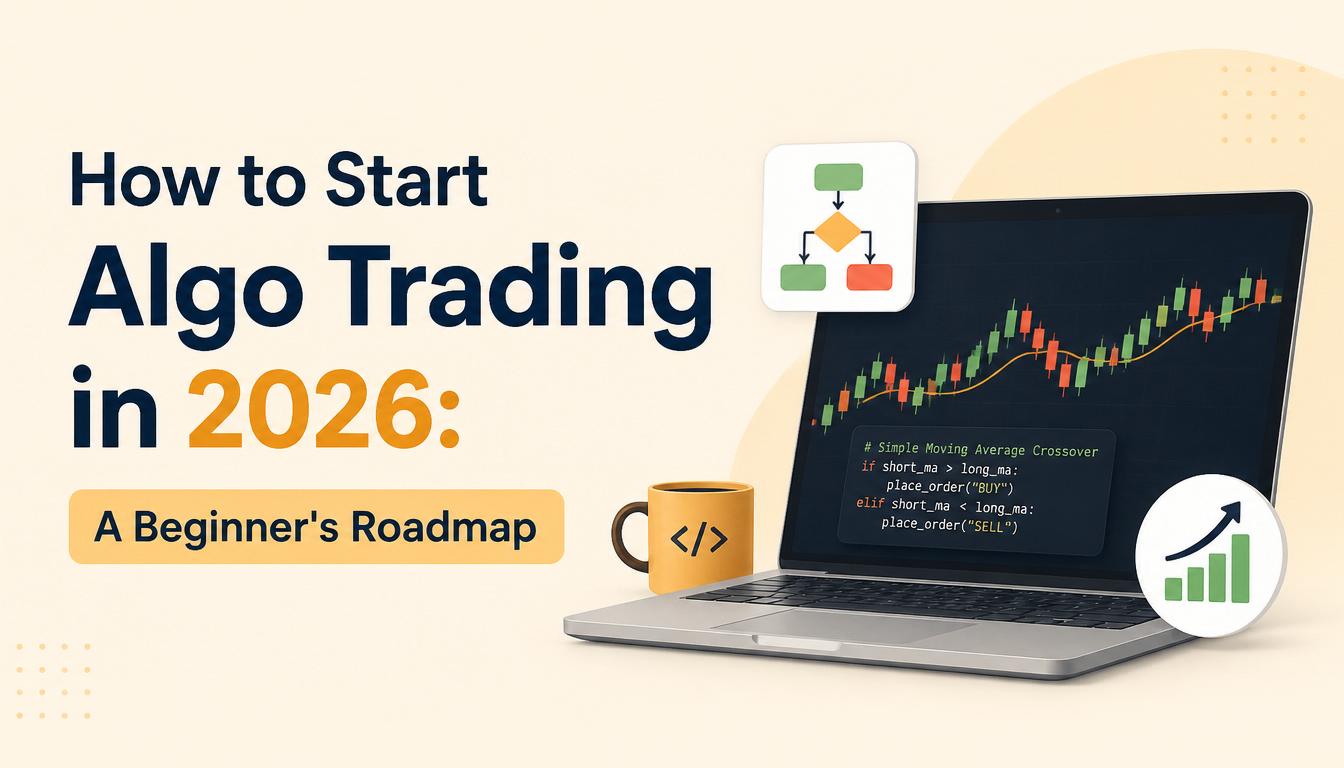
Five years ago, building a trading bot meant wrestling with clunky APIs and a five-figure brokerage minimum. In 2026, you can wire up your first automated strategy on a free paper-trading account in an afternoon. The barrier to entry has collapsed. The barrier to making money, though, has not. This guide shows you how to start algo trading the right way — the tools, the realistic costs, your first strategy, and the mistakes that quietly drain most beginner accounts.
By the end, you’ll have a concrete roadmap instead of a vague ambition.
Table of Contents
- What algo trading actually is
- Do you need to know how to code?
- The realistic cost to start algo trading
- Step 1: Pick your tools
- Step 2: Build your first strategy
- Step 3: Backtest before you risk a cent
- Step 4: Paper trade, then go live small
- Mistakes that kill beginner accounts
- FAQ
- Key takeaways
What algo trading actually is
Algorithmic trading — “algo trading” for short — means handing your trading rules to software that runs them automatically. Instead of staring at charts and clicking buy, you define a precise rule. For example: “buy when the 50-day moving average crosses above the 200-day.” A program then executes it for you, around the clock, without hesitation or fear.
This isn’t a fringe activity anymore. The global algorithmic trading market reached roughly $20 billion in 2026, according to Mordor Intelligence. Retail traders — people like you, not hedge funds — are now the fastest-growing segment, at around 38% of the market. Tools once locked behind institutional doors are a free API call away.

Do you need to know how to code?
Short answer: not to start, but it helps enormously.
There are two paths. The first is no-code platforms like 3Commas, Pionex, or Cryptohopper. You configure pre-built bots through a dashboard. They’re a gentle on-ramp, and they’re fine for learning the mechanics. The second path is writing your own code, usually in Python. This is where serious, flexible algo trading lives.
Why Python? Because the ecosystem is unmatched. Libraries like Pandas (data handling), NumPy (math), and backtrader or zipline (backtesting) do the heavy lifting. You write strategy logic, not plumbing. If you’ve never coded, you can learn enough Python to build a simple bot in a few weekends. That effort pays off, because no-code platforms always cap what you can express.
The realistic cost to start algo trading
Here’s the honest math, because hype merchants love to skip it.
- Software and data: $0 to start. Paper-trading accounts, historical price data, and the core Python libraries are all free.
- Brokerage minimum: $0 with Alpaca, which offers a developer-friendly API and commission-free stock trading. Interactive Brokers, the institutional favorite, has historically expected around $10,000 for full features.
- Real trading capital: This is the real question, and it deserves its own answer. See our guide on how much money you need to start algo trading. The short version: begin with money you can afford to lose entirely.
So you can learn and test for free. You only need capital when you’re ready to trade live — and you should not rush that day.
Step 1: Pick your tools
To start algo trading, you need three things: a broker with an API, a language, and a place to run your code.
- A broker with an API and a paper account. Alpaca is the most beginner-friendly choice in 2026. Interactive Brokers is the power-user option. For crypto, exchanges like Binance and Bybit expose robust APIs.
- A language and libraries. Python, plus Pandas and a backtesting library. We compare the options in best programming language for trading.
- An environment. Use a Jupyter Notebook to experiment. Then move to a simple script you can run on a cheap cloud server once you go live.
Resist the urge to buy an expensive course or a “guaranteed” bot before you’ve placed a single paper trade. The tools above cost nothing.
Step 2: Build your first strategy
Your first strategy should be almost embarrassingly simple. The goal isn’t profit. It’s learning the full loop, end to end.
A classic starting point is the moving-average crossover. You buy when a short-term average crosses above a long-term average, and sell when it crosses back below. It’s not a money printer, and that’s the point. It’s simple enough that you can reason about every trade it makes.
Write the rule in plain English first. Then translate it into code that does four things: fetch historical prices, compute the two averages, generate buy and sell signals, and record the results. Get that loop working, and you’ll understand more than most people who only talk about algo trading.
Step 3: Backtest before you risk a cent
Backtesting means running your strategy against historical data to see how it would have performed. It’s essential. It’s also where beginners fool themselves most badly.
The trap is overfitting: tuning your strategy until it looks brilliant on past data. In reality, you’ve just memorized noise. The research here is sobering. Studies of large cohorts of backtested strategies find that in-sample metrics like the Sharpe ratio have almost no predictive power for live results — correlations often fall below 0.05, as documented in work on optimal trading rules. A backtest showing 2% monthly returns can flip to a loss once you subtract realistic slippage and fees.
So treat a great backtest with suspicion, not celebration. Test on data your strategy has never seen. Include fees and slippage. Assume reality will be worse than your screen suggests.
Step 4: Paper trade, then go live small
Once your strategy survives backtesting, run it on a paper-trading account: live market data, fake money. This catches the problems a backtest can’t. Bad fills. API rate limits. Your code crashing at 3 a.m.
Only after weeks of clean paper trading should you go live. Even then, start with an amount so small that losing it is a cheap lesson — many traders begin with a few hundred dollars and risk well under 1% of it per trade. Add logging and alerts so you know instantly when something breaks. Set a hard daily loss limit that shuts the bot off automatically. Protect your API keys like passwords, and never commit them to a public repository. The professionals who blow up usually do it on operational failures, not bad strategy ideas. Knight Capital is the cautionary tale: it lost $440 million in 45 minutes from a botched software deployment.
Mistakes that kill beginner accounts
Most beginners don’t fail because their strategy is bad. They fail because of avoidable errors:
- They skip validation. Over 80% of retail traders lose money, often because they never properly test a strategy before trusting it with real cash.
- They over-optimize. Chasing a perfect backtest produces a strategy that fits the past and breaks in the present.
- They ignore costs. Slippage and fees turn paper winners into real losers.
- They go big too soon. A large early loss ends most trading careers before they begin.
- They chase someone else’s bot. A strategy you don’t understand is one you can’t fix when it breaks.
Avoid these five, and you’re already ahead of the majority.
FAQ
Is algo trading profitable for beginners? It can be, but rarely quickly. Most beginners lose money in their first year while they learn. A realistic year-one goal is competence — and not blowing up your account. Profit comes after that.
How much money do I need to start algo trading? You can learn and backtest for $0. To trade live, many brokers have no minimum. Even so, deploy only money you can afford to lose. See our dedicated guide for the full breakdown.
Can I start algo trading without knowing how to code? Yes, through no-code platforms like 3Commas or Pionex. But learning basic Python dramatically expands what you can build, and it’s worth the effort.
Is algo trading legal? Yes. For retail traders on regulated brokers, it’s completely legal. You’re simply automating orders you could place by hand.
How long before I’m making money? Plan for 6 to 12 months of learning before consistent results. Treat anyone promising faster with deep skepticism.
Key takeaways
- You can start algo trading for free. Paper accounts, market data, and Python libraries cost nothing.
- Code is optional to begin, essential to grow. Python is the language to learn.
- Your first strategy should be simple. Master the full loop before chasing complexity.
- Backtesting lies if you let it. Guard against overfitting, and always include costs.
- Go live small. Operational discipline matters more than a clever strategy.
Ready to build your first bot? Grab our free Algo Trading Starter Kit: a step-by-step PDF checklist, a Python moving-average bot template, and our beginner broker comparison. Get instant access → and join 12,000+ traders learning to automate the smart way.
Leave a Reply