Most people picture algorithmic trading as a wall of glowing monitors in a Wall Street tower. The reality in 2026 is far more ordinary: a laptop, a free API key, and a few dozen lines of Python. Algo trading for beginners has never been more accessible — yet the gap between “running a bot” and “running a profitable bot” still trips up almost everyone who starts.
This complete guide walks you through the whole picture: what algorithmic trading is, how it actually works, the tools you need, and the discipline that separates the people who last from the people who blow up in month one.
Table of Contents
- What is algo trading?
- How algorithmic trading actually works
- Why algo trading for beginners is booming in 2026
- The tools you need to begin
- Your first strategy, step by step
- Backtesting without fooling yourself
- Risk management is the real edge
- Common algo trading mistakes for beginners
- How long until algo trading for beginners pays off?
- FAQ
- Key takeaways
What is algo trading?
Algorithmic trading means using a computer program to place trades according to rules you define in advance. You write the logic once — “buy when this condition is true, sell when that one is” — and the software executes it tirelessly, without emotion, fatigue, or second-guessing.
That last part matters more than beginners expect. Most trading losses come from human behavior: panic selling, revenge trading, holding a loser too long. A bot does exactly what it’s told, every time. The catch is that it will follow a bad rule just as faithfully as a good one.

How algorithmic trading actually works
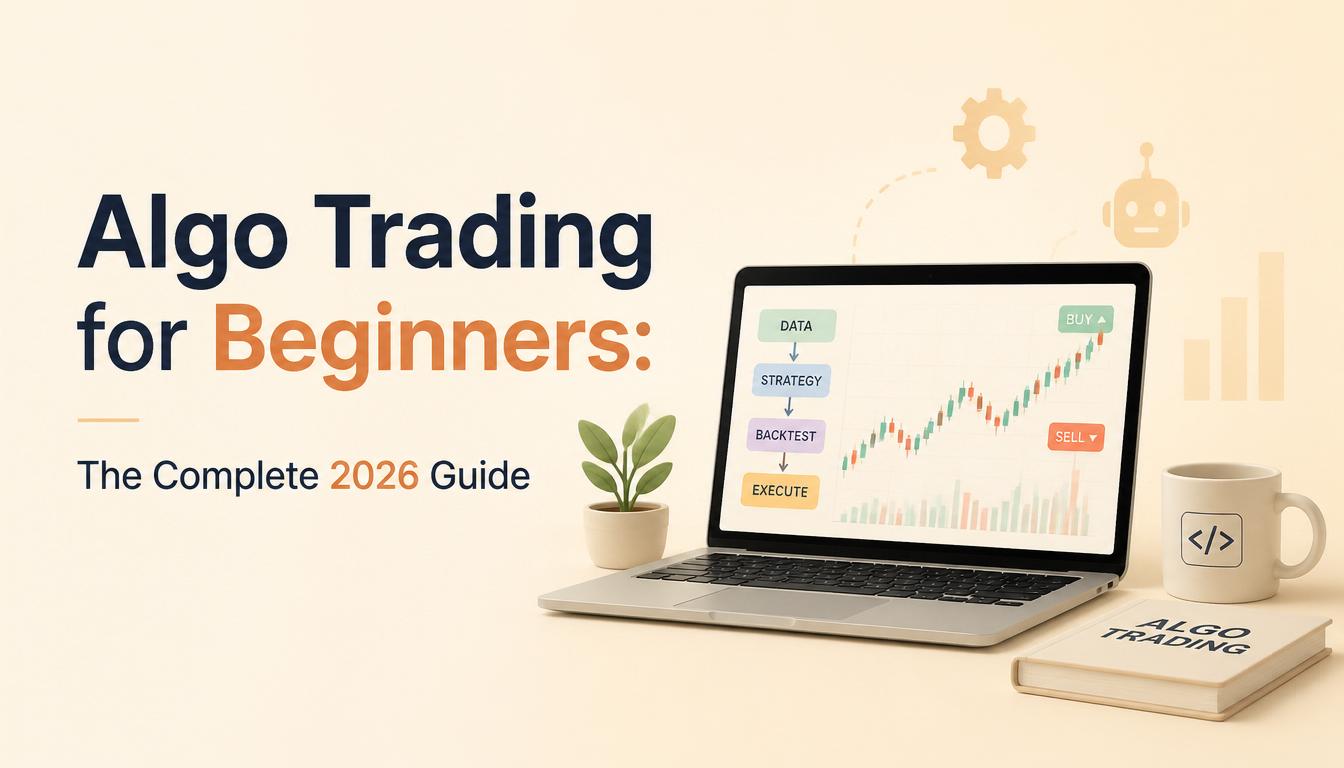
Every algo trading system, from a hobbyist’s script to a hedge fund’s engine, runs the same basic loop:
- Collect data. Pull live or historical prices from a broker or exchange.
- Generate a signal. Apply your rule to decide buy, sell, or hold.
- Execute the order. Send it to the broker through an API.
- Manage the position. Track stops, targets, and exits.
- Log everything. Record what happened so you can review and improve.
Institutions handle over 80% of equity trades this way, according to industry estimates cited by QuantVPS. The difference between them and you isn’t the loop — it’s the quality of the rules and the rigor of the testing.
Why algo trading for beginners is booming in 2026
The 2020s have been defined by the democratization of this field. Cloud computing, API-first brokers, and a flood of free educational content mean an individual can now run strategies that once required a quant team. That shift is why algo trading for beginners has gone mainstream.
The numbers reflect it. Retail traders are now the fastest-growing segment of the algorithmic trading market, which industry analysts size at roughly $20 billion in 2026. Commission-free brokers and no-minimum accounts have removed the financial gatekeeping that kept beginners out a decade ago.
The tools you need to begin
You need surprisingly little to start. Here’s the core stack for algo trading for beginners:
- A broker with an API and paper trading. Alpaca is the friendliest on-ramp in 2026; Interactive Brokers is the power-user standard.
- Python. The dominant language, thanks to libraries like Pandas, NumPy, and backtesting frameworks such as backtrader.
- A development environment. A Jupyter Notebook for experiments, then a simple script for live runs.
- Historical data. Free sources cover most beginner needs.
Notice what’s missing: an expensive course, a “guaranteed” signal service, or a five-figure account. Treat anyone selling those with caution.
Your first strategy, step by step
Resist the urge to build something clever. Your first strategy exists to teach you the workflow, not to make money.
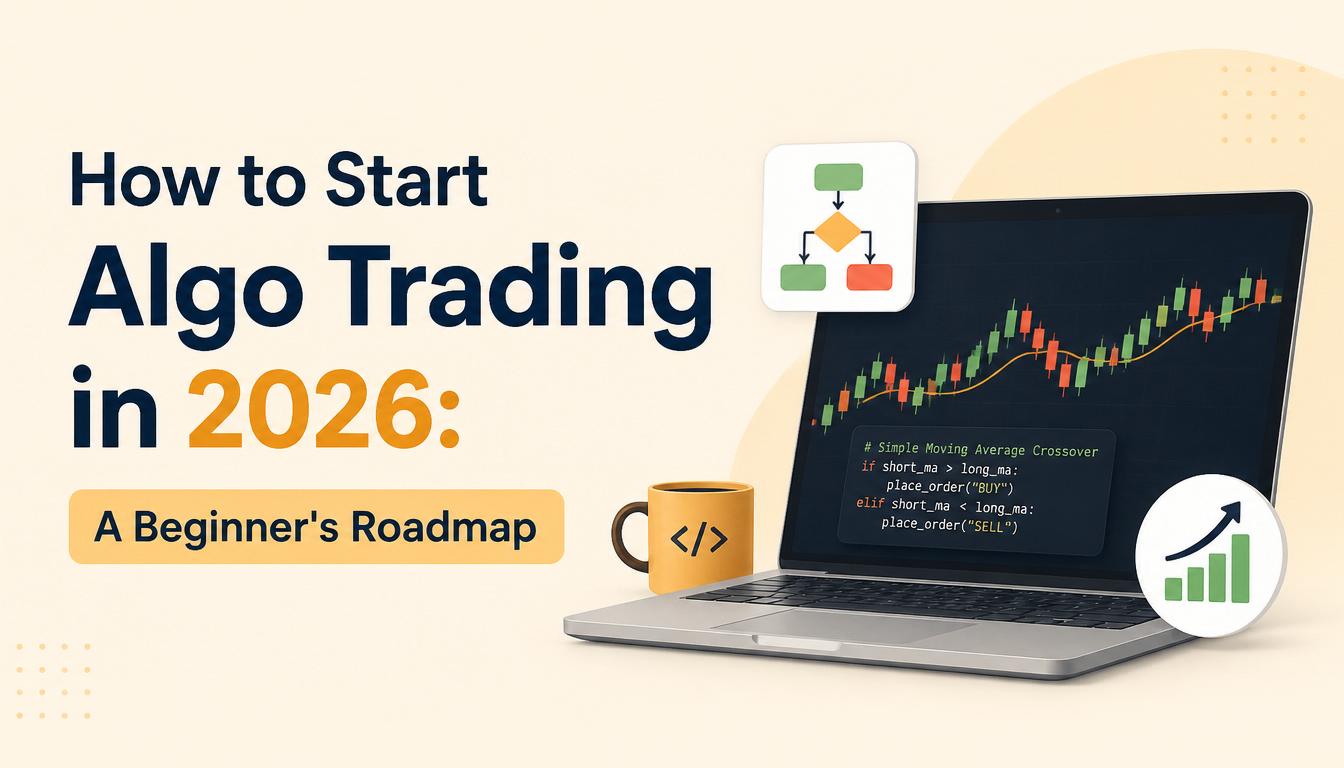
Start with a moving-average crossover. Buy when a short-term average rises above a long-term average, and sell when it drops back below. Now turn it into code in four steps:
- Fetch a year of daily prices for one asset.
- Calculate a 50-day and a 200-day moving average.
- Mark each day as buy, sell, or hold based on the crossover.
- Tally the results and compare them to simply holding the asset.
If you can run that end to end, you understand more than most people who only talk about trading bots.
Backtesting without fooling yourself
Backtesting runs your strategy against past data to estimate how it would have performed. It’s essential, and it’s a minefield.
Three traps catch nearly every beginner:
- Overfitting — tuning parameters until the backtest looks perfect, then watching it fail live.
- Look-ahead bias — accidentally using information your strategy wouldn’t have had at the time.
- Survivorship bias — testing only on assets that still exist, which hides past disasters.
As the team at QuantifiedStrategies emphasizes, a clean backtest must include realistic fees and slippage. A strategy showing 2% monthly gains can become a loser once you subtract trading costs. Test on data the strategy has never seen, and assume live results will be worse than the screen suggests.
Risk management is the real edge
Here’s the truth experienced traders learn the hard way: survival beats brilliance. No strategy is complete without explicit risk controls.
The standard rules are simple and worth following from day one:
- Risk only 1–2% of your account per trade.
- Use stop-loss orders on every position.
- Set a daily loss limit that shuts the bot off automatically.
- Add circuit breakers so a code bug can’t drain the account.
These rules feel boring next to a clever strategy. They are also the reason some traders are still trading after five years while others quit in five weeks. Protect the account first. Profit can only come from an account that still exists.
Common algo trading mistakes for beginners
Most beginners fail for predictable reasons, not exotic ones:
- Going live too fast, before weeks of clean paper trading.
- Skipping risk limits, so one bad day erases months of gains.
- Trusting a backtest blindly, ignoring fees and overfitting.
- Copying a bot they don’t understand, leaving them helpless when it breaks.
- Chasing complexity, when a simple, well-tested rule would serve better.
Avoid these, and you’re already ahead of most people who start.
How long until algo trading for beginners pays off?
This is the question nobody selling a course wants to answer honestly. The realistic timeline is months, not days.
Plan for three to six months of learning before you trade real money with any seriousness. The first month goes to Python basics and your first working backtest. The next few months go to testing strategies, paper trading, and — most importantly — learning what doesn’t work. That negative knowledge is worth as much as any winning rule.
Even then, expect your first live year to be about survival rather than profit. Most beginners lose money early. The ones who stick around treat that period as tuition, not failure. They keep position sizes tiny, log every trade, and review their mistakes weekly.
Set your expectations here and you’ll avoid the trap that ends most journeys: quitting after a fast loss that you mistook for proof the whole thing was a scam. Algo trading for beginners rewards patience far more than it rewards cleverness.
FAQ
Is algo trading good for beginners? Yes, as a learning path — but not as a get-rich-quick scheme. Beginners should expect a learning curve of several months before trading real money seriously.
Do I need to know how to code for algo trading? Not to start. No-code platforms like 3Commas and Pionex let you configure bots through a dashboard. But basic Python dramatically expands what you can build.
How much money do I need? You can learn and backtest for free. To trade live, see our guide on how much money you need to start algo trading — and only use money you can afford to lose.
Can algo trading be profitable? It can, but profit is far from guaranteed. Most beginners lose money in year one. The realistic goal early on is competence and capital preservation.
What’s the best first strategy? A moving-average crossover. It’s simple enough to understand fully, which is exactly why it’s a good teacher.
Key takeaways
- Algo trading for beginners is accessible — a laptop, Python, and a free broker API are enough to start.
- Every system runs the same loop: data, signal, execution, management, logging.
- Your first strategy should be simple. Learn the workflow before chasing returns.
- Backtesting lies if you let it. Guard against overfitting, look-ahead, and survivorship bias.
- Risk management is the real edge. Position sizing and loss limits keep you in the game.
Want a head start? Download our free Algo Trading Starter Kit: a beginner-friendly PDF roadmap, a ready-to-run Python bot template, and our broker comparison cheat sheet. Get instant access → and join 12,000+ traders learning to automate the smart way.