Tag: automated trading

  • Best AI Crypto Trading Bots in 2026: Ranked & Compared

    Best AI Crypto Trading Bots in 2026: Ranked & Compared

    The word “AI” sells a lot of crypto trading bots in 2026. Most of those products are normal rule-based bots wrapped in modern language. A real handful, though, use genuine machine learning, sentiment analysis, and large language models to do things that traditional bots simply can’t. This guide separates the two.

    We ranked the six best AI crypto trading bots based on what their AI actually does, how well it works, and whether the price matches the value. There’s a clear winner for most traders and a right pick for several use cases. We also tell you, without flinching, when “AI” is just a marketing label you should ignore.

    How we ranked the best AI crypto trading bots

    Four criteria drove the ranking. What the AI actually does comes first — a clear, explainable AI feature beats a vague “AI-powered” label every time. Trading performance matters second, judged on what the AI demonstrably contributes versus what a rule-based bot could do. Ease of use decides whether you’ll actually run the platform; powerful AI you can’t operate is just expensive. And cost relative to value filters out platforms that charge for marketing instead of capability.

    A note on honesty borrowed from every credible bot review: no bot — AI or otherwise — guarantees profits. The AI in these systems improves execution and adaptation, not the laws of markets.

    At a glance: the comparison table

    BotAI capabilityStarting priceBest forDifficulty
    CryptohopperAI strategy votingFree trial, $15+/moHands-off automationEasy–Intermediate
    3CommasSmartTrade + AI signals~$22–29/moMulti-exchangeIntermediate
    IntellectiaGPT analysis + agentsPaid tiersResearch-driven tradingIntermediate
    HaasOnlineSentiment + advancedPaid tiersSentiment-aware tradingAdvanced
    AlgosOneAutonomous neural netPaid tiersMulti-asset autonomousAdvanced
    PionexAI parameter suggestionsFree (0.05% fee)BeginnersEasy
    A dashboard comparing the best AI crypto trading bots — Cryptohopper, 3Commas, Intellectia, HaasOnline, AlgosOne, and Pionex

    #1 Cryptohopper — best AI strategy automation

    Cryptohopper takes the top spot because its AI does something specific and useful you can actually verify. Its AI Strategy Designer lets you feed the system 10–20 different indicators and strategies. The AI module then analyzes the market in real time and “votes” on which one is currently most effective, automatically switching from trend-following indicators to oscillators if the market shifts from trending to range-bound.

    That’s a legitimate, explainable AI use case — adaptive strategy selection based on regime — rather than vague “AI predictions.” Combined with 17+ exchange support, a marketplace of copyable strategies, and a free 14-day trial across plans, it’s the most useful AI bot for most users.

    Pros: Real adaptive AI logic, marketplace, copy trading, 14-day free trial. Cons: Marketplace strategy subscriptions can inflate total cost. Best for: Traders who want hands-off automation with adaptive strategy switching. Try Cryptohopper →

    #2 3Commas — best AI for multi-exchange traders

    3Commas earned its place by integrating AI into a deeply customizable platform rather than building around it. SmartTrade workflows, AI-augmented signal routing, and TradingView integration let serious traders combine their own logic with AI-driven enhancements across 15–18 exchanges.

    This is the right pick for traders who already know what they want to do and want AI to sharpen the execution rather than make the decisions. Its 220,000+ active users and around 99.6% uptime add to the case. Our 3Commas vs Cryptohopper deep dive covers the head-to-head.

    Pros: Deep customization, wide exchange support, AI augments rather than replaces logic. Cons: Steeper learning curve; AI features feel additive rather than central. Best for: Multi-exchange traders who want AI as a layer on their own strategy. Try 3Commas →

    #3 Intellectia — best GPT-powered analysis

    Intellectia is the most distinctly “modern AI” entry on this list. It uses autonomous AI agents and GPT models to dig through huge volumes of data, perform technical analysis, understand price drivers, and pull news sentiment — all surfaced alongside the trading view to give on-the-fly market insights.

    This is less “auto-trader” and more “AI research partner.” For traders who make decisions and want LLM-powered context rather than a bot that trades for them, Intellectia is the standout. Treat its output as research input, not a buy signal in itself.

    Pros: GPT-class models, sentiment + news integration, strong analysis surface. Cons: More research tool than autonomous trader; paid tiers required for full features. Best for: Research-driven traders who want LLM-powered market context. Try Intellectia →

    #4 HaasOnline — best sentiment + technical AI

    HaasOnline has been in the bot space longer than most competitors and has matured into a serious AI-augmented platform. Its standout feature: it can scan Bloomberg news feeds and X (Twitter) posts, perform sentiment analysis, and adjust trading limits accordingly — bridging technical signals and the wider information environment.

    This is the right tool when you want a system that reacts to news context, not just price action. The learning curve is real, but the depth rewards committed users.

    Pros: Real sentiment analysis, news integration, deep customization, long track record. Cons: Steep learning curve; pricing tiers can climb. Best for: Advanced traders who want sentiment-aware automation. Try HaasOnline →

    #5 AlgosOne — most autonomous AI

    AlgosOne is the most “AI-first” platform on this list. It uses neural networks, machine learning, and natural language processing to analyze global markets and execute trades in real time, building predictive models from technical indicators, news sentiment, and macroeconomic data across crypto, forex, and stocks.

    That’s a big technical claim, and the platform delivers a more autonomous experience than rule-based bots. The trade-off is opacity — by definition you’re trusting a neural net you can’t fully audit. Suitable only for advanced users who understand what that means.

    Pros: Genuinely autonomous AI design, multi-asset coverage, real-time adaptation. Cons: Opaque decision-making; demands trust in the model. Best for: Advanced traders comfortable with model-based, multi-asset autonomous systems. Try AlgosOne →

    #6 Pionex — best free AI-assisted bots

    Pionex earns the final spot for one reason: it’s the cheapest credible AI-assisted entry point. Its AI parameter recommender analyzes recent volatility and suggests grid range and spacing — not full autonomous AI, but a useful machine-learning assist where it matters most.

    Combined with 16 free built-in bots and a flat 0.05% trading fee, this is the beginner’s AI bot. You don’t get GPT analysis or neural-net trading; you get sensible automation with AI help on setup, free.

    Pros: Free bots, low 0.05% fees, AI parameter suggestions, beginner-friendly. Cons: AI features are limited compared to Cryptohopper or AlgosOne. Best for: Beginners and value-focused traders. Try Pionex →

    What “AI” actually means here

    The term covers several different things in 2026, and it’s worth knowing which:

    • AI parameter suggestion. Machine learning that recommends bot settings based on historical patterns. Useful, not magical.
    • Adaptive strategy switching. Models that pick the best strategy for current conditions from a pre-defined set, like Cryptohopper does.
    • Sentiment analysis. NLP models that read news and social posts to flag bullish or bearish sentiment shifts.
    • Predictive modeling. Neural networks that try to forecast price direction. Most ambitious, least reliable in practice.
    • GPT-based analysis. Large language models summarizing context and surfacing insights for the human trader.

    The strongest AI crypto trading bots usually combine two or three of these, with clear explanations of what each does.

    How to tell real AI from marketing

    Use these four questions before paying for any “AI” bot.

    1. What specifically does the AI do? If the answer is vague — “predicts the market,” “finds opportunities” — assume marketing. Look for specific, explainable mechanics.
    2. Can the developer describe the model? Reputable platforms explain whether they use NLP, neural networks, regime-detection models, or other specific techniques. Black boxes are red flags.
    3. Is there a paper trial or sandbox? Real platforms let you test the AI on simulated money before committing. “Trust us” platforms don’t.
    4. Does it promise guaranteed returns? This single claim disqualifies any bot. Markets don’t allow guarantees; AI doesn’t change that.

    Apply these four and most “AI” bots wash out. The handful that remain are the ones worth your money.

    The clear winner

    For most traders in 2026, Cryptohopper is the best AI crypto trading bot — its adaptive strategy switching is the most useful AI feature in the consumer market, and a 14-day free trial means you can test before paying.

    Step up to 3Commas if you want AI as a layer on a deeply customizable platform. Choose Intellectia for GPT-powered research, HaasOnline for sentiment-aware trading, or AlgosOne for autonomous multi-asset. And start with Pionex if you’re new and want AI-assisted setup for free.

    FAQ

    What is the best AI crypto trading bot in 2026? For most users, Cryptohopper — its adaptive AI strategy switching is the most useful consumer AI feature available, with a 14-day free trial. 3Commas is the best choice for multi-exchange traders who want deep control.

    Are AI crypto trading bots profitable? Some can be, when configured properly and run with disciplined risk management. The AI improves execution and adaptation, not the underlying market reality. No bot guarantees profit.

    Is “AI” just a marketing word in most bots? Often, yes. Real AI bots explain specifically what their AI does — adaptive strategy selection, sentiment analysis, GPT-class analysis. Vague “AI-powered” labels with no specifics are usually marketing.

    Do AI crypto trading bots work better than rule-based ones? Sometimes, in regime-shifting markets. Rule-based bots run fixed logic; the best AI bots adapt. The premium isn’t always worth it for simple grid or DCA strategies, where rule-based bots are perfectly capable.

    Which AI bot is best for beginners? Pionex for cost and simplicity, with AI parameter suggestions on grid bots. Cryptohopper if you want full AI strategy switching and don’t mind a small monthly fee.

    Can AI crypto trading bots predict the market? No, and any bot claiming to is overselling. The best AI bots adapt strategy selection to current conditions, parse sentiment, or summarize context. They don’t predict the future. Treat any “AI predicts X” claim as marketing, not capability.

    Do AI crypto trading bots work for stocks and forex too? Some — AlgosOne explicitly covers crypto, forex, and stocks. Most bots in this guide are crypto-focused. For forex automation specifically, see our best forex strategies for automation guide.

    Key takeaways

    • The best AI crypto trading bots in 2026 are Cryptohopper, 3Commas, Intellectia, HaasOnline, AlgosOne, and Pionex.
    • Cryptohopper is the overall winner for its adaptive strategy switching — a useful, explainable AI feature.
    • Real AI is specific: parameter suggestion, regime switching, sentiment, GPT analysis, predictive modeling.
    • Most “AI” labels are marketing — verify what the AI actually does before paying.
    • No bot guarantees profits; AI improves execution and adaptation, not the laws of markets.

    Want to test AI bots safely? Our free Algo Trading Starter Kit includes an AI-bot evaluation checklist, setup guides, and our deep dive on crypto trading bot strategiesGrab it free → and pick a real AI bot, not a marketing label.

  • Crypto Trading Bot Strategies: A Practical 2026 Guide

    Crypto Trading Bot Strategies: A Practical 2026 Guide

    Pick any crypto trading bot platform in 2026 and you’ll see the same handful of strategies under different names. Strip away the branding and only five core approaches actually power most automated crypto trading: DCA, grid, momentum/trend, arbitrage, and AI. This guide is the practical map — what each strategy does, when to pick it, when not to, and how the choices fit together as part of a real automated operation.

    Unlike a ranked listicle, this is a working guide for the trader trying to build, not browse. By the end you should know which crypto trading bot strategies belong in your toolkit, which to avoid, and how to combine them so that something is always earning regardless of market regime.

    How to think about crypto trading bot strategies

    The first reframe most beginners need: a bot is an executor, not a strategist. As multiple 2026 bot guides emphasize, bots automate execution, not strategy creation. A mediocre strategy executed flawlessly still produces mediocre results.

    That means your first decision isn’t “which bot platform” — it’s “which strategy fits this market and my temperament.” The five strategies below differ in what they require from the market, from your capital, and from you. Get that fit right and the platform becomes almost interchangeable; get it wrong and even the best platform won’t save you. Crypto trading bot strategies live or die on that match.

    A dashboard showing five crypto trading bot strategies — DCA, grid, momentum, arbitrage, and AI — running side by side

    The five core strategies

    StrategyProfits fromBest marketDifficulty
    DCAAccumulating over timeAny (long-term)Beginner
    GridSideways oscillationRange-boundBeginner
    Momentum / trendSustained movesTrendingBeginner–Intermediate
    ArbitrageCross-market gapsAny (fleeting)Advanced
    AI / sentimentAdaptive signalsAnyAdvanced

    Two of these (DCA, grid) are beginner-friendly. Two (arbitrage, AI) are advanced. Momentum sits in between. Most successful automated portfolios mix two or three at any time, not just one.

    DCA bots

    Dollar-cost averaging is the simplest strategy in this guide and the most reliably useful. A DCA bot buys a fixed dollar amount of an asset on a fixed schedule, ignoring price entirely. Over time, it smooths out volatility — you buy more when prices are low and less when they’re high — by automating something humans almost never do consistently by hand.

    The mechanism handles one of trading’s hardest problems: timing. Instead of relying on a perfect entry, the bot spreads entries across time or price levels. As token-management guides note, this can meaningfully reduce the risk of entering all at once, especially in volatile markets. A practical example: $200 a week into a single asset over five weeks accumulated 20.77 tokens at an average $48.15 — about 8% better than dropping $1,000 in on day one in one historical period.

    When DCA works. Long-term accumulation of an asset you believe in. Bear markets where your fixed schedule keeps you buying through the fear.

    When DCA fails. Assets in terminal decline — you keep buying something that never recovers. DCA reduces timing risk, not asset-selection risk.

    Best for: Beginners and long-term believers who want a hands-off, low-stress entry into automated crypto.

    Grid bots

    A grid bot places a ladder of buy and sell orders at evenly spaced price intervals within a defined range. When the price drops to a buy level, the bot purchases. When it rebounds to the next sell level, the bot sells. The profit is the spread between each buy and sell pair, repeated indefinitely.

    In realistic conditions, every time BTC moves $1,000 within the range and returns, a typical grid completes one cycle and captures roughly 0.8–1.2% profit on that level’s capital. If BTC oscillates three or four times per day, the daily returns add up meaningfully over weeks.

    When grids work. Sideways or choppy markets with regular oscillation within a recognizable range. High-volume pairs with deep liquidity.

    When grids fail. A strong sustained breakout out of the range leaves the grid accumulating losses on one side. A stop-loss outside the grid is non-negotiable, as our grid trading on Binance and Bybit guide explains in detail.

    Best for: Traders who want a near-passive bot to harvest crypto’s constant chop.

    Momentum and trend-following bots

    Trend-following bots aim to enter when momentum is strong and exit when the trend weakens. The simplest version uses moving averages: buy when a fast moving average crosses above a slow one; exit when it crosses back. More advanced variants use RSI, MACD, or breakout rules to confirm signals.

    Crypto’s tendency to produce strong, persistent moves rewards trend systems that catch a real run, even though they get whipsawed in choppy markets. As our momentum bot vs buy-and-hold guide shows, the real edge is often drawdown protection — the bot exits during crashes — rather than higher raw returns.

    When momentum works. Sustained trends, especially around macro catalysts and major news cycles.

    When momentum fails. Range-bound chop, where the bot gets whipsawed by false breakouts.

    Best for: Traders who want a rules-based way to ride big moves without sitting through full crashes.

    Arbitrage bots

    Arbitrage exploits price differences for the same asset across exchanges or related instruments. Buy low on one venue, sell high on another, capture the spread. In crypto, this is almost entirely an algorithmic game — opportunities exist for seconds.

    Cross-exchange spot arbitrage is the simplest version retail traders can attempt. More advanced versions include triangular arbitrage (three-way trades on a single exchange), funding-rate arbitrage on perpetual futures, and on-chain DeFi arbitrage — see our DeFi arbitrage bots deep dive for that frontier.

    When arbitrage works. Volatile markets with temporary price dislocations, especially after major news. Cross-exchange spreads on newer or less liquid pairs.

    When arbitrage fails. When fees, slippage, and transfer times eat the thin margin — which is most of the time on liquid pairs.

    Best for: Technically capable traders with fast systems and multi-exchange accounts.

    AI and sentiment bots

    The newest frontier. AI bots use machine learning and natural language processing to analyze data well beyond what a rule-based bot can — order-book microstructure, social-media sentiment, on-chain whale activity, news flow. The newest agents in 2026 aim to adapt strategies in real time rather than execute a fixed rule.

    Cryptohopper’s AI strategy module, for instance, feeds the system 10–20 different indicators and votes on which is currently most effective, automatically switching between trend-following and oscillator-based logic as conditions change. Other entrants like Intellectia and Dash2Trade integrate GPT-class models with sentiment analysis and news parsing.

    When AI works. Markets where regimes shift fast and a rigid rule-based bot would lag. Operators who understand what the AI is actually doing under the hood.

    When AI fails. Anyone who treats “AI” as a magic word without checking the underlying logic — many products marketed as AI are repackaged grid or martingale bots dressed in modern language.

    Best for: Advanced traders comfortable with model-based systems and willing to verify the inner workings.

    Matching strategy to market regime

    Here’s the meta-insight that separates serious operators from beginners. No single strategy works in every market. The smart play is matching the active bot to the current regime.

    Range-bound market? Grids and DCA thrive. Trend bots get chopped up. Trending market? Momentum and trend-following capture the move. Grids accumulate losses on the losing side. High-volatility news cycle? Arbitrage and AI sentiment bots have more to work with. Set rigid grids aside. Quiet market? DCA keeps accumulating. Most others earn little.

    The discipline isn’t running every strategy always — it’s recognizing the regime and turning bots on or off accordingly. Many of the best crypto trading bot strategies fail not because they’re flawed but because they’re run in the wrong weather.

    Combining bots into a portfolio

    A practical setup for a serious automated operation looks like this. A DCA bot quietly accumulates a long-term position in BTC or ETH on a weekly schedule, regardless of conditions. A grid bot runs on a liquid altcoin pair during sideways stretches and gets paused during strong trends. A momentum bot scans for clear breakouts and rides them on a third asset. Optionally, an arbitrage bot picks up smaller wins on cross-exchange spreads.

    Each bot has its own capital allocation, its own risk limits, and its own kill-switch. Diversification across strategies and assets means that when any single bot underperforms — because regimes always rotate — the others keep the overall portfolio working. This is the model serious retail operators converge on by their second or third year.

    Risk management for any bot

    Whichever strategies you run, a few rules apply across the board.

    • Risk no more than 1–2% per trade. This is the single most important habit on any bot.
    • Always use a stop-loss outside your bot’s working range. For grids especially, this is non-negotiable.
    • Set a hard daily loss limit that shuts the bot off automatically. Bots can lose far faster than humans.
    • Never enable withdrawals on the API key. Trade-only keys mean a breach can’t drain funds.
    • Paper trade for weeks before deploying a new bot live.

    These five aren’t optional. They’re the difference between bots that compound modest edges and bots that blow up dramatically.

    Platforms that run these strategies

    You don’t have to code. Pionex packages 16 built-in bots covering DCA, grid, and more, free with a flat 0.05% trading fee. 3Commas is a rule-based automation platform with 220,000+ users, deep DCA and grid customization, and TradingView signal integration. Bitsgap combines grid, DCA, arbitrage, and rebalancing tools across 15+ exchanges. Cryptohopper leads on AI strategy automation and copy trading. Our best trading bots comparison ranks these head to head.

    Code-it-yourself in Python is also a valid path; see our best programming language for trading guide for the case.

    Common mistakes

    The errors that drain accounts run with surprising consistency across crypto trading bot strategies:

    • Running a grid in a trend or a trend bot in chop — wrong tool for the regime.
    • Trusting a black-box AI bot you can’t explain in one sentence.
    • Over-leveraging to chase faster returns; one bad streak ends the account.
    • Skipping the stop-loss, especially on grids and DCA into declining assets.
    • Treating any bot as “set and forget.” Regimes change. You must check in.

    Avoid these five and you’re already ahead of most automated traders.

    FAQ

    What are the best crypto trading bot strategies for beginners? DCA and grid bots — both have low transaction costs, simple mechanics, and clear sweet spots. Start with one, learn its behavior across a few weeks, then add a second.

    Can I run multiple crypto trading bot strategies at the same time? Yes, and serious operators usually do. The combination of DCA, grid, and momentum across different assets provides natural diversification — when one strategy struggles, others typically still earn.

    Do AI crypto trading bots really work? Some do, with real machine-learning models and sentiment analysis. Many “AI” products are marketing dressing on rule-based bots. Demand transparency about the actual logic before trusting one with capital.

    Which strategy is most profitable? None universally. Profitability depends on regime. Momentum shines in trends, grid in chop, arbitrage in dislocations. Matching the active strategy to the market matters more than which strategy you favor.

    Do I need to code to run these strategies? No. Pionex, 3Commas, Bitsgap, and Cryptohopper all offer no-code interfaces. Coding helps you customize, but it isn’t required to start.

    Key takeaways

    • Five core crypto trading bot strategies cover most automated crypto trading: DCA, grid, momentum, arbitrage, and AI.
    • DCA and grid are the strongest starting points — simple, automatable, forgiving.
    • No strategy works in every market; matching strategy to regime is the meta-skill.
    • Combine strategies into a portfolio for diversification across regimes.
    • Risk discipline is the constant — 1–2% per trade, stop-losses, trade-only API keys, and never set-and-forget.

    Ready to build your bot portfolio? Our free Algo Trading Starter Kit includes a strategy-selection matrix, setup checklists for each bot type, and our best trading bots comparison. Grab it free → and run the right strategy in the right market, every time.

  • Grid Trading on Binance and Bybit: A 2026 Setup Guide

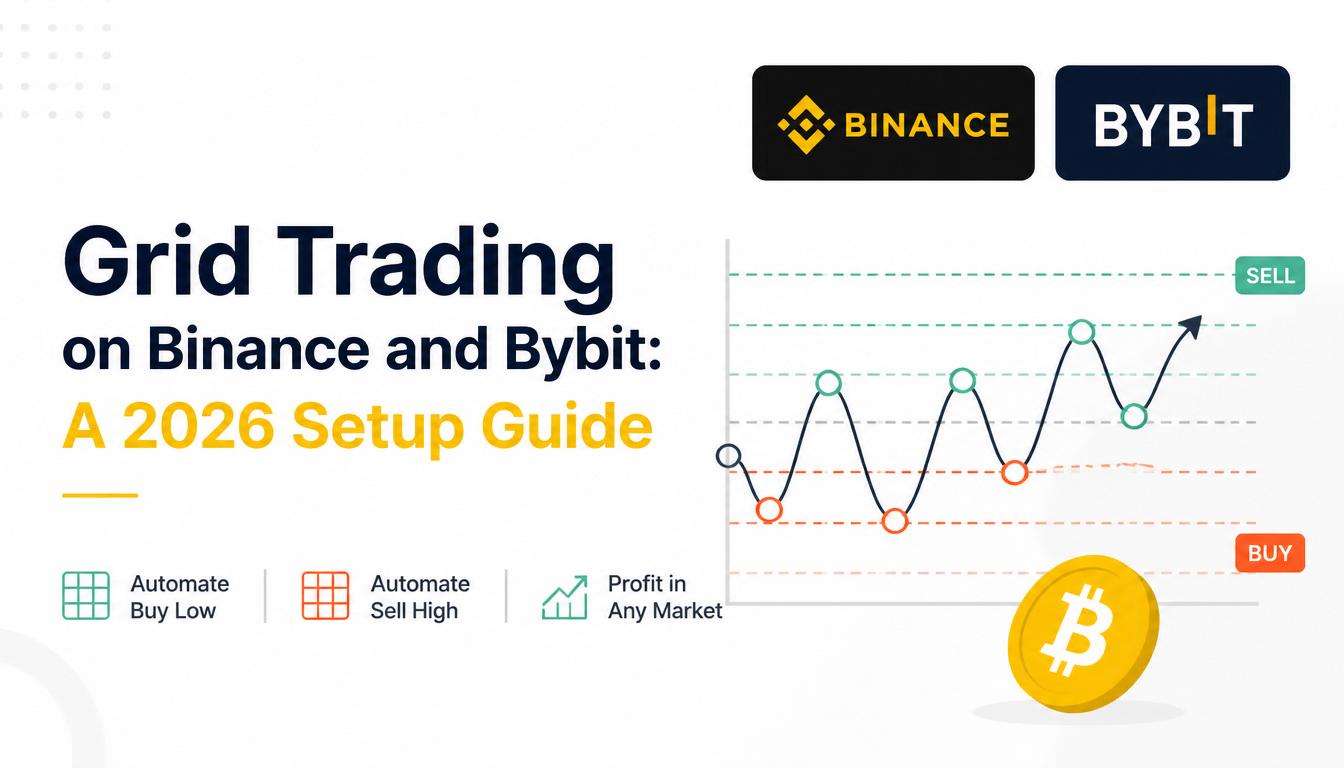
    Grid Trading on Binance and Bybit: A 2026 Setup Guide

    Grid trading is the favorite automated strategy in crypto for a reason — it profits from movement without needing to predict direction. Both Binance and Bybit offer powerful, free native grid bots, and they’re available in just a few clicks. The question isn’t whether you can use them. It’s how to set them up so they actually work.

    This is a practical, step-by-step guide to grid trading on Binance and Bybit in 2026 — the exact menus, the best pairs, the right range and spacing, and the common mistakes that turn a sensible bot into a slow drain. Get the setup right and a grid can quietly harvest the sideways markets that frustrate every other strategy.

    What you need before you start

    Two things, both small. First, a verified account on Binance or Bybit (or both — many traders use both). Second, a clear view of recent price action for the pair you plan to trade, because that view drives every parameter you’ll set.

    Read our grid trading strategy guide if you want the deeper theory of why grids work. This one is purely the setup mechanics.

    A side-by-side of grid bot setup screens on Binance and Bybit, illustrating grid trading on Binance and Bybit

    How grid trading works on Binance and Bybit

    The mechanics are identical on both platforms. A grid bot places a series of limit buy and sell orders at predetermined price intervals within a defined range. When the price drops to a grid line, the bot buys. When it rises to the next grid line above, the bot sells. The profit on each round trip is the spread between the buy and the sell.

    Both platforms charge only standard trading fees — no bot subscription. The setup process is also nearly identical in shape: pick a pair, set a range, choose grid spacing and number, allocate capital, and go. As Bybit’s documentation explains, the bot then runs continuously, replacing orders as they fill.

    Step 1: Pick the right pair

    The pair decides whether your grid has a chance.

    Stick to high-volume, liquid pairs with at least $10M in daily volume. BTC/USDT and ETH/USDT are the classic starting points — deep liquidity, tight spreads, and well-behaved volatility. Major altcoins like SOL/USDT, BNB/USDT, and XRP/USDT also work.

    Avoid low-cap meme coins, newly listed tokens, and thin pairs. Their order books are too thin, slippage destroys grid profitability, and a single whale order can wreck your range. The discipline here is half the job.

    Step 2: Choose your range

    The range is the price band you expect the asset to stay inside while the bot runs.

    Look at the last month or two of price action. Identify recent highs and lows. Set your range comfortably inside that band — too narrow and a normal swing escapes it; too wide and your capital spreads thin across levels that rarely trigger.

    A useful tactic: anchor the range to support and resistance levels you can see on the chart, not to wishful targets. The grid wants chop within a believable band, not a hope for a breakout.

    Step 3: Set the grid spacing and count

    This is where most beginners over-tune and under-think.

    Grid spacing — the gap between adjacent buy and sell orders — should balance trade frequency against exchange fees. Aim for 0.5–1% spacing depending on the coin’s volatility. Tighter on calmer pairs, wider on choppier ones.

    For BTC/USDT with a $20,000 range, 30–50 grid levels is a solid starting point. For altcoins with a smaller dollar range (say $5), 15–25 grids works well. Both Binance and Bybit will suggest defaults based on recent volatility — those defaults are a reasonable starting point until you learn what your specific market wants.

    Step 4: Set order size and capital

    The bot needs enough capital to place orders at every grid level. Both platforms calculate the minimum based on your range and grid count.

    Use money you can afford to lose. Grid trading is durable but not safe — strong trends can leave you accumulating losses on one side. Conservative sizing means you survive the trends that hurt grids most. Start small while you learn how the bot behaves with real money.

    Step 5: Add a stop-loss

    Both Binance and Bybit let you set a stop-loss outside the grid range. Use it.

    This is the single most-skipped step and the leading cause of blown grid accounts. Without a stop, a strong breakout out of your range leaves the grid accumulating an ever-larger underwater position. A stop just outside the range turns a catastrophic loss into a manageable, planned one.

    Setting up grid trading on Binance

    The exact path on Binance:

    1. Navigate to Trade → Strategy Trading → Grid Trading (or “Strategy Trading” in the top menu).
    2. Choose the pair (e.g. BTC/USDT).
    3. Pick Manual or AI mode. AI mode analyzes the last 7 days of price data and suggests range and grid count — a useful starting point for beginners.
    4. Set the price range, number of grids, and investment amount.
    5. Optionally add a stop-loss/take-profit price outside the range.
    6. Click Create.

    The bot starts immediately, placing orders at every grid level. You can monitor performance, pause, or close it from the same screen.

    Setting up grid trading on Bybit

    Bybit’s flow is similar and famously clean.

    1. Open the Trading Bot section from the main navigation.
    2. Choose Spot Grid (or Futures Grid for derivatives).
    3. Pick the pair.
    4. Set range, grid count, and investment. Bybit also offers AI parameter suggestions based on recent volatility.
    5. Add a stop-loss outside the grid.
    6. Confirm and start.

    Bybit supports spot grid, futures grid, and a DCA-grid hybrid — useful for traders who want to accumulate while harvesting chop. The interface is particularly beginner-friendly, which makes Bybit a strong second-platform if you’ve started on Binance.

    Common grid trading mistakes

    Most grid blowups come from the same handful of errors:

    • No stop-loss. The single most common, most expensive mistake.
    • Range based on hope. Setting the band where you wish the price would stay, not where it actually trades.
    • Grid on a strong trend. Running a neutral grid against an established trend bleeds steadily.
    • Over-leverage. Stacking too many levels with too much size, leaving no margin buffer.
    • Ignoring fees. A too-tight grid pays fees on every micro-trip and earns almost nothing.

    In sideways and choppy markets, grid trading significantly outperforms holding. In strong bull markets, holding usually wins. In bear markets, a grid with a stop-loss loses less than holding. Knowing which regime you’re in is half the skill.

    Monitoring and tuning your grid

    You set up a grid bot. Then what? “Set and forget” is the marketing line; the reality is light, regular maintenance.

    Check weekly, not daily. A working grid doesn’t need babysitting hour-by-hour, but a weekly look catches problems early. The questions are simple. Is price still inside the range? Is the market still ranging or has it started to trend? Are you hitting your fee-vs-profit ratio?

    Watch the regime. A grid that thrived in a sideways week can bleed in a trending week. If the price has been pushing one direction steadily for days, pause the bot or widen the range. Continuing to grid a clear trend is the most common mistake in grid trading on Binance and Bybit alike.

    Adjust spacing as volatility changes. A grid tuned for quiet markets will churn fees in volatile ones. If the asset’s daily range has doubled, your spacing should probably widen. Both platforms let you stop and re-launch a bot easily — don’t be precious about killing one that no longer fits.

    Track real P&L, not paper P&L. A grid showing “profitable trades” can still be losing overall once unrealized losses on the underwater side are counted. Look at total balance, not just closed-trade stats.

    Compound the wins. If a grid is profitable across a full cycle of conditions, gradually increase its capital. Don’t add capital after a single hot week — wait for the bot to prove durability.

    That weekly check, plus a stop-loss that you actually respect, separates traders who run grids for years from those who blow up in a month.

    FAQ

    Is grid trading on Binance or Bybit better? Both are excellent and free. Binance has deeper liquidity and more pairs; Bybit has a particularly clean interface. Many traders use both. See our Pionex vs Binance comparison for a third option focused purely on grid bots.

    What are the best pairs for grid trading? High-volume majors like BTC/USDT, ETH/USDT, SOL/USDT, BNB/USDT, and XRP/USDT. Avoid low-cap meme coins, newly listed tokens, and anything with under $10M daily volume.

    What grid spacing should I use? 0.5–1% between adjacent orders, depending on the coin’s volatility. For BTC/USDT with a $20,000 range, 30–50 grids is a solid starting point.

    How long does it take a grid bot to make money? It depends on volatility and how often price oscillates through your range. In choppy markets, profits compound steadily; in dead markets, the bot earns little while fees accrue.

    Do I need to monitor a grid bot constantly? No, but check it weekly. Confirm the market is still ranging within your set band, and switch the bot off (or widen the range) if a strong trend emerges.

    Can I run multiple grids at once on Binance or Bybit? Yes. Both platforms let you run several grid bots simultaneously on different pairs. Just make sure your total capital allocation across all bots respects your overall risk budget.

    Does grid trading on Binance work with futures? Yes — Binance offers a Futures Grid option in the same Strategy Trading section. Bybit also offers Futures Grid. Be careful with leverage: a grid bot on leveraged futures amplifies both wins and losses, so position size very conservatively.

    Key takeaways

    • Grid trading on Binance and Bybit is free, native, and easy to set up — both platforms offer capable spot and futures grid bots.
    • Pick high-volume major pairs; avoid low-cap meme coins.
    • Anchor your range to real support and resistance, not hopes.
    • Use 0.5–1% spacing with 15–50 grids depending on the pair’s price.
    • Always add a stop-loss outside the grid — the single most important safeguard.

    Ready to launch your first grid? Our free Algo Trading Starter Kit includes a parameter worksheet for both Binance and Bybit, a stop-loss calculator, and our deep dive on the grid trading strategyGrab it free → and trade the chop, not the noise.

  • Best Crypto Exchanges for Bots in 2026: Top 6 Ranked

    Best Crypto Exchanges for Bots in 2026: Top 6 Ranked

    Your trading bot is only as good as the exchange it runs on. The wrong choice — slow API, opaque fees, thin liquidity — quietly bleeds a profitable strategy into a losing one. The right one gives your bot the speed, depth, and reliability it needs to compound small edges into real returns.

    This guide ranks the six best crypto exchanges for bots in 2026, judged on the things that actually matter for automated trading: API quality and latency, fees, supported bot strategies, and liquidity. We name a clear winner and tell you exactly which exchange fits each kind of trader.

    How we ranked the best crypto exchanges for bots

    Four factors decide an exchange’s fitness for automated trading. API speed and reliability comes first — a slow or unstable API is a deal-breaker. Fee structure comes second, because at bot-level trade frequencies, fees decide whether an edge survives. Bot strategy support matters next, since some exchanges (Binance, Bybit, Pionex) offer native bots while others lean on third-party platforms. Finally, liquidity affects fills and slippage, especially for grid and scalping strategies. According to Phemex’s 2026 exchange analysis, Binance, Bybit, Coinbase, and Kraken lead on fee transparency in 2026 — a strong baseline.

    At a glance: the comparison table

    ExchangeBest forSpot feeBot supportAPI
    BinanceLiquidity, all-rounder0.10% (lower with VIP)Native + third-partyFast, weight-based
    BybitDerivatives bots0.10% spot, 0.02% maker derivsNative + third-partySub-100ms
    OKXAdvanced strategiesTiered, volume-basedNative + third-partyRobust
    KrakenControl + transparencyTieredThird-partyGranular, complex orders
    Coinbase AdvancedUS usersTieredThird-party + sandboxSolid REST/WebSocket
    PionexBuilt-in bots0.05% flat16 native bots, freeClosed ecosystem
    A dashboard showing the best crypto exchanges for bots — Binance, Bybit, OKX, Kraken, Coinbase, and Pionex

    #1 Binance — deepest liquidity, broadest tools

    Binance takes the top spot for one decisive reason: liquidity. Across more than 500 trading pairs, its order books are the deepest in the business, which means cleaner fills and less slippage than anywhere else. For a bot, that depth is the difference between a paper edge and a real one.

    It also offers native bots through its Strategy Trading section — spot grid, futures grid, DCA, rebalancing, and arbitrage — entirely free. Combined with a fast, weight-based API and a robust third-party bot ecosystem, Binance is the default for most automated traders.

    Pros: Unmatched liquidity, free native bots, fast API, deep ecosystem. Cons: Default 0.10% spot fee is higher than Pionex; geographic restrictions for some users. Best for: Most automated traders, especially those running multiple strategies. Try Binance →

    #2 Bybit — fast API, low derivatives fees

    Bybit is the connoisseur’s choice for derivatives automation. Its sub-100ms API execution and maker rebates make it especially well-suited to high-frequency or scalping strategies, and its derivatives fees — about 0.02% maker, 0.055% taker — are among the lowest in the industry.

    Bybit also offers native spot, futures, and DCA-grid hybrid bots through a particularly clean interface. For traders who care about every basis point and every millisecond, it’s the strongest option.

    Pros: Fast execution, very low derivatives fees, clean bot UI, maker rebates. Cons: Spot fees similar to Binance; smaller ecosystem than Binance. Best for: Derivatives bots, scalping, and latency-sensitive strategies. Try Bybit →

    #3 OKX — advanced tools for experienced traders

    OKX positions itself as the platform for experienced crypto traders running sophisticated strategies. Automated trading bots, full API connectivity, and tiered fee incentives based on volume reward serious operators who push trade flow.

    It supports complex order types, deep pair coverage, and a full-featured developer sandbox that lets you build and test without risking capital. It’s not the easiest place to start, but the ceiling is high.

    Pros: Advanced order types, strong API, volume-based fee tiers, full sandbox. Cons: Less beginner-friendly than Binance or Pionex. Best for: Experienced traders running advanced or volume-heavy strategies. Try OKX →

    #4 Kraken — granular control and transparency

    Kraken is the trader’s exchange when control matters. Its API supports complex order types, advanced charting data, and detailed trade-history exports, which is perfect for strategies that need granular control over execution and post-trade analysis.

    It also leads on fee transparency, publishing detailed schedules and help articles explaining maker/taker mechanics with worked examples. That openness is itself a quality signal — it tells you the exchange respects the trader.

    Pros: Granular API, deep order types, excellent transparency, strong security. Cons: Smaller native-bot toolkit; lighter altcoin coverage than Binance. Best for: Precision-focused traders and US users who want a regulated venue. Try Kraken →

    #5 Coinbase Advanced — best for US compliance

    For US-based traders, regulatory clarity matters as much as raw features. Coinbase Advanced offers a clean REST and WebSocket API, a full-featured sandbox for testing, and the strongest regulatory standing of any major US exchange.

    It won’t match Binance for fees or liquidity, but it provides peace of mind that’s worth real money for US users running automated strategies. A predictable, compliant venue is part of risk management.

    Pros: Strong US compliance, full sandbox, solid API documentation, trusted brand. Cons: Higher fees than competitors; smaller pair selection. Best for: US-based traders prioritizing compliance and trust. Try Coinbase →

    #6 Pionex — best built-in bot suite

    Pionex is the outlier on this list, and a deliberate inclusion. It bundles 16 built-in bots completely free, charging only a flat 0.05% trading fee — half of Binance’s default spot rate. For a beginner or anyone wanting capable automation without monthly subscriptions, it’s unbeatable on value.

    The trade-off is the closed ecosystem. You hold funds on Pionex, not on an external exchange you connect to. For traders who want one platform that does everything, that’s a feature; for those who want exchange flexibility, it’s the reason Pionex sits at #6 rather than higher.

    Pros: 16 free bots, lowest flat fee (0.05%), beginner-friendly. Cons: Closed ecosystem, fewer pairs than Binance, less customization. Best for: Beginners and value-focused traders. Try Pionex →

    Which strategies suit which exchange

    Match the exchange to the strategy, not the headline ranking.

    • Grid bots: Binance and Bybit for liquidity, Pionex for free native bots.
    • Scalping: Bybit for fast execution and maker rebates.
    • DCA: any of the six; Pionex’s free DCA bot is hard to beat for cost.
    • Arbitrage: Binance and OKX for cross-pair depth.
    • High-frequency / advanced: OKX or Bybit, with co-location considerations.

    This is the practical version of the crypto trading strategies playbook — strategy and venue aren’t independent choices.

    Security: what matters for bot users

    For automated trading, security is mostly about API keys, not exchange storage. The non-negotiable rule: when creating API keys, enable trading but never enable withdrawals. A trade-only key means that even in a worst-case breach, no one can move funds off the exchange.

    All six exchanges support this and offer two-factor authentication. Use both. The exchanges themselves have varying reputations on security — Binance, Kraken, and Coinbase have the longest clean records — but the API-key discipline matters more than which venue you pick.

    The clear winner

    For most automated traders in 2026, Binance is the best crypto exchange for bots — unmatched liquidity, free native bots, fast API, and the deepest ecosystem. It’s the default for a reason.

    Pick Bybit if you focus on derivatives or scalping, OKX if you run advanced strategies, Kraken if granular control and transparency top your list, Coinbase Advanced if you need US compliance, and Pionex if you want the lowest possible cost with capable built-in bots. There’s no universal winner — but if you’re unsure, start with Binance.

    Choosing the best crypto exchanges for bots: a quick framework

    If the ranked list still leaves you unsure, ask four questions in this order.

    Where do you live? US users start with Coinbase Advanced or Kraken for regulatory clarity. Everyone else has more options. The best crypto exchanges for bots in your country are the ones you can actually use without friction.

    What’s your strategy? A grid bot wants liquidity and low fees — Binance or Pionex. A scalping bot wants speed — Bybit. An arbitrage bot wants deep order books across many pairs — Binance or OKX. Match the venue to the strategy first.

    How much will you trade? High volume earns you VIP fee tiers on Binance, OKX, and Kraken that can cut costs significantly. Low volume on Pionex’s flat 0.05% is often the cheapest path.

    Do you want one exchange or several? Many serious traders run on two — a primary venue plus a backup for redundancy, or one for spot and one for derivatives. There’s no rule that says you must commit to one of the best crypto exchanges for bots forever.

    Walk through those four and the right venue usually picks itself.

    FAQ

    What is the best crypto exchange for trading bots? Binance, for most traders — deepest liquidity, fast API, and free native bots. Bybit is a close second for derivatives, and Pionex wins on cost.

    Which exchange has the lowest fees for bot trading? Pionex at a flat 0.05%, undercutting Binance’s default 0.10% spot. Bybit’s derivatives fees (0.02% maker) are also exceptionally competitive.

    Do all exchanges have native trading bots? No. Binance, Bybit, OKX, and Pionex offer native bots. Kraken and Coinbase rely more on third-party bot platforms connected via API.

    Is it safe to give a bot my exchange API key? Yes, if you create the key with trading enabled but withdrawals disabled. A trade-only key can’t move funds even in a worst-case scenario.

    Which exchange is best for US users? Coinbase Advanced and Kraken offer the strongest US regulatory standing. Binance.US is an option but with a narrower feature set than global Binance.

    How many exchanges should I use for bot trading? Most retail traders do well with one primary venue. Serious operators often add a second for redundancy or because different strategies suit different venues — a grid on Binance and a scalper on Bybit, for example. Among the best crypto exchanges for bots, you rarely need more than two.

    Can I move between exchanges later? Yes. Your bots are connected via API key, so switching means revoking one key and creating another on the new exchange. Your funds also move freely between exchanges. Test the new venue’s API on a small balance before migrating a working strategy.

    Key takeaways

    • The best crypto exchanges for bots in 2026 are Binance, Bybit, OKX, Kraken, Coinbase Advanced, and Pionex.
    • Binance is the overall winner — liquidity, free native bots, fast API.
    • Bybit excels at derivatives; Pionex wins on cost with 16 free built-in bots.
    • Always create trade-only API keys with withdrawals disabled — the single most important bot-safety rule.
    • Match the exchange to your strategy and jurisdiction, not to the loudest reputation.

    Ready to put your bot to work? Our free Algo Trading Starter Kit includes an exchange-selection checklist, API-key setup guide, and our full comparison of the best trading botsGrab it free → and pick the venue that actually fits your strategy.

  • Best Forex EA 2026: Top Expert Advisors Ranked & Reviewed

    Best Forex EA 2026: Top Expert Advisors Ranked & Reviewed

    Search “best forex EA” and you’ll wade through a swamp of fake screenshots, rented Lamborghinis, and robots promising 1,000% a year. Let’s be blunt before we rank anything: there is no magic EA that prints money. The best expert advisors are tools. They can give you an edge when configured properly and run with disciplined risk management. Even then, none are risk-free.

    With that honesty established, some EAs are far better than others. This guide explains how to separate a credible expert advisor from a scam, the criteria that actually predict performance, and the top forex EAs worth considering in 2026.

    First: how to spot a scam EA

    Before any ranking, learn the filter that protects your money. The single most important factor in choosing the best forex EA is whether the developer provides real, verified live trading statistics — not backtests, not screenshots, but a third-party-verified live track record (typically on Myfxbook or FX Blue).

    Red flags that should make you walk away:

    • Backtest-only results. A flawless backtest with no verified live record usually means overfitting.
    • Guaranteed returns or “no-loss” claims. Markets don’t work that way.
    • Hidden strategy. If the EA won’t explain its logic, assume it’s a martingale or grid bot that doubles down on losers until it blows up.
    • Review-incentive ratings. Even high MQL5 scores can be inflated by review incentives, so weigh them carefully.

    Pass an EA through this filter first. Most fail it.

    A MetaTrader chart running an expert advisor with a verified Myfxbook track record, illustrating the best forex EA

    How we evaluate the best forex EA options

    The EAs below are framed around the criteria that genuinely predict real-world performance, drawn from how the major EA rating services rank them: verified live performance first, then drawdown and risk managementlength of track recordtransparency of strategy, and platform compatibility (MT4/MT5). Note that we’re describing categories and contenders, not promising any of them will profit for you — configuration, broker, and market conditions all matter.

    At a glance: top expert advisors

    EAKnown forModelWatch-out
    Forex Gold InvestorBalanced, verified resultsOne-time purchaseGold-focused volatility
    Happy GoldLongest track record (since 2013)PaidPast results ≠ future
    Quantum QueenHighest MQL5 rating (4.98)PaidRatings can be incentivized
    Dark Venus / Dark DioneTeam-backed, VIP supportPaid + communityDione carries higher volatility

    Forex Gold Investor — most balanced

    Forex Gold Investor is frequently cited as the most balanced option among popular EAs. Its appeal is a combination retail traders rarely get: a one-time purchase (no endless subscription), solid verified results, and a strategy that’s relatively straightforward to understand.

    Focused on gold (XAU/USD), it benefits from that market’s strong trends but also inherits its volatility, so position sizing matters. For traders who want a transparent, fairly priced EA with a real track record, it’s a sensible starting point.

    Happy Gold — longest track record

    Track record length matters because surviving many market regimes is itself evidence. Happy Gold stands out for having one of the longest histories among active EAs, with a record stretching back to 2013.

    A decade-plus of live operation doesn’t guarantee future profit — nothing does — but an EA that has weathered multiple cycles is inherently more credible than a six-month wonder with a glossy backtest. Treat longevity as a meaningful, if imperfect, signal of robustness.

    Quantum Queen — highest-rated (with caveats)

    Quantum Queen carries the highest user rating on MQL5 (4.98/5) with strong community feedback. That makes it one of the most visible EAs of 2026.

    The caveat is important and we’ll state it plainly: MQL5 ratings can be influenced by review incentives, so a near-perfect score isn’t proof of performance. Use the rating as a starting point for research, not a verdict. Demand the verified live record before trusting any capital to it — the same standard you’d apply to any EA.

    The Dark Venus series — team-backed

    The Dark Venus series suits traders who want a tested setup with ongoing support. Dark Venus leads for those who value a team-backed product with continued development and a VIP community, while its sibling Dark Dione has shown the strongest early live results — though it also carries the most volatility of the group.

    That volatility trade-off is the lesson in miniature: higher early returns usually come with bigger swings. Match the variant to your risk tolerance, not to whichever number looks biggest.

    What the best forex EA can and can’t do

    It helps to set expectations precisely, because the marketing never does.

    A good EA can do several real things. It can execute a tested strategy without emotion, around the clock, far faster than you could by hand. It can enforce risk rules you’d be tempted to override in the moment. And it can free you from staring at charts during the London and New York sessions. Those are genuine, valuable benefits.

    A good EA cannot do the things the scams promise. It can’t guarantee profit. It can’t adapt to a market regime it was never designed for. And it can’t turn a losing strategy into a winning one — it only executes faster. The best forex EA is a disciplined executor of a sound plan, nothing more and nothing less.

    This framing protects you. Once you accept that an EA is a tool and not an oracle, the absurd claims become easy to dismiss, and the realistic question takes over: does this EA execute a strategy with a genuine, verified edge? That’s the only question worth asking.

    Free vs paid EAs

    You’ll find both free and paid expert advisors, and price alone tells you little about quality.

    Free EAs are great for learning. You can study the code, see how a strategy is built, and test it on a demo account at zero cost. The risk is that free EAs are often abandoned, unsupported, or — worse — hide a martingale strategy that looks fine until it blows up. Paid EAs may come with support, updates, and (sometimes) a verified track record, but the price tag is no guarantee of profit; plenty of expensive EAs are overfit junk.

    The deciding factor is never the cost. It’s the verified live track record and the transparency of the strategy. A free EA with a real, public Myfxbook history beats a $500 black box every time. Judge the evidence, not the invoice.

    Realistic returns from a forex EA

    Let’s anchor expectations, because this is where EA buyers get hurt most. The ads show 50% months. Reality is quieter.

    A solid, well-run EA targets modest, compounding returns. Think low single digits to maybe low double digits per month in good conditions, with losing months mixed in. Any EA advertising consistent 30%, 50%, or 100% monthly gains is either curve-fit to the past or an outright scam. High advertised returns almost always hide high risk — usually a martingale that’s one bad streak from zero.

    Drawdown matters as much as return. An EA that makes 8% a month but periodically draws down 40% is far more dangerous than one making 3% with a 10% max drawdown. The second is something you can actually live with and keep running. The first will scare you into switching it off at the worst moment. When you read an EA’s verified track record, look at the depth of its drawdowns first, returns second.

    Treat the realistic picture as good news, not bad. A genuine EA returning a steady few percent a month, compounding over years, is a real edge most traders never achieve. The fantasy numbers are the trap. The modest, durable ones are the goal.

    How to deploy an EA safely

    Owning a good EA is half the battle; running it well is the rest.

    1. Verify the live track record on Myfxbook before buying.
    2. Backtest it yourself on quality data, including spreads and slippage.
    3. Demo-trade it for weeks on your broker — execution differs between brokers.
    4. Start on a small live account with conservative lot sizes.
    5. Use a VPS so the EA runs 24/5 without your computer being on, and monitor it.
    6. Kill-switch rules: set a max drawdown at which you turn it off, no exceptions.

    An EA is not “set and forget.” It’s a tool you supervise.

    FAQ

    What is the best forex EA in 2026? There’s no single best — it depends on your risk tolerance and broker. Forex Gold Investor is often cited as the most balanced for its one-time purchase and verified results, but every EA must be validated against its live track record.

    Are forex EAs profitable? They can be, when configured properly and run with strict risk management — but none are risk-free or guaranteed. Most EAs sold online fail the verified-live-results test entirely.

    How do I know if an EA is a scam? Demand third-party-verified live results (Myfxbook/FX Blue). Walk away from backtest-only proof, guaranteed-return claims, or any EA that hides its strategy.

    Do I need a VPS to run an EA? Strongly recommended. A VPS keeps the EA running 24/5 with low latency, independent of your home computer, which matters for consistent execution.

    Is a one-time-purchase EA better than a subscription? Not inherently, but a one-time purchase avoids recurring costs eating into returns. Judge by the verified track record and transparency first, pricing model second.

    What return should I expect from the best forex EA? Realistically, modest compounding returns — low single digits to maybe low double digits per month in good conditions, with losing months mixed in. Any EA advertising consistent 30%+ monthly gains is almost certainly overfit or a scam.

    Do EAs work on MT4 or MT5? Both. EAs are written in MQL4 for MT4 or MQL5 for MT5. New development increasingly targets MT5 for its faster backtesting and multi-asset support, but plenty of proven EAs still run on MT4.

    How much does a good forex EA cost? Prices range widely — from free community EAs to one-time purchases of a few hundred dollars to monthly subscriptions. Price is a poor quality signal on its own. A free EA with a verified live track record beats an expensive black box, so judge the evidence before the invoice.

    Do I need a VPS to run a forex EA? It’s strongly recommended. A VPS keeps your EA running 24/5 with low latency, independent of whether your home computer is on or connected. For consistent execution — especially around active sessions and news — a cheap VPS is one of the best small investments an EA trader can make.

    Key takeaways

    • There is no magic EA — the best forex EA is a tool that needs proper configuration and risk management.
    • Demand verified live results; backtest-only proof and guaranteed returns are red flags.
    • Top contenders include Forex Gold Investor (balanced), Happy Gold (longevity), Quantum Queen (popular, with rating caveats), and the Dark Venus series.
    • A long track record is a meaningful, imperfect signal of robustness.
    • Deploy on a VPS, demo first, start small, and set a hard drawdown kill-switch.

    Want to vet EAs like a pro? Our free Algo Trading Starter Kit includes an EA due-diligence checklist, a Myfxbook verification guide, and our broker and prop-firm comparison. Grab it free → and never buy a robot on a screenshot again.

  • 3Commas vs Cryptohopper: Which Crypto Bot Wins in 2026?

    3Commas vs Cryptohopper: Which Crypto Bot Wins in 2026?

    Two names dominate the crypto-bot conversation, and choosing between them shapes how you’ll trade for years. So here’s the matchup that matters: 3Commas vs Cryptohopper. Both are mature, capable platforms with loyal users — but they’re built on opposite philosophies, and the right pick depends entirely on what kind of trader you are.

    This head-to-head compares them on the things that decide real outcomes: pricing, features, exchange support, ease of use, and reliability. We’ll name a winner in each category and, at the end, tell you exactly who should choose which.

    The verdict up front

    If you want precise, hands-on control, choose 3Commas. If you want simple, hands-off automation, choose Cryptohopper. That single distinction decides the 3Commas vs Cryptohopper debate for most people — everything below is the detail behind it.

    3Commas is a versatile powerhouse for traders who demand granular control. Cryptohopper is built for those who’d rather follow proven strategies and let AI handle the adjustments. Neither is “better” in the abstract; they’re built for different traders.

    A split-screen comparing the 3Commas and Cryptohopper dashboards, illustrating 3Commas vs Cryptohopper

    3Commas vs Cryptohopper at a glance

    Factor3CommasCryptohopper
    PhilosophyHands-on controlHands-off automation
    Starting price~$22–29/moFree trial, ~$15+/mo
    Exchanges15–1810–12
    Standout featureDCA/grid precision, SmartTradeMarketplace, copy trading, AI
    Best forExperienced, customizingBeginners, following experts
    Reliability~99.6% uptime, large communitySolid APIs, fewer outages reported

    Design philosophy

    This is the heart of the 3Commas vs Cryptohopper difference. 3Commas appeals to traders who want to fine-tune every aspect of a trade. It’s famous for advanced DCA and grid strategies, precise entry and exit conditions, and TradingView signal integration. You’re the pilot.

    Cryptohopper takes the opposite approach. It’s built for simplicity and automation. Its marketplace lets you subscribe to expert strategies or follow top traders directly, while built-in AI adjusts as the market changes. You’re more the passenger, by design — which, for many, is the appeal.

    Pricing

    3Commas offers tiered plans starting around $22/month for the Starter tier and climbing to roughly $75/month for Pro, with occasional promotional swings. The price you see is largely the price you pay.

    Cryptohopper’s headline pricing starts lower. There’s a 14-day free trial, and paid plans begin around $15/month. But there’s a catch. Its marketplace strategies often carry their own monthly fees, typically $10–$50, which can quietly inflate your real spend if you rely on third-party signals. As side-by-side comparisons note, the sticker price and the real cost can diverge. Winner on transparency: 3Commas. Winner on entry price: Cryptohopper, if you avoid paid marketplace strategies.

    Features and strategies

    Both cover the essentials — DCA and grid bots, backtesting, and a mobile app. The difference is direction.

    3Commas leans into manual precision: the SmartTrade terminal, trailing stop-losses, conditional triggers, and deep TradingView integration. Cryptohopper leans into automation and AI: its AI Strategy Designer, strategy marketplace, copy trading, and even triangular arbitrage. If your edge is your own logic, 3Commas gives you more levers. If you’d rather borrow proven edges, Cryptohopper’s marketplace is the draw. Winner: tie — it depends on whether you build or follow.

    Exchange support

    Here 3Commas has a clear edge. It supports 15–18 exchanges, including Binance, Coinbase, Kraken, Bybit, OKX, plus niche venues like Bitfinex and Gate.io, with several dedicated to derivatives and futures.

    Cryptohopper’s list is shorter, typically 10–12 platforms. For most traders on major exchanges, either is fine. But if you trade altcoins on smaller venues, Cryptohopper’s narrower support can be a dealbreaker. Winner: 3Commas.

    Ease of use

    Cryptohopper wins here, and it’s not especially close for beginners. Its simpler, automation-first design and the ability to subscribe to ready-made strategies mean a newcomer can get running fast without understanding every setting.

    3Commas’ depth is its strength and its cost. More levers means a steeper learning curve. A beginner can feel overwhelmed by options they don’t yet need. Winner: Cryptohopper.

    Backtesting and demo trading

    Before you risk real money, you want to test. Both platforms let you, with different emphases.

    3Commas offers solid backtesting on its bot strategies, plus a paper-trading mode to run a bot on live prices with fake money. The depth here suits a trader who wants to validate precise settings before going live. Cryptohopper also provides backtesting and a paper-trading account, and its marketplace adds a twist: you can review a strategy’s published track record before subscribing. That’s useful, but treat marketplace stats with the same skepticism you’d apply to any advertised result. Winner: a tie — both cover the essentials well.

    The honest caveat applies to both. A good backtest is necessary but never sufficient. Whichever platform you choose, paper trade for weeks before committing real capital, and include fees in every test.

    Security and safety

    Both platforms connect to your exchange through API keys, and the safety rule is identical on each. When you create the key, enable trading but never enable withdrawals. A trade-only key means that even in a worst-case breach, no one can move funds off your exchange.

    Beyond that, both 3Commas and Cryptohopper are established, widely used platforms with years of operating history. Enable two-factor authentication on both your exchange and the bot account. Neither platform holds your coins — your funds stay on the exchange — which is a meaningful safety advantage of bot trading over handing money to a third party. On security, it’s another tie: the practices that keep you safe are the same on both.

    Reliability and community

    Both are reliable, with a nuance. 3Commas has a larger, more vocal community and publishes transparency around uptime, averaging roughly 99.6% in recent reports — reassuring for higher-frequency strategies. Cryptohopper’s API integrations are rock-solid too, with relatively few downtime incidents reported during the March 2026 volatility spike.

    Call it a near-tie, with 3Commas edging ahead on transparency and community size. Winner: 3Commas, narrowly.

    3Commas vs Cryptohopper for each strategy

    The right pick can also depend on the strategy you want to run.

    For DCA and grid bots, both are strong, but 3Commas is famous for the precision of its DCA settings. If you want to fine-tune deviation steps and safety orders, it has the edge. For copy trading and following experts, Cryptohopper wins outright — its marketplace and signaller ecosystem are built for exactly that, while 3Commas leans toward building your own. For TradingView-signal-driven strategies, 3Commas is the natural home, thanks to its deep integration.

    For pure hands-off automation, Cryptohopper’s AI adjustments and ready-made strategies fit best. And for multi-exchange or derivatives trading, 3Commas pulls ahead again on breadth. So the 3Commas vs Cryptohopper answer shifts with your goal: builders and multi-exchange traders lean 3Commas, while followers and set-and-forget users lean Cryptohopper.

    Mobile apps and support

    Bot trading doesn’t stop when you leave your desk, so the mobile experience matters. Both platforms offer apps for iOS and Android. You can monitor bots, check positions, and make adjustments on the go.

    3Commas’ app mirrors its desktop depth, which is powerful but can feel busy on a small screen. Cryptohopper’s app leans simpler, in keeping with its overall philosophy. Neither is a clear loser; the better one is whichever matches how you like to work.

    Support follows the same pattern. Both provide documentation, tutorials, and help channels. 3Commas benefits from a larger, more active community, so answers to obscure questions are often a search away. Cryptohopper’s marketplace and forums add peer support around specific strategies. For a beginner, that community depth is worth more than it sounds — most early questions have already been answered by someone else.

    One practical tip applies to both. Before committing money, spend an evening in each platform’s free or trial tier with the mobile app open. The interface you actually enjoy using is the one you’ll stick with, and consistency beats features over the long run.

    Who should choose which

    Choose 3Commas if you’re an experienced or improving trader who wants granular control, trades across multiple or niche exchanges, uses TradingView signals, or runs derivatives. It’s the versatile powerhouse.

    Choose Cryptohopper if you’re a beginner or prefer a hands-off approach, want to follow or copy expert strategies, and value simplicity over precision. It’s the smoother on-ramp.

    Still torn in the 3Commas vs Cryptohopper decision? Ask one question: do you want to build strategies or follow them? Builders pick 3Commas. Followers pick Cryptohopper.

    FAQ

    Is 3Commas or Cryptohopper better? Neither universally. 3Commas is better for hands-on control and wide exchange support; Cryptohopper is better for hands-off automation and following expert strategies. Your trading style decides.

    Which is cheaper, 3Commas or Cryptohopper? Cryptohopper has a lower entry price (~$15/mo plus a free trial), but its marketplace strategy fees can inflate the real cost. 3Commas (~$22–29/mo) is more transparent about total spend.

    Which is better for beginners? Cryptohopper, thanks to its simpler design and ready-made strategies. 3Commas is more powerful but has a steeper learning curve.

    Which supports more exchanges? 3Commas, with 15–18 exchanges versus Cryptohopper’s 10–12 — a meaningful gap if you trade on smaller or niche venues.

    Can both bots run DCA and grid strategies? Yes, both support DCA and grid bots. 3Commas is known for finer control over them; Cryptohopper wraps them in a more automated, beginner-friendly experience.

    Is my money safe with 3Commas or Cryptohopper? Neither platform holds your funds — your coins stay on your exchange, connected via API keys. Create those keys with trading enabled but withdrawals disabled, and your funds can’t be moved even in a worst-case breach.

    Do 3Commas and Cryptohopper offer free trials? Cryptohopper offers a 14-day free trial across its plans. 3Commas has historically offered limited free access and trial periods. Both let you test the core experience before paying, which is the smart way to choose between them.

    Which is better for serious or full-time traders? 3Commas, in most cases. Its multi-exchange support, derivatives access, granular control, and TradingView integration suit a trader running several strategies at scale. Cryptohopper remains excellent for those who prefer to follow proven strategies rather than build their own, even at a serious level.

    Can I switch from one platform to the other later? Yes, and you’re not locked in. Your funds never leave your exchange, so switching means disconnecting the API key from one platform and connecting it to the other. You will need to rebuild your bot configurations, though, so it’s smart to test both during their free trials before committing to either.

    Key takeaways

    • The 3Commas vs Cryptohopper choice comes down to control versus automation.
    • 3Commas wins on customization, exchange support (15–18), and transparent pricing.
    • Cryptohopper wins on ease of use, its strategy marketplace, copy trading, and AI.
    • Builders should pick 3Commas; followers should pick Cryptohopper.
    • Both are reliable — neither is a money printer, and your strategy still does the real work.

    Want help deciding? Our free Algo Trading Starter Kit includes a bot-selection quiz, setup guides for both platforms, and our full comparison of the best trading botsGrab it free → and start on the platform that actually fits you.

  • Best Trading Bots 2026: Top 6 Ranked and Compared

    Best Trading Bots 2026: Top 6 Ranked and Compared

    The trading-bot market is crowded, loud, and full of inflated promises. Strip away the hype and only a handful of platforms are worth your money in 2026. We tested and compared the leading options on the things that actually matter — features, pricing, exchange support, and how forgiving each is for a beginner — and ranked the six best trading bots you can run today.

    There’s no single “best for everyone.” But there is a clear winner for most people, plus a right pick for each budget and skill level. Here’s the honest breakdown.

    A comparison dashboard of the best trading bots of 2026 — Pionex, 3Commas, Cryptohopper, and Bitsgap

    How we ranked the best trading bots

    We scored each platform on four things: value (what you get per dollar), features (strategies and customization), exchange support, and beginner-friendliness. We weighted value and beginner-friendliness highest, because the best trading bots for most readers are the ones you can actually afford and operate without a quant background. A bot you can’t configure correctly is worse than no bot at all.

    A note on honesty: no bot is a money printer. As every credible bot review stresses, results depend on the underlying strategy and your risk management. These tools execute your plan; they don’t supply one.

    At a glance: the comparison table

    BotBest forStarting priceExchangesDifficulty
    PionexBeginners, valueFree (0.05% fee)Built-inEasy
    3CommasCustomization~$22–29/mo15–18Intermediate
    CryptohopperHands-off / AIFree trial, $15+/mo17+Easy–Intermediate
    BitsgapAll-in-one~$23/mo17+Intermediate
    CoinruleRule-based simplicityFree tier, paid plans10+Easy
    DIY (Python)Full controlFree + serverAny (API)Advanced

    #1 Pionex — best for beginners and value

    Pionex wins the top spot for one simple reason: it’s the best value in the market. It bundles 16 built-in bots — grid, DCA, and more — completely free, charging only a low 0.05% trading fee. There’s no monthly subscription at all.

    For a beginner, that combination is unbeatable. You get proven grid and DCA automation, a friendly interface, and structured earn products, all without a recurring bill eating into a small account.

    Pros: Free bots, very low fees, beginner-friendly, no subscription. Cons: Trades only within Pionex (not your own exchange), fewer advanced customization options. Best for: Beginners and anyone who wants capable automation without monthly costs. Try Pionex →

    #2 3Commas — best for serious customization

    3Commas is the power user’s choice. It supports DCA, grid, and signal bots across 15–18 exchanges including Binance, Coinbase, Kraker, Bybit, and OKX, with precise entry/exit conditions, trailing stops, and TradingView signal integration.

    If you want to fine-tune every aspect of a strategy and connect custom signals, 3Commas delivers the deepest control of any mainstream bot. Its SmartTrade terminal and strong uptime record (around 99.6%) make it a favorite of experienced traders.

    Pros: Deep customization, wide exchange support, TradingView integration, reliable. Cons: Steeper learning curve, monthly cost (~$22–29 to start). Best for: Intermediate-to-advanced traders who want granular control. Try 3Commas →

    #3 Cryptohopper — best for hands-off automation

    Cryptohopper is built for simplicity and automation. Its standout features are a strategy marketplace and copy trading — you can subscribe to expert strategies or mirror top traders directly, while built-in AI adjusts as conditions change. It supports 17+ exchanges.

    The trade-off is that marketplace strategies often carry their own monthly fees, which can inflate your total spend. But for someone who wants a genuinely hands-off experience, it’s the most “set and follow” option here.

    Pros: AI strategy designer, marketplace, copy trading, 14-day free trial. Cons: Marketplace subscriptions add up; less manual precision than 3Commas. Best for: Hands-off traders who’d rather follow proven strategies. Try Cryptohopper →

    #4 Bitsgap — best all-in-one toolkit

    Bitsgap offers cloud-based grid and DCA bots plus a unique combo bot that merges both strategies. It adds advanced order types, demo trading on real market data, and detailed analytics, across 17+ exchanges.

    It sits neatly between Pionex’s simplicity and 3Commas’ depth — a strong all-rounder for traders who want more than free bots but less complexity than a full power-user suite.

    Pros: Combo bot, demo mode, good analytics, wide exchange support. Cons: Mid-range pricing (~$23/mo), longer backtests gated to higher plans. Best for: Traders wanting a versatile, all-in-one toolkit. Try Bitsgap →

    #5 Coinrule — best for rule-based simplicity

    Coinrule lets you build automated rules in plain “if-this-then-that” logic, no coding required. It’s a gentle bridge between no-code bots and custom strategies, with a free tier to start.

    It won’t match 3Commas for depth, but for translating a clear trading idea into an automated rule without a marketplace or a learning curve, it’s excellent.

    Pros: Intuitive rule builder, no coding, free tier. Cons: Fewer advanced strategies, smaller exchange list. Best for: Beginners who want to express their own simple rules. Try Coinrule →

    #6 Build your own — best for full control

    The final option isn’t a product — it’s coding your own bot in Python. It’s free aside from a cheap server, and it gives total control over your logic, with no platform limits or subscription.

    The cost is effort: you’ll need to learn enough Python and manage your own infrastructure. But for anyone serious about a custom edge, nothing beats owning your code. Our guide to the best programming language for trading is the place to start.

    Pros: Total control, no subscription, no platform limits. Cons: Requires coding and self-managed infrastructure. Best for: Technical traders building a custom edge.

    The clear winner

    For most people in 2026, Pionex is the best trading bot — free, capable, and beginner-friendly, with no subscription to erode a small account. It’s the easiest place to start and the best value, full stop.

    Step up to 3Commas when you outgrow Pionex and want deep customization across your own exchange accounts. Choose Cryptohopper if you’d rather follow expert strategies hands-off. The “best” bot is the one that matches where you are — but if you’re unsure, start with Pionex.

    How to choose your trading bot

    • Total beginner / small budget? Pionex — free bots, low fees.
    • Want deep control on your own exchanges? 3Commas.
    • Prefer hands-off, follow-the-experts? Cryptohopper.
    • Want an all-in-one with demo mode? Bitsgap.
    • Like simple rule-building? Coinrule.
    • Technical and want full control? Build your own.

    Whatever you pick, the bot is only as good as the strategy behind it. Backtest with real fees, paper trade, and start small.

    Are the best trading bots safe to use?

    Safety has two halves: the platform, and the strategy. Both matter, and beginners usually worry about the wrong one.

    On the platform side, the established names here — Pionex, 3Commas, Cryptohopper, Bitsgap — are reputable and widely used. They connect to your exchange through API keys, and here’s the key safety rule: when you create those keys, enable trading but never enable withdrawals. A trade-only key means that even if the bot or platform were compromised, no one can move your funds off the exchange. This single setting eliminates the scariest risk. Use a strong, unique password and two-factor authentication on both the exchange and the bot account, too.

    The bigger danger is the strategy, not the software. The best trading bots execute flawlessly — including a flawed strategy straight into a loss. A bot doesn’t make a bad idea good; it just runs it faster and more consistently. That’s why every section of this guide circles back to the same point: backtest with real fees, paper trade first, and start with money you can afford to lose.

    Two more red flags worth naming. Avoid any bot promising guaranteed returns — markets don’t offer guarantees, and the claim marks a scam. And be wary of obscure, unproven platforms asking for full account access or upfront “activation” deposits. Stick to the established names, lock down your API keys, and respect the strategy, and a trading bot is a safe, powerful tool rather than a risk.

    Common trading bot mistakes

    Even with the best trading bots, beginners trip on the same predictable mistakes. Avoid these and you’re ahead of most.

    Chasing a bot’s past returns. A strategy that printed last month may bleed this month. Markets change, and yesterday’s winner is not tomorrow’s. Judge the logic, not the recent screenshot.

    Setting and forgetting. Bots automate execution, not judgment. Check in regularly. Turn a bot off when its market disappears — a grid bot in a strong trend, for example, needs intervention.

    Over-leveraging. A bot will happily run a reckless position size into the ground. Set conservative sizing and a daily loss limit inside the bot itself.

    Skipping the paper-trade phase. Free demo modes exist for a reason. Run any new bot on fake money first, until its live behavior matches your expectations.

    Trusting a “guaranteed returns” bot. This one bears repeating because it’s the costliest. No legitimate bot guarantees profit. The claim is the clearest signal of a scam.

    The thread through all five: the bot is a tool, and tools reward skilled, attentive operators. Treat it as a slot machine and it will pay out like one.

    FAQ

    What is the best trading bot in 2026? For most people, Pionex — it offers free, capable grid and DCA bots with only a small trading fee and no subscription. Power users may prefer 3Commas for its deeper customization.

    Are trading bots profitable? They can be, but only with a sound strategy and disciplined risk management. The bot executes your plan; profitability comes from the strategy, not the software.

    Are free trading bots any good? Yes — Pionex’s free built-in bots are genuinely capable and among the best value available. A free bot running a sound strategy can outperform an expensive one running a weak idea.

    Do I need to code to use a trading bot? No. Pionex, 3Commas, Cryptohopper, Bitsgap, and Coinrule are all no-code. Coding only matters if you want to build a fully custom bot.

    Which bot is best for beginners? Pionex, for its free bots and simple interface. Coinrule is a strong second for those who want to build their own simple rules.

    Do trading bots work for stocks and forex, or just crypto? The bots ranked here are crypto-focused. For stocks and forex, automation usually runs through MetaTrader expert advisors or platforms like TradingView with a broker bridge. The core principle is the same: the strategy matters more than the software.

    How much money do I need to start with a trading bot? Less than you’d think. Pionex’s free bots work on small balances, and crypto lets you start with under $100. Just match the strategy to the account — low-cost grid or DCA bots suit small balances far better than fee-heavy scalping.

    Key takeaways

    • The best trading bots of 2026 are Pionex, 3Commas, Cryptohopper, Bitsgap, and Coinrule — plus building your own.
    • Pionex is the overall winner for value and beginner-friendliness — free bots, low fees, no subscription.
    • 3Commas wins for customization; Cryptohopper for hands-off automation.
    • No bot is a money printer — results depend on the strategy and risk management behind it.
    • Match the bot to your skill and budget, backtest with real fees, and start small.

    Ready to automate? Our free Algo Trading Starter Kit includes a bot-selection checklist, ready-to-run strategy templates, and our full platform comparison. Grab it free → and pick the bot that fits you, not the loudest ad.

  • Forex Trading Strategies for Automation: A 2026 Guide

    Forex Trading Strategies for Automation: A 2026 Guide

    Forex is the world’s largest and most mature market for automated trading, and it isn’t close. Decades before crypto bots existed, foreign-exchange traders were running automated systems on MetaTrader, and that head start shows: the tooling, the strategy libraries, and the funnel infrastructure are all more developed here than anywhere else. If you want to automate, forex trading strategies are some of the most battle-tested options available.

    This is a practical guide, not a ranked listicle. We’ll start with what actually makes forex different for automation, tour the major strategy types that work, walk through the MT4/MT5 ecosystem you’ll likely use, and end with the honest warnings most “AI EA” sellers skip.

    What this guide covers

    What makes forex suited to automation

    A few structural features make forex unusually friendly to bots. It trades 24 hours a day, five days a week, across global sessions. A system can work while you sleep, without the weekend gaps that complicate stocks. It’s also extraordinarily liquid, especially in the major pairs, which means tight spreads and clean fills for automated orders. And it’s driven by quantifiable forces — interest rates, economic releases, and clear technical levels. Those translate neatly into rules a program can follow.

    Leverage is the double-edged extra. It lets small accounts run meaningful automated forex trading strategies, but it magnifies losses just as fast as gains. Respect it, and forex is a superb proving ground for automation. Ignore it, and it’s the fastest way to blow an account.

    A MetaTrader chart running an expert advisor across forex pairs, illustrating automated forex trading strategies

    The MT4/MT5 expert advisor ecosystem

    You can’t discuss forex automation without MetaTrader. MT4 and MT5 host the largest ecosystem of ready-made algorithms and third-party tools in retail trading. They let you deploy automated forex trading strategies without programming from scratch, drawing on a marketplace of thousands of bots.

    The automated programs are called Expert Advisors (EAs) — bots written in the MQL language that run directly on your charts. You can buy or download thousands of them from the MQL5 marketplace, or code your own. This maturity is a genuine advantage: proven strategies, deep documentation, and a vast community. It’s also a hazard, because the same marketplace is full of overfit, dangerous EAs sold with fantasy backtests. The ecosystem gives you everything — including plenty of ways to lose money fast.

    Trend-following strategies

    Trend following is the best starting point for automated forex, and most experts agree. The logic is simple: identify a directional move and ride it until it reverses. A moving-average crossover is the classic beginner version — buy when a fast average crosses above a slow one, and sell when it crosses back.

    It works in forex because currencies are driven by slow-moving macro forces like rate cycles, so they can trend for weeks or months. The trade-off is familiar. Trend systems get chopped up in sideways markets, taking small repeated losses while they wait for a real move. The same momentum logic that beats buy-and-hold applies here — the edge is often in disciplined exits, not perfect entries.

    Breakout and session strategies

    Breakout strategies aim to catch a new move the moment price decisively clears a key level. In forex, these are often tied to sessions. An Opening Range Breakout (ORB) system, for instance, marks the high and low of a session’s opening range and trades the break beyond it. Specialized EAs exist to automate these time-based setups.

    Session timing matters because forex volatility concentrates around the London and New York opens and their overlap. A breakout system that fires during those liquid, active windows behaves very differently from one running through the quiet Asian afternoon. Tying a strategy to the right session is half of making it work.

    Range and mean-reversion strategies

    When a pair isn’t trending, it’s often ranging — oscillating between support and resistance. Range strategies bet that price will revert toward the middle of that band, buying near the bottom and selling near the top.

    This is the forex cousin of the mean reversion strategy, and it suits the long, quiet consolidation phases that frustrate trend followers. The danger is identical, too: when a range finally breaks, a mean-reversion bot keeps fading the move and bleeds. A stop-loss outside the range and a filter to detect a genuine breakout are non-negotiable.

    Carry trade strategies

    The carry trade is uniquely a forex play. It profits from the interest-rate differential between two currencies: you hold a higher-yielding currency against a lower-yielding one and earn the daily interest (swap), regardless of price movement.

    It’s a slower, income-oriented strategy rather than an active one. Modern automated versions go further: AI can dynamically optimize carry positions by weighing interest-rate differentials, volatility forecasts, and geopolitical risk. The risk is real, though. An adverse currency move can wipe out months of accumulated interest in days, so carry works best with conservative sizing and a close eye on central-bank policy.

    News trading strategies

    Forex reacts violently to economic releases — rate decisions, inflation prints, jobs reports. News strategies aim to trade those spikes, and this is an area where automation has a genuine, structural edge. AI systems that parse a release and execute within milliseconds can act long before a human finishes reading the headline.

    It’s also high-risk. Spreads widen dramatically around news, slippage spikes, and a surprise can whip price both directions before settling. News trading rewards fast, well-tested systems and punishes anyone improvising. For most retail traders, it’s an advanced strategy to approach carefully, if at all.

    The martingale and grid warning

    Here is the warning the EA marketplaces won’t put in bold. As seasoned forex automation writers caution, many forex bots marketed as “AI-powered” are nothing of the sort — they’re martingale or grid systems that double down on losing positions.

    These produce gorgeous, smooth equity curves for months, which is exactly what makes them so easy to sell. Then a single sustained trend against the position triggers a losing streak that wipes out every gain and then some. The smooth curve was never skill; it was a hidden time bomb. Before deploying any EA, understand the underlying logic. If it adds to losers or refuses to explain how it trades, walk away — no matter how good the track record looks.

    Choosing among the forex trading strategies

    With several options on the table, how do you pick? Match the strategy to the market and to yourself.

    Start with the market. Is the pair trending or ranging? Trend-following and breakout systems want direction and momentum. Range and mean-reversion systems want quiet consolidation. Running the wrong one in the wrong regime is the most common way these forex trading strategies fail.

    Then match your temperament and time. Trend following is the gentlest entry point — simple rules, infrequent trades, forgiving of imperfect timing. Carry trading suits patient, income-minded traders who watch central banks. News trading demands speed and nerve, so leave it until you’re experienced. Breakout and range systems sit in between.

    A practical path for most beginners looks like this. Learn a trend-following EA first on a demo account. Get comfortable with how it behaves through both trends and chop. Only then add a second strategy for the conditions the first handles badly — typically a range system to complement a trend system. That pairing covers most market regimes between them.

    Whatever you choose, never run a strategy you can’t explain. If you can’t say in one sentence why it should make money, you can’t tell whether it’s broken or just having a bad week. Clarity about the edge matters more than any single indicator setting.

    Sessions and pairs: timing your forex trading strategies

    Two practical levers shape every forex system. Pairs: the majors (EUR/USD, GBP/USD, USD/JPY) offer the tightest spreads and cleanest automation, while exotics carry wider spreads that can swallow a strategy’s edge. Stick to liquid majors while you learn. Sessions: match your strategy to the right window — breakout systems thrive around the volatile London and New York opens, while range systems prefer the quieter hours.

    Getting this context right is the difference between a strategy that works in theory and one that works in your account. The same forex trading strategies can win or lose purely based on which pair and session you run them in.

    Backtesting your forex trading strategies

    No forex strategy should go live untested. Every algorithm needs thorough backtesting against historical data to reveal its real performance characteristics and expose its weaknesses before real money is on the line.

    MT4/MT5 include a strategy tester for exactly this, but use it honestly: include spreads, swaps, and slippage, and test across both trending and ranging periods. A system that only worked in last year’s trend will fail the moment conditions change. As with any market, treat a flawless backtest as a warning sign of overfitting, not a guarantee. Then paper trade on a demo account — MetaTrader makes this easy — before committing live capital.

    FAQ

    What is the best forex trading strategy for beginners? Trend following, usually via a moving-average crossover. It’s simple to understand, easy to automate on MT4/MT5, and forgiving of imperfect timing — the standard recommended starting point.

    What are Expert Advisors? EAs are automated trading programs written in MQL that run on MT4 or MT5 charts. They execute forex trading strategies for you and can be bought, downloaded, or coded yourself.

    Are forex trading bots profitable? They can be with a sound strategy and disciplined risk management. But many marketplace bots are overfit or hidden martingale systems, so understanding the underlying logic matters more than the advertised returns.

    Is MT4 or MT5 better for automated trading? Both host huge EA ecosystems. MT5 is newer with more features and asset classes; MT4 still has the largest library of existing EAs. For pure forex automation, either works — pick what your broker supports best.

    Why are martingale forex bots dangerous? They double down on losing trades, producing smooth returns until one sustained adverse trend triggers a catastrophic losing streak that erases months of gains. Avoid any bot that adds to losers.

    What are the best forex pairs for automated strategies? The majors — EUR/USD, GBP/USD, USD/JPY — are best. They offer the tightest spreads and deepest liquidity, so bots get clean fills. Exotic pairs carry wider spreads that can swallow a strategy’s edge, so stick to majors while you learn.

    Do automated forex strategies work on a small account? Yes. Forex leverage lets small accounts run meaningful positions, and most strategies scale down fine. But leverage cuts both ways, so size conservatively — a small account with reckless leverage blows up fastest.

    Key takeaways

    • Forex is the most mature market for automation, with the deepest tooling and the MT4/MT5 EA ecosystem.
    • Trend following is the best starting strategy; breakout, range, carry, and news systems each suit specific conditions.
    • The MT4/MT5 ecosystem is powerful but full of overfit EAs — understand any bot before running it.
    • Beware martingale and grid bots sold as “AI” — smooth curves that eventually blow up.
    • Match pair and session to your strategy, and backtest honestly with spreads and swaps before going live.

    Want to automate forex the safe way? Our free Algo Trading Starter Kit includes an EA vetting checklist, a backtesting worksheet, and our broker and prop-firm comparison. Download it free → and build a forex system on proven rules, not marketplace hype.

  • High-Frequency Trading Strategies: A 2026 Reality Check

    High-Frequency Trading Strategies: A 2026 Reality Check

    Let’s start with the conclusion most guides bury at the bottom: you, a retail trader at home, almost certainly cannot run true high-frequency trading. Not because you’re not smart enough, but because HFT is an arms race won with nanoseconds, custom hardware, and real estate inside exchange data centers. Understanding it still matters enormously, though — because these are the systems on the other side of many of your trades, and knowing how they work makes you a sharper trader.

    This is a clear-eyed tour of the major high-frequency trading strategies: what they are, how they make money, and exactly where the line sits between what institutions do and what a retail trader can realistically touch.

    What this guide covers

    What high-frequency trading actually is

    High-frequency trading (HFT) is a form of algorithmic trading defined by extreme speed and volume. Thousands of orders are placed, modified, and cancelled in fractions of a second. The holding period for a position can be milliseconds. The goal isn’t to predict where a stock goes next week. It’s to capture vanishingly small edges, billions of times, faster than anyone else.

    And it dominates. As VT Markets explains, HFT firms account for an estimated 50–60% of total US equity trading volume in 2026. When you buy a share, there’s a strong chance an HFT system is on the other side. These aren’t fringe players — they are the plumbing of modern markets. That scale is why understanding high-frequency trading strategies is worthwhile even if you’ll never run one.

    A data-center server rack beside a millisecond-scale order flow chart, illustrating high-frequency trading strategies

    How HFT took over the markets

    HFT didn’t always rule. In the 1990s, trading was still mostly human. Then exchanges went electronic. Orders that once took seconds now took milliseconds.

    The 2000s lit the fuse. Regulation pushed US markets toward electronic, fragmented venues. That fragmentation created tiny price gaps between exchanges. Fast firms raced to capture them. Speed itself became a product you could buy.

    By the 2010s, the arms race was in full swing. Firms spent fortunes on faster cables and closer servers. One company famously laid a straighter fiber line between Chicago and New York just to shave a few milliseconds. The book Flash Boys then brought the whole practice to public attention.

    Today the trend has only deepened. HFT is the market’s backbone, not its fringe. The edges are smaller, the hardware more extreme, and the competition fiercer. Speed that cost millions a decade ago is now table stakes. That history is why a retail trader can’t simply “start” high-frequency trading. You’re not picking up a strategy. You’re stepping into a thirty-year infrastructure war.

    Market making: the dominant strategy

    The most prevalent of all high-frequency trading strategies is electronic market making. The idea is old; the speed is new.

    A market-making firm simultaneously posts both a buy order (the bid) and a sell order (the ask) for a security, then profits from the tiny spread between them. Buy at the bid, sell at the ask, capture the difference, repeat at enormous scale. In doing so, these firms provide liquidity — they’re standing ready to take the other side of trades, which keeps markets functioning smoothly.

    The edge per trade is microscopic, often a fraction of a cent. The profit comes from doing it across thousands of securities, millions of times a day. It’s a volume business built on speed and inventory management, not on any single brilliant prediction.

    Statistical arbitrage

    Statistical arbitrage hunts temporary pricing inefficiencies between related securities. Think of a stock and the index fund that holds it, or the same stock listed on two different exchanges.

    When the historical price relationship between two such instruments drifts out of line, the algorithm bets it will snap back. It buys the cheap one, sells the rich one, and profits as the relationship reverts. The HFT twist is speed. These dislocations exist for a heartbeat, so the system must detect and act before the gap closes. It’s the same mean-reversion logic retail quants use, run at a pace no human could follow.

    Latency arbitrage

    Latency arbitrage is the most controversial entry on this list, and the one that most directly involves retail infrastructure. It exploits the speed difference between a fast data feed and a slower one.

    Here’s the mechanism. A fast feed receives a price update — say from a big institutional order or a news event. Software detects that a slower broker’s quote hasn’t caught up yet. It then places an order at the stale price before that broker updates, profiting from the difference. The execution window is typically 50–200 milliseconds, with a profit of roughly 0.5–3 pips per trade after spread. It’s pure speed arbitrage, capturing the lag between who knows the new price first.

    Momentum ignition

    Momentum ignition is the most aggressive — and legally fraught — strategy on this list. The concept: trigger a rapid price move, often by firing a burst of orders, to induce other algorithms to pile in, then profit from the move you helped create.

    Because it can shade into market manipulation, momentum ignition sits in a gray-to-black legal zone and draws regulatory scrutiny. We include it for completeness and understanding, not endorsement. Knowing it exists helps explain some of the sudden, inexplicable spikes you’ll occasionally see on a chart.

    The technology arms race

    Here’s why retail can’t simply join in. By 2026, the competitive standard requires latency measured in nanoseconds to microseconds — and achieving that takes a stack most individuals can’t assemble:

    • FPGAs and custom hardware that process market data in dedicated silicon rather than general-purpose code.
    • Co-location — physically placing your servers inside or beside the exchange’s data center to cut the distance light has to travel.
    • Direct market-access feeds that bypass the slower retail data pipelines entirely.
    • Teams of specialized engineers and quants maintaining it all.

    This is an infrastructure war measured in the speed of light through fiber. The barrier isn’t intelligence — it’s millions of dollars of equipment and physical proximity to the exchange.

    Can retail traders use high-frequency trading strategies?

    The honest answer: not true HFT. You cannot out-spec a firm with FPGAs co-located at the exchange, and trying to compete on raw latency is a guaranteed way to lose.

    But the logic behind several of these strategies scales down. You can run market-making-style bots on some crypto exchanges, capturing spread without nanosecond speed. You can run statistical-arbitrage and mean-reversion strategies on longer timeframes where milliseconds don’t decide the outcome. The trick is to borrow the idea while competing on a timeframe where speed isn’t the edge — minutes or hours, not microseconds. That’s a game retail can actually play.

    What you should not do is buy a product promising retail “HFT” returns. Genuine high-frequency trading strategies are inseparable from infrastructure you don’t have, and anyone selling otherwise is trading on the word’s mystique.

    Are high-frequency trading strategies good or bad for markets?

    This is one of the most debated questions in modern finance, and the honest answer is: both, depending on the strategy.

    On the positive side, market-making HFT provides genuine liquidity. It narrows spreads and makes it easier to buy or sell instantly at a fair price. When you get a near-instant fill on a liquid stock at a tight spread, high-frequency trading strategies are part of why. For the everyday investor, that’s a real, if invisible, benefit.

    On the negative side, critics point to fragility. HFT liquidity can vanish in an instant during stress, deepening “flash crash” events where prices gap violently in seconds. And strategies like momentum ignition shade into manipulation, extracting value rather than adding it. Latency arbitrage, too, profits purely from being faster than someone else, which many see as a tax on slower participants rather than a service.

    The balanced view is that HFT made markets cheaper and more liquid in normal times, while adding new forms of instability in abnormal ones. Regulators continue to wrestle with that trade-off. For you, the practical point is simpler: these systems are a permanent feature of the landscape, so the goal is to trade in a way that doesn’t depend on beating them.

    What high-frequency trading strategies mean for you

    Even if you never run one, HFT shapes the market you trade in. Two practical takeaways:

    First, don’t compete on speed. Your edge as a retail trader is patience, flexibility, and timeframes the giants ignore — not reaction time. Trying to scalp micro-moves against HFT market makers is bringing a stopwatch to a photo finish.

    Second, expect the plumbing. Tight spreads on liquid stocks exist partly because market makers compete them down — a benefit to you. But sudden liquidity vanishing in a panic, or strange momentary spikes, often trace back to these systems too. Understanding the machinery makes its behavior less mysterious and your own decisions calmer.

    The bigger lesson is one of mindset. High-frequency trading strategies win by being the fastest. You never will be, and you don’t need to be. Retail traders thrive on the timeframes the giants ignore — the hours, days, and weeks where a good idea, not a fast cable, decides the outcome. Cede the microseconds without a fight, and play the game where your patience, not your hardware, is the edge. That is a contest a disciplined retail trader can actually win.

    FAQ

    What are the main high-frequency trading strategies? The major ones are market making (the most common), statistical arbitrage, latency arbitrage, and momentum ignition — the last of which raises serious legal concerns.

    Can a retail trader do high-frequency trading? Not true HFT. It requires nanosecond latency, FPGAs, and co-location at the exchange. Retail traders can borrow the underlying logic on slower timeframes where speed isn’t the edge.

    How much of the market is high-frequency trading? HFT firms account for an estimated 50–60% of total US equity trading volume in 2026, making them dominant participants.

    Is high-frequency trading legal? Most HFT is legal and even provides liquidity. Momentum ignition is the exception — it can constitute manipulation and draws regulatory scrutiny.

    Is latency arbitrage a threat to retail traders? It mainly exploits speed gaps between professional feeds and slower brokers. As a retail trader, the practical lesson is simply not to compete on speed against systems built for it.

    Why is high-frequency trading so controversial? Because it cuts both ways. Market-making HFT adds liquidity and tightens spreads, which helps ordinary investors. But that liquidity can vanish in a crisis, and tactics like momentum ignition shade into manipulation. Regulators still debate the balance.

    Key takeaways

    • True high-frequency trading strategies are an institutional arms race — won with FPGAs, co-location, and nanosecond latency.
    • The four major strategies are market making, statistical arbitrage, latency arbitrage, and momentum ignition (the last legally fraught).
    • HFT is 50–60% of US equity volume — it’s the market’s plumbing, not a fringe activity.
    • Retail can’t run true HFT, but can borrow the logic on slower timeframes where speed isn’t the deciding edge.
    • Don’t compete on speed. Your retail edge is patience and timeframes the giants ignore.

    Want to trade smart against the machines, not race them? Our free Algo Trading Starter Kit includes strategy templates built for retail-friendly timeframes, a backtesting checklist, and our broker comparison. Grab it free → and play the game you can actually win.

  • 6 Passive Income Trading Strategies That Work in 2026

    6 Passive Income Trading Strategies That Work in 2026

    “Set it and forget it.” That phrase sells more trading bots than any backtest ever could. The fantasy is intoxicating: flip a switch, walk away, and watch money trickle in while you sleep. So let’s be honest from the first line — none of these passive income trading strategies are truly hands-off, and anyone who tells you otherwise is selling something. What they can be is low-effort once set up correctly, which is a different and far more achievable promise.

    This guide ranks six automated approaches by how genuinely passive each one is, explains how it makes money, and flags the work it still quietly demands. Think of “passive” as a spectrum, not a switch.

    What you’ll learn

    First, the honest truth about “passive”

    Here’s what the marketing skips: a bot automates execution, not judgment. It will place orders all night without you. It will not notice that the market regime changed, that your strategy stopped working, or that it’s time to switch off. That part is still your job.

    As multiple 2026 bot reviews stress, you can’t simply “set it and forget it.” A strategy that printed money last month may bleed this month, so the genuinely successful operators review their bots, adjust parameters, and turn them off at the right moments. The realistic goal of passive income trading strategies isn’t zero effort — it’s converting hours of active screen-watching into minutes of weekly oversight. That’s still a fantastic trade. Just go in with clear eyes.

    A dashboard ranking six passive income trading strategies by how hands-off each is

    How we ranked these passive income trading strategies

    We ranked the six on a single axis that matters most to you: how truly hands-off each is once running, balanced against how reliably it generates income. A strategy that needs daily babysitting scores low on “passive,” no matter how clever. Among passive income trading strategies, the most hands-off options sit at the top; the most demanding at the bottom.

    At a glance: the passive-ness ranking

    StrategyHow passiveProfits fromMain risk
    DCA botsVery highLong-term accumulationBuys through downtrends
    Index / rebalancingVery highDiversified market growthMarket-level returns only
    Grid botsMedium-highSideways oscillationStrong breakouts
    Trend-followingMediumSustained trendsChoppy whipsaws
    Copy tradingMediumA leader’s skillLeader’s drawdowns
    ArbitrageLowCross-market gapsThin margins, upkeep

    #1 DCA bots — the most hands-off

    Dollar-cost averaging bots buy a fixed amount of an asset on a fixed schedule, ignoring price entirely. Over time, this smooths out volatility — you buy more when prices are low and less when they’re high, automatically.

    It’s the closest thing to genuinely passive on this list because there’s almost nothing to tune. You’re not timing anything; you’re systematically accumulating. As the bot reviews note, DCA bots are especially effective for people who want a simple, automated buy-low-on-average approach without advanced knowledge.

    How passive: Very. Set the amount and schedule, then review monthly. The catch: It accumulates through downturns too, so it suits assets you believe in long-term — not anything you’d panic over.

    #2 Grid trading bots

    A grid bot places a ladder of buy orders below the current price and sell orders above it. Each time price oscillates through the range, it banks a small profit. It’s a favorite for sideways, choppy markets.

    Once configured, a grid bot runs itself for days — solidly in passive territory. But it carries a real risk: a strong breakout out of your range leaves it accumulating losses on one side. Our full grid trading strategy guide covers the mechanics and the all-important stop-loss.

    How passive: Fairly. Runs unattended, but needs a sensible range and a stop. The catch: A strong trend breaks the grid. It wants chop, not conviction.

    #3 Trend-following bots

    A trend-following or momentum bot rides established trends — buying strength, exiting weakness — using simple rules like a moving-average crossover. It aims to capture the bulk of a big move and sidestep the worst crashes.

    It’s reasonably passive: the rules are mechanical, and the bot trades infrequently compared to a scalper. The trade-off is whipsaws — in choppy markets it gets chopped up with small losses, the mirror image of where a grid thrives.

    How passive: Moderately. Infrequent trades, but benefits from occasional review. The catch: Sideways markets cause repeated small losses.

    #4 Copy trading

    Copy trading lets you automatically mirror the trades of an experienced trader. Platforms like Zignaly built entire profit-sharing ecosystems around it. You’re outsourcing the strategy itself to someone with a track record.

    It can be very hands-off — once you’ve chosen who to follow, the trades happen automatically. But the passivity is deceptive. Your returns are only as good as the trader you copied, and even strong traders have losing streaks. Choosing and monitoring who you follow is the work that replaces strategy-building.

    How passive: Hands-off to run, but choosing and vetting traders is ongoing. The catch: You inherit someone else’s drawdowns and decisions.

    #5 Index and rebalancing bots

    These bots hold a basket of assets at target weights and automatically rebalance — trimming winners and topping up laggards — to maintain the allocation. It’s a disciplined, low-touch way to stay diversified.

    The income here is long-term and steady rather than active trading profit, which makes it genuinely low-maintenance. It won’t shoot the lights out, but it won’t demand much either.

    How passive: Very. Rebalancing runs on a schedule. The catch: Returns track the market, so don’t expect outsized gains.

    #6 Arbitrage bots — least passive

    Arbitrage bots exploit price differences for the same asset across exchanges. In theory it’s market-neutral income; in practice it’s the least passive option here.

    Edges are thin and fleeting, fees and transfer times eat them, and staying competitive demands constant monitoring and infrastructure. It’s powerful for technically capable operators but a poor fit for anyone seeking a quiet, hands-off income.

    How passive: Barely. Demands monitoring, speed, and upkeep. The catch: Thin margins and high technical overhead.

    Crypto vs stocks: where these strategies fit

    The market you choose shapes which passive income trading strategies make sense.

    Crypto runs 24/7 and swings hard, which suits grid and DCA bots especially well. There’s always movement to harvest, and no market close to interrupt the bot. The no-code ecosystem — Pionex, 3Commas, Bitsgap — is also most mature here. The cost is sharper volatility and lighter regulation, so conservative position sizing matters more.

    Stocks and ETFs move slower and rest overnight and on weekends. That favors trend-following and index/rebalancing bots over high-frequency oscillation. The upside is stronger regulation and decades of clean data for testing. The 2026 removal of the $25,000 day-trading minimum also made automated equity strategies viable on smaller accounts.

    Most beginners start in crypto for its accessibility and round-the-clock action, then add equity strategies as they grow. Neither is strictly better. Match the market to the strategy — and to how much volatility you can comfortably sleep through.

    The maintenance nobody mentions

    Whichever you choose, budget for the recurring work that keeps “passive” income alive:

    • Regime checks. Confirm the strategy still fits current market conditions — grids want chop, trend bots want trends.
    • Performance review. Compare live results to expectations and kill what’s clearly broken.
    • Risk hygiene. Verify stops, position sizes, and that no single position has ballooned.
    • The off switch. The most underrated skill is turning a bot off when its market disappears.

    Do this for fifteen minutes a week and you’ve earned the “passive” label honestly. Skip it, and the market eventually collects what you ignored.

    What can these strategies realistically earn?

    This is where expectations need an anchor. Ignore the screenshots of triple-digit months — they’re survivorship bias at best, fabrication at worst.

    Realistic returns from passive income trading strategies land in the same range as other disciplined automated approaches: roughly single digits to the low double digits annually for most retail operators, in good conditions. A well-run grid bot in a choppy market or a steady DCA accumulation can compound respectably over time. But none of these are money printers, and all of them have losing stretches. As honest bot reviews repeatedly note, no platform can promise guaranteed returns, and any that does is a red flag.

    The mindset that works: treat this as a way to make your capital work a little harder with a little oversight, not as a salary replacement you can switch on overnight. The people who succeed with passive income trading strategies are the ones who size expectations correctly. They compound modest, real returns instead of chasing fantasy ones — and they never risk money they can’t afford to lose on the promise of “passive.” Anchor your expectations there, and these strategies become a genuine asset that quietly works in the background, rather than a disappointment waiting to happen — and a far better use of idle capital than letting it sit untouched.

    How to start with passive income trading strategies

    1. Match the strategy to your assets and temperament — DCA for long-term conviction, grid for sideways markets, copy trading if you’d rather outsource.
    2. Use a reputable platform (3Commas, Pionex, Bitsgap) or code your own.
    3. Paper trade first, then start with capital you can afford to lose.
    4. Schedule a weekly check-in from day one — it’s the habit that separates real income from slow bleed.

    FAQ

    Are passive income trading strategies actually passive? Not entirely. Bots automate execution, not judgment. The realistic goal is low-effort — minutes of weekly oversight instead of hours of active trading — not zero effort.

    Which strategy is the most hands-off? DCA bots, followed by index/rebalancing bots. Both run on a schedule with little to tune, making them the closest to genuinely passive.

    Can I lose money with these bots? Yes. Grid and DCA bots can lose in strongly adverse markets, copy trading inherits the leader’s losses, and no honest platform promises guaranteed returns.

    Do I need coding skills? No. Most of these run on no-code platforms like Pionex, 3Commas, and Bitsgap. Coding only helps if you want to customize a strategy.

    How much time do they really take? Plan for roughly fifteen minutes a week of review — regime checks, performance, and risk hygiene. That light upkeep is what keeps the income flowing.

    Which markets suit passive income bots best? Crypto suits grid and DCA bots thanks to 24/7 volatility and mature no-code platforms. Stocks suit trend-following and rebalancing bots, with stronger regulation and deeper data for testing. Many traders eventually run both.

    Key takeaways

    • No passive income trading strategies are truly hands-off — bots automate execution, not judgment.
    • DCA and index/rebalancing bots are the most passive; arbitrage is the least.
    • Grid and trend bots sit in the middle — low-touch, but each has a market it hates (trends and chop, respectively).
    • Copy trading outsources the strategy but not the responsibility of choosing well.
    • Budget ~15 minutes weekly for regime checks and risk hygiene — that’s the price of keeping “passive” income alive.

    Want a low-effort income setup that won’t blow up? Our free Algo Trading Starter Kit includes a strategy-matcher quiz, a weekly-review checklist, and our vetted platform comparison. Download it free → and build income you can actually walk away from — for a week, at least.