Tag: algorithmic trading

  • MT4 vs MT5 for Algo Trading: Which Should You Use?

    MT4 vs MT5 for Algo Trading: Which Should You Use?

    For two decades, MetaTrader 4 was the default home of retail automated trading. Then MetaTrader 5 arrived, the industry slowly shifted, and in 2026 the question is no longer academic: MetaQuotes has stopped selling new MT4 licenses. So in the MT4 vs MT5 debate for algo trading, which platform should you actually build on?

    The short answer is MT5 — but the reasons matter, especially if you have legacy EAs on MT4. This guide compares the two on everything that affects an algorithmic trader: backtesting, programming language, asset support, execution speed, and the EA ecosystem, then covers what migration involves.

    The verdict up front

    For algorithmic trading in 2026, MetaTrader 5 is the better choice. Its multi-threaded backtesting, more capable MQL5 language, multi-asset support, and lower-latency execution make it the stronger platform for building and testing strategies. The main reason to still touch MT4 is a legacy EA that only exists in MQL4.

    If you’re starting fresh, build on MT5. If you’re maintaining old systems, read the migration section before you commit. The rest of this comparison explains why MT5 wins each round.

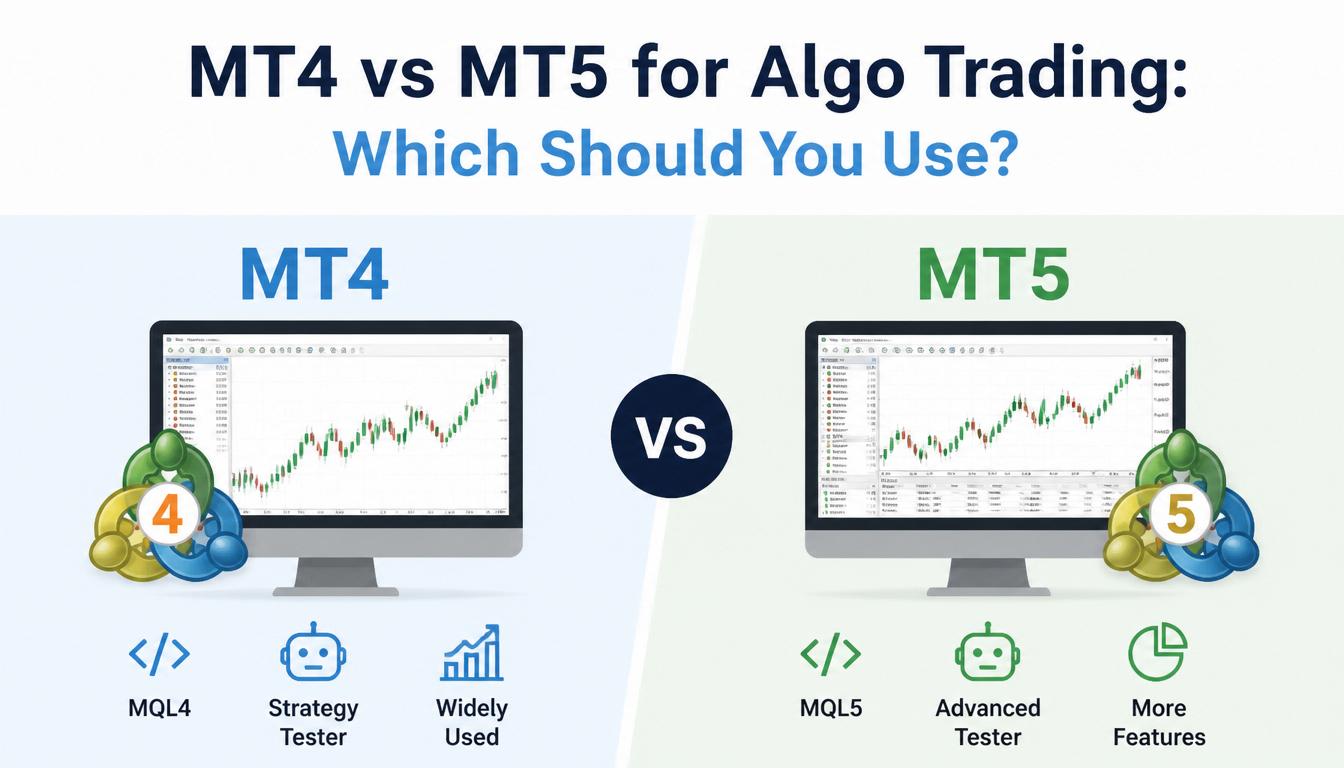
    A side-by-side of the MT4 and MT5 strategy testers, illustrating MT4 vs MT5 for algo trading

    MT4 vs MT5 at a glance

    FactorMT4MT5
    BacktestingSingle-threadedMulti-threaded, multi-currency
    LanguageMQL4 (simpler, limited)MQL5 (advanced, OOP)
    AssetsMainly forexForex, stocks, futures
    Execution32-bit64-bit, lower latency
    EA libraryLargest (legacy)Growing, modern
    FutureLicenses discontinuedActively developed

    Backtesting: the biggest difference

    For an algo trader, this is the headline. MT4’s strategy tester is single-threaded; MT5’s is multi-threaded and multi-currency, with far more data options. The practical impact is enormous.

    As MQL5 community benchmarks show3–5x speed improvements in optimization are achievable, and the gap widens at scale. A complex genetic optimization that takes 48 hours on MT4 can finish in about 15 minutes using MT5’s Cloud Network. When you’re iterating on a strategy, that’s the difference between testing one idea a day and testing dozens. Winner: MT5, decisively.

    MQL4 vs MQL5: the programming language

    EAs are written in MetaQuotes’ MQL language, and the versions differ. MQL4 is simpler but more limited. MQL5 is more advanced and versatile, with proper object-oriented programming features that make complex algorithms and indicators easier to build.

    For a beginner writing a basic moving-average EA, MQL4’s simplicity can feel friendlier. But for anything sophisticated — multi-asset logic, complex risk modules, reusable components — MQL5’s structure pays off. Winner: MT5 for serious development; MT4 only for the simplest scripts.

    Asset class support

    MT4 was built for forex and mostly stays there. MT5 is a true multi-asset platform, supporting forex, stocks, and futures from one interface.

    If your automated strategy only trades currency pairs, this may not matter. But if you want one platform to run forex and equity or futures strategies, MT5 is the only option of the two. Winner: MT5.

    Execution speed

    MT5 is a 64-bit, multi-threaded application, while MT4 is older 32-bit software. That architecture lets MT5 process price updates and order executions with lower latency, especially during high-volatility periods when speed matters most.

    For most retail strategies trading on minute or hourly timeframes, the difference is modest. For anything latency-sensitive, MT5’s modern engine is the safer foundation. Winner: MT5.

    The EA ecosystem

    This is MT4’s one genuine advantage. Because it dominated for so long, MT4 still hosts the largest library of existing EAs — thousands of legacy robots and indicators built over fifteen-plus years.

    MT5’s library is smaller but growing fast, and all new serious development targets it. So MT4 wins on sheer back-catalogue, but that catalogue is aging and increasingly unsupported. Winner: MT4 on quantity today, MT5 on the future.

    Why MT4 is being phased out

    The decision is partly being made for you. As industry analysts noteMetaQuotes has ceased selling new MT4 licenses and limited its support for the platform. Brokers now face higher maintenance costs and security risks keeping MT4 alive. That pressure is pushing the whole industry toward MT5.

    Practically, that means MT4’s days are numbered. Building a new automated trading operation on a platform with discontinued licenses and shrinking support is a technical risk you don’t need to take. Winner: MT5.

    Should you migrate?

    It depends on what you have. Starting fresh? Build on MT5 — there’s no good reason to begin on a phased-out platform. Running profitable legacy MT4 EAs? Don’t rush. MQL4 code doesn’t run on MT5 unchanged; it needs porting to MQL5, which is real work and can introduce subtle behavior changes (backtests can even differ between the two).

    The sensible path: keep stable MT4 systems running while they perform, but develop anything new in MT5, and plan an eventual migration before broker support for MT4 fully dries up.

    MT5 features that matter for algo trading

    Beyond the headline MT4 vs MT5 differences, a few MT5 features are worth knowing because they directly help an automated trader.

    The economic calendar is built in. MT5 ships with an integrated calendar of news events. Your EA can read it and, for example, stand down around high-impact releases. MT4 has no native equivalent.

    More timeframes and order types. MT5 offers 21 timeframes versus MT4’s 9, plus additional pending-order types. That gives a strategy finer control over both its signals and its entries.

    Depth of Market (DOM). MT5 shows the order book for instruments that support it. For strategies that care about liquidity and order flow, that visibility is useful and simply absent on MT4.

    A built-in MQL5 community and cloud. MT5 connects directly to the MQL5 marketplace, signals, and the cloud testing network. The cloud is what makes those massive optimization speed-ups possible, renting distributed computing power on demand.

    Native multi-asset accounting. Because MT5 was designed for stocks and futures as well as forex, it handles different instrument types cleanly in one account. For a trader running strategies across asset classes, that’s a structural convenience MT4 was never built to provide.

    None of these single-handedly decides the MT4 vs MT5 question — the backtesting speed does that — but together they make MT5 the more capable home for a serious automated operation.

    Getting started with MT5 for algo trading

    If the MT4 vs MT5 verdict points you to MT5, here’s how to begin without wasted steps.

    First, pick a broker that offers MT5 and supports automated trading. Most major forex and CFD brokers now do, and many include a demo account. Open the demo first. You want to test EAs with fake money before risking real capital, and MT5’s demo behaves like the live platform.

    Second, learn the strategy tester. It’s the single most valuable tool for an algo trader, and MT5’s multi-threaded version is where the platform earns its keep. Run your EA across both trending and ranging historical periods, and always include realistic spreads and slippage. A backtest that ignores costs lies to you.

    Third, set up a VPS. A virtual private server keeps your EA running 24/5 with low latency, independent of whether your home computer is on. For any serious automated strategy, this is not optional — a missed signal because your laptop slept can erase a week of gains.

    Finally, start small and supervise. Deploy on a small live account once the demo results hold up. Then monitor it. An EA is a tool you watch, not a machine you abandon. Set a maximum drawdown at which you switch it off, and respect that limit without exception.

    The bigger picture beyond MetaTrader

    One honest caveat for context. While MetaTrader still dominates retail forex automation, the cutting edge is moving. New development increasingly favors cTrader for execution and TradingView for research, with Python powering the new wave of AI-driven funds.

    MetaTrader remains the right starting point for most retail algo traders — the ecosystem and broker support are unmatched. But if you’re investing years into a skill set, know that Python and modern platforms are where the field is heading. Our guide to the best programming language for trading covers that path.

    FAQ

    Is MT4 or MT5 better for algo trading? MT5, clearly. It offers multi-threaded backtesting (3–5x faster), the more capable MQL5 language, multi-asset support, and lower-latency execution. MT4’s only edge is its larger legacy EA library.

    Can I run my MT4 EA on MT5? Not directly. MQL4 code must be ported to MQL5, which is real development work and can subtly change behavior. Test thoroughly after any migration.

    Why are brokers dropping MT4? MetaQuotes stopped selling new MT4 licenses and limited support, raising brokers’ maintenance costs and security risks. The industry is steadily consolidating on MT5.

    Is MT5 harder to learn than MT4? Slightly, because MQL5 is more advanced. But for serious algo development, that power is an advantage, and the platforms feel broadly similar to use.

    Should a beginner start on MT4 or MT5? MT5. There’s no reason to learn a phased-out platform, and MT5’s faster backtesting alone makes learning more productive.

    Is MQL5 hard to learn if I know MQL4? There’s a learning curve, since MQL5 is more object-oriented and structured. But the concepts transfer, and the added structure pays off for anything beyond a simple script. Most MQL4 developers adapt within a few weeks.

    Can I run the same EA on both MT4 and MT5? Not without porting. An MQL4 EA must be rewritten in MQL5 to run on MT5, and behavior can differ subtly afterward. Always re-test a ported EA thoroughly before trusting it with real money.

    Does MT5 cost more than MT4? For traders, both are free to download — your broker provides them. The cost difference falls on brokers, where MT4’s discontinued licenses and higher maintenance are pushing the industry toward MT5.

    Is MT5 backtesting really more accurate than MT4? It can be. MT5’s tester supports real tick data and multi-currency testing, which models real conditions more faithfully than MT4’s single-threaded, single-symbol approach. Just remember that even a perfect backtest doesn’t guarantee live results — include spreads and slippage, and test out-of-sample either way.

    Do most brokers still support MT4 in 2026? Many do, but the trend is clearly away from it. With MetaQuotes no longer selling new MT4 licenses and trimming support, brokers are steadily steering clients to MT5. If you’re choosing now, pick a broker with strong MT5 support so you’re not stranded on a platform that’s being wound down.

    Key takeaways

    • In the MT4 vs MT5 debate for algo trading, MT5 is the clear winner in 2026.
    • MT5’s multi-threaded backtesting is 3–5x faster — the single biggest advantage for strategy development.
    • MQL5 is more capable, MT5 is multi-asset, and its execution is lower-latency.
    • MT4’s only real edge is its large legacy EA library — but licenses are discontinued and support is shrinking.
    • Start fresh on MT5; migrate legacy MT4 systems deliberately, not in a panic.

    Setting up your automated trading? Our free Algo Trading Starter Kit includes an MT5 setup guide, a backtesting checklist, and our broker comparison. Grab it free → and build on the platform with a future, not a sunset.

  • Forex Trading Strategies for Automation: A 2026 Guide

    Forex Trading Strategies for Automation: A 2026 Guide

    Forex is the world’s largest and most mature market for automated trading, and it isn’t close. Decades before crypto bots existed, foreign-exchange traders were running automated systems on MetaTrader, and that head start shows: the tooling, the strategy libraries, and the funnel infrastructure are all more developed here than anywhere else. If you want to automate, forex trading strategies are some of the most battle-tested options available.

    This is a practical guide, not a ranked listicle. We’ll start with what actually makes forex different for automation, tour the major strategy types that work, walk through the MT4/MT5 ecosystem you’ll likely use, and end with the honest warnings most “AI EA” sellers skip.

    What this guide covers

    What makes forex suited to automation

    A few structural features make forex unusually friendly to bots. It trades 24 hours a day, five days a week, across global sessions. A system can work while you sleep, without the weekend gaps that complicate stocks. It’s also extraordinarily liquid, especially in the major pairs, which means tight spreads and clean fills for automated orders. And it’s driven by quantifiable forces — interest rates, economic releases, and clear technical levels. Those translate neatly into rules a program can follow.

    Leverage is the double-edged extra. It lets small accounts run meaningful automated forex trading strategies, but it magnifies losses just as fast as gains. Respect it, and forex is a superb proving ground for automation. Ignore it, and it’s the fastest way to blow an account.

    A MetaTrader chart running an expert advisor across forex pairs, illustrating automated forex trading strategies

    The MT4/MT5 expert advisor ecosystem

    You can’t discuss forex automation without MetaTrader. MT4 and MT5 host the largest ecosystem of ready-made algorithms and third-party tools in retail trading. They let you deploy automated forex trading strategies without programming from scratch, drawing on a marketplace of thousands of bots.

    The automated programs are called Expert Advisors (EAs) — bots written in the MQL language that run directly on your charts. You can buy or download thousands of them from the MQL5 marketplace, or code your own. This maturity is a genuine advantage: proven strategies, deep documentation, and a vast community. It’s also a hazard, because the same marketplace is full of overfit, dangerous EAs sold with fantasy backtests. The ecosystem gives you everything — including plenty of ways to lose money fast.

    Trend-following strategies

    Trend following is the best starting point for automated forex, and most experts agree. The logic is simple: identify a directional move and ride it until it reverses. A moving-average crossover is the classic beginner version — buy when a fast average crosses above a slow one, and sell when it crosses back.

    It works in forex because currencies are driven by slow-moving macro forces like rate cycles, so they can trend for weeks or months. The trade-off is familiar. Trend systems get chopped up in sideways markets, taking small repeated losses while they wait for a real move. The same momentum logic that beats buy-and-hold applies here — the edge is often in disciplined exits, not perfect entries.

    Breakout and session strategies

    Breakout strategies aim to catch a new move the moment price decisively clears a key level. In forex, these are often tied to sessions. An Opening Range Breakout (ORB) system, for instance, marks the high and low of a session’s opening range and trades the break beyond it. Specialized EAs exist to automate these time-based setups.

    Session timing matters because forex volatility concentrates around the London and New York opens and their overlap. A breakout system that fires during those liquid, active windows behaves very differently from one running through the quiet Asian afternoon. Tying a strategy to the right session is half of making it work.

    Range and mean-reversion strategies

    When a pair isn’t trending, it’s often ranging — oscillating between support and resistance. Range strategies bet that price will revert toward the middle of that band, buying near the bottom and selling near the top.

    This is the forex cousin of the mean reversion strategy, and it suits the long, quiet consolidation phases that frustrate trend followers. The danger is identical, too: when a range finally breaks, a mean-reversion bot keeps fading the move and bleeds. A stop-loss outside the range and a filter to detect a genuine breakout are non-negotiable.

    Carry trade strategies

    The carry trade is uniquely a forex play. It profits from the interest-rate differential between two currencies: you hold a higher-yielding currency against a lower-yielding one and earn the daily interest (swap), regardless of price movement.

    It’s a slower, income-oriented strategy rather than an active one. Modern automated versions go further: AI can dynamically optimize carry positions by weighing interest-rate differentials, volatility forecasts, and geopolitical risk. The risk is real, though. An adverse currency move can wipe out months of accumulated interest in days, so carry works best with conservative sizing and a close eye on central-bank policy.

    News trading strategies

    Forex reacts violently to economic releases — rate decisions, inflation prints, jobs reports. News strategies aim to trade those spikes, and this is an area where automation has a genuine, structural edge. AI systems that parse a release and execute within milliseconds can act long before a human finishes reading the headline.

    It’s also high-risk. Spreads widen dramatically around news, slippage spikes, and a surprise can whip price both directions before settling. News trading rewards fast, well-tested systems and punishes anyone improvising. For most retail traders, it’s an advanced strategy to approach carefully, if at all.

    The martingale and grid warning

    Here is the warning the EA marketplaces won’t put in bold. As seasoned forex automation writers caution, many forex bots marketed as “AI-powered” are nothing of the sort — they’re martingale or grid systems that double down on losing positions.

    These produce gorgeous, smooth equity curves for months, which is exactly what makes them so easy to sell. Then a single sustained trend against the position triggers a losing streak that wipes out every gain and then some. The smooth curve was never skill; it was a hidden time bomb. Before deploying any EA, understand the underlying logic. If it adds to losers or refuses to explain how it trades, walk away — no matter how good the track record looks.

    Choosing among the forex trading strategies

    With several options on the table, how do you pick? Match the strategy to the market and to yourself.

    Start with the market. Is the pair trending or ranging? Trend-following and breakout systems want direction and momentum. Range and mean-reversion systems want quiet consolidation. Running the wrong one in the wrong regime is the most common way these forex trading strategies fail.

    Then match your temperament and time. Trend following is the gentlest entry point — simple rules, infrequent trades, forgiving of imperfect timing. Carry trading suits patient, income-minded traders who watch central banks. News trading demands speed and nerve, so leave it until you’re experienced. Breakout and range systems sit in between.

    A practical path for most beginners looks like this. Learn a trend-following EA first on a demo account. Get comfortable with how it behaves through both trends and chop. Only then add a second strategy for the conditions the first handles badly — typically a range system to complement a trend system. That pairing covers most market regimes between them.

    Whatever you choose, never run a strategy you can’t explain. If you can’t say in one sentence why it should make money, you can’t tell whether it’s broken or just having a bad week. Clarity about the edge matters more than any single indicator setting.

    Sessions and pairs: timing your forex trading strategies

    Two practical levers shape every forex system. Pairs: the majors (EUR/USD, GBP/USD, USD/JPY) offer the tightest spreads and cleanest automation, while exotics carry wider spreads that can swallow a strategy’s edge. Stick to liquid majors while you learn. Sessions: match your strategy to the right window — breakout systems thrive around the volatile London and New York opens, while range systems prefer the quieter hours.

    Getting this context right is the difference between a strategy that works in theory and one that works in your account. The same forex trading strategies can win or lose purely based on which pair and session you run them in.

    Backtesting your forex trading strategies

    No forex strategy should go live untested. Every algorithm needs thorough backtesting against historical data to reveal its real performance characteristics and expose its weaknesses before real money is on the line.

    MT4/MT5 include a strategy tester for exactly this, but use it honestly: include spreads, swaps, and slippage, and test across both trending and ranging periods. A system that only worked in last year’s trend will fail the moment conditions change. As with any market, treat a flawless backtest as a warning sign of overfitting, not a guarantee. Then paper trade on a demo account — MetaTrader makes this easy — before committing live capital.

    FAQ

    What is the best forex trading strategy for beginners? Trend following, usually via a moving-average crossover. It’s simple to understand, easy to automate on MT4/MT5, and forgiving of imperfect timing — the standard recommended starting point.

    What are Expert Advisors? EAs are automated trading programs written in MQL that run on MT4 or MT5 charts. They execute forex trading strategies for you and can be bought, downloaded, or coded yourself.

    Are forex trading bots profitable? They can be with a sound strategy and disciplined risk management. But many marketplace bots are overfit or hidden martingale systems, so understanding the underlying logic matters more than the advertised returns.

    Is MT4 or MT5 better for automated trading? Both host huge EA ecosystems. MT5 is newer with more features and asset classes; MT4 still has the largest library of existing EAs. For pure forex automation, either works — pick what your broker supports best.

    Why are martingale forex bots dangerous? They double down on losing trades, producing smooth returns until one sustained adverse trend triggers a catastrophic losing streak that erases months of gains. Avoid any bot that adds to losers.

    What are the best forex pairs for automated strategies? The majors — EUR/USD, GBP/USD, USD/JPY — are best. They offer the tightest spreads and deepest liquidity, so bots get clean fills. Exotic pairs carry wider spreads that can swallow a strategy’s edge, so stick to majors while you learn.

    Do automated forex strategies work on a small account? Yes. Forex leverage lets small accounts run meaningful positions, and most strategies scale down fine. But leverage cuts both ways, so size conservatively — a small account with reckless leverage blows up fastest.

    Key takeaways

    • Forex is the most mature market for automation, with the deepest tooling and the MT4/MT5 EA ecosystem.
    • Trend following is the best starting strategy; breakout, range, carry, and news systems each suit specific conditions.
    • The MT4/MT5 ecosystem is powerful but full of overfit EAs — understand any bot before running it.
    • Beware martingale and grid bots sold as “AI” — smooth curves that eventually blow up.
    • Match pair and session to your strategy, and backtest honestly with spreads and swaps before going live.

    Want to automate forex the safe way? Our free Algo Trading Starter Kit includes an EA vetting checklist, a backtesting worksheet, and our broker and prop-firm comparison. Download it free → and build a forex system on proven rules, not marketplace hype.

  • Crypto Trading Strategies: 7 That Actually Work in 2026

    Crypto Trading Strategies: 7 That Actually Work in 2026

    Crypto never sleeps, and that’s exactly why it rewards a plan over a hunch. Markets that run 24/7, swing violently, and react to a single tweet will punish emotional trading fast. The traders who do well aren’t glued to charts at 3 a.m. They’re running tested crypto trading strategies, usually automated, that execute the same rules whether they’re awake or not.

    This guide ranks seven crypto trading strategies that genuinely work in 2026. For each, you’ll learn how it makes money and who it suits. We’ve ordered them roughly from most beginner-friendly to most advanced, so you can start where you are.

    What you’ll learn

    What makes crypto different

    Three features set crypto apart and shape every strategy on this list. First, it trades 24/7. There’s no closing bell, so a human can’t watch it all, which hands a structural edge to bots. Second, it’s extremely volatile, creating both more opportunity and more risk than stocks or forex. Third, it’s driven heavily by sentiment and on-chain activity. Whale moves, social hype, and news can swing prices in minutes.

    The throughline is emotion. As crypto strategy guides repeatedly note, human emotion is the single biggest performance drag in trading, and crypto’s volatility amplifies it. Remove the human from the moment of execution, and consistent results become possible. That’s why most crypto trading strategies that work are run by bots.

    A dashboard showing seven crypto trading strategies side by side with price charts

    How we ranked these crypto trading strategies

    We scored each strategy on three things: how beginner-friendly it is, how reliably it generates returns across market conditions, and how well it suits automation. A strategy that demands constant manual attention scored lower. In a 24/7 market, anything you can’t automate eventually breaks you. The most accessible, automatable approaches sit at the top.

    At a glance: the seven strategies

    StrategyProfits fromBest marketDifficulty
    DCALong-term accumulationAny (long-term)Beginner
    Grid tradingSideways oscillationChoppyBeginner
    Momentum / trendSustained movesTrendingBeginner
    Swing (RSI)Multi-day swingsVolatileIntermediate
    ScalpingTiny fast movesLiquid, volatileAdvanced
    ArbitrageCross-exchange gapsAny (fleeting)Advanced
    AI / sentimentAdaptive signalsAnyAdvanced

    #1 Dollar-cost averaging (DCA)

    The simplest and most reliable starting point. A DCA bot buys a fixed dollar amount on a fixed schedule, ignoring price. Over time it smooths out volatility — you automatically buy more when prices are low and less when they’re high.

    DCA removes the two things that wreck beginners: timing and emotion. You’re not predicting tops and bottoms; you’re systematically accumulating. It’s the single most dependable way to build a crypto position. And it pairs perfectly with the long-term conviction most newcomers already have.

    Best for: Beginners and long-term believers who want a hands-off, low-stress approach.

    #2 Grid trading

    A grid bot places a ladder of buy orders below the current price and sell orders above it. It banks a small profit each time price oscillates through the range. It profits from movement without predicting direction, which makes it a crypto favorite for sideways markets.

    Crypto’s constant chop is ideal fuel for a grid. The catch is a strong breakout, which leaves the grid accumulating losses on one side — so a stop-loss is essential. Our full grid trading strategy guide covers the mechanics and a worked example.

    Best for: Beginners wanting an automated income stream in range-bound markets.

    #3 Momentum and trend following

    Momentum strategies buy strength and sell weakness, riding established trends until they fade. In crypto, trends can run hard and long, which rewards a bot that simply holds the move and exits when it breaks.

    A simple moving-average rule is enough to start. As our breakdown of how a momentum bot beats buy-and-hold shows, the real edge is often risk control. Stepping aside during crashes matters more than chasing raw return. Crypto’s violent downtrends make that drawdown protection especially valuable.

    Best for: Beginners who want a rules-based way to ride big crypto moves.

    #4 Swing trading with RSI

    Swing trading captures multi-day price swings rather than long-term holds or split-second scalps. A common automated version uses the RSI indicator. You buy when RSI signals oversold and sell when it signals overbought, holding for days at a time.

    It’s a middle path — more active than DCA, far calmer than scalping. RSI-based swing trading lets you benefit from crypto’s big swings without staring at screens, which makes it popular with part-time traders. It shares DNA with the mean reversion strategy, betting that extreme moves snap back.

    Best for: Intermediate, part-time traders comfortable reading one or two indicators.

    #5 Scalping

    Scalping takes many tiny, fast profits, entering and exiting within seconds or minutes on 1- to 5-minute charts. It targets the most liquid, volatile assets and demands rapid execution — pure bot territory.

    It’s powerful but punishing. As our crypto scalping bot guide details, fees and latency decide everything. Paper returns routinely collapse by 80% live once real costs are included. Scalping rewards only those who genuinely master the math and infrastructure.

    Best for: Advanced traders who can handle low-latency execution and tight fee management.

    #6 Arbitrage

    Arbitrage exploits price differences for the same coin across exchanges — buy low on one, sell high on another. In 2026 this is almost entirely an algorithmic game, one where bots hold a genuine, structural advantage over manual traders.

    The edges are real but thin and fleeting; fees and transfer times eat them, and competition closes them in seconds. It demands speed, capital, and solid infrastructure, which keeps it firmly in advanced territory.

    Best for: Advanced, technically capable traders with fast systems and multi-exchange accounts.

    #7 AI and sentiment bots

    The newest frontier. In 2026, crypto trading is shifting away from simple if/then bots. The new wave is autonomous AI agents that use machine learning to read market sentiment and on-chain whale activity in real time.

    Unlike a fixed grid or moving-average rule, these systems aim to adapt to changing conditions. The promise is real, but so is the hype — many “AI” products are just repackaged grid or martingale bots. Demand transparency about the underlying logic before trusting one with capital.

    Best for: Advanced traders who understand what the AI is actually doing under the hood.

    Why automation wins for crypto trading strategies

    Notice the pattern: nearly every strategy here works best as a bot. That’s not a coincidence. A 24/7 market makes manual execution impossible to sustain, and crypto’s volatility makes emotional mistakes especially costly.

    Bots that run rule-based crypto trading strategies without emotion consistently outperform manual trading over time. The edge is biggest for retail traders, who can’t watch markets around the clock. Automation doesn’t guarantee profit; a bad strategy automated is still a bad strategy. But it removes the single biggest drag on performance — you, at your worst moment, clicking the wrong button.

    How to choose your strategy

    Match the strategy to your experience and the market you expect:

    • Brand new? Start with DCA — almost nothing to tune, and it builds the habit.
    • Sideways market? A grid bot harvests the chop.
    • Expecting a trend? A momentum bot rides it with built-in crash protection.
    • Part-time and patient? Swing trading with RSI.
    • Technical and fast? Scalping or arbitrage reward your edge.
    • Want adaptive signals? AI bots — but only if you understand them.

    Whichever you pick, the workflow never changes: understand the logic, backtest with real fees, paper trade, then start small.

    How much can crypto strategies realistically earn?

    Set expectations before you set up a bot. The screenshots of 500% months are survivorship bias or outright fiction, and chasing them is how beginners blow up.

    Realistic returns from disciplined crypto trading strategies look modest next to the hype. A well-run grid bot in a choppy market, or steady DCA accumulation through a cycle, can compound respectably over time. But every approach here has losing stretches, and crypto’s volatility means the swings are wider than in stocks or forex. No honest platform promises guaranteed returns; any that does is a red flag.

    The mindset that works treats these strategies as a way to make capital work harder with discipline, not as a lottery ticket. Returns are measured per year, not per day. Size positions so a bad run is survivable, never bet money you can’t afford to lose, and let small, repeatable edges compound. That patience is what separates the traders still standing after a full cycle from the ones who chased a fantasy and vanished.

    Crypto trading strategies: mistakes to avoid

    • Chasing hype coins with a strategy built for liquid majors.
    • Skipping the stop-loss, especially on grid and scalping bots.
    • Trusting a black-box “AI” bot you can’t explain.
    • Over-leveraging in a market that can move 20% in an hour.
    • Ignoring fees, which quietly erode every high-frequency strategy.

    FAQ

    What is the best crypto trading strategy for beginners? DCA, hands down. It removes timing and emotion, needs almost no tuning, and suits the long-term conviction most beginners already have. Grid trading is a strong second for sideways markets.

    Are crypto trading bots profitable? They can be, but only with a sound underlying strategy and disciplined risk management. Bots that run rule-based strategies without emotion tend to outperform manual trading — but a weak strategy automated still loses.

    Which crypto trading strategy is most profitable? There’s no universal winner; it depends on market conditions. Momentum shines in trends, grid in chop, arbitrage in fragmented markets. Matching strategy to conditions matters more than the strategy itself.

    Do I need to code to use these strategies? No. Platforms like Pionex, 3Commas, and Bitsgap offer no-code bots for DCA, grid, and more. Coding helps you customize, but it isn’t required to start.

    Are AI crypto trading bots worth it? Sometimes — but many are repackaged grid or martingale strategies dressed up as “AI.” Demand transparency about the actual logic before trusting one, and treat guaranteed-return claims as red flags.

    Can I run multiple crypto strategies at once? You can, but beginners shouldn’t. Master one strategy end to end before adding another. Running several untested bots at once multiplies the ways you can lose, without teaching you which one actually works.

    Is crypto trading riskier than stocks? Generally yes. Crypto is more volatile and less regulated, so the swings are larger in both directions. That’s exactly why disciplined, automated strategies and strict position sizing matter even more here than in calmer markets.

    Key takeaways

    • The seven crypto trading strategies that work are DCA, grid, momentum, swing, scalping, arbitrage, and AI bots.
    • DCA and grid are the best starting points — simple, automatable, and forgiving.
    • Crypto’s 24/7 volatility makes automation a structural advantage, because it removes emotional execution.
    • Scalping, arbitrage, and AI are advanced — powerful, but unforgiving of fees, latency, and hype.
    • Match the strategy to the market, backtest with real costs, and always use a protective stop-loss to cap the downside.

    Ready to put a strategy to work? Our free Algo Trading Starter Kit includes ready-to-run bot templates for DCA, grid, and momentum, a fee calculator, and our vetted exchange comparison. Grab it free → and let tested rules trade crypto while you sleep, working through every session you can’t watch yourself.

  • High-Frequency Trading Strategies: A 2026 Reality Check

    High-Frequency Trading Strategies: A 2026 Reality Check

    Let’s start with the conclusion most guides bury at the bottom: you, a retail trader at home, almost certainly cannot run true high-frequency trading. Not because you’re not smart enough, but because HFT is an arms race won with nanoseconds, custom hardware, and real estate inside exchange data centers. Understanding it still matters enormously, though — because these are the systems on the other side of many of your trades, and knowing how they work makes you a sharper trader.

    This is a clear-eyed tour of the major high-frequency trading strategies: what they are, how they make money, and exactly where the line sits between what institutions do and what a retail trader can realistically touch.

    What this guide covers

    What high-frequency trading actually is

    High-frequency trading (HFT) is a form of algorithmic trading defined by extreme speed and volume. Thousands of orders are placed, modified, and cancelled in fractions of a second. The holding period for a position can be milliseconds. The goal isn’t to predict where a stock goes next week. It’s to capture vanishingly small edges, billions of times, faster than anyone else.

    And it dominates. As VT Markets explains, HFT firms account for an estimated 50–60% of total US equity trading volume in 2026. When you buy a share, there’s a strong chance an HFT system is on the other side. These aren’t fringe players — they are the plumbing of modern markets. That scale is why understanding high-frequency trading strategies is worthwhile even if you’ll never run one.

    A data-center server rack beside a millisecond-scale order flow chart, illustrating high-frequency trading strategies

    How HFT took over the markets

    HFT didn’t always rule. In the 1990s, trading was still mostly human. Then exchanges went electronic. Orders that once took seconds now took milliseconds.

    The 2000s lit the fuse. Regulation pushed US markets toward electronic, fragmented venues. That fragmentation created tiny price gaps between exchanges. Fast firms raced to capture them. Speed itself became a product you could buy.

    By the 2010s, the arms race was in full swing. Firms spent fortunes on faster cables and closer servers. One company famously laid a straighter fiber line between Chicago and New York just to shave a few milliseconds. The book Flash Boys then brought the whole practice to public attention.

    Today the trend has only deepened. HFT is the market’s backbone, not its fringe. The edges are smaller, the hardware more extreme, and the competition fiercer. Speed that cost millions a decade ago is now table stakes. That history is why a retail trader can’t simply “start” high-frequency trading. You’re not picking up a strategy. You’re stepping into a thirty-year infrastructure war.

    Market making: the dominant strategy

    The most prevalent of all high-frequency trading strategies is electronic market making. The idea is old; the speed is new.

    A market-making firm simultaneously posts both a buy order (the bid) and a sell order (the ask) for a security, then profits from the tiny spread between them. Buy at the bid, sell at the ask, capture the difference, repeat at enormous scale. In doing so, these firms provide liquidity — they’re standing ready to take the other side of trades, which keeps markets functioning smoothly.

    The edge per trade is microscopic, often a fraction of a cent. The profit comes from doing it across thousands of securities, millions of times a day. It’s a volume business built on speed and inventory management, not on any single brilliant prediction.

    Statistical arbitrage

    Statistical arbitrage hunts temporary pricing inefficiencies between related securities. Think of a stock and the index fund that holds it, or the same stock listed on two different exchanges.

    When the historical price relationship between two such instruments drifts out of line, the algorithm bets it will snap back. It buys the cheap one, sells the rich one, and profits as the relationship reverts. The HFT twist is speed. These dislocations exist for a heartbeat, so the system must detect and act before the gap closes. It’s the same mean-reversion logic retail quants use, run at a pace no human could follow.

    Latency arbitrage

    Latency arbitrage is the most controversial entry on this list, and the one that most directly involves retail infrastructure. It exploits the speed difference between a fast data feed and a slower one.

    Here’s the mechanism. A fast feed receives a price update — say from a big institutional order or a news event. Software detects that a slower broker’s quote hasn’t caught up yet. It then places an order at the stale price before that broker updates, profiting from the difference. The execution window is typically 50–200 milliseconds, with a profit of roughly 0.5–3 pips per trade after spread. It’s pure speed arbitrage, capturing the lag between who knows the new price first.

    Momentum ignition

    Momentum ignition is the most aggressive — and legally fraught — strategy on this list. The concept: trigger a rapid price move, often by firing a burst of orders, to induce other algorithms to pile in, then profit from the move you helped create.

    Because it can shade into market manipulation, momentum ignition sits in a gray-to-black legal zone and draws regulatory scrutiny. We include it for completeness and understanding, not endorsement. Knowing it exists helps explain some of the sudden, inexplicable spikes you’ll occasionally see on a chart.

    The technology arms race

    Here’s why retail can’t simply join in. By 2026, the competitive standard requires latency measured in nanoseconds to microseconds — and achieving that takes a stack most individuals can’t assemble:

    • FPGAs and custom hardware that process market data in dedicated silicon rather than general-purpose code.
    • Co-location — physically placing your servers inside or beside the exchange’s data center to cut the distance light has to travel.
    • Direct market-access feeds that bypass the slower retail data pipelines entirely.
    • Teams of specialized engineers and quants maintaining it all.

    This is an infrastructure war measured in the speed of light through fiber. The barrier isn’t intelligence — it’s millions of dollars of equipment and physical proximity to the exchange.

    Can retail traders use high-frequency trading strategies?

    The honest answer: not true HFT. You cannot out-spec a firm with FPGAs co-located at the exchange, and trying to compete on raw latency is a guaranteed way to lose.

    But the logic behind several of these strategies scales down. You can run market-making-style bots on some crypto exchanges, capturing spread without nanosecond speed. You can run statistical-arbitrage and mean-reversion strategies on longer timeframes where milliseconds don’t decide the outcome. The trick is to borrow the idea while competing on a timeframe where speed isn’t the edge — minutes or hours, not microseconds. That’s a game retail can actually play.

    What you should not do is buy a product promising retail “HFT” returns. Genuine high-frequency trading strategies are inseparable from infrastructure you don’t have, and anyone selling otherwise is trading on the word’s mystique.

    Are high-frequency trading strategies good or bad for markets?

    This is one of the most debated questions in modern finance, and the honest answer is: both, depending on the strategy.

    On the positive side, market-making HFT provides genuine liquidity. It narrows spreads and makes it easier to buy or sell instantly at a fair price. When you get a near-instant fill on a liquid stock at a tight spread, high-frequency trading strategies are part of why. For the everyday investor, that’s a real, if invisible, benefit.

    On the negative side, critics point to fragility. HFT liquidity can vanish in an instant during stress, deepening “flash crash” events where prices gap violently in seconds. And strategies like momentum ignition shade into manipulation, extracting value rather than adding it. Latency arbitrage, too, profits purely from being faster than someone else, which many see as a tax on slower participants rather than a service.

    The balanced view is that HFT made markets cheaper and more liquid in normal times, while adding new forms of instability in abnormal ones. Regulators continue to wrestle with that trade-off. For you, the practical point is simpler: these systems are a permanent feature of the landscape, so the goal is to trade in a way that doesn’t depend on beating them.

    What high-frequency trading strategies mean for you

    Even if you never run one, HFT shapes the market you trade in. Two practical takeaways:

    First, don’t compete on speed. Your edge as a retail trader is patience, flexibility, and timeframes the giants ignore — not reaction time. Trying to scalp micro-moves against HFT market makers is bringing a stopwatch to a photo finish.

    Second, expect the plumbing. Tight spreads on liquid stocks exist partly because market makers compete them down — a benefit to you. But sudden liquidity vanishing in a panic, or strange momentary spikes, often trace back to these systems too. Understanding the machinery makes its behavior less mysterious and your own decisions calmer.

    The bigger lesson is one of mindset. High-frequency trading strategies win by being the fastest. You never will be, and you don’t need to be. Retail traders thrive on the timeframes the giants ignore — the hours, days, and weeks where a good idea, not a fast cable, decides the outcome. Cede the microseconds without a fight, and play the game where your patience, not your hardware, is the edge. That is a contest a disciplined retail trader can actually win.

    FAQ

    What are the main high-frequency trading strategies? The major ones are market making (the most common), statistical arbitrage, latency arbitrage, and momentum ignition — the last of which raises serious legal concerns.

    Can a retail trader do high-frequency trading? Not true HFT. It requires nanosecond latency, FPGAs, and co-location at the exchange. Retail traders can borrow the underlying logic on slower timeframes where speed isn’t the edge.

    How much of the market is high-frequency trading? HFT firms account for an estimated 50–60% of total US equity trading volume in 2026, making them dominant participants.

    Is high-frequency trading legal? Most HFT is legal and even provides liquidity. Momentum ignition is the exception — it can constitute manipulation and draws regulatory scrutiny.

    Is latency arbitrage a threat to retail traders? It mainly exploits speed gaps between professional feeds and slower brokers. As a retail trader, the practical lesson is simply not to compete on speed against systems built for it.

    Why is high-frequency trading so controversial? Because it cuts both ways. Market-making HFT adds liquidity and tightens spreads, which helps ordinary investors. But that liquidity can vanish in a crisis, and tactics like momentum ignition shade into manipulation. Regulators still debate the balance.

    Key takeaways

    • True high-frequency trading strategies are an institutional arms race — won with FPGAs, co-location, and nanosecond latency.
    • The four major strategies are market making, statistical arbitrage, latency arbitrage, and momentum ignition (the last legally fraught).
    • HFT is 50–60% of US equity volume — it’s the market’s plumbing, not a fringe activity.
    • Retail can’t run true HFT, but can borrow the logic on slower timeframes where speed isn’t the deciding edge.
    • Don’t compete on speed. Your retail edge is patience and timeframes the giants ignore.

    Want to trade smart against the machines, not race them? Our free Algo Trading Starter Kit includes strategy templates built for retail-friendly timeframes, a backtesting checklist, and our broker comparison. Grab it free → and play the game you can actually win.

  • 6 Passive Income Trading Strategies That Work in 2026

    6 Passive Income Trading Strategies That Work in 2026

    “Set it and forget it.” That phrase sells more trading bots than any backtest ever could. The fantasy is intoxicating: flip a switch, walk away, and watch money trickle in while you sleep. So let’s be honest from the first line — none of these passive income trading strategies are truly hands-off, and anyone who tells you otherwise is selling something. What they can be is low-effort once set up correctly, which is a different and far more achievable promise.

    This guide ranks six automated approaches by how genuinely passive each one is, explains how it makes money, and flags the work it still quietly demands. Think of “passive” as a spectrum, not a switch.

    What you’ll learn

    First, the honest truth about “passive”

    Here’s what the marketing skips: a bot automates execution, not judgment. It will place orders all night without you. It will not notice that the market regime changed, that your strategy stopped working, or that it’s time to switch off. That part is still your job.

    As multiple 2026 bot reviews stress, you can’t simply “set it and forget it.” A strategy that printed money last month may bleed this month, so the genuinely successful operators review their bots, adjust parameters, and turn them off at the right moments. The realistic goal of passive income trading strategies isn’t zero effort — it’s converting hours of active screen-watching into minutes of weekly oversight. That’s still a fantastic trade. Just go in with clear eyes.

    A dashboard ranking six passive income trading strategies by how hands-off each is

    How we ranked these passive income trading strategies

    We ranked the six on a single axis that matters most to you: how truly hands-off each is once running, balanced against how reliably it generates income. A strategy that needs daily babysitting scores low on “passive,” no matter how clever. Among passive income trading strategies, the most hands-off options sit at the top; the most demanding at the bottom.

    At a glance: the passive-ness ranking

    StrategyHow passiveProfits fromMain risk
    DCA botsVery highLong-term accumulationBuys through downtrends
    Index / rebalancingVery highDiversified market growthMarket-level returns only
    Grid botsMedium-highSideways oscillationStrong breakouts
    Trend-followingMediumSustained trendsChoppy whipsaws
    Copy tradingMediumA leader’s skillLeader’s drawdowns
    ArbitrageLowCross-market gapsThin margins, upkeep

    #1 DCA bots — the most hands-off

    Dollar-cost averaging bots buy a fixed amount of an asset on a fixed schedule, ignoring price entirely. Over time, this smooths out volatility — you buy more when prices are low and less when they’re high, automatically.

    It’s the closest thing to genuinely passive on this list because there’s almost nothing to tune. You’re not timing anything; you’re systematically accumulating. As the bot reviews note, DCA bots are especially effective for people who want a simple, automated buy-low-on-average approach without advanced knowledge.

    How passive: Very. Set the amount and schedule, then review monthly. The catch: It accumulates through downturns too, so it suits assets you believe in long-term — not anything you’d panic over.

    #2 Grid trading bots

    A grid bot places a ladder of buy orders below the current price and sell orders above it. Each time price oscillates through the range, it banks a small profit. It’s a favorite for sideways, choppy markets.

    Once configured, a grid bot runs itself for days — solidly in passive territory. But it carries a real risk: a strong breakout out of your range leaves it accumulating losses on one side. Our full grid trading strategy guide covers the mechanics and the all-important stop-loss.

    How passive: Fairly. Runs unattended, but needs a sensible range and a stop. The catch: A strong trend breaks the grid. It wants chop, not conviction.

    #3 Trend-following bots

    A trend-following or momentum bot rides established trends — buying strength, exiting weakness — using simple rules like a moving-average crossover. It aims to capture the bulk of a big move and sidestep the worst crashes.

    It’s reasonably passive: the rules are mechanical, and the bot trades infrequently compared to a scalper. The trade-off is whipsaws — in choppy markets it gets chopped up with small losses, the mirror image of where a grid thrives.

    How passive: Moderately. Infrequent trades, but benefits from occasional review. The catch: Sideways markets cause repeated small losses.

    #4 Copy trading

    Copy trading lets you automatically mirror the trades of an experienced trader. Platforms like Zignaly built entire profit-sharing ecosystems around it. You’re outsourcing the strategy itself to someone with a track record.

    It can be very hands-off — once you’ve chosen who to follow, the trades happen automatically. But the passivity is deceptive. Your returns are only as good as the trader you copied, and even strong traders have losing streaks. Choosing and monitoring who you follow is the work that replaces strategy-building.

    How passive: Hands-off to run, but choosing and vetting traders is ongoing. The catch: You inherit someone else’s drawdowns and decisions.

    #5 Index and rebalancing bots

    These bots hold a basket of assets at target weights and automatically rebalance — trimming winners and topping up laggards — to maintain the allocation. It’s a disciplined, low-touch way to stay diversified.

    The income here is long-term and steady rather than active trading profit, which makes it genuinely low-maintenance. It won’t shoot the lights out, but it won’t demand much either.

    How passive: Very. Rebalancing runs on a schedule. The catch: Returns track the market, so don’t expect outsized gains.

    #6 Arbitrage bots — least passive

    Arbitrage bots exploit price differences for the same asset across exchanges. In theory it’s market-neutral income; in practice it’s the least passive option here.

    Edges are thin and fleeting, fees and transfer times eat them, and staying competitive demands constant monitoring and infrastructure. It’s powerful for technically capable operators but a poor fit for anyone seeking a quiet, hands-off income.

    How passive: Barely. Demands monitoring, speed, and upkeep. The catch: Thin margins and high technical overhead.

    Crypto vs stocks: where these strategies fit

    The market you choose shapes which passive income trading strategies make sense.

    Crypto runs 24/7 and swings hard, which suits grid and DCA bots especially well. There’s always movement to harvest, and no market close to interrupt the bot. The no-code ecosystem — Pionex, 3Commas, Bitsgap — is also most mature here. The cost is sharper volatility and lighter regulation, so conservative position sizing matters more.

    Stocks and ETFs move slower and rest overnight and on weekends. That favors trend-following and index/rebalancing bots over high-frequency oscillation. The upside is stronger regulation and decades of clean data for testing. The 2026 removal of the $25,000 day-trading minimum also made automated equity strategies viable on smaller accounts.

    Most beginners start in crypto for its accessibility and round-the-clock action, then add equity strategies as they grow. Neither is strictly better. Match the market to the strategy — and to how much volatility you can comfortably sleep through.

    The maintenance nobody mentions

    Whichever you choose, budget for the recurring work that keeps “passive” income alive:

    • Regime checks. Confirm the strategy still fits current market conditions — grids want chop, trend bots want trends.
    • Performance review. Compare live results to expectations and kill what’s clearly broken.
    • Risk hygiene. Verify stops, position sizes, and that no single position has ballooned.
    • The off switch. The most underrated skill is turning a bot off when its market disappears.

    Do this for fifteen minutes a week and you’ve earned the “passive” label honestly. Skip it, and the market eventually collects what you ignored.

    What can these strategies realistically earn?

    This is where expectations need an anchor. Ignore the screenshots of triple-digit months — they’re survivorship bias at best, fabrication at worst.

    Realistic returns from passive income trading strategies land in the same range as other disciplined automated approaches: roughly single digits to the low double digits annually for most retail operators, in good conditions. A well-run grid bot in a choppy market or a steady DCA accumulation can compound respectably over time. But none of these are money printers, and all of them have losing stretches. As honest bot reviews repeatedly note, no platform can promise guaranteed returns, and any that does is a red flag.

    The mindset that works: treat this as a way to make your capital work a little harder with a little oversight, not as a salary replacement you can switch on overnight. The people who succeed with passive income trading strategies are the ones who size expectations correctly. They compound modest, real returns instead of chasing fantasy ones — and they never risk money they can’t afford to lose on the promise of “passive.” Anchor your expectations there, and these strategies become a genuine asset that quietly works in the background, rather than a disappointment waiting to happen — and a far better use of idle capital than letting it sit untouched.

    How to start with passive income trading strategies

    1. Match the strategy to your assets and temperament — DCA for long-term conviction, grid for sideways markets, copy trading if you’d rather outsource.
    2. Use a reputable platform (3Commas, Pionex, Bitsgap) or code your own.
    3. Paper trade first, then start with capital you can afford to lose.
    4. Schedule a weekly check-in from day one — it’s the habit that separates real income from slow bleed.

    FAQ

    Are passive income trading strategies actually passive? Not entirely. Bots automate execution, not judgment. The realistic goal is low-effort — minutes of weekly oversight instead of hours of active trading — not zero effort.

    Which strategy is the most hands-off? DCA bots, followed by index/rebalancing bots. Both run on a schedule with little to tune, making them the closest to genuinely passive.

    Can I lose money with these bots? Yes. Grid and DCA bots can lose in strongly adverse markets, copy trading inherits the leader’s losses, and no honest platform promises guaranteed returns.

    Do I need coding skills? No. Most of these run on no-code platforms like Pionex, 3Commas, and Bitsgap. Coding only helps if you want to customize a strategy.

    How much time do they really take? Plan for roughly fifteen minutes a week of review — regime checks, performance, and risk hygiene. That light upkeep is what keeps the income flowing.

    Which markets suit passive income bots best? Crypto suits grid and DCA bots thanks to 24/7 volatility and mature no-code platforms. Stocks suit trend-following and rebalancing bots, with stronger regulation and deeper data for testing. Many traders eventually run both.

    Key takeaways

    • No passive income trading strategies are truly hands-off — bots automate execution, not judgment.
    • DCA and index/rebalancing bots are the most passive; arbitrage is the least.
    • Grid and trend bots sit in the middle — low-touch, but each has a market it hates (trends and chop, respectively).
    • Copy trading outsources the strategy but not the responsibility of choosing well.
    • Budget ~15 minutes weekly for regime checks and risk hygiene — that’s the price of keeping “passive” income alive.

    Want a low-effort income setup that won’t blow up? Our free Algo Trading Starter Kit includes a strategy-matcher quiz, a weekly-review checklist, and our vetted platform comparison. Download it free → and build income you can actually walk away from — for a week, at least.

  • Crypto Scalping Bot Strategy: A 2026 Beginner’s Guide

    Crypto Scalping Bot Strategy: A 2026 Beginner’s Guide

    Somewhere right now, a piece of software is opening and closing a Bitcoin position in under a second, pocketing a fraction of a percent, and doing it again. And again. Hundreds of times a day. That’s a crypto scalping bot at work — and it’s one of the most seductive ideas in automated trading. Tiny wins, stacked endlessly, into something big. The dream sells itself.

    The reality is more demanding. A crypto scalping bot can absolutely make money, but the margin between profit and loss is razor-thin, and it’s decided by two unforgiving forces most beginners ignore: fees and latency. This guide shows you how scalping actually works, walks through the brutal math, and tells you honestly what it takes to come out ahead.

    What this guide covers

    What crypto scalping actually is

    Scalping is the art of taking many small profits instead of a few big ones. A scalper doesn’t care where Bitcoin will be next month. It cares where the price will be in the next thirty seconds, and it tries to capture a sliver of that move — 0.2%, maybe 0.5% — before exiting and hunting the next one.

    Crypto is a natural home for this. It trades 24/7, it’s volatile, and its order books update constantly, so there are always tiny dislocations to exploit. No human can scalp effectively, though. The trades are too fast and too frequent. This is automation’s territory by necessity, not preference, which is exactly why the crypto scalping bot exists.

    A fast-updating crypto order book with a scalping bot executing rapid trades, illustrating a crypto scalping bot strategy

    How a crypto scalping bot works

    Strip away the marketing and every crypto scalping bot runs the same tight loop, just very fast:

    1. Ingest data. Stream live order-book and price data from the exchange.
    2. Generate a signal. Apply a rule — an order-book imbalance, a micro-breakout, a short moving-average cross — to decide whether a quick edge exists.
    3. Send the order. Fire the entry the instant the signal triggers.
    4. Exit fast. Take the small profit at a preset target, or cut the loss just as quickly.
    5. Apply risk checks. Cap position size and daily loss so one bad tick can’t wreck the account.

    A scalper bot may execute dozens or hundreds of trades per day this way. That frequency is the whole point — and also the whole problem, because every single trade pays a toll.

    The brutal math of fees

    Here is the part the “1% a day!” screenshots never show you. When you trade hundreds of times a day, fees stop being a footnote and become the main character.

    Consider this: a reasonably good scalping strategy wins about 60% of its trades. Sounds healthy. But research summarized by TradingView Hub found that paper returns of around 1% per day shrink to roughly 0.2% per day in live trading once you subtract exchange fees and spread — an 80% collapse between simulation and reality. The strategy didn’t change. The costs simply ate four-fifths of the edge.

    It gets starker. A CoinMetrics analysis found that only about 12% of micro-spread trading opportunities are actually profitable once fees and latency are accounted for. Eighty-eight percent of the “edges” a naive bot sees are mirages that vanish at the cash register. For a scalping bot, fee structure isn’t a detail — it’s the strategy.

    Why latency makes or breaks you

    The second killer is speed. Scalping profits live in a window measured in milliseconds, and if you’re slow, the window slams shut before you get through it.

    The numbers are unforgiving. When targeting 0.2–0.5% moves, profit margins on micro-spread trades vanish entirely above 200 milliseconds of latency. For reference, human reaction time is 200–250 milliseconds — meaning a human is, by definition, too slow to scalp at all. A competent crypto scalping bot executes in 5–50 milliseconds, and that gap is its entire reason to exist.

    This is why where and how your bot runs matters as much as its logic. A bot on a laggy home connection routing through a slow API is bringing a knife to a gunfight against systems co-located beside the exchange.

    A worked example

    Let’s make the math concrete. Suppose your bot targets a 0.30% move per trade on a futures pair.

    • Gross target: 0.30% per winning trade.
    • Fees: using futures maker orders at 0.02% per side, a round trip costs about 0.04%.
    • Net per win: roughly 0.26%.
    • Losses: on a losing trade you give back your stop, say 0.30%, plus the same 0.04% in fees.

    Now apply a 60% win rate over 100 trades: 60 wins at +0.26% and 40 losses at −0.34%. That nets out to roughly +2.0% across the 100 trades — genuinely good.

    But flip one variable. Use taker orders at 0.05% per side instead of maker, and the round-trip fee jumps to 0.10%. Suddenly each win nets only 0.20% and each loss costs 0.40%, and the same 100 trades barely break even. One fee setting flipped a winner into a coin toss. That sensitivity is the essence of scalping.

    What it takes to actually profit

    Put the pieces together and a profitable crypto scalping bot needs a specific, demanding combination:

    • A genuine edge — a signal with a win rate of at least 57–60%, validated out-of-sample, not curve-fit to last month.
    • Maker-order fees — using limit orders that add liquidity (around 0.02%) instead of taker orders that remove it.
    • Low latency — execution well under 200ms, ideally in the tens of milliseconds, via a fast connection or a cloud server near the exchange.
    • Strict risk control — tight per-trade stops and a hard daily loss limit, because high frequency means errors compound fast.
    • The right market phase — scalping suits liquid, volatile, ranging conditions and struggles in dead or violently trending markets.

    Miss any one of these and the math quietly turns against you. This is not a “set it and forget it” strategy.

    Where a crypto scalping bot wins and loses

    Matching the bot to conditions is half the battle.

    It wins when: the market is liquid and choppy, spreads are tight, volatility is steady, and your execution is fast. High-liquidity majors like BTC and ETH on a low-fee futures venue are the classic playground.

    It loses when: liquidity is thin (slippage explodes), the market is dead (no moves to capture, but fees still accrue), or a violent one-way trend runs your quick exits over. Thin altcoins are especially dangerous — the spread alone can exceed your profit target.

    The honest summary: scalping is the strategy most sensitive to costs and conditions. When everything aligns, it’s beautiful. When it doesn’t, it bleeds quietly.

    Common crypto scalping bot mistakes

    Most scalping failures come from the same handful of errors. Avoid these and you’ve dodged the majority of blown accounts.

    • Trading taker fees. Paying to remove liquidity instead of using maker limit orders can double your costs and flip a winner into a loser. On a high-frequency strategy, the fee tier is not optional.
    • Backtesting without costs. A backtest that ignores fees, spread, and slippage will always look brilliant and always lie. Model every cost before believing a single result.
    • Scalping illiquid altcoins. Thin order books mean wide spreads and ugly slippage. On a low-cap token, the spread alone can exceed your entire profit target.
    • Ignoring latency. Running a crypto scalping bot on a slow home connection guarantees you arrive after the edge is gone. Measure your real latency before going live.
    • No daily loss limit. At hundreds of trades a day, a malfunctioning strategy can bleed fast. A hard daily stop is the circuit breaker that saves the account.
    • Over-optimizing the win rate. Tuning parameters until the backtest hits 70% usually means you’ve fit noise. A robust 58% beats a fragile 70% every time.

    The pattern is clear: scalping punishes carelessness faster than any other strategy, because every mistake is multiplied by your trade count.

    Scalping vs other bot strategies

    It helps to see where scalping sits among automated approaches. A grid bot also trades frequently in small increments, but it’s passive about timing — it just harvests oscillation within a range. A scalping bot is active, hunting specific micro-signals and demanding speed. A momentum bot, by contrast, trades rarely and holds for days, caring nothing about milliseconds.

    That contrast reveals the trade-off. Scalping offers the most frequent feedback and, in theory, the steadiest stream of small wins — but it’s the most cost-sensitive and the most operationally demanding of the lot. If fees, latency, and constant tuning sound exhausting, a grid or momentum approach delivers far more return per unit of effort. Scalping rewards those who genuinely enjoy optimizing a fast machine; for everyone else, a slower strategy is usually the smarter use of capital.

    Getting started without getting burned

    If you want to try it, do it the survivable way:

    1. Start on a paper or testnet account. Prove the logic before risking a cent.
    2. Measure your real latency to the exchange, and pick a low-fee venue with a maker rebate.
    3. Model fees explicitly in every backtest — a strategy that’s profitable before fees and a loser after is the default outcome.
    4. Use a reputable platform if you’re not coding your own; tools like 3Commas, Pionex, and HaasOnline offer scalping presets.
    5. Start tiny and scale slowly, watching whether live results track your backtest. They usually won’t at first.

    Treat the first months as calibration, not income. The traders who survive scalping are the ones who respected the math before the market taught it to them.

    FAQ

    Is a crypto scalping bot profitable? It can be, but only with a real edge (57–60%+ win rate), maker-order fees, low latency, and strict risk control. Without those, fees and slippage usually erase the profit.

    Why do scalping backtests look so much better than live results? Because backtests often ignore real fees, spread, and slippage. Live returns commonly fall around 80% below paper returns once those costs are included.

    Do I need to code to run a crypto scalping bot? Not necessarily. Platforms like Pionex, 3Commas, and HaasOnline offer ready-made scalping bots, though coding your own gives more control over the edge.

    How fast does a scalping bot need to be? Fast. Profit margins on micro-moves disappear above 200ms of latency. Good bots execute in 5–50ms, far beyond human reaction time.

    What’s the biggest mistake scalping beginners make? Ignoring fees. At hundreds of trades a day, the difference between maker and taker fees alone can flip a winning strategy into a losing one.

    Key takeaways

    • A crypto scalping bot captures many tiny, fast profits rather than a few big ones — pure automation territory.
    • Fees are the main character. Paper returns near 1%/day routinely shrink to ~0.2%/day live, and only ~12% of micro-edges survive costs.
    • Latency decides everything. Above 200ms, the edge vanishes; good bots run in 5–50ms.
    • Profit demands a 57–60%+ win rate, maker fees, low latency, and tight risk control — all at once.
    • It’s not passive. Scalping is the most cost- and condition-sensitive strategy in the automated toolkit.

    Want to test a scalping setup safely? Our free Algo Trading Starter Kit includes a fee-and-latency calculator, a paper-trading checklist, and our low-fee exchange comparison. Grab it free → and find out if the math works before you risk real capital.

  • The Mean Reversion Strategy Hedge Funds Use (Simplified)

    The Mean Reversion Strategy Hedge Funds Use (Simplified)

    Some of the most sophisticated quant funds on earth make money from a deceptively simple idea: prices that stray too far from their average tend to snap back. That’s the mean reversion strategy. Stripped of the PhD-level math, it’s something a retail trader can understand in an afternoon and automate in a weekend. You’re not predicting the future. You’re betting that markets overreact, then correct.

    This guide simplifies what hedge funds do into rules you can actually use. You’ll get the core logic, the exact entry and exit signals, and a worked example. Then an honest look at where the strategy works — and where it quietly breaks.

    What this guide covers

    The core idea: buy fear, sell greed

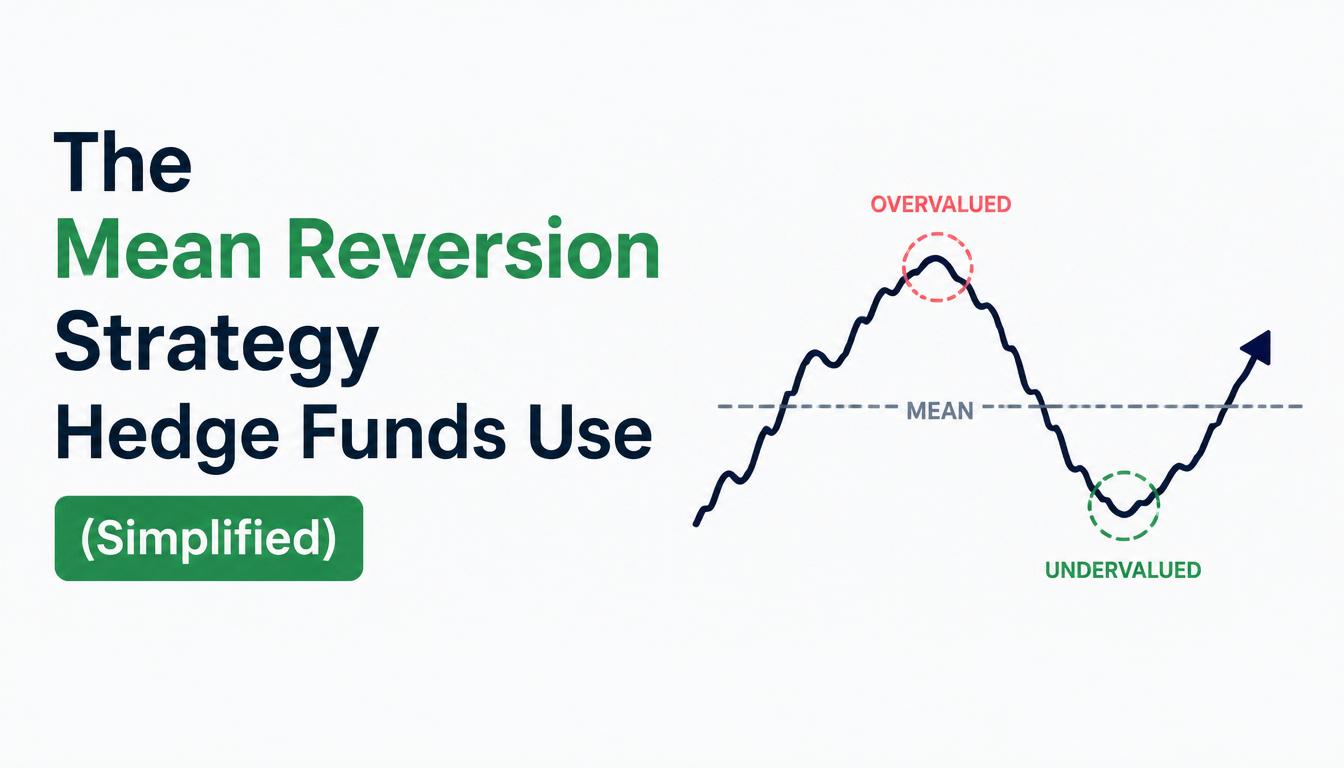
    Mean reversion rests on a single financial theory: asset prices don’t trend endlessly in one direction. They tend to return — to “revert” — to a historical average over time. When a price spikes far above its norm, the strategy expects it to fall back. When it crashes far below, it expects a bounce.

    In plain terms, you buy weakness and sell strength. It’s the opposite of momentum, which buys strength and sells weakness. Where momentum assumes a move will continue, the mean reversion strategy assumes an extreme move has overshot and will correct. Both can be true — just in different market conditions.

    A price chart with Bollinger Bands showing price reverting to its moving average, illustrating the mean reversion strategy

    How the mean reversion strategy works

    The strategy needs two things: a definition of “the average,” and a measure of how far price has strayed from it. Traders typically use one of three tools:

    • Bollinger Bands — bands set a couple of standard deviations above and below a moving average. Price touching the lower band signals “too cheap.”
    • RSI (Relative Strength Index) — a momentum oscillator; readings below 30 flag oversold, above 70 flag overbought.
    • Statistical z-scores — a precise measure of how many standard deviations price sits from its mean.

    When the measure hits an extreme, the strategy takes the contrarian side and waits for the snap back toward the average. That’s the whole engine.

    A worked example with real rules

    Let’s turn the theory into a concrete, testable system on a stock.

    • Entry signal: buy when the price closes below the lower Bollinger Band, or when RSI drops below 30 (oversold).
    • Exit signal: sell when the price reverts to its moving average, or when RSI climbs back above 50.

    Imagine a quality stock that drops sharply on a market-wide scare, pushing RSI down to 25 and price below the lower band. The bot buys. Over the next week, panic fades and buyers return. Price drifts back to its 20-day average, RSI recovers past 50, and the bot sells into the rebound. You captured the overreaction’s correction without predicting a single headline.

    As QuantifiedStrategies notes, these simple band- and RSI-based rules are exactly the kind that backtest well on equities.

    How hedge funds actually use it

    The retail version above is one trade on one stock. Hedge funds run the same logic at vastly larger scale — and that scale is the difference.

    Mean reversion is a core component of statistical arbitrage. Quant funds run factor analysis, regression, and machine-learning models to spot tiny pricing inefficiencies across dozens or hundreds of assets at once. They take many small mean-reverting bets simultaneously, diversifying away single-name risk. There’s even a structural tailwind. Large funds operate under mandates that force them to rebalance, often against the prevailing trend — a steady source of the reversion that nimble traders can anticipate.

    You won’t replicate a fund’s infrastructure. But the underlying bet — extremes correct — is identical, and on a single liquid stock it’s well within reach.

    Where the mean reversion strategy works best

    Matching the strategy to the right market is everything.

    • Stocks and ETFs — the natural home. Equities mean-revert reliably, especially large, liquid names after market-wide overreactions.
    • Range-bound conditions — when price oscillates around a stable average rather than trending, reversion signals are cleanest.
    • High-liquidity assets — tight spreads make the small, frequent edges worth capturing.

    This is why the strategy is a staple of equity stat-arb desks and a sensible first contrarian system for retail stock traders.

    Where it breaks down

    Now the honesty. The mean reversion strategy has one catastrophic failure mode: a strong, sustained trend.

    Say a price keeps falling for a real reason — a collapsing company, a regime shift. “Buying the dip” then means catching a falling knife, again and again, as your “cheap” entry gets cheaper. The strategy assumes the move was an overreaction. When it’s actually a justified repricing, reversion never comes. This is also why it works poorly on forex, which tends to trend more than it reverts. The fix is non-negotiable: a stop-loss to cap the trade when reversion fails, plus regime awareness to stand down in strong trends.

    Mean reversion vs momentum

    The clearest way to understand mean reversion is against its opposite. A mean reversion strategy buys weakness and sells strength, betting an extreme move reverses. A momentum strategy does the reverse — it buys strength and sells weakness, betting the move continues.

    That single difference dictates where each one wins. Mean reversion thrives in range-bound, choppy markets, where price keeps oscillating around a stable average. Momentum thrives in strong, persistent trends, the exact conditions that destroy a reversion bot. Run the wrong one in the wrong regime and you’ll lose steadily.

    This is why serious traders rarely pick just one. As our roundup of algo trading strategies that work explains, the most robust modern systems detect the market regime and switch behavior accordingly — leaning on reversion when the market ranges and stepping aside when it trends. Knowing both strategies turns a one-trick bot into an adaptable one.

    Risk management for the mean reversion strategy

    Because the mean reversion strategy deliberately buys falling assets, risk control isn’t optional — it’s the whole game. A few rules keep a contrarian bet from becoming a catastrophe.

    • Always use a stop-loss. Place it beyond the point where “overreaction” stops being a credible explanation. If price blows past it, the move was real, and you want out.
    • Size positions small. You may add to a losing position as it falls; that only works if each entry is modest enough to survive being wrong.
    • Add a regime filter. Check a long-term trend indicator first. If the asset is in a strong downtrend, stand aside — reversion signals are traps there.
    • Cap total exposure. Several “cheap” assets can all keep falling together in a market-wide rout. Limit how much capital the strategy can deploy at once.

    Get these right and a failed trade is a small, planned loss. Get them wrong and a single falling knife can undo months of patient gains.

    Mean reversion indicators compared

    The three tools that flag an overextended price aren’t interchangeable. Each has a personality worth knowing before you build.

    Bollinger Bands wrap a moving average in two bands set a couple of standard deviations away. Price tagging the lower band means it’s stretched unusually far below its recent norm. The bands adapt to volatility on their own — widening in wild markets and tightening in calm ones — which makes them intuitive and self-adjusting. The downside is that in a strong trend, price can “walk the band” for a long time, firing signal after signal that never reverts.

    RSI measures the speed and size of recent moves on a 0–100 scale. Readings below 30 flag oversold, above 70 overbought. It’s simple and widely understood. But it’s a blunt instrument: a stock can stay oversold for weeks in a genuine decline, so RSI alone catches plenty of falling knives.

    Z-scores are the quant’s choice. A z-score states exactly how many standard deviations price sits from its mean. That gives a precise, comparable measure across different assets, which is why statistical-arbitrage desks favor it. The catch is that it assumes well-behaved data, and real markets often aren’t.

    In practice, many traders combine two. They use a z-score or Bollinger Band to define “how stretched,” then RSI to confirm momentum is actually fading. No single indicator is a silver bullet. The mean reversion strategy works best when the signal is corroborated and paired with the stop-loss discipline covered above.

    Building a simple mean reversion bot

    You can automate a basic version with Python in a weekend:

    1. Pick a liquid stock or ETF with a history of ranging behavior.
    2. Compute a 20-day moving average and Bollinger Bands (or RSI) with pandas.
    3. Code the entry/exit rules from the example above.
    4. Add a stop-loss outside the band to survive failed reversions.
    5. Backtest with fees and slippage, then paper trade before going live.

    Resist over-tuning the band widths and RSI thresholds to a single backtest — that’s overfitting, and it’s how a clean idea turns fragile. None of this demands advanced math; it just rewards clean data and disciplined, consistent rules.

    FAQ

    Is the mean reversion strategy profitable? It can be, particularly on liquid stocks in range-bound conditions. Profitability depends on disciplined exits and avoiding strong trends, where the strategy fails.

    What indicators does mean reversion use? Most commonly Bollinger Bands, RSI (oversold below 30, overbought above 70), and statistical z-scores to measure how far price has strayed from its average.

    Why do hedge funds use mean reversion? It’s central to statistical arbitrage. Funds take many small reverting bets across many assets, diversifying risk, and benefit from forced rebalancing that often pushes against the trend.

    What markets does mean reversion work in? Best in stocks and ETFs, especially range-bound ones. It works poorly in trending markets like forex, which revert less and trend more.

    What’s the biggest risk? Catching a falling knife — buying a “cheap” asset that keeps falling because the move was justified, not an overreaction. A stop-loss is essential.

    Mean reversion vs momentum — which is better? Neither universally. Mean reversion wins in range-bound markets; momentum wins in trending ones. The strongest setups detect the market regime and switch between them rather than committing to one.

    How long should I hold a mean reversion trade? Until price reverts to its average or your exit signal fires — RSI back above 50, for instance — or until your stop-loss is hit. These trades are typically short, lasting days to a couple of weeks, not months.

    Can I use mean reversion on crypto? Yes, but carefully. Large-cap coins do revert after sharp overreactions, yet crypto also produces violent, sustained trends that punish contrarian bets. Use a tighter stop and a regime filter, stick to liquid coins, and keep size small while you learn how it behaves.

    Key takeaways

    • The mean reversion strategy buys fear and sells greed, betting extreme moves snap back to an average.
    • It uses Bollinger Bands, RSI, or z-scores to flag overextended prices, with clear entry and exit rules.
    • Hedge funds run it at scale as the core of statistical-arbitrage strategies.
    • It works best on liquid, range-bound stocks and poorly in strong trends or forex.
    • A stop-loss is mandatory — its fatal flaw is catching a falling knife when reversion never comes.

    Want to build this bot the right way? Our free Algo Trading Starter Kit includes a Python mean-reversion template with Bollinger Bands and RSI, a backtesting checklist, and our broker comparison. Download it free → and trade the snapback with rules, not guesses.

  • 5 Algo Trading Strategies That Actually Work in 2026

    5 Algo Trading Strategies That Actually Work in 2026

    Search “algo trading strategies” and you’ll find a thousand exotic-sounding systems promising the moon. Strip away the hype and the field narrows fast. A handful of approaches have survived decades of real markets because they exploit durable behavior — not curve-fit noise. This guide ranks the five algo trading strategies that genuinely work in 2026. For each, you’ll learn how it makes money and who it suits.

    These aren’t secret formulas. They’re the proven workhorses that professionals and serious retail traders actually deploy — and that you can learn, test, and automate yourself.

    A comparison dashboard of five algo trading strategies: momentum, mean reversion, grid, arbitrage, and breakout

    What you’ll learn

    How we picked these strategies

    Three filters: each strategy must have a clear, logical edge (a reason it works beyond a pretty backtest), a track record across market regimes, and be realistically automatable by an individual trader. That rules out the black-box “AI” systems that can’t explain why they trade — and keeps the workhorses that have earned their place.

    At a glance: the five strategies

    StrategyProfits fromBest marketDifficulty
    Momentum / trendPersistent trendsTrendingBeginner
    Mean reversionOverreactions snapping backRange-boundIntermediate
    Grid tradingSideways volatilityChoppyBeginner
    ArbitragePrice gaps between marketsAny (fleeting)Advanced
    BreakoutNew trends startingVolatileIntermediate

    #1 Momentum / trend following

    The most battle-tested of all algo trading strategies. Momentum buys what’s rising and sells what’s falling, betting that trends persist long enough to ride.

    It works because trends often form after institutional accumulation or macro catalysts. As Snap Innovations notes, that behavior shows up consistently across equities, crypto, and forex. Trend-following systems typically win only 35–45% of trades. But their winners dwarf their losers, producing positive expectancy over time. Our deep dive on how a simple momentum bot beats buy-and-hold shows the rules in action.

    Best for: Beginners. The rules are simple, automatable, and forgiving of imperfect timing.

    #2 Mean reversion

    The mirror image of momentum. Mean reversion bets that after an extreme move, price snaps back toward its average — you buy fear and sell greed.

    Implementations use Bollinger Bands, RSI extremes, or statistical z-scores to flag overextended conditions. It’s a cornerstone of the statistical-arbitrage strategies hedge funds run, as our guide to the mean reversion strategy hedge funds use explains. The catch: it works best on stocks and struggles in strongly trending assets like forex.

    Best for: Intermediate traders comfortable with indicators and range-bound markets.

    #3 Grid trading

    A strategy that profits from movement without predicting direction. Grid trading places laddered buy and sell orders across a range, banking small gains on each oscillation.

    It thrives in choppy, range-bound markets — exactly the conditions that frustrate trend followers — and it’s a favorite for crypto automation. Its weakness is a strong breakout, which leaves the grid accumulating losses on one side. See our full grid trading strategy guide for the mechanics and a worked example.

    Best for: Beginners who want a hands-off bot in sideways markets — with a stop-loss.

    #4 Arbitrage

    The closest thing to a “free lunch,” and the hardest to capture. Arbitrage exploits price differences for the same asset across markets or related instruments.

    Pure arbitrage opportunities are rare and fleeting in 2026. Capturing them increasingly demands colocation servers, cross-exchange APIs, and predictive latency models. That makes it a professional’s game more than a beginner’s. Still, simpler cross-exchange spreads in crypto remain accessible to technically capable retail traders. A coin priced slightly higher on one exchange than another lets you buy low and sell high almost instantly — until fees and transfer times eat the gap. The edge is real but thin, and competition closes it fast.

    Best for: Advanced traders with strong infrastructure and low-latency setups.

    #5 Breakout trading

    Breakout strategies aim to catch a new trend at its birth — entering when price decisively breaks a key level on rising volume.

    The appeal is getting in early on a big move. The cost is false breakouts that reverse and stop you out. Modern systems increasingly add machine learning to filter genuine breakouts from noise and to adjust stop-losses dynamically. Volume is the usual confirmation: a breakout on heavy volume is more likely to hold than one on a quiet day. It pairs naturally with momentum — breakout gets you in, momentum keeps you in.

    Best for: Intermediate traders who can tolerate a lower win rate for occasional large gains.

    The hybrid reality of modern algo trading strategies

    Here’s what the “which strategy is best” debate misses: the most consistent performers in 2026 aren’t pure systems at all. They’re hybrids.

    The emerging best practice pairs a transparent, well-understood core — usually momentum or mean reversion — with an adaptive layer. That layer detects the market regime and adjusts parameters accordingly, an approach ThinkMarkets highlights for 2026. A mean-reversion bot that knows to stand down when a strong trend forms avoids that strategy’s worst weakness. The lesson: don’t marry one strategy. Understand several, and let conditions dictate which is active.

    How to choose your first algo trading strategy

    Don’t start with the hardest. Match the strategy to your level and the market you’ll trade:

    • Total beginner? Start with momentum — simple rules, forgiving, automatable.
    • Trading a sideways market? A grid or mean-reversion approach fits the conditions.
    • Strong coder with infrastructure? Arbitrage rewards your edge.
    • Want early entries into big moves? Breakout, ideally paired with momentum.

    Whichever you pick, the workflow is the same: understand the logic, backtest honestly with fees and slippage, paper trade, then start small. The strategy matters less than the discipline you bring to testing it. Skip that discipline, and even the best strategy on this list will quietly lose money.

    Algo trading strategies to avoid

    Knowing what doesn’t work is half the battle. A few categories drain more accounts than they fill.

    The black-box “AI” bot. If a system can’t tell you why it trades, you can’t fix it when it breaks — and it will break. Opaque neural-net bots sold with screenshots of perfect returns are the classic trap.

    The over-optimized backtest. Any strategy tuned until its historical curve looks flawless has usually memorized noise. A backtest Sharpe ratio above 3.0 is a red flag, not a trophy; such systems almost always collapse live.

    The “guaranteed signals” subscription. Paid signal groups promising fixed monthly returns sell certainty that markets never provide. If the edge were real, they’d trade it, not sell it.

    The martingale doubler. Some strategies double position size after every loss. They show smooth equity curves right up until the single losing streak that wipes the account. Avoid anything whose risk grows as it loses.

    The common thread: every reliable strategy has a transparent, explainable edge. If you can’t articulate why it makes money, it probably doesn’t.

    How to backtest any strategy

    Whichever of these algo trading strategies you choose, the test process decides whether it survives contact with real markets:

    1. Get clean data covering several years and at least one bear market, so you see how the strategy behaves under stress.
    2. Code the rules exactly — no peeking at future data, the bias that silently inflates most amateur backtests.
    3. Include all costs: commissions, spreads, and slippage. A strategy that’s profitable before costs and a loser after is common.
    4. Test out-of-sample. Reserve recent data the strategy never “saw” during development, and confirm the edge holds there.
    5. Paper trade the survivor for weeks before risking a cent.

    A strategy that clears every step still isn’t guaranteed to profit — but one that skips them is almost guaranteed to fail.

    Do you need to code these strategies?

    Not always — and the answer shapes which strategy to start with.

    Grid trading is the most no-code-friendly. Platforms like Pionex and 3Commas offer built-in grid bots you configure through a dashboard, with no programming required. Momentum and mean reversion sit in the middle. No-code platforms can run simple versions, but writing your own in Python unlocks far more control over the rules. Arbitrage is the exception. Capturing it reliably almost always demands custom code and low-latency infrastructure, which is part of why it’s an advanced strategy.

    If you can’t code yet, that’s fine. Start with a grid or a pre-built momentum bot. Learn how the mechanics feel with real, small money first, and add Python later. When you’re ready to build your own, our guide to the best programming language for trading walks through why Python is the obvious first choice.

    The key point is simple. A lack of coding skill is not a reason to avoid algo trading strategies altogether. It’s only a reason to pick the ones with mature no-code tools while you learn.

    FAQ

    What is the most profitable algo trading strategy? There’s no single winner — profitability depends on market conditions. Momentum and trend following have the most durable, cross-market track record. That’s why they top most lists of algo trading strategies.

    Which algo trading strategy is best for beginners? Momentum, for its simple, automatable rules. Grid trading is a close second for hands-off sideways markets.

    Do these strategies work in crypto? Yes. Momentum, grid, and arbitrage are especially popular in crypto, though its higher volatility raises both the opportunity and the risk.

    Can I combine multiple strategies? Yes — and the best modern systems do. Hybrids that switch behavior based on market regime are the 2026 standard among serious traders.

    How do I know a strategy actually works? Look for a logical edge plus robust out-of-sample backtests including costs. A great backtest with no explainable edge is usually overfitting.

    How many strategies should a beginner run at once? Just one. Master a single strategy end to end — logic, backtest, paper trade, then live — before adding another. Running several untested systems at once multiplies the ways you can lose without teaching you which one actually works.

    Are these algo trading strategies legal? Yes. For retail traders on regulated brokers and exchanges, all five are completely legal. You’re automating orders you could place by hand. High-frequency and arbitrage tactics face more scrutiny at the institutional level, but the retail versions are standard practice.

    Do I need a lot of money to trade these strategies? No. You can backtest and paper-trade all of them for free, and most work on small live accounts. Arbitrage and some high-frequency variants are the exception — they need more capital and infrastructure to be worthwhile.

    Can these strategies make me rich quickly? No. Even the proven ones target steady, compounding edges, not overnight riches. Realistic returns are measured per year, not per week. Treat anyone promising fast riches from a strategy as a warning sign.

    Key takeaways

    • The proven algo trading strategies are momentum, mean reversion, grid, arbitrage, and breakout.
    • Momentum/trend following is the most beginner-friendly and has the strongest cross-market record.
    • Mean reversion and grid suit range-bound markets; arbitrage and breakout are more advanced.
    • The 2026 edge is hybridization — a transparent core plus regime-aware adaptation.
    • Logic + honest backtesting beats complexity. A strategy you can’t explain is one you can’t trust.

    Ready to test a strategy for real? Our free Algo Trading Starter Kit includes Python templates for momentum and mean-reversion bots, a backtesting checklist, and our broker comparison. Grab it free → and stop collecting strategies — start testing one.

  • How a Simple Momentum Bot Beats Buy-and-Hold in 2026

    How a Simple Momentum Bot Beats Buy-and-Hold in 2026

    Buy-and-hold is the strategy everyone defends and few actually survive. It works beautifully on a chart — until a 40% drawdown arrives and you sell at the bottom like everyone else. A simple momentum bot offers a different deal: similar long-run returns, but with a fraction of the gut-wrenching pain. That trade is the real reason momentum has endured for decades, and it’s why a modest bot can quietly outperform the “just hold” crowd where it counts.

    Notice the careful wording. A momentum bot doesn’t always print more raw profit than buy-and-hold. What it does is win on risk — and once you understand that distinction, the appeal becomes obvious.

    What this guide covers

    The core idea: ride strength, cut weakness

    Momentum trading rests on one stubborn market observation: things that have been going up tend to keep going up for a while, and things falling tend to keep falling. You buy strength and you sell weakness, riding a move until it fades.

    Buy-and-hold ignores this entirely. It owns the asset through every storm, accepting the full drawdown in exchange for never missing the recovery. A momentum bot instead steps aside when the trend turns down, sitting in cash through the worst declines and stepping back in when strength returns. Same asset, very different ride.

    A chart comparing a momentum bot equity curve against buy-and-hold, with shallower drawdowns

    How a simple momentum bot works

    The beauty of a momentum bot is that the rules fit on an index card. A classic version uses a single moving average:

    1. Entry: when the price closes above its 200-day moving average, buy.
    2. Exit: when the price closes below the 200-day moving average, sell and hold cash.
    3. Repeat: let the rule decide, every day, with no opinions.

    That’s it. When the asset is in an uptrend, the bot is invested. When it breaks down, the bot is out. There’s no forecasting, no news-reading, no emotion — exactly the qualities that make momentum a natural fit for automation. As QuantifiedStrategies documents, even these bare-bones rules produce a coherent, testable strategy.

    What the backtests actually show

    Here’s where honesty matters, because the marketing usually skips it.

    In realistic backtests, a simple momentum strategy often keeps almost even with buy-and-hold on raw return. One representative test showed momentum producing a 7.2% CAGR versus buy-and-hold’s 7.9% — slightly behind on the headline number. If you only look at total return, buy-and-hold edges it out.

    But that momentum strategy achieved its result while spending only about 65% of the time in the market. For a third of the period, it sat safely in cash, exposed to nothing. That single fact reframes the whole comparison — and it’s the key to why a momentum bot can still be the smarter choice.

    Why the real edge is risk, not return

    Returns tell you what you earned. Risk tells you whether you could stomach the journey to earn it. This is where momentum wins decisively.

    Because the bot exits during downtrends, it sidesteps the deepest crashes. That produces lower maximum drawdowns and higher risk-adjusted returns than buy-and-hold, even when the raw CAGR is a touch lower. A strategy that returns slightly less but never puts you through a 50% loss is, for most real humans, the better strategy — because you’ll actually stick with it.

    Buy-and-hold’s hidden failure isn’t its math. It’s that few investors hold through the pain. A momentum bot enforces the discipline that humans lack, capping the drawdown that makes people capitulate at the worst possible moment. That behavioral edge is worth more than a fraction of a percent in CAGR.

    Where a momentum bot shines and stalls

    Momentum is not magic, and matching it to the right conditions matters.

    It shines when:

    • Markets trend persistently, up or down, giving the bot clean signals to follow.
    • You care about drawdown control as much as raw return.
    • You want a hands-off, rules-based system you can actually trust through a crash.

    It stalls when:

    • Markets chop sideways, whipsawing the bot in and out for small losses (a “death by a thousand cuts” that a grid strategy would actually enjoy).
    • Trends reverse sharply, since a lagging moving average always exits a step late.

    No single strategy wins everywhere. Momentum trades a little choppy-market friction for major crash protection — usually a deal worth taking.

    Tuning the lookback period

    The single biggest dial on a momentum bot is the lookback period — how far back the moving average reaches. It quietly decides the bot’s entire personality.

    short lookback (say a 50-day average) reacts fast. The bot catches new trends early and exits declines quickly, but it pays for that speed with frequent whipsaws in choppy markets — lots of small in-and-out losses. A long lookback (200 days or more) reacts slowly. It ignores short-term noise and stays in major trends longer, but it gives back more profit at every turn because it always exits late.

    There is no universally “correct” number. The 200-day average is popular precisely because it’s slow enough to filter noise while still dodging the worst crashes. The honest danger here is optimization: testing dozens of lookbacks and picking whichever scored best on past data. That’s curve-fitting, and it rarely survives live. Pick a sensible, round number for a defensible reason, and resist the urge to tune it to perfection.

    Momentum bot vs mean reversion

    It helps to understand momentum by its opposite. A momentum bot assumes a move will continue — it buys strength. A mean reversion strategy assumes an extreme move will reverse — it buys weakness. They are mirror images, and they win in opposite conditions.

    Momentum thrives in trending markets and suffers in choppy ones. Mean reversion thrives in range-bound, choppy markets and gets destroyed by strong trends. Neither is “better.” They’re tools for different weather. This is exactly why the most robust setups, covered in our roundup of algo trading strategies that work, often combine a momentum core with regime awareness — running trend-following logic when the market trends and standing aside, or switching to reversion, when it doesn’t. A momentum bot is the natural first strategy to master, but knowing its mirror image makes you a far sharper builder.

    Momentum through a crash: a worked illustration

    Theory is easy to dismiss, so picture how the strategy behaves in a real downturn. Take a broad equity index entering a bear market that ultimately falls 35% from its peak.

    A buy-and-hold investor rides the entire decline. On paper they simply hold. In practice, many capitulate near the bottom, locking in the loss and missing the recovery. Their drawdown is the full 35%, and the emotional toll is worse than the number suggests.

    The trend-following bot behaves differently. As the index breaks below its 200-day moving average early in the decline, the bot sells and moves to cash. It then sits out the bulk of the crash, untouched. When the index eventually reclaims its moving average during the recovery, the bot buys back and rejoins the uptrend.

    The result is telling. The bot’s worst drawdown might be 12–15% instead of 35%, because it exited before the deepest part of the fall. It gives up some of the sharp initial rebound, since moving averages always re-enter late. So over the full cycle, its total return may land close to buy-and-hold’s. But the path is far smoother.

    That smoother path is the entire point. A trader who never sees their account cut by a third is far more likely to stay invested and follow the system. The strategy’s value shows up precisely in the years buy-and-hold investors would rather forget. In a relentless bull market with no real correction, the same bot will lag — there’s no crash to dodge, and its time in cash only costs it upside. Judge it across a full cycle, crashes included, not in a single calm stretch.

    Building your first momentum bot

    You can build a basic momentum bot in an afternoon with Python and a free data source:

    1. Pull historical prices for one liquid asset — an index ETF is ideal.
    2. Compute the 200-day moving average with a library like pandas.
    3. Generate signals: invested when price is above the average, cash when below.
    4. Backtest honestly, including fees and slippage, and compare both the CAGR and the maximum drawdown against buy-and-hold.
    5. Paper trade before risking real money.

    Keep it simple at first. The temptation to add filters and indicators is exactly how beginners overfit a clean idea into a fragile one.

    The honest caveats

    A momentum bot is a tool, not a money machine, and the same traps apply.

    Over-optimization is the big one. Academic research shows that strategies with backtest Sharpe ratios above 3.0 almost always underperform in live trading — a sky-high backtest is a warning, not a trophy. Live execution adds its own friction: slippage, fees, and the occasional need to monitor and adjust. And in a long, uninterrupted bull market, plain buy-and-hold will simply beat a momentum bot that keeps stepping out. The bot earns its keep across full cycles, including the bad years, not in any single green stretch.

    FAQ

    Does a momentum bot really beat buy-and-hold? On raw return, often only narrowly — sometimes buy-and-hold wins. On risk-adjusted return and drawdown, a momentum bot frequently wins clearly, because it sidesteps the worst declines.

    What’s the simplest momentum bot rule? Buy when price closes above its 200-day moving average; sell to cash when it closes below. One rule, fully automatable.

    Why does momentum spend time in cash? It exits during downtrends to avoid losses. That’s the source of its lower drawdown — and why it sometimes trails buy-and-hold’s total return in roaring bull markets.

    Does a momentum bot work on crypto? Yes, and crypto’s strong trends can suit it well, but higher volatility means more whipsaws in choppy phases. Test before trusting it.

    Is momentum trading hard to automate? No. Its rules-based, unemotional nature makes momentum one of the most beginner-friendly strategies to code.

    Momentum bot vs buy-and-hold — which should a beginner use? If you’d panic-sell in a crash, a momentum bot’s drawdown protection makes it the safer choice, even when raw returns are similar. If you can genuinely hold through a 35% decline without flinching, low-cost buy-and-hold is simpler. Be honest about your temperament — most people overestimate their tolerance for pain.

    Key takeaways

    • A momentum bot rides strength and exits weakness using a simple rule like a 200-day moving average.
    • On raw return it roughly matches buy-and-hold — sometimes a touch lower (7.2% vs 7.9% CAGR in one test).
    • Its real edge is risk: lower drawdowns and higher risk-adjusted returns, while spending less time exposed.
    • The biggest practical win is behavioral — the bot holds the discipline humans lose in a crash.
    • It struggles in choppy markets and long bull runs; test across full cycles, not one good year.

    Want to build this bot yourself? Our free Algo Trading Starter Kit includes a ready-to-run Python momentum-bot template, a backtest worksheet that compares drawdowns, and our broker comparison. Download it free → and trade the trend with discipline instead of hope.