Tag: retail trading

  • High-Frequency Trading Strategies: A 2026 Reality Check

    High-Frequency Trading Strategies: A 2026 Reality Check

    Let’s start with the conclusion most guides bury at the bottom: you, a retail trader at home, almost certainly cannot run true high-frequency trading. Not because you’re not smart enough, but because HFT is an arms race won with nanoseconds, custom hardware, and real estate inside exchange data centers. Understanding it still matters enormously, though — because these are the systems on the other side of many of your trades, and knowing how they work makes you a sharper trader.

    This is a clear-eyed tour of the major high-frequency trading strategies: what they are, how they make money, and exactly where the line sits between what institutions do and what a retail trader can realistically touch.

    What this guide covers

    What high-frequency trading actually is

    High-frequency trading (HFT) is a form of algorithmic trading defined by extreme speed and volume. Thousands of orders are placed, modified, and cancelled in fractions of a second. The holding period for a position can be milliseconds. The goal isn’t to predict where a stock goes next week. It’s to capture vanishingly small edges, billions of times, faster than anyone else.

    And it dominates. As VT Markets explains, HFT firms account for an estimated 50–60% of total US equity trading volume in 2026. When you buy a share, there’s a strong chance an HFT system is on the other side. These aren’t fringe players — they are the plumbing of modern markets. That scale is why understanding high-frequency trading strategies is worthwhile even if you’ll never run one.

    A data-center server rack beside a millisecond-scale order flow chart, illustrating high-frequency trading strategies

    How HFT took over the markets

    HFT didn’t always rule. In the 1990s, trading was still mostly human. Then exchanges went electronic. Orders that once took seconds now took milliseconds.

    The 2000s lit the fuse. Regulation pushed US markets toward electronic, fragmented venues. That fragmentation created tiny price gaps between exchanges. Fast firms raced to capture them. Speed itself became a product you could buy.

    By the 2010s, the arms race was in full swing. Firms spent fortunes on faster cables and closer servers. One company famously laid a straighter fiber line between Chicago and New York just to shave a few milliseconds. The book Flash Boys then brought the whole practice to public attention.

    Today the trend has only deepened. HFT is the market’s backbone, not its fringe. The edges are smaller, the hardware more extreme, and the competition fiercer. Speed that cost millions a decade ago is now table stakes. That history is why a retail trader can’t simply “start” high-frequency trading. You’re not picking up a strategy. You’re stepping into a thirty-year infrastructure war.

    Market making: the dominant strategy

    The most prevalent of all high-frequency trading strategies is electronic market making. The idea is old; the speed is new.

    A market-making firm simultaneously posts both a buy order (the bid) and a sell order (the ask) for a security, then profits from the tiny spread between them. Buy at the bid, sell at the ask, capture the difference, repeat at enormous scale. In doing so, these firms provide liquidity — they’re standing ready to take the other side of trades, which keeps markets functioning smoothly.

    The edge per trade is microscopic, often a fraction of a cent. The profit comes from doing it across thousands of securities, millions of times a day. It’s a volume business built on speed and inventory management, not on any single brilliant prediction.

    Statistical arbitrage

    Statistical arbitrage hunts temporary pricing inefficiencies between related securities. Think of a stock and the index fund that holds it, or the same stock listed on two different exchanges.

    When the historical price relationship between two such instruments drifts out of line, the algorithm bets it will snap back. It buys the cheap one, sells the rich one, and profits as the relationship reverts. The HFT twist is speed. These dislocations exist for a heartbeat, so the system must detect and act before the gap closes. It’s the same mean-reversion logic retail quants use, run at a pace no human could follow.

    Latency arbitrage

    Latency arbitrage is the most controversial entry on this list, and the one that most directly involves retail infrastructure. It exploits the speed difference between a fast data feed and a slower one.

    Here’s the mechanism. A fast feed receives a price update — say from a big institutional order or a news event. Software detects that a slower broker’s quote hasn’t caught up yet. It then places an order at the stale price before that broker updates, profiting from the difference. The execution window is typically 50–200 milliseconds, with a profit of roughly 0.5–3 pips per trade after spread. It’s pure speed arbitrage, capturing the lag between who knows the new price first.

    Momentum ignition

    Momentum ignition is the most aggressive — and legally fraught — strategy on this list. The concept: trigger a rapid price move, often by firing a burst of orders, to induce other algorithms to pile in, then profit from the move you helped create.

    Because it can shade into market manipulation, momentum ignition sits in a gray-to-black legal zone and draws regulatory scrutiny. We include it for completeness and understanding, not endorsement. Knowing it exists helps explain some of the sudden, inexplicable spikes you’ll occasionally see on a chart.

    The technology arms race

    Here’s why retail can’t simply join in. By 2026, the competitive standard requires latency measured in nanoseconds to microseconds — and achieving that takes a stack most individuals can’t assemble:

    • FPGAs and custom hardware that process market data in dedicated silicon rather than general-purpose code.
    • Co-location — physically placing your servers inside or beside the exchange’s data center to cut the distance light has to travel.
    • Direct market-access feeds that bypass the slower retail data pipelines entirely.
    • Teams of specialized engineers and quants maintaining it all.

    This is an infrastructure war measured in the speed of light through fiber. The barrier isn’t intelligence — it’s millions of dollars of equipment and physical proximity to the exchange.

    Can retail traders use high-frequency trading strategies?

    The honest answer: not true HFT. You cannot out-spec a firm with FPGAs co-located at the exchange, and trying to compete on raw latency is a guaranteed way to lose.

    But the logic behind several of these strategies scales down. You can run market-making-style bots on some crypto exchanges, capturing spread without nanosecond speed. You can run statistical-arbitrage and mean-reversion strategies on longer timeframes where milliseconds don’t decide the outcome. The trick is to borrow the idea while competing on a timeframe where speed isn’t the edge — minutes or hours, not microseconds. That’s a game retail can actually play.

    What you should not do is buy a product promising retail “HFT” returns. Genuine high-frequency trading strategies are inseparable from infrastructure you don’t have, and anyone selling otherwise is trading on the word’s mystique.

    Are high-frequency trading strategies good or bad for markets?

    This is one of the most debated questions in modern finance, and the honest answer is: both, depending on the strategy.

    On the positive side, market-making HFT provides genuine liquidity. It narrows spreads and makes it easier to buy or sell instantly at a fair price. When you get a near-instant fill on a liquid stock at a tight spread, high-frequency trading strategies are part of why. For the everyday investor, that’s a real, if invisible, benefit.

    On the negative side, critics point to fragility. HFT liquidity can vanish in an instant during stress, deepening “flash crash” events where prices gap violently in seconds. And strategies like momentum ignition shade into manipulation, extracting value rather than adding it. Latency arbitrage, too, profits purely from being faster than someone else, which many see as a tax on slower participants rather than a service.

    The balanced view is that HFT made markets cheaper and more liquid in normal times, while adding new forms of instability in abnormal ones. Regulators continue to wrestle with that trade-off. For you, the practical point is simpler: these systems are a permanent feature of the landscape, so the goal is to trade in a way that doesn’t depend on beating them.

    What high-frequency trading strategies mean for you

    Even if you never run one, HFT shapes the market you trade in. Two practical takeaways:

    First, don’t compete on speed. Your edge as a retail trader is patience, flexibility, and timeframes the giants ignore — not reaction time. Trying to scalp micro-moves against HFT market makers is bringing a stopwatch to a photo finish.

    Second, expect the plumbing. Tight spreads on liquid stocks exist partly because market makers compete them down — a benefit to you. But sudden liquidity vanishing in a panic, or strange momentary spikes, often trace back to these systems too. Understanding the machinery makes its behavior less mysterious and your own decisions calmer.

    The bigger lesson is one of mindset. High-frequency trading strategies win by being the fastest. You never will be, and you don’t need to be. Retail traders thrive on the timeframes the giants ignore — the hours, days, and weeks where a good idea, not a fast cable, decides the outcome. Cede the microseconds without a fight, and play the game where your patience, not your hardware, is the edge. That is a contest a disciplined retail trader can actually win.

    FAQ

    What are the main high-frequency trading strategies? The major ones are market making (the most common), statistical arbitrage, latency arbitrage, and momentum ignition — the last of which raises serious legal concerns.

    Can a retail trader do high-frequency trading? Not true HFT. It requires nanosecond latency, FPGAs, and co-location at the exchange. Retail traders can borrow the underlying logic on slower timeframes where speed isn’t the edge.

    How much of the market is high-frequency trading? HFT firms account for an estimated 50–60% of total US equity trading volume in 2026, making them dominant participants.

    Is high-frequency trading legal? Most HFT is legal and even provides liquidity. Momentum ignition is the exception — it can constitute manipulation and draws regulatory scrutiny.

    Is latency arbitrage a threat to retail traders? It mainly exploits speed gaps between professional feeds and slower brokers. As a retail trader, the practical lesson is simply not to compete on speed against systems built for it.

    Why is high-frequency trading so controversial? Because it cuts both ways. Market-making HFT adds liquidity and tightens spreads, which helps ordinary investors. But that liquidity can vanish in a crisis, and tactics like momentum ignition shade into manipulation. Regulators still debate the balance.

    Key takeaways

    • True high-frequency trading strategies are an institutional arms race — won with FPGAs, co-location, and nanosecond latency.
    • The four major strategies are market making, statistical arbitrage, latency arbitrage, and momentum ignition (the last legally fraught).
    • HFT is 50–60% of US equity volume — it’s the market’s plumbing, not a fringe activity.
    • Retail can’t run true HFT, but can borrow the logic on slower timeframes where speed isn’t the deciding edge.
    • Don’t compete on speed. Your retail edge is patience and timeframes the giants ignore.

    Want to trade smart against the machines, not race them? Our free Algo Trading Starter Kit includes strategy templates built for retail-friendly timeframes, a backtesting checklist, and our broker comparison. Grab it free → and play the game you can actually win.
  • Is Algo Trading Profitable in 2026? The Honest Data

    Is Algo Trading Profitable in 2026? The Honest Data

    It’s the question every aspiring trader types into a search bar at midnight: is algo trading profitable, or is it just a high-tech way to lose money faster? The internet answers with two extremes. One side promises passive riches. The other shouts “it’s all a scam.” The truth, backed by real data, sits in a more useful middle.

    Yes, algo trading can be profitable. But the people who actually profit look very different from the ones who buy a bot and hope. This guide lays out the real numbers — success rates, return ranges, costs, and the traits that separate the winners — so you can judge your own odds honestly.

    Table of Contents

    The short, honest answer

    Algo trading is profitable for a minority of disciplined, well-prepared traders and unprofitable for the rushing majority. The software itself doesn’t create profit — it executes a strategy. A good strategy with sound risk management can compound steadily; a weak one just loses money more efficiently.

    So the real question isn’t whether algo trading can be profitable. It demonstrably can. The question is whether you will put in the work the profitable minority did.

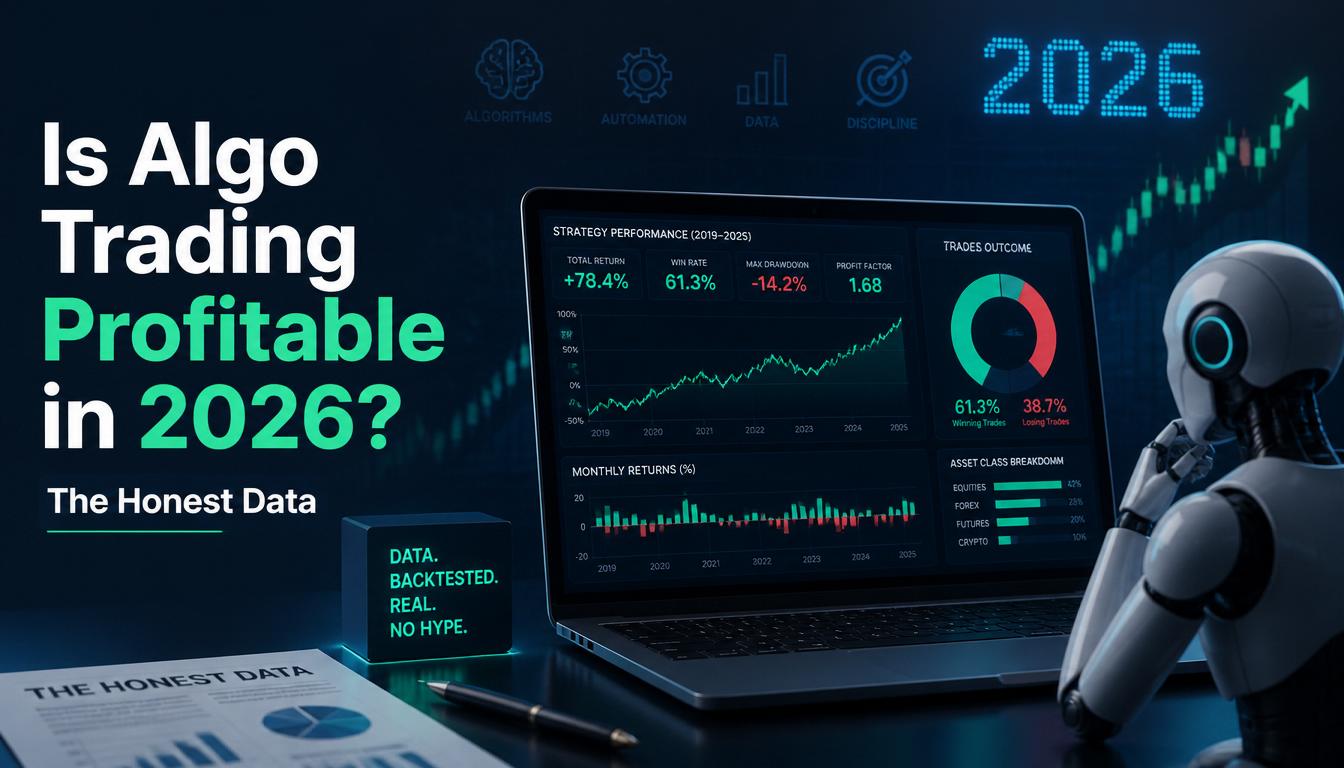
    A trading performance dashboard showing equity curve and metrics, used to answer is algo trading profitable

    Is algo trading profitable? The success-rate data

    Let’s start with the headline number. Around 60% of retail algorithmic traders post positive annual returns, according to data summarized by TradingView Hub. Stacked against the 5–10% success rate of manual day traders, that looks like a strong endorsement of automation.

    But there’s a catch hidden in the framing. That 60% describes people who reached the stage of deploying a tested system — a group that already self-selected for discipline and skill. For newcomers who jump in unprepared, the same body of research points to a brutal 90% first-year failure rate.

    So is algo trading profitable? For the prepared, the odds are genuinely good. For the impatient, they’re terrible. Both facts are true at once.

    What returns are actually realistic

    Forget the screenshots of 500% months. Grounded figures look like this:

    • Beginners: roughly 5–15% annually once they have a working, tested system.
    • Experienced traders with proven strategies: often 15–25% annually.
    • Retail traders using algorithmic strategies have seen average returns improve by about 23% versus discretionary trading, per the same research.

    These are good, compounding returns — not lottery wins. Anyone promising consistent double-digit monthly gains is selling something. Realistic profitability is a marathon of small edges, not a sprint to riches.

    The costs nobody advertises

    Profitability is revenue minus costs, and the costs are where beginners get ambushed.

    Running a serious algo operation carries an annual cost floor estimated between $1,200 and $6,000 — covering market data feeds, cloud servers, and software tools. On top of that sit trading costs: commissions, fees, and slippage that quietly erode every strategy’s edge.

    There’s also a time cost. Building genuine competency realistically takes 6 to 18 months of dedicated study. If your strategy only earns 10% a year on a small account, those fixed costs can swallow the entire profit. Scale matters, and undercapitalized traders often lose to costs alone.

    Why most strategies fail

    The single biggest profit-killer is overfitting — tuning a strategy until it looks perfect on historical data, then watching it collapse live.

    The evidence here is damning. Quantopian’s study of 888 algorithmic strategies found that backtest Sharpe ratios had near-zero predictive power for live returns, as discussed by QuantStart. Worse, the more a trader optimized to fit the past, the worse the live performance. Over-optimized strategies can lose up to 80% of their backtested profits when deployed.

    Add the 2-to-5-year strategy half-life — edges decay as markets adapt — and you see why “set and forget” is a myth. Profitable traders constantly research, retest, and replace fading strategies.

    Is algo trading profitable across different markets?

    Profitability also depends on where you trade. The same strategy logic behaves very differently across asset classes, and each market has its own profit drivers and traps.

    Crypto is the most volatile, which cuts both ways. High swings create more opportunity for short-term strategies like grid and momentum bots, but they also magnify losses and slippage. Fees vary widely between exchanges, and thin order books can wreck a backtest’s assumptions. Many beginners find their first profits here — and lose them just as fast.

    Stocks and ETFs are more stable and better regulated, with deeper data history for backtesting. After the 2026 removal of the $25,000 Pattern Day Trader minimum, automated equity strategies became viable on far smaller accounts. The trade-off is that liquid, heavily-traded names attract serious institutional competition.

    Forex offers high liquidity and the leverage that many automated systems are built around. That leverage is exactly why undercapitalized traders blow up — it amplifies both the edge and the mistakes. The mature MT4/MT5 ecosystem makes deployment easy, which is a double-edged convenience.

    So can it be profitable in any of them? It can be in all three, but the realistic returns and risks shift with each. Match the market to your capital, your tolerance for volatility, and the strategy you can actually test well.

    The traits of the profitable 10%

    If roughly 10% survive and profit, what do they share? The data points to a clear profile.

    People with backgrounds in engineering, statistics, computer science, or mathematics have a measurable head start. A 2024 QuantConnect survey found that 68% of their profitable users held STEM degrees. That doesn’t mean a non-STEM trader can’t win. It means the work rewards specific skills: statistical rigor, skepticism toward noise, and comfort with code. All three are learnable without a degree.

    Beyond credentials, the profitable share clear habits. They keep ruthless backtesting hygiene. They size positions conservatively. They research constantly. And they treat year one as tuition rather than payday.

    How to tilt the odds in your favor

    You can’t guarantee profit, but you can move yourself toward the winning 10%:

    1. Learn the statistics first. Understand overfitting, out-of-sample testing, and slippage before you trust any backtest.
    2. Start with a simple, robust strategy. Complexity hides overfitting.
    3. Test out-of-sample and include all costs. Assume live results will be worse than the screen.
    4. Size positions conservatively. Survival enables compounding; a blowup ends it.
    5. Keep researching. Expect to replace strategies as their edge decays.

    Do these, and “is algo trading profitable?” stops being a gamble and becomes a question of execution.

    FAQ

    Is algo trading actually profitable for retail traders? For a prepared minority, yes — about 60% of those who deploy tested systems are profitable. For unprepared beginners, the first-year failure rate is around 90%.

    How much can I realistically make? Beginners with a working system see roughly 5–15% annually; experienced traders often reach 15–25%. Monthly-doubling claims are red flags.

    Why do so many algo traders lose money? Mostly overfitting. Backtests look great, then fail live — over-optimized strategies can lose up to 80% of their paper profits in real markets.

    Do I need a STEM degree to profit? No, but it helps. 68% of profitable users in one survey had STEM backgrounds, because the work rewards statistical rigor and coding skill — both learnable without a degree.

    How long until algo trading becomes profitable? Plan for 6 to 18 months of study before consistent profits, and treat your first live year as a learning cost.

    Key takeaways

    • Is algo trading profitable? Yes — for the prepared minority, not the rushing majority.
    • ~60% of deployed retail algo traders profit, but the first-year failure rate is ~90%.
    • Realistic returns are 5–25% annually, not monthly miracles.
    • Costs ($1,200–$6,000/year) and overfitting are the biggest profit-killers.
    • The winning 10% share rigor, conservative sizing, and constant research.

    Want to join the profitable minority? Download our free Algo Trading Starter Kit: a backtesting-hygiene checklist, a Python strategy template, and our broker comparison. Get instant access → and join 12,000+ traders learning to automate with rigor, not hope.

  • How to Start Algo Trading in 2026: A Beginner’s Roadmap

    How to Start Algo Trading in 2026: A Beginner’s Roadmap

    Five years ago, building a trading bot meant wrestling with clunky APIs and a five-figure brokerage minimum. In 2026, you can wire up your first automated strategy on a free paper-trading account in an afternoon. The barrier to entry has collapsed. The barrier to making money, though, has not. This guide shows you how to start algo trading the right way — the tools, the realistic costs, your first strategy, and the mistakes that quietly drain most beginner accounts.

    By the end, you’ll have a concrete roadmap instead of a vague ambition.

    Table of Contents

    What algo trading actually is

    Algorithmic trading — “algo trading” for short — means handing your trading rules to software that runs them automatically. Instead of staring at charts and clicking buy, you define a precise rule. For example: “buy when the 50-day moving average crosses above the 200-day.” A program then executes it for you, around the clock, without hesitation or fear.

    This isn’t a fringe activity anymore. The global algorithmic trading market reached roughly $20 billion in 2026, according to Mordor Intelligence. Retail traders — people like you, not hedge funds — are now the fastest-growing segment, at around 38% of the market. Tools once locked behind institutional doors are a free API call away.

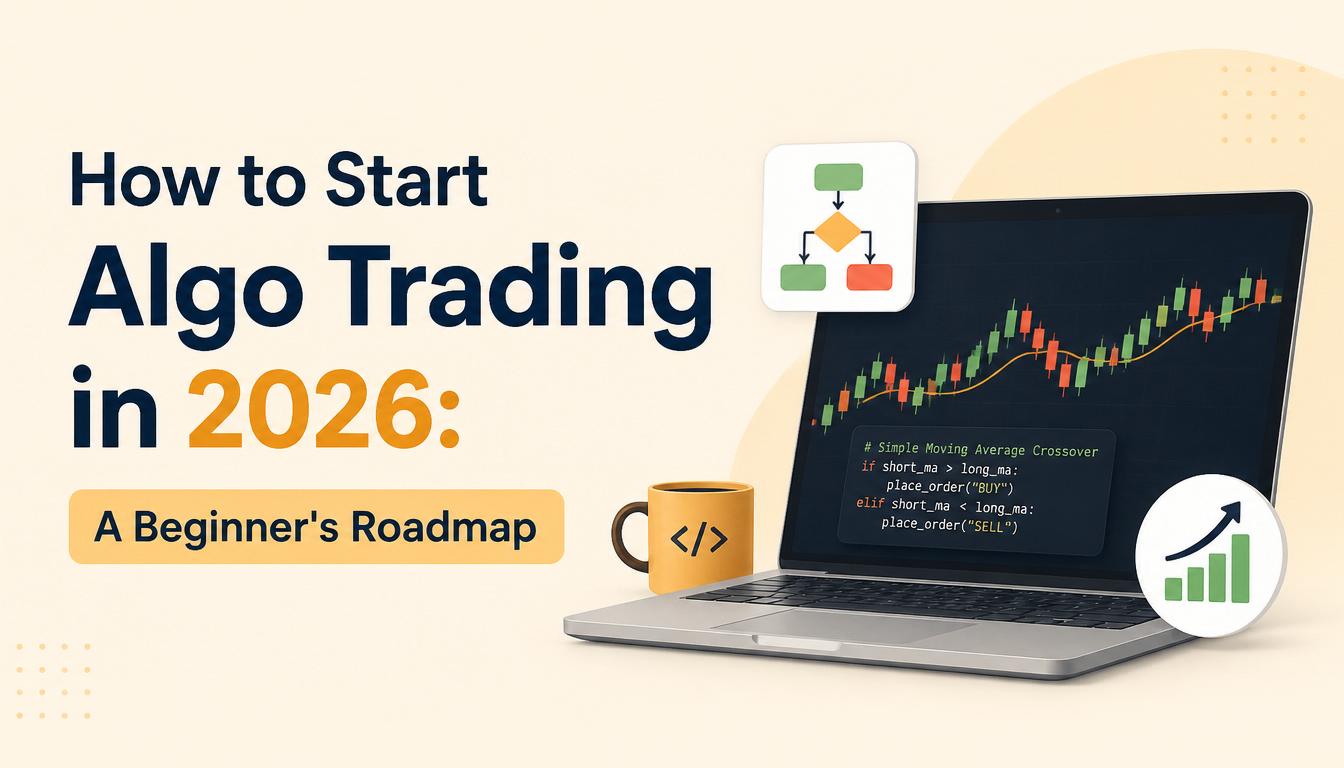
    A laptop showing a candlestick chart beside Python code, illustrating how to start algo trading at home

    Do you need to know how to code?

    Short answer: not to start, but it helps enormously.

    There are two paths. The first is no-code platforms like 3Commas, Pionex, or Cryptohopper. You configure pre-built bots through a dashboard. They’re a gentle on-ramp, and they’re fine for learning the mechanics. The second path is writing your own code, usually in Python. This is where serious, flexible algo trading lives.

    Why Python? Because the ecosystem is unmatched. Libraries like Pandas (data handling), NumPy (math), and backtrader or zipline (backtesting) do the heavy lifting. You write strategy logic, not plumbing. If you’ve never coded, you can learn enough Python to build a simple bot in a few weekends. That effort pays off, because no-code platforms always cap what you can express.

    The realistic cost to start algo trading

    Here’s the honest math, because hype merchants love to skip it.

    • Software and data: $0 to start. Paper-trading accounts, historical price data, and the core Python libraries are all free.
    • Brokerage minimum: $0 with Alpaca, which offers a developer-friendly API and commission-free stock trading. Interactive Brokers, the institutional favorite, has historically expected around $10,000 for full features.
    • Real trading capital: This is the real question, and it deserves its own answer. See our guide on how much money you need to start algo trading. The short version: begin with money you can afford to lose entirely.

    So you can learn and test for free. You only need capital when you’re ready to trade live — and you should not rush that day.

    Step 1: Pick your tools

    To start algo trading, you need three things: a broker with an API, a language, and a place to run your code.

    • A broker with an API and a paper account. Alpaca is the most beginner-friendly choice in 2026. Interactive Brokers is the power-user option. For crypto, exchanges like Binance and Bybit expose robust APIs.
    • A language and libraries. Python, plus Pandas and a backtesting library. We compare the options in best programming language for trading.
    • An environment. Use a Jupyter Notebook to experiment. Then move to a simple script you can run on a cheap cloud server once you go live.

    Resist the urge to buy an expensive course or a “guaranteed” bot before you’ve placed a single paper trade. The tools above cost nothing.

    Step 2: Build your first strategy

    Your first strategy should be almost embarrassingly simple. The goal isn’t profit. It’s learning the full loop, end to end.

    A classic starting point is the moving-average crossover. You buy when a short-term average crosses above a long-term average, and sell when it crosses back below. It’s not a money printer, and that’s the point. It’s simple enough that you can reason about every trade it makes.

    Write the rule in plain English first. Then translate it into code that does four things: fetch historical prices, compute the two averages, generate buy and sell signals, and record the results. Get that loop working, and you’ll understand more than most people who only talk about algo trading.

    Step 3: Backtest before you risk a cent

    Backtesting means running your strategy against historical data to see how it would have performed. It’s essential. It’s also where beginners fool themselves most badly.

    The trap is overfitting: tuning your strategy until it looks brilliant on past data. In reality, you’ve just memorized noise. The research here is sobering. Studies of large cohorts of backtested strategies find that in-sample metrics like the Sharpe ratio have almost no predictive power for live results — correlations often fall below 0.05, as documented in work on optimal trading rules. A backtest showing 2% monthly returns can flip to a loss once you subtract realistic slippage and fees.

    So treat a great backtest with suspicion, not celebration. Test on data your strategy has never seen. Include fees and slippage. Assume reality will be worse than your screen suggests.

    Step 4: Paper trade, then go live small

    Once your strategy survives backtesting, run it on a paper-trading account: live market data, fake money. This catches the problems a backtest can’t. Bad fills. API rate limits. Your code crashing at 3 a.m.

    Only after weeks of clean paper trading should you go live. Even then, start with an amount so small that losing it is a cheap lesson — many traders begin with a few hundred dollars and risk well under 1% of it per trade. Add logging and alerts so you know instantly when something breaks. Set a hard daily loss limit that shuts the bot off automatically. Protect your API keys like passwords, and never commit them to a public repository. The professionals who blow up usually do it on operational failures, not bad strategy ideas. Knight Capital is the cautionary tale: it lost $440 million in 45 minutes from a botched software deployment.

    Mistakes that kill beginner accounts

    Most beginners don’t fail because their strategy is bad. They fail because of avoidable errors:

    • They skip validation. Over 80% of retail traders lose money, often because they never properly test a strategy before trusting it with real cash.
    • They over-optimize. Chasing a perfect backtest produces a strategy that fits the past and breaks in the present.
    • They ignore costs. Slippage and fees turn paper winners into real losers.
    • They go big too soon. A large early loss ends most trading careers before they begin.
    • They chase someone else’s bot. A strategy you don’t understand is one you can’t fix when it breaks.

    Avoid these five, and you’re already ahead of the majority.

    FAQ

    Is algo trading profitable for beginners? It can be, but rarely quickly. Most beginners lose money in their first year while they learn. A realistic year-one goal is competence — and not blowing up your account. Profit comes after that.

    How much money do I need to start algo trading? You can learn and backtest for $0. To trade live, many brokers have no minimum. Even so, deploy only money you can afford to lose. See our dedicated guide for the full breakdown.

    Can I start algo trading without knowing how to code? Yes, through no-code platforms like 3Commas or Pionex. But learning basic Python dramatically expands what you can build, and it’s worth the effort.

    Is algo trading legal? Yes. For retail traders on regulated brokers, it’s completely legal. You’re simply automating orders you could place by hand.

    How long before I’m making money? Plan for 6 to 12 months of learning before consistent results. Treat anyone promising faster with deep skepticism.

    Key takeaways

    • You can start algo trading for free. Paper accounts, market data, and Python libraries cost nothing.
    • Code is optional to begin, essential to grow. Python is the language to learn.
    • Your first strategy should be simple. Master the full loop before chasing complexity.
    • Backtesting lies if you let it. Guard against overfitting, and always include costs.
    • Go live small. Operational discipline matters more than a clever strategy.

    Ready to build your first bot? Grab our free Algo Trading Starter Kit: a step-by-step PDF checklist, a Python moving-average bot template, and our beginner broker comparison. Get instant access → and join 12,000+ traders learning to automate the smart way.