Category: Quantitative trading

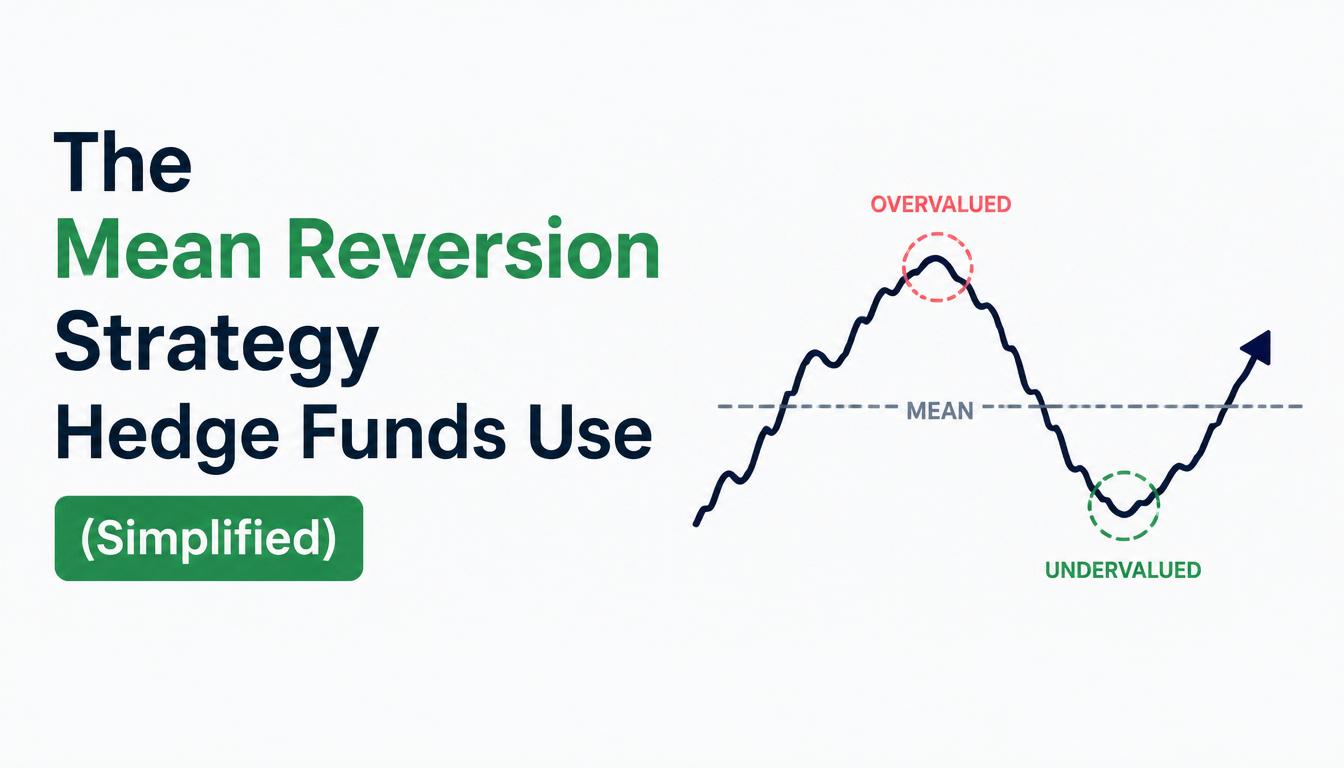
  • The Mean Reversion Strategy Hedge Funds Use (Simplified)

    The Mean Reversion Strategy Hedge Funds Use (Simplified)

    Some of the most sophisticated quant funds on earth make money from a deceptively simple idea: prices that stray too far from their average tend to snap back. That’s the mean reversion strategy. Stripped of the PhD-level math, it’s something a retail trader can understand in an afternoon and automate in a weekend. You’re not predicting the future. You’re betting that markets overreact, then correct.

    This guide simplifies what hedge funds do into rules you can actually use. You’ll get the core logic, the exact entry and exit signals, and a worked example. Then an honest look at where the strategy works — and where it quietly breaks.

    What this guide covers

    The core idea: buy fear, sell greed

    Mean reversion rests on a single financial theory: asset prices don’t trend endlessly in one direction. They tend to return — to “revert” — to a historical average over time. When a price spikes far above its norm, the strategy expects it to fall back. When it crashes far below, it expects a bounce.

    In plain terms, you buy weakness and sell strength. It’s the opposite of momentum, which buys strength and sells weakness. Where momentum assumes a move will continue, the mean reversion strategy assumes an extreme move has overshot and will correct. Both can be true — just in different market conditions.

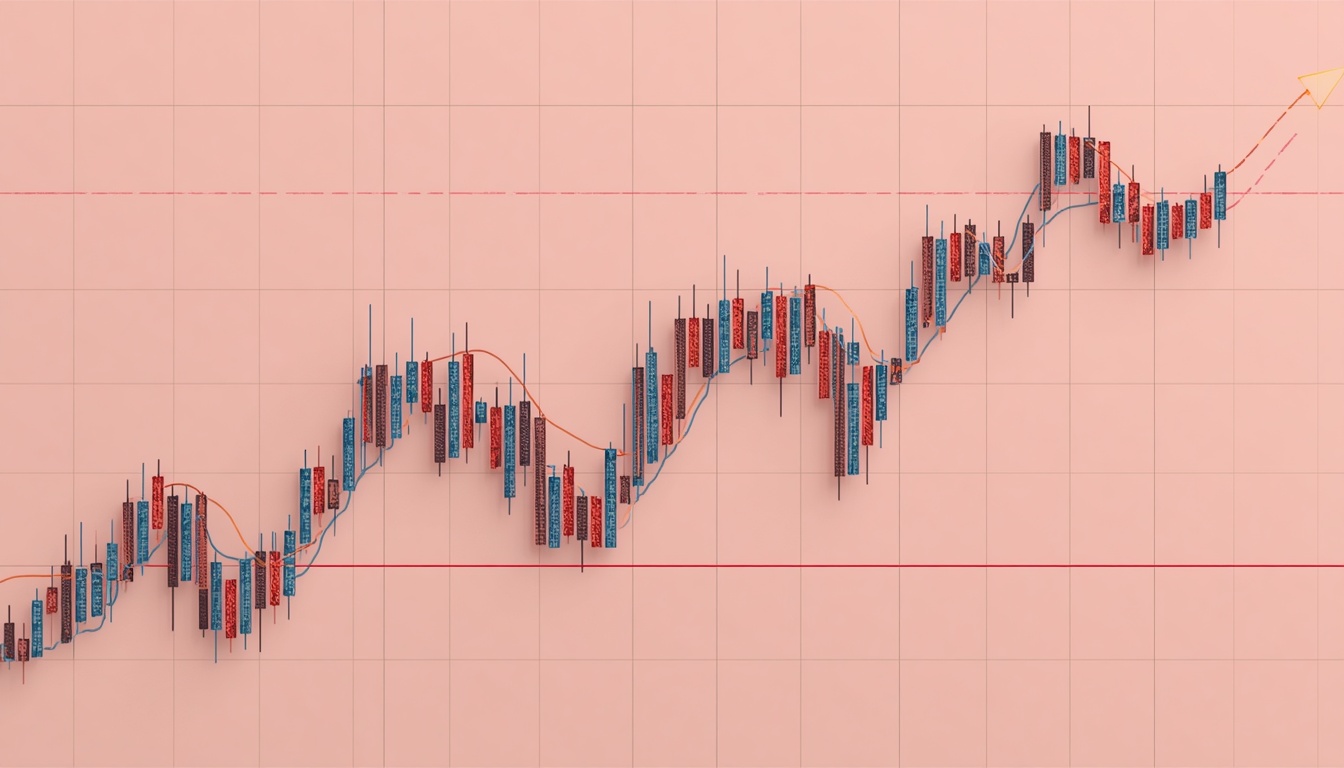
    A price chart with Bollinger Bands showing price reverting to its moving average, illustrating the mean reversion strategy

    How the mean reversion strategy works

    The strategy needs two things: a definition of “the average,” and a measure of how far price has strayed from it. Traders typically use one of three tools:

    • Bollinger Bands — bands set a couple of standard deviations above and below a moving average. Price touching the lower band signals “too cheap.”
    • RSI (Relative Strength Index) — a momentum oscillator; readings below 30 flag oversold, above 70 flag overbought.
    • Statistical z-scores — a precise measure of how many standard deviations price sits from its mean.

    When the measure hits an extreme, the strategy takes the contrarian side and waits for the snap back toward the average. That’s the whole engine.

    A worked example with real rules

    Let’s turn the theory into a concrete, testable system on a stock.

    • Entry signal: buy when the price closes below the lower Bollinger Band, or when RSI drops below 30 (oversold).
    • Exit signal: sell when the price reverts to its moving average, or when RSI climbs back above 50.

    Imagine a quality stock that drops sharply on a market-wide scare, pushing RSI down to 25 and price below the lower band. The bot buys. Over the next week, panic fades and buyers return. Price drifts back to its 20-day average, RSI recovers past 50, and the bot sells into the rebound. You captured the overreaction’s correction without predicting a single headline.

    As QuantifiedStrategies notes, these simple band- and RSI-based rules are exactly the kind that backtest well on equities.

    How hedge funds actually use it

    The retail version above is one trade on one stock. Hedge funds run the same logic at vastly larger scale — and that scale is the difference.

    Mean reversion is a core component of statistical arbitrage. Quant funds run factor analysis, regression, and machine-learning models to spot tiny pricing inefficiencies across dozens or hundreds of assets at once. They take many small mean-reverting bets simultaneously, diversifying away single-name risk. There’s even a structural tailwind. Large funds operate under mandates that force them to rebalance, often against the prevailing trend — a steady source of the reversion that nimble traders can anticipate.

    You won’t replicate a fund’s infrastructure. But the underlying bet — extremes correct — is identical, and on a single liquid stock it’s well within reach.

    Where the mean reversion strategy works best

    Matching the strategy to the right market is everything.

    • Stocks and ETFs — the natural home. Equities mean-revert reliably, especially large, liquid names after market-wide overreactions.
    • Range-bound conditions — when price oscillates around a stable average rather than trending, reversion signals are cleanest.
    • High-liquidity assets — tight spreads make the small, frequent edges worth capturing.

    This is why the strategy is a staple of equity stat-arb desks and a sensible first contrarian system for retail stock traders.

    Where it breaks down

    Now the honesty. The mean reversion strategy has one catastrophic failure mode: a strong, sustained trend.

    Say a price keeps falling for a real reason — a collapsing company, a regime shift. “Buying the dip” then means catching a falling knife, again and again, as your “cheap” entry gets cheaper. The strategy assumes the move was an overreaction. When it’s actually a justified repricing, reversion never comes. This is also why it works poorly on forex, which tends to trend more than it reverts. The fix is non-negotiable: a stop-loss to cap the trade when reversion fails, plus regime awareness to stand down in strong trends.

    Mean reversion vs momentum

    The clearest way to understand mean reversion is against its opposite. A mean reversion strategy buys weakness and sells strength, betting an extreme move reverses. A momentum strategy does the reverse — it buys strength and sells weakness, betting the move continues.

    That single difference dictates where each one wins. Mean reversion thrives in range-bound, choppy markets, where price keeps oscillating around a stable average. Momentum thrives in strong, persistent trends, the exact conditions that destroy a reversion bot. Run the wrong one in the wrong regime and you’ll lose steadily.

    This is why serious traders rarely pick just one. As our roundup of algo trading strategies that work explains, the most robust modern systems detect the market regime and switch behavior accordingly — leaning on reversion when the market ranges and stepping aside when it trends. Knowing both strategies turns a one-trick bot into an adaptable one.

    Risk management for the mean reversion strategy

    Because the mean reversion strategy deliberately buys falling assets, risk control isn’t optional — it’s the whole game. A few rules keep a contrarian bet from becoming a catastrophe.

    • Always use a stop-loss. Place it beyond the point where “overreaction” stops being a credible explanation. If price blows past it, the move was real, and you want out.
    • Size positions small. You may add to a losing position as it falls; that only works if each entry is modest enough to survive being wrong.
    • Add a regime filter. Check a long-term trend indicator first. If the asset is in a strong downtrend, stand aside — reversion signals are traps there.
    • Cap total exposure. Several “cheap” assets can all keep falling together in a market-wide rout. Limit how much capital the strategy can deploy at once.

    Get these right and a failed trade is a small, planned loss. Get them wrong and a single falling knife can undo months of patient gains.

    Mean reversion indicators compared

    The three tools that flag an overextended price aren’t interchangeable. Each has a personality worth knowing before you build.

    Bollinger Bands wrap a moving average in two bands set a couple of standard deviations away. Price tagging the lower band means it’s stretched unusually far below its recent norm. The bands adapt to volatility on their own — widening in wild markets and tightening in calm ones — which makes them intuitive and self-adjusting. The downside is that in a strong trend, price can “walk the band” for a long time, firing signal after signal that never reverts.

    RSI measures the speed and size of recent moves on a 0–100 scale. Readings below 30 flag oversold, above 70 overbought. It’s simple and widely understood. But it’s a blunt instrument: a stock can stay oversold for weeks in a genuine decline, so RSI alone catches plenty of falling knives.

    Z-scores are the quant’s choice. A z-score states exactly how many standard deviations price sits from its mean. That gives a precise, comparable measure across different assets, which is why statistical-arbitrage desks favor it. The catch is that it assumes well-behaved data, and real markets often aren’t.

    In practice, many traders combine two. They use a z-score or Bollinger Band to define “how stretched,” then RSI to confirm momentum is actually fading. No single indicator is a silver bullet. The mean reversion strategy works best when the signal is corroborated and paired with the stop-loss discipline covered above.

    Building a simple mean reversion bot

    You can automate a basic version with Python in a weekend:

    1. Pick a liquid stock or ETF with a history of ranging behavior.
    2. Compute a 20-day moving average and Bollinger Bands (or RSI) with pandas.
    3. Code the entry/exit rules from the example above.
    4. Add a stop-loss outside the band to survive failed reversions.
    5. Backtest with fees and slippage, then paper trade before going live.

    Resist over-tuning the band widths and RSI thresholds to a single backtest — that’s overfitting, and it’s how a clean idea turns fragile. None of this demands advanced math; it just rewards clean data and disciplined, consistent rules.

    FAQ

    Is the mean reversion strategy profitable? It can be, particularly on liquid stocks in range-bound conditions. Profitability depends on disciplined exits and avoiding strong trends, where the strategy fails.

    What indicators does mean reversion use? Most commonly Bollinger Bands, RSI (oversold below 30, overbought above 70), and statistical z-scores to measure how far price has strayed from its average.

    Why do hedge funds use mean reversion? It’s central to statistical arbitrage. Funds take many small reverting bets across many assets, diversifying risk, and benefit from forced rebalancing that often pushes against the trend.

    What markets does mean reversion work in? Best in stocks and ETFs, especially range-bound ones. It works poorly in trending markets like forex, which revert less and trend more.

    What’s the biggest risk? Catching a falling knife — buying a “cheap” asset that keeps falling because the move was justified, not an overreaction. A stop-loss is essential.

    Mean reversion vs momentum — which is better? Neither universally. Mean reversion wins in range-bound markets; momentum wins in trending ones. The strongest setups detect the market regime and switch between them rather than committing to one.

    How long should I hold a mean reversion trade? Until price reverts to its average or your exit signal fires — RSI back above 50, for instance — or until your stop-loss is hit. These trades are typically short, lasting days to a couple of weeks, not months.

    Can I use mean reversion on crypto? Yes, but carefully. Large-cap coins do revert after sharp overreactions, yet crypto also produces violent, sustained trends that punish contrarian bets. Use a tighter stop and a regime filter, stick to liquid coins, and keep size small while you learn how it behaves.

    Key takeaways

    • The mean reversion strategy buys fear and sells greed, betting extreme moves snap back to an average.
    • It uses Bollinger Bands, RSI, or z-scores to flag overextended prices, with clear entry and exit rules.
    • Hedge funds run it at scale as the core of statistical-arbitrage strategies.
    • It works best on liquid, range-bound stocks and poorly in strong trends or forex.
    • A stop-loss is mandatory — its fatal flaw is catching a falling knife when reversion never comes.

    Want to build this bot the right way? Our free Algo Trading Starter Kit includes a Python mean-reversion template with Bollinger Bands and RSI, a backtesting checklist, and our broker comparison. Download it free → and trade the snapback with rules, not guesses.
  • 5 Algo Trading Strategies That Actually Work in 2026

    5 Algo Trading Strategies That Actually Work in 2026

    Search “algo trading strategies” and you’ll find a thousand exotic-sounding systems promising the moon. Strip away the hype and the field narrows fast. A handful of approaches have survived decades of real markets because they exploit durable behavior — not curve-fit noise. This guide ranks the five algo trading strategies that genuinely work in 2026. For each, you’ll learn how it makes money and who it suits.

    These aren’t secret formulas. They’re the proven workhorses that professionals and serious retail traders actually deploy — and that you can learn, test, and automate yourself.

    A comparison dashboard of five algo trading strategies: momentum, mean reversion, grid, arbitrage, and breakout

    What you’ll learn

    How we picked these strategies

    Three filters: each strategy must have a clear, logical edge (a reason it works beyond a pretty backtest), a track record across market regimes, and be realistically automatable by an individual trader. That rules out the black-box “AI” systems that can’t explain why they trade — and keeps the workhorses that have earned their place.

    At a glance: the five strategies

    StrategyProfits fromBest marketDifficulty
    Momentum / trendPersistent trendsTrendingBeginner
    Mean reversionOverreactions snapping backRange-boundIntermediate
    Grid tradingSideways volatilityChoppyBeginner
    ArbitragePrice gaps between marketsAny (fleeting)Advanced
    BreakoutNew trends startingVolatileIntermediate

    #1 Momentum / trend following

    The most battle-tested of all algo trading strategies. Momentum buys what’s rising and sells what’s falling, betting that trends persist long enough to ride.

    It works because trends often form after institutional accumulation or macro catalysts. As Snap Innovations notes, that behavior shows up consistently across equities, crypto, and forex. Trend-following systems typically win only 35–45% of trades. But their winners dwarf their losers, producing positive expectancy over time. Our deep dive on how a simple momentum bot beats buy-and-hold shows the rules in action.

    Best for: Beginners. The rules are simple, automatable, and forgiving of imperfect timing.

    #2 Mean reversion

    The mirror image of momentum. Mean reversion bets that after an extreme move, price snaps back toward its average — you buy fear and sell greed.

    Implementations use Bollinger Bands, RSI extremes, or statistical z-scores to flag overextended conditions. It’s a cornerstone of the statistical-arbitrage strategies hedge funds run, as our guide to the mean reversion strategy hedge funds use explains. The catch: it works best on stocks and struggles in strongly trending assets like forex.

    Best for: Intermediate traders comfortable with indicators and range-bound markets.

    #3 Grid trading

    A strategy that profits from movement without predicting direction. Grid trading places laddered buy and sell orders across a range, banking small gains on each oscillation.

    It thrives in choppy, range-bound markets — exactly the conditions that frustrate trend followers — and it’s a favorite for crypto automation. Its weakness is a strong breakout, which leaves the grid accumulating losses on one side. See our full grid trading strategy guide for the mechanics and a worked example.

    Best for: Beginners who want a hands-off bot in sideways markets — with a stop-loss.

    #4 Arbitrage

    The closest thing to a “free lunch,” and the hardest to capture. Arbitrage exploits price differences for the same asset across markets or related instruments.

    Pure arbitrage opportunities are rare and fleeting in 2026. Capturing them increasingly demands colocation servers, cross-exchange APIs, and predictive latency models. That makes it a professional’s game more than a beginner’s. Still, simpler cross-exchange spreads in crypto remain accessible to technically capable retail traders. A coin priced slightly higher on one exchange than another lets you buy low and sell high almost instantly — until fees and transfer times eat the gap. The edge is real but thin, and competition closes it fast.

    Best for: Advanced traders with strong infrastructure and low-latency setups.

    #5 Breakout trading

    Breakout strategies aim to catch a new trend at its birth — entering when price decisively breaks a key level on rising volume.

    The appeal is getting in early on a big move. The cost is false breakouts that reverse and stop you out. Modern systems increasingly add machine learning to filter genuine breakouts from noise and to adjust stop-losses dynamically. Volume is the usual confirmation: a breakout on heavy volume is more likely to hold than one on a quiet day. It pairs naturally with momentum — breakout gets you in, momentum keeps you in.

    Best for: Intermediate traders who can tolerate a lower win rate for occasional large gains.

    The hybrid reality of modern algo trading strategies

    Here’s what the “which strategy is best” debate misses: the most consistent performers in 2026 aren’t pure systems at all. They’re hybrids.

    The emerging best practice pairs a transparent, well-understood core — usually momentum or mean reversion — with an adaptive layer. That layer detects the market regime and adjusts parameters accordingly, an approach ThinkMarkets highlights for 2026. A mean-reversion bot that knows to stand down when a strong trend forms avoids that strategy’s worst weakness. The lesson: don’t marry one strategy. Understand several, and let conditions dictate which is active.

    How to choose your first algo trading strategy

    Don’t start with the hardest. Match the strategy to your level and the market you’ll trade:

    • Total beginner? Start with momentum — simple rules, forgiving, automatable.
    • Trading a sideways market? A grid or mean-reversion approach fits the conditions.
    • Strong coder with infrastructure? Arbitrage rewards your edge.
    • Want early entries into big moves? Breakout, ideally paired with momentum.

    Whichever you pick, the workflow is the same: understand the logic, backtest honestly with fees and slippage, paper trade, then start small. The strategy matters less than the discipline you bring to testing it. Skip that discipline, and even the best strategy on this list will quietly lose money.

    Algo trading strategies to avoid

    Knowing what doesn’t work is half the battle. A few categories drain more accounts than they fill.

    The black-box “AI” bot. If a system can’t tell you why it trades, you can’t fix it when it breaks — and it will break. Opaque neural-net bots sold with screenshots of perfect returns are the classic trap.

    The over-optimized backtest. Any strategy tuned until its historical curve looks flawless has usually memorized noise. A backtest Sharpe ratio above 3.0 is a red flag, not a trophy; such systems almost always collapse live.

    The “guaranteed signals” subscription. Paid signal groups promising fixed monthly returns sell certainty that markets never provide. If the edge were real, they’d trade it, not sell it.

    The martingale doubler. Some strategies double position size after every loss. They show smooth equity curves right up until the single losing streak that wipes the account. Avoid anything whose risk grows as it loses.

    The common thread: every reliable strategy has a transparent, explainable edge. If you can’t articulate why it makes money, it probably doesn’t.

    How to backtest any strategy

    Whichever of these algo trading strategies you choose, the test process decides whether it survives contact with real markets:

    1. Get clean data covering several years and at least one bear market, so you see how the strategy behaves under stress.
    2. Code the rules exactly — no peeking at future data, the bias that silently inflates most amateur backtests.
    3. Include all costs: commissions, spreads, and slippage. A strategy that’s profitable before costs and a loser after is common.
    4. Test out-of-sample. Reserve recent data the strategy never “saw” during development, and confirm the edge holds there.
    5. Paper trade the survivor for weeks before risking a cent.

    A strategy that clears every step still isn’t guaranteed to profit — but one that skips them is almost guaranteed to fail.

    Do you need to code these strategies?

    Not always — and the answer shapes which strategy to start with.

    Grid trading is the most no-code-friendly. Platforms like Pionex and 3Commas offer built-in grid bots you configure through a dashboard, with no programming required. Momentum and mean reversion sit in the middle. No-code platforms can run simple versions, but writing your own in Python unlocks far more control over the rules. Arbitrage is the exception. Capturing it reliably almost always demands custom code and low-latency infrastructure, which is part of why it’s an advanced strategy.

    If you can’t code yet, that’s fine. Start with a grid or a pre-built momentum bot. Learn how the mechanics feel with real, small money first, and add Python later. When you’re ready to build your own, our guide to the best programming language for trading walks through why Python is the obvious first choice.

    The key point is simple. A lack of coding skill is not a reason to avoid algo trading strategies altogether. It’s only a reason to pick the ones with mature no-code tools while you learn.

    FAQ

    What is the most profitable algo trading strategy? There’s no single winner — profitability depends on market conditions. Momentum and trend following have the most durable, cross-market track record. That’s why they top most lists of algo trading strategies.

    Which algo trading strategy is best for beginners? Momentum, for its simple, automatable rules. Grid trading is a close second for hands-off sideways markets.

    Do these strategies work in crypto? Yes. Momentum, grid, and arbitrage are especially popular in crypto, though its higher volatility raises both the opportunity and the risk.

    Can I combine multiple strategies? Yes — and the best modern systems do. Hybrids that switch behavior based on market regime are the 2026 standard among serious traders.

    How do I know a strategy actually works? Look for a logical edge plus robust out-of-sample backtests including costs. A great backtest with no explainable edge is usually overfitting.

    How many strategies should a beginner run at once? Just one. Master a single strategy end to end — logic, backtest, paper trade, then live — before adding another. Running several untested systems at once multiplies the ways you can lose without teaching you which one actually works.

    Are these algo trading strategies legal? Yes. For retail traders on regulated brokers and exchanges, all five are completely legal. You’re automating orders you could place by hand. High-frequency and arbitrage tactics face more scrutiny at the institutional level, but the retail versions are standard practice.

    Do I need a lot of money to trade these strategies? No. You can backtest and paper-trade all of them for free, and most work on small live accounts. Arbitrage and some high-frequency variants are the exception — they need more capital and infrastructure to be worthwhile.

    Can these strategies make me rich quickly? No. Even the proven ones target steady, compounding edges, not overnight riches. Realistic returns are measured per year, not per week. Treat anyone promising fast riches from a strategy as a warning sign.

    Key takeaways

    • The proven algo trading strategies are momentum, mean reversion, grid, arbitrage, and breakout.
    • Momentum/trend following is the most beginner-friendly and has the strongest cross-market record.
    • Mean reversion and grid suit range-bound markets; arbitrage and breakout are more advanced.
    • The 2026 edge is hybridization — a transparent core plus regime-aware adaptation.
    • Logic + honest backtesting beats complexity. A strategy you can’t explain is one you can’t trust.

    Ready to test a strategy for real? Our free Algo Trading Starter Kit includes Python templates for momentum and mean-reversion bots, a backtesting checklist, and our broker comparison. Grab it free → and stop collecting strategies — start testing one.

  • How a Simple Momentum Bot Beats Buy-and-Hold in 2026

    How a Simple Momentum Bot Beats Buy-and-Hold in 2026

    Buy-and-hold is the strategy everyone defends and few actually survive. It works beautifully on a chart — until a 40% drawdown arrives and you sell at the bottom like everyone else. A simple momentum bot offers a different deal: similar long-run returns, but with a fraction of the gut-wrenching pain. That trade is the real reason momentum has endured for decades, and it’s why a modest bot can quietly outperform the “just hold” crowd where it counts.

    Notice the careful wording. A momentum bot doesn’t always print more raw profit than buy-and-hold. What it does is win on risk — and once you understand that distinction, the appeal becomes obvious.

    What this guide covers

    The core idea: ride strength, cut weakness

    Momentum trading rests on one stubborn market observation: things that have been going up tend to keep going up for a while, and things falling tend to keep falling. You buy strength and you sell weakness, riding a move until it fades.

    Buy-and-hold ignores this entirely. It owns the asset through every storm, accepting the full drawdown in exchange for never missing the recovery. A momentum bot instead steps aside when the trend turns down, sitting in cash through the worst declines and stepping back in when strength returns. Same asset, very different ride.

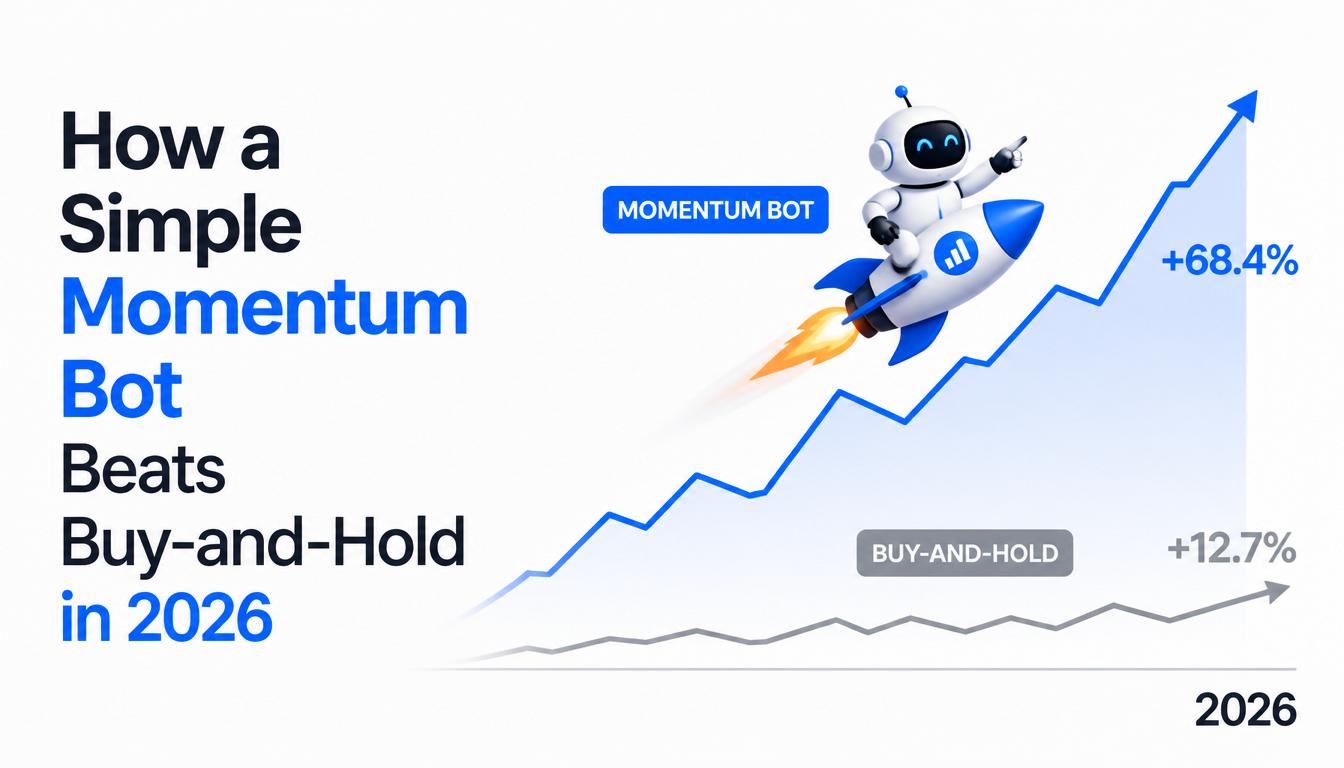
    A chart comparing a momentum bot equity curve against buy-and-hold, with shallower drawdowns

    How a simple momentum bot works

    The beauty of a momentum bot is that the rules fit on an index card. A classic version uses a single moving average:

    1. Entry: when the price closes above its 200-day moving average, buy.
    2. Exit: when the price closes below the 200-day moving average, sell and hold cash.
    3. Repeat: let the rule decide, every day, with no opinions.

    That’s it. When the asset is in an uptrend, the bot is invested. When it breaks down, the bot is out. There’s no forecasting, no news-reading, no emotion — exactly the qualities that make momentum a natural fit for automation. As QuantifiedStrategies documents, even these bare-bones rules produce a coherent, testable strategy.

    What the backtests actually show

    Here’s where honesty matters, because the marketing usually skips it.

    In realistic backtests, a simple momentum strategy often keeps almost even with buy-and-hold on raw return. One representative test showed momentum producing a 7.2% CAGR versus buy-and-hold’s 7.9% — slightly behind on the headline number. If you only look at total return, buy-and-hold edges it out.

    But that momentum strategy achieved its result while spending only about 65% of the time in the market. For a third of the period, it sat safely in cash, exposed to nothing. That single fact reframes the whole comparison — and it’s the key to why a momentum bot can still be the smarter choice.

    Why the real edge is risk, not return

    Returns tell you what you earned. Risk tells you whether you could stomach the journey to earn it. This is where momentum wins decisively.

    Because the bot exits during downtrends, it sidesteps the deepest crashes. That produces lower maximum drawdowns and higher risk-adjusted returns than buy-and-hold, even when the raw CAGR is a touch lower. A strategy that returns slightly less but never puts you through a 50% loss is, for most real humans, the better strategy — because you’ll actually stick with it.

    Buy-and-hold’s hidden failure isn’t its math. It’s that few investors hold through the pain. A momentum bot enforces the discipline that humans lack, capping the drawdown that makes people capitulate at the worst possible moment. That behavioral edge is worth more than a fraction of a percent in CAGR.

    Where a momentum bot shines and stalls

    Momentum is not magic, and matching it to the right conditions matters.

    It shines when:

    • Markets trend persistently, up or down, giving the bot clean signals to follow.
    • You care about drawdown control as much as raw return.
    • You want a hands-off, rules-based system you can actually trust through a crash.

    It stalls when:

    • Markets chop sideways, whipsawing the bot in and out for small losses (a “death by a thousand cuts” that a grid strategy would actually enjoy).
    • Trends reverse sharply, since a lagging moving average always exits a step late.

    No single strategy wins everywhere. Momentum trades a little choppy-market friction for major crash protection — usually a deal worth taking.

    Tuning the lookback period

    The single biggest dial on a momentum bot is the lookback period — how far back the moving average reaches. It quietly decides the bot’s entire personality.

    short lookback (say a 50-day average) reacts fast. The bot catches new trends early and exits declines quickly, but it pays for that speed with frequent whipsaws in choppy markets — lots of small in-and-out losses. A long lookback (200 days or more) reacts slowly. It ignores short-term noise and stays in major trends longer, but it gives back more profit at every turn because it always exits late.

    There is no universally “correct” number. The 200-day average is popular precisely because it’s slow enough to filter noise while still dodging the worst crashes. The honest danger here is optimization: testing dozens of lookbacks and picking whichever scored best on past data. That’s curve-fitting, and it rarely survives live. Pick a sensible, round number for a defensible reason, and resist the urge to tune it to perfection.

    Momentum bot vs mean reversion

    It helps to understand momentum by its opposite. A momentum bot assumes a move will continue — it buys strength. A mean reversion strategy assumes an extreme move will reverse — it buys weakness. They are mirror images, and they win in opposite conditions.

    Momentum thrives in trending markets and suffers in choppy ones. Mean reversion thrives in range-bound, choppy markets and gets destroyed by strong trends. Neither is “better.” They’re tools for different weather. This is exactly why the most robust setups, covered in our roundup of algo trading strategies that work, often combine a momentum core with regime awareness — running trend-following logic when the market trends and standing aside, or switching to reversion, when it doesn’t. A momentum bot is the natural first strategy to master, but knowing its mirror image makes you a far sharper builder.

    Momentum through a crash: a worked illustration

    Theory is easy to dismiss, so picture how the strategy behaves in a real downturn. Take a broad equity index entering a bear market that ultimately falls 35% from its peak.

    A buy-and-hold investor rides the entire decline. On paper they simply hold. In practice, many capitulate near the bottom, locking in the loss and missing the recovery. Their drawdown is the full 35%, and the emotional toll is worse than the number suggests.

    The trend-following bot behaves differently. As the index breaks below its 200-day moving average early in the decline, the bot sells and moves to cash. It then sits out the bulk of the crash, untouched. When the index eventually reclaims its moving average during the recovery, the bot buys back and rejoins the uptrend.

    The result is telling. The bot’s worst drawdown might be 12–15% instead of 35%, because it exited before the deepest part of the fall. It gives up some of the sharp initial rebound, since moving averages always re-enter late. So over the full cycle, its total return may land close to buy-and-hold’s. But the path is far smoother.

    That smoother path is the entire point. A trader who never sees their account cut by a third is far more likely to stay invested and follow the system. The strategy’s value shows up precisely in the years buy-and-hold investors would rather forget. In a relentless bull market with no real correction, the same bot will lag — there’s no crash to dodge, and its time in cash only costs it upside. Judge it across a full cycle, crashes included, not in a single calm stretch.

    Building your first momentum bot

    You can build a basic momentum bot in an afternoon with Python and a free data source:

    1. Pull historical prices for one liquid asset — an index ETF is ideal.
    2. Compute the 200-day moving average with a library like pandas.
    3. Generate signals: invested when price is above the average, cash when below.
    4. Backtest honestly, including fees and slippage, and compare both the CAGR and the maximum drawdown against buy-and-hold.
    5. Paper trade before risking real money.

    Keep it simple at first. The temptation to add filters and indicators is exactly how beginners overfit a clean idea into a fragile one.

    The honest caveats

    A momentum bot is a tool, not a money machine, and the same traps apply.

    Over-optimization is the big one. Academic research shows that strategies with backtest Sharpe ratios above 3.0 almost always underperform in live trading — a sky-high backtest is a warning, not a trophy. Live execution adds its own friction: slippage, fees, and the occasional need to monitor and adjust. And in a long, uninterrupted bull market, plain buy-and-hold will simply beat a momentum bot that keeps stepping out. The bot earns its keep across full cycles, including the bad years, not in any single green stretch.

    FAQ

    Does a momentum bot really beat buy-and-hold? On raw return, often only narrowly — sometimes buy-and-hold wins. On risk-adjusted return and drawdown, a momentum bot frequently wins clearly, because it sidesteps the worst declines.

    What’s the simplest momentum bot rule? Buy when price closes above its 200-day moving average; sell to cash when it closes below. One rule, fully automatable.

    Why does momentum spend time in cash? It exits during downtrends to avoid losses. That’s the source of its lower drawdown — and why it sometimes trails buy-and-hold’s total return in roaring bull markets.

    Does a momentum bot work on crypto? Yes, and crypto’s strong trends can suit it well, but higher volatility means more whipsaws in choppy phases. Test before trusting it.

    Is momentum trading hard to automate? No. Its rules-based, unemotional nature makes momentum one of the most beginner-friendly strategies to code.

    Momentum bot vs buy-and-hold — which should a beginner use? If you’d panic-sell in a crash, a momentum bot’s drawdown protection makes it the safer choice, even when raw returns are similar. If you can genuinely hold through a 35% decline without flinching, low-cost buy-and-hold is simpler. Be honest about your temperament — most people overestimate their tolerance for pain.

    Key takeaways

    • A momentum bot rides strength and exits weakness using a simple rule like a 200-day moving average.
    • On raw return it roughly matches buy-and-hold — sometimes a touch lower (7.2% vs 7.9% CAGR in one test).
    • Its real edge is risk: lower drawdowns and higher risk-adjusted returns, while spending less time exposed.
    • The biggest practical win is behavioral — the bot holds the discipline humans lose in a crash.
    • It struggles in choppy markets and long bull runs; test across full cycles, not one good year.

    Want to build this bot yourself? Our free Algo Trading Starter Kit includes a ready-to-run Python momentum-bot template, a backtest worksheet that compares drawdowns, and our broker comparison. Download it free → and trade the trend with discipline instead of hope.

  • The Grid Trading Strategy That Works in Any Market

    The Grid Trading Strategy That Works in Any Market

    Imagine a strategy that doesn’t care whether the market goes up or down — one that quietly profits from the simple fact that prices wiggle. No predictions. No staring at charts trying to call the next move. Just a ladder of orders that buys low and sells high, over and over, while you do something else. That’s the promise of the grid trading strategy, and it’s why it has become one of the most popular automated approaches for crypto and forex traders in 2026.

    The promise is real — but so are the caveats. This walkthrough shows you exactly how the grid works, a worked example with real numbers, and the honest truth about the markets where it prints versus the ones where it bleeds.

    What this guide covers

    The core idea in one paragraph

    Grid trading places a series of buy and sell orders at fixed price intervals above and below a starting price. Together they form a grid. As the price oscillates, it triggers buys on the way down and sells on the way up. Each swing locks in a small profit. The magic is that you never have to predict direction — you only need the price to move. Volatility, usually the trader’s enemy, becomes the fuel.

    A price chart overlaid with evenly spaced buy and sell order lines, illustrating the grid trading strategy

    How the grid trading strategy works

    Picture a price hovering around $100. You define a range — say $90 to $110 — and slice it into evenly spaced levels every $2. At each level you place an order: buys below the current price, sells above it.

    When the price drops to $98, your buy order fills. When it climbs back to $100, the matching sell order fires, and you pocket the $2 spread. The price falls again, you buy again, it rises, you sell again. Each completed round trip banks a small, mechanical profit. The grid trading strategy turns a choppy, sideways market — the kind that frustrates trend traders — into a steady series of payouts.

    A bot handles all of this. Once you set the range, the spacing, and the order size, the software places and replaces orders around the clock. As B2Broker explains, this hands-off, rules-based execution is precisely what makes grids so popular for automation.

    A worked example with real numbers

    Numbers make it click. Let’s run a simple forex grid on EUR/USD.

    • Range: 1.1800 to 1.2000
    • Grid spacing: every 50 pips
    • Order size: a fixed lot at each level

    A geopolitical headline drags the pair down to 1.1850, filling your buy order there. Two days later, positive economic data pushes it back up to 1.1950, triggering the sell. That round trip nets roughly 100 pips of profit — without you predicting a single thing about the news.

    Now multiply that. In a market that chops between 1.1800 and 1.2000 for three weeks, the same grid might complete a dozen of these round trips. None individually impressive; together, a meaningful return. That compounding of small, repeatable wins is the entire appeal of the grid trading strategy.

    The three types of grids

    You can tune a grid to your market view:

    • Neutral grid — buys and sells balanced around the price, built for sideways, range-bound markets. The classic, lowest-opinion version.
    • Bullish grid — weighted toward accumulating on dips and selling into strength, for markets you expect to drift upward.
    • Bearish grid — weighted toward selling rallies and covering on dips, for markets you expect to grind lower.

    Beginners should start neutral. It makes the fewest assumptions and best demonstrates how the mechanics behave before you add a directional bias.

    Where the grid trading strategy shines

    Grids are at their best when three conditions line up:

    • Range-bound, choppy markets. Sideways price action that punishes trend followers is exactly what feeds a grid.
    • High-liquidity assets. Forex majors and large-cap crypto fill orders cleanly and keep spacing predictable.
    • Frequent volatility. The more the price oscillates within your range, the more round trips you bank.

    This is the kernel of truth behind “works in any market” — because it doesn’t need a trend, a grid keeps working in the flat, directionless conditions where most other strategies stall.

    Where it breaks down

    Now the honesty the marketing skips. A grid’s great weakness is a strong, sustained trend.

    Say the price breaks out of your range and keeps running one direction. The grid keeps filling orders on the losing side. It buys all the way down in a crash, or sells all the way up in a rally. Either way, you accumulate an ever-larger underwater position. The “works in any market” claim quietly fails exactly here.

    Two more costs bite. First, transaction costs: a grid fires many trades, and spreads plus commissions skim a little off every one. Second, margin pressure: holding multiple open positions demands capital, and an aggressive grid on a small account can hit a margin call fast. Respect these, or the strategy that felt like free money turns expensive.

    Tuning the grid: range, spacing, and size

    Three dials control a grid, and how you set them decides everything.

    The range is the price band you expect the asset to stay inside. Set it too narrow and a normal swing escapes it. Set it too wide and your capital spreads thin across levels that rarely trigger. The usual anchor points are recent support and resistance — the prices where the asset has reversed before.

    The spacing is the gap between orders. Tight spacing means more frequent, smaller round trips and more transaction costs. Wide spacing means fewer, larger wins but longer waits between fills. In a calm market you tighten the grid; in a volatile one you widen it so noise doesn’t churn your account with fees.

    The order size is how much you commit at each level. This is your risk dial. Smaller sizes let you cover more levels and survive a move against you. Larger sizes amplify both the profit and the danger. Beginners almost always start too large — resist it.

    There’s no single “best” setting. The right grid matches the asset’s typical volatility, and the only honest way to find it is to backtest and paper trade before risking real money.

    The grid trading strategy across crypto, forex, and stocks

    The same mechanics behave differently depending on where you deploy them.

    Crypto is the natural home of the grid trading strategy. Coins swing constantly, exchanges offer built-in grid bots, and large-cap pairs like BTC and ETH provide the liquidity grids need. The flip side is that crypto also produces violent trends — exactly the condition that hurts a grid most.

    Forex is the other classic fit. Major pairs are deeply liquid and often range for extended stretches, especially in quiet sessions. Leverage is widely available, which magnifies both the small wins and the breakout risk.

    Stocks and commodities can work too, but they trend more persistently and carry session gaps that can jump straight over your levels. Grids here demand wider ranges and more caution. Wherever you run it, the rule holds: the grid trading strategy wants chop, not conviction.

    Common grid trading mistakes to avoid

    Most grid blowups trace back to the same handful of errors:

    • No stop-loss. The single most common and most expensive mistake. Without a cap, a breakout turns a working grid into a growing loss.
    • A range built on hope. Setting the band to where you wish the price would stay, instead of where it actually trades.
    • Grids on trending assets. Running a neutral grid on something in a strong, established trend fights the strategy’s core weakness head-on.
    • Over-leverage. Stacking too many levels with too much size, leaving no margin buffer for an adverse move.
    • Ignoring fees. On a tight grid, transaction costs can quietly eat most of the profit. Always model them before going live.

    Grid trading vs buy-and-hold

    It’s worth asking why you’d run a grid at all instead of simply buying and holding. The answer comes down to what each approach is built for.

    Buy-and-hold bets on direction. You profit only if the asset rises over your holding period, and you ride out every dip along the way. It’s simple, cheap, and powerful in a long bull market — but it does nothing in a market that goes sideways for months.

    A grid bets on movement. It harvests the sideways chop that buy-and-hold sleeps through, turning a flat market into a stream of small wins. The trade-off is that it caps your upside: in a roaring bull run, a grid will sell its position too early and underperform a holder who simply sat tight.

    So they suit opposite conditions. Buy-and-hold wins the strong trends; the grid trading strategy wins the range. Many traders run both — holding a core position while a grid works a separate slice of capital on the swings. Neither is “better” in the abstract. The market you expect decides which one earns its keep.

    Setting up your first grid

    If you want to try it without learning to code, platforms like Pionex and 3Commas offer built-in grid bots. Start with these guardrails:

    1. Pick a range-bound, liquid asset — a forex major or a large-cap coin, not an illiquid token.
    2. Set a sensible range around recent support and resistance, not wishful extremes.
    3. Use conservative spacing and small order sizes so you can survive a breakout.
    4. Add a stop-loss outside the grid to cap the trend risk that kills grids.
    5. Paper trade first, then start small with money you can afford to lose.

    That stop-loss step is the one most beginners skip — and it’s the difference between a bad week and a blown account.

    FAQ

    Is the grid trading strategy profitable? It can be in range-bound, volatile markets, banking many small wins. In a strong trend it can lose steadily, so profitability depends heavily on matching it to the right conditions and using a stop.

    Does grid trading really work in any market? Mostly. It excels in sideways, choppy markets and keeps working where trend strategies stall — but a strong sustained breakout is its weak point. Treat “any market” as “any range-bound market.”

    What markets is grid trading best for? Highly liquid, frequently oscillating assets: forex majors and large-cap cryptocurrencies are the classic choices, though it’s also used on stocks and commodities.

    How much money do I need for a grid bot? Enough to hold several open positions comfortably. Undercapitalized grids face margin pressure quickly, so start small and conservative rather than maxing out levels.

    Do I need to code to run a grid? No. Grid bots are built into platforms like Pionex and 3Commas, making this one of the most beginner-accessible automated strategies.

    Key takeaways

    • The grid trading strategy profits from price swings, not predictions — volatility is the fuel.
    • It places laddered buy and sell orders across a range and banks the spread on each round trip.
    • It shines in range-bound, liquid, volatile markets and keeps working where trend strategies stall.
    • Its weakness is a strong sustained trend, plus transaction costs and margin pressure.
    • Always add a stop-loss outside the grid — it’s the safeguard beginners most often forget.

    Want to launch your first grid the safe way? Our free Algo Trading Starter Kit includes a grid-bot setup checklist, the range-and-spacing worksheet we use, and our vetted platform comparison. Download it free → and turn market noise into a plan instead of a gamble.

  • Best Programming Language for Trading in 2026: Ranked

    Best Programming Language for Trading in 2026: Ranked

    Ask ten quants which language to learn and you’ll get ten confident, contradictory answers. The truth is simpler. The best programming language for trading depends on what you’re building. A research notebook, a backtesting engine, and a system firing orders in nanoseconds each reward a different tool. This guide ranks the five that actually matter in 2026. It scores each on the criteria that count and tells you which to learn first.

    No vague “it depends.” You’ll get a clear winner, the situations where another language beats it, and a path to start coding this week.

    How we ranked the best programming language for trading

    Each language is scored on four things that determine real-world fit: ecosystem (libraries and community), execution speedlearning curve, and where it dominates. Ecosystem and learning curve carry the most weight here. For 95% of retail and aspiring algo traders, getting a strategy built and tested matters far more than shaving microseconds off execution.

    Jump to a language

    The quick verdict

    If you’re starting out, learn Python. It wins on every axis that matters to a beginner and most professionals. You get the largest ecosystem, the gentlest learning curve, and enough speed for everything short of high-frequency trading. The other four languages earn their place only in specific situations. We’ll map those out so you know when to reach for them.

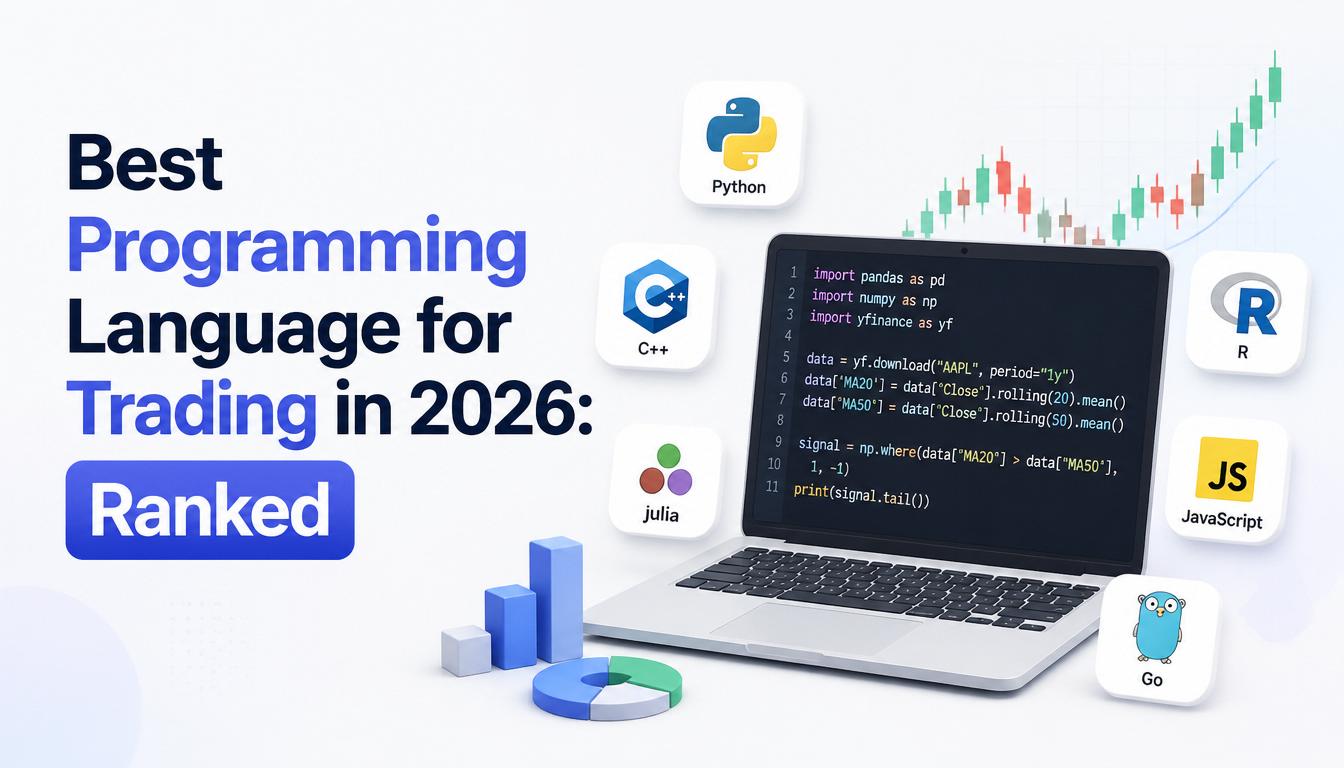
    Code editor showing Python trading strategy beside a ranking chart of the best programming language for trading

    At a glance: the comparison table

    LanguageBest forSpeedLearning curveVerdict
    PythonResearch, backtesting, MLGoodEasyStart here
    C++HFT, ultra-low latencyEliteSteepSpecialists only
    RStatistical researchModerateModerateAnalysts
    Java / C#Enterprise execution systemsVery goodModerateScaling up
    JuliaHigh-speed researchVery goodEasy–moderateOne to watch

    #1 Python — the default winner

    Python is the dominant language for quant research, strategy development, and the entire machine-learning workflow. Its readable syntax pairs with an unmatched scientific stack: NumPy, pandas, scikit-learn, TensorFlow, and PyTorch. That combination lets you focus on the strategy instead of fighting the language.

    Pros: Clear, concise syntax for rapid prototyping; the deepest library ecosystem in finance; a massive community, so every problem you hit has already been answered somewhere.

    Cons: Slower raw execution than C++, so it isn’t built for nanosecond-level high-frequency trading.

    Best for: Beginners, retail algo traders, researchers, and anyone whose edge comes from the idea, not the microsecond. In practice you’ll lean on backtesting libraries like backtrader and Zipline, which have no real equal elsewhere. As QuantStart notes, Python’s productivity advantage is decisive for the research-to-deployment pipeline most traders actually run.

    #2 C++ — the speed king

    C++ is the backbone of professional high-frequency trading. In 2026 there’s still no real alternative for HFT, market-making, and ultra-low-latency arbitrage. Its hardware-level optimization lets systems process orders in nanoseconds.

    Pros: Unmatched execution speed and fine-grained control over memory and hardware.

    Cons: A steep learning curve, and a smaller financial-development community than Python’s. You’ll write far more code to accomplish the same task.

    Best for: Latency-sensitive professionals and firms where being first to the trade is the strategy. For everyone else, it’s overkill — you’d spend months on plumbing a beginner doesn’t need.

    #3 R — the statistician’s tool

    R is built for traders and researchers who want to understand market data deeply. If your focus is statistical precision rather than execution speed, R is arguably the most effective choice.

    Pros: Exceptional for time-series analysis, risk evaluation, and hypothesis testing; richer statistical tooling than Python for certain quant work.

    Cons: Slower performance and weaker production-execution support, so it’s better for research than for live trading.

    Best for: Quant analysts and statistical-arbitrage researchers who live in the data and hand execution to another layer.

    #4 Java / C# — the enterprise workhorse

    Java (and its close cousin C#) is the reliable solution for large-scale, enterprise-grade trading systems, prized for security, portability, and stability under load.

    Pros: Strikes a strong balance between performance, platform independence, and enterprise features; excellent for systems that must run reliably for years.

    Cons: More verbose than Python and lighter on cutting-edge research libraries.

    Best for: Traders scaling a proven strategy into a robust, always-on production system — or developers already fluent in the language.

    #5 Julia — the fast-rising challenger

    Julia is projected to be the fastest-growing language in quant trading, and it’s easy to see why. It combines near-C++ speed with Python-like simplicity, aiming to end the trade-off between fast and friendly.

    Pros: High performance with readable syntax; purpose-built for numerical and scientific computing.

    Cons: A younger, smaller ecosystem than Python’s, so you’ll occasionally hit missing libraries or thinner documentation.

    Best for: Forward-looking researchers who want speed without C++’s pain — and anyone willing to bet on where the field is heading.

    Honorable mentions: Rust and JavaScript

    Two more languages deserve a nod, even if they don’t crack the top five.

    Rust is increasingly paired with or substituted for C++ in low-latency systems. It delivers similar speed with far safer memory handling, which means fewer of the crashes that plague C++ code. Its trading ecosystem is still young, so it’s a specialist choice rather than a starting point. But it’s worth watching as the modern alternative to C++.

    JavaScript (with Node.js) shows up in crypto bots and web-connected dashboards. It’s convenient if you already build web apps, and many exchange APIs have solid JavaScript support. The catch is the thin quantitative library ecosystem. For serious research and backtesting, you’ll still want Python. Treat JavaScript as a glue language, not your analytical core.

    How to choose the best programming language for trading for you

    Match the language to your goal, not to internet hype:

    • You’re a beginner or retail trader → Python. Full stop. It’s the best programming language for trading for the vast majority of people reading this.
    • You need nanosecond execution → C++. But be honest about whether you actually do; almost no retail strategy does.
    • You’re a stats-first researcher → R, with execution handled elsewhere.
    • You’re hardening a strategy into enterprise production → Java or C#.
    • You want tomorrow’s edge today → Julia.

    The wrong move is choosing C++ “because it’s fastest” before you’ve ever shipped a working backtest. Speed you can’t use is not an advantage.

    How long does each take to learn?

    A fair question, since time is the real cost. Here’s a rough guide for someone starting from little or no coding background.

    • Python: weeks to your first working bot. You can write a simple moving-average backtest within a month of focused practice. This is a big part of why it’s the best programming language for trading for beginners.
    • R: a few months to fluency if you’re comfortable with statistics. The syntax is approachable, but its strengths only pay off once you know what to test.
    • Java / C#: several months. The languages are verbose, and production-grade trading code adds its own complexity.
    • Julia: similar to Python for basics, slightly longer in practice because you’ll hit ecosystem gaps and lean on smaller communities for help.
    • C++: the longest road by far — often a year or more before you’re writing safe, performant trading code. The payoff is real, but only for those who genuinely need it.

    The takeaway is blunt. Time-to-first-strategy favors Python so heavily that the choice barely qualifies as a contest for most people.

    Mistakes people make choosing a trading language

    A few avoidable errors send beginners down the wrong path:

    • Optimizing for speed they’ll never use. Picking C++ for a daily or hourly strategy is solving a problem you don’t have.
    • Language-hopping. Jumping between languages instead of getting good at one. Depth beats breadth early on.
    • Choosing by job-posting buzzwords. Hedge-fund listings aren’t your roadmap; your own goals are.
    • Ignoring the ecosystem. A slightly faster language with no backtesting libraries will slow you down, not speed you up.
    • Waiting to feel “ready.” The real mistake is spending weeks choosing instead of building. Pick Python and start.

    Which language should you learn second?

    Once Python feels comfortable and you’ve shipped a few working strategies, a second language can extend your reach. The right pick depends entirely on where you hit a wall.

    Hit a speed wall — your strategy needs faster execution than Python can give? Learn C++ or Rust for the latency-critical piece, and keep Python for research. Hit a statistics wall — you want deeper modeling tools? Add R for the analysis layer. Building toward a robust, always-on production systemJava or C# will serve you well.

    Notice the pattern. You add a second language to solve a specific, concrete problem you’ve actually run into. You don’t collect languages for their own sake. Most traders go years before they truly need a second one, and some never do. Let a real bottleneck — not curiosity or status — decide your next step.

    The polyglot reality

    Here’s the secret the “which language wins” debate misses: most production trading systems aren’t built in one language at all. They’re polyglot — a research stack in Python, an execution layer in Java or C#, and an ultra-low-latency component in C++ or Rust.

    You don’t need that on day one. Start with Python and build something that works. Add a second language only when a real bottleneck demands it. The best programming language for trading is the one that gets you to a tested, live strategy fastest. For almost everyone, that’s Python.

    FAQ

    What is the best programming language for trading beginners? Python, without question. Its gentle syntax and enormous library ecosystem let you build and backtest a strategy faster than any other language.

    Is C++ better than Python for trading? Only for ultra-low-latency, high-frequency systems. For research, backtesting, and the strategies retail traders run, Python’s productivity wins easily.

    Do I need to know multiple languages? Not to start. Most professionals end up polyglot, but you should learn one — Python — well before adding a second.

    Is Julia worth learning for trading in 2026? It’s promising, combining speed and simplicity, and it’s the fastest-growing quant language. But its ecosystem is younger, so start with Python unless you have a specific reason.

    Can I use JavaScript for algo trading? You can, especially for web-connected dashboards and some crypto bots, but it lacks the deep quantitative libraries that make Python the standard.

    Key takeaways

    • The best programming language for trading for most people is Python — easiest to learn, deepest ecosystem, fast enough for nearly everything.
    • C++ wins only for nanosecond-level high-frequency trading, at the cost of a steep learning curve.
    • R suits statistical research; Java/C# suits enterprise execution systems.
    • Julia is the rising challenger — fast and friendly, but with a younger ecosystem.
    • Real systems are polyglot. Start with one language, add others only when a bottleneck forces it.

    Pick a language and start building today. Our free Algo Trading Starter Kit includes a beginner Python setup guide, a ready-to-run bot template, and a roadmap from first script to first live trade. Grab it here → and skip the months most people waste choosing tools instead of building.

  • Is Algo Trading Profitable in 2026? The Honest Data

    Is Algo Trading Profitable in 2026? The Honest Data

    It’s the question every aspiring trader types into a search bar at midnight: is algo trading profitable, or is it just a high-tech way to lose money faster? The internet answers with two extremes. One side promises passive riches. The other shouts “it’s all a scam.” The truth, backed by real data, sits in a more useful middle.

    Yes, algo trading can be profitable. But the people who actually profit look very different from the ones who buy a bot and hope. This guide lays out the real numbers — success rates, return ranges, costs, and the traits that separate the winners — so you can judge your own odds honestly.

    Table of Contents

    The short, honest answer

    Algo trading is profitable for a minority of disciplined, well-prepared traders and unprofitable for the rushing majority. The software itself doesn’t create profit — it executes a strategy. A good strategy with sound risk management can compound steadily; a weak one just loses money more efficiently.

    So the real question isn’t whether algo trading can be profitable. It demonstrably can. The question is whether you will put in the work the profitable minority did.

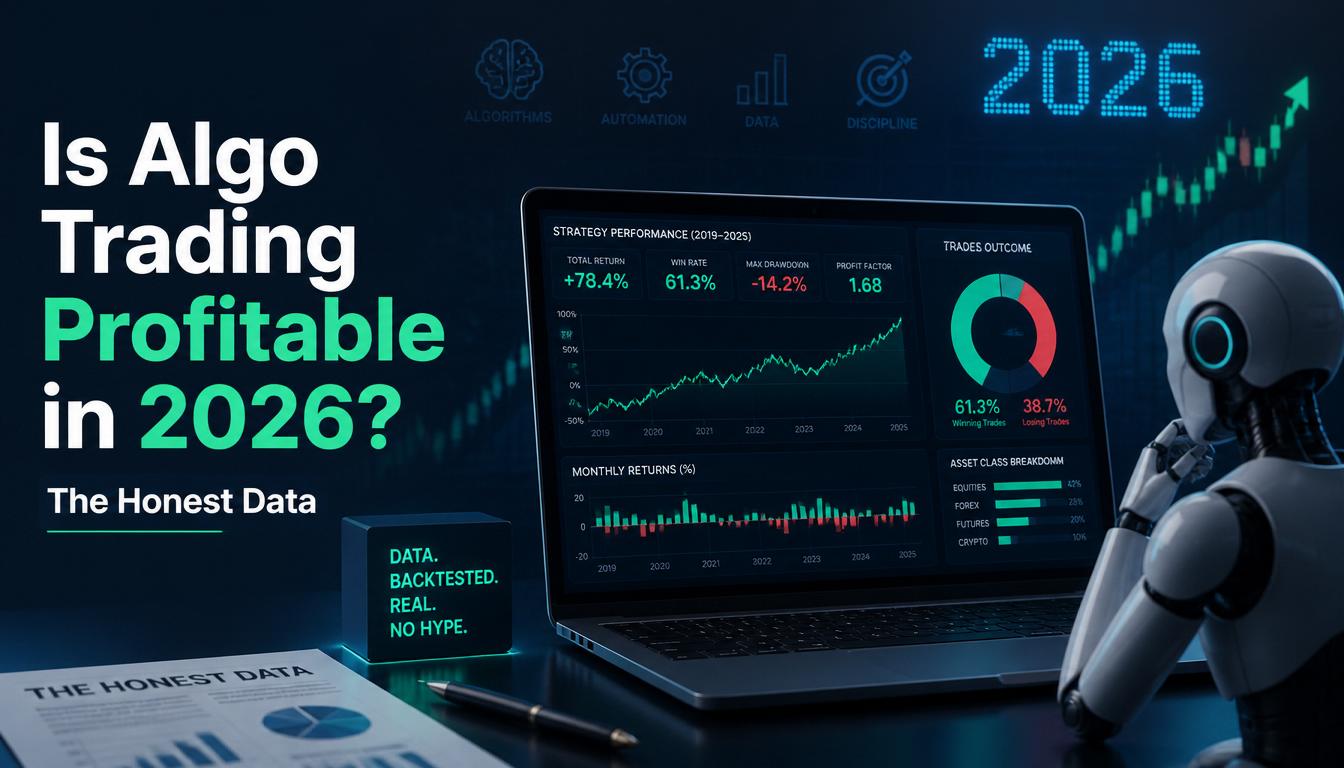
    A trading performance dashboard showing equity curve and metrics, used to answer is algo trading profitable

    Is algo trading profitable? The success-rate data

    Let’s start with the headline number. Around 60% of retail algorithmic traders post positive annual returns, according to data summarized by TradingView Hub. Stacked against the 5–10% success rate of manual day traders, that looks like a strong endorsement of automation.

    But there’s a catch hidden in the framing. That 60% describes people who reached the stage of deploying a tested system — a group that already self-selected for discipline and skill. For newcomers who jump in unprepared, the same body of research points to a brutal 90% first-year failure rate.

    So is algo trading profitable? For the prepared, the odds are genuinely good. For the impatient, they’re terrible. Both facts are true at once.

    What returns are actually realistic

    Forget the screenshots of 500% months. Grounded figures look like this:

    • Beginners: roughly 5–15% annually once they have a working, tested system.
    • Experienced traders with proven strategies: often 15–25% annually.
    • Retail traders using algorithmic strategies have seen average returns improve by about 23% versus discretionary trading, per the same research.

    These are good, compounding returns — not lottery wins. Anyone promising consistent double-digit monthly gains is selling something. Realistic profitability is a marathon of small edges, not a sprint to riches.

    The costs nobody advertises

    Profitability is revenue minus costs, and the costs are where beginners get ambushed.

    Running a serious algo operation carries an annual cost floor estimated between $1,200 and $6,000 — covering market data feeds, cloud servers, and software tools. On top of that sit trading costs: commissions, fees, and slippage that quietly erode every strategy’s edge.

    There’s also a time cost. Building genuine competency realistically takes 6 to 18 months of dedicated study. If your strategy only earns 10% a year on a small account, those fixed costs can swallow the entire profit. Scale matters, and undercapitalized traders often lose to costs alone.

    Why most strategies fail

    The single biggest profit-killer is overfitting — tuning a strategy until it looks perfect on historical data, then watching it collapse live.

    The evidence here is damning. Quantopian’s study of 888 algorithmic strategies found that backtest Sharpe ratios had near-zero predictive power for live returns, as discussed by QuantStart. Worse, the more a trader optimized to fit the past, the worse the live performance. Over-optimized strategies can lose up to 80% of their backtested profits when deployed.

    Add the 2-to-5-year strategy half-life — edges decay as markets adapt — and you see why “set and forget” is a myth. Profitable traders constantly research, retest, and replace fading strategies.

    Is algo trading profitable across different markets?

    Profitability also depends on where you trade. The same strategy logic behaves very differently across asset classes, and each market has its own profit drivers and traps.

    Crypto is the most volatile, which cuts both ways. High swings create more opportunity for short-term strategies like grid and momentum bots, but they also magnify losses and slippage. Fees vary widely between exchanges, and thin order books can wreck a backtest’s assumptions. Many beginners find their first profits here — and lose them just as fast.

    Stocks and ETFs are more stable and better regulated, with deeper data history for backtesting. After the 2026 removal of the $25,000 Pattern Day Trader minimum, automated equity strategies became viable on far smaller accounts. The trade-off is that liquid, heavily-traded names attract serious institutional competition.

    Forex offers high liquidity and the leverage that many automated systems are built around. That leverage is exactly why undercapitalized traders blow up — it amplifies both the edge and the mistakes. The mature MT4/MT5 ecosystem makes deployment easy, which is a double-edged convenience.

    So can it be profitable in any of them? It can be in all three, but the realistic returns and risks shift with each. Match the market to your capital, your tolerance for volatility, and the strategy you can actually test well.

    The traits of the profitable 10%

    If roughly 10% survive and profit, what do they share? The data points to a clear profile.

    People with backgrounds in engineering, statistics, computer science, or mathematics have a measurable head start. A 2024 QuantConnect survey found that 68% of their profitable users held STEM degrees. That doesn’t mean a non-STEM trader can’t win. It means the work rewards specific skills: statistical rigor, skepticism toward noise, and comfort with code. All three are learnable without a degree.

    Beyond credentials, the profitable share clear habits. They keep ruthless backtesting hygiene. They size positions conservatively. They research constantly. And they treat year one as tuition rather than payday.

    How to tilt the odds in your favor

    You can’t guarantee profit, but you can move yourself toward the winning 10%:

    1. Learn the statistics first. Understand overfitting, out-of-sample testing, and slippage before you trust any backtest.
    2. Start with a simple, robust strategy. Complexity hides overfitting.
    3. Test out-of-sample and include all costs. Assume live results will be worse than the screen.
    4. Size positions conservatively. Survival enables compounding; a blowup ends it.
    5. Keep researching. Expect to replace strategies as their edge decays.

    Do these, and “is algo trading profitable?” stops being a gamble and becomes a question of execution.

    FAQ

    Is algo trading actually profitable for retail traders? For a prepared minority, yes — about 60% of those who deploy tested systems are profitable. For unprepared beginners, the first-year failure rate is around 90%.

    How much can I realistically make? Beginners with a working system see roughly 5–15% annually; experienced traders often reach 15–25%. Monthly-doubling claims are red flags.

    Why do so many algo traders lose money? Mostly overfitting. Backtests look great, then fail live — over-optimized strategies can lose up to 80% of their paper profits in real markets.

    Do I need a STEM degree to profit? No, but it helps. 68% of profitable users in one survey had STEM backgrounds, because the work rewards statistical rigor and coding skill — both learnable without a degree.

    How long until algo trading becomes profitable? Plan for 6 to 18 months of study before consistent profits, and treat your first live year as a learning cost.

    Key takeaways

    • Is algo trading profitable? Yes — for the prepared minority, not the rushing majority.
    • ~60% of deployed retail algo traders profit, but the first-year failure rate is ~90%.
    • Realistic returns are 5–25% annually, not monthly miracles.
    • Costs ($1,200–$6,000/year) and overfitting are the biggest profit-killers.
    • The winning 10% share rigor, conservative sizing, and constant research.

    Want to join the profitable minority? Download our free Algo Trading Starter Kit: a backtesting-hygiene checklist, a Python strategy template, and our broker comparison. Get instant access → and join 12,000+ traders learning to automate with rigor, not hope.

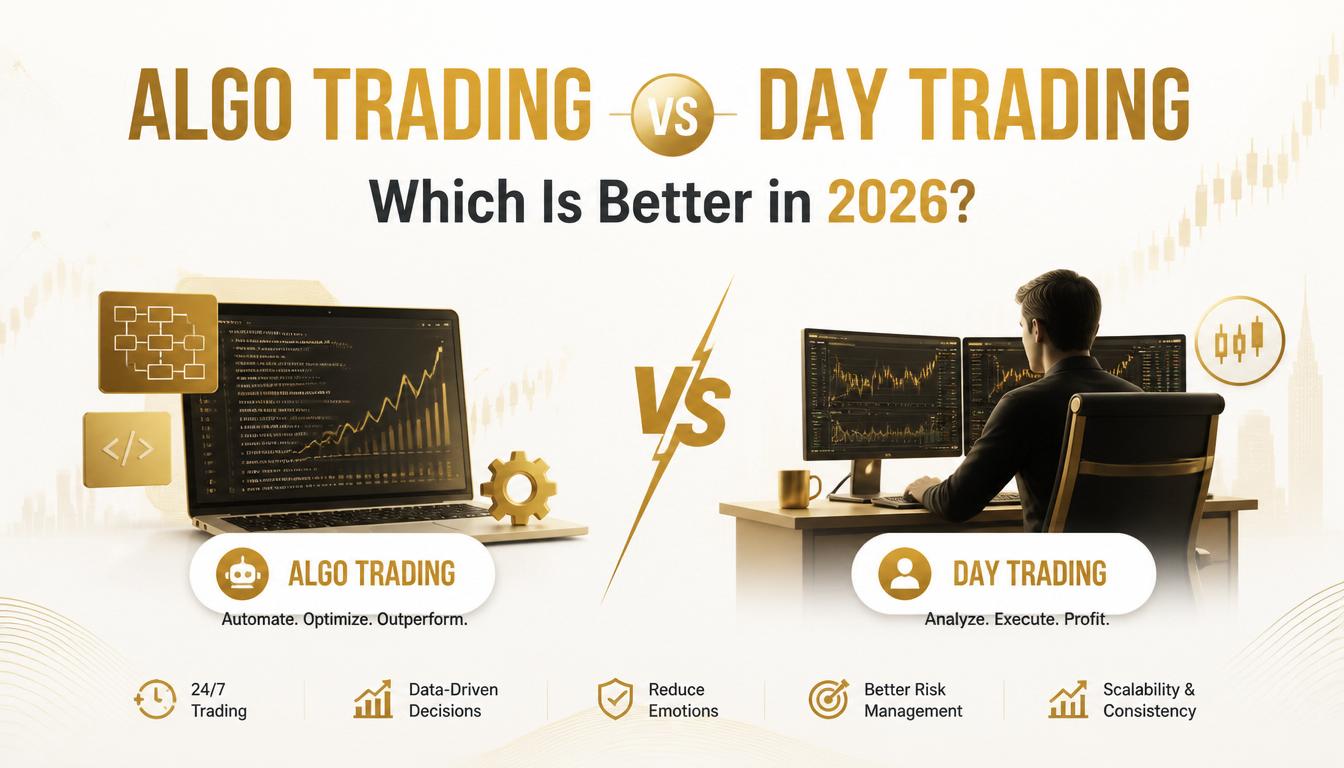
  • Algo Trading vs Day Trading: Which Is Better in 2026?

    Algo Trading vs Day Trading: Which Is Better in 2026?

    Picture two traders at 9:30 a.m. One stares at six monitors, finger hovering over the buy button, reacting to every tick. The other has already left for the gym — their code is handling the open. That image captures the heart of the algo trading vs day trading debate. In 2026, the gap between the two approaches is wider than ever.

    So which one actually wins? The honest answer depends on your temperament, your skills, and how much you value your time. This guide breaks down the real differences — speed, success rates, costs, and stress — so you can decide which fits you, rather than which sounds cooler.

    Table of Contents

    The core difference

    Day trading is manual. A human watches the market, makes decisions in real time, and clicks to enter and exit positions within the same day. The edge comes from skill, intuition, and the ability to read context that no rulebook fully captures.

    Algorithmic trading is automated. You define the rules in advance, and software executes them — often faster than any human could react. The edge comes from speed, consistency, and the removal of emotion from the moment of decision.

    Everything else in the algo trading vs day trading comparison flows from that single split: human judgment in the moment versus rules written ahead of time.

    Split-screen of a manual day trader at multiple monitors beside an automated trading bot dashboard, illustrating algo trading vs day trading

    Algo trading vs day trading: side by side

    Here’s the comparison at a glance before we dig into each row.

    FactorAlgo TradingDay Trading
    ExecutionAutomated, millisecond-fastManual, human reaction time
    EmotionRemoved at decision timeConstant battle
    Skill neededCoding + strategy designChart reading + discipline
    Time per dayLow once deployedHigh, screen-bound
    AdaptabilityRigid to its rulesFlexible to news and context
    ScalabilityTrades many markets at onceLimited by human attention
    Main failure modeOverfitting a backtestEmotional, impulsive trades

    Neither column is strictly “better.” They fail differently and they win differently.

    Speed and execution

    This is the one area where the contest isn’t close. Algorithmic systems execute in milliseconds, capturing price moves a human would miss entirely. As WealthArc notes, this speed lets bots profit from even the smallest fluctuations. They act on opportunities the instant those appear.

    A day trader simply cannot compete on raw speed. By the time you see a setup, process it, and click, the algorithm has already acted — possibly thousands of times. If your strategy depends on being first, automation wins by default.

    Success rates: what the data says

    Here’s where the numbers get interesting. Roughly 60% of retail algorithmic traders post positive annual returns, compared to a sobering 5–10% success rate among manual day traders, according to data summarized by TradingView Hub.

    That sounds like a knockout for automation — but read it carefully. The algo figure reflects people who got far enough to deploy a tested system, a group that already self-selects for discipline. It does not mean a beginner who buys a bot has a 60% shot. The same research notes a roughly 90% first-year failure rate for those who jump in unprepared.

    In other words, automation raises the ceiling, but only for traders who put in the work first.

    Emotion, discipline, and stress

    Day trading is a psychological grind. Fear, greed, and fatigue erode good judgment, and most manual losses trace back to emotional decisions rather than bad analysis. Holding screens for hours is genuinely exhausting.

    Algorithmic trading removes emotion from the moment of execution — the bot never panics or revenge-trades. But it doesn’t remove emotion entirely. You still have to resist switching off a strategy during a drawdown. You also have to resist tinkering with rules that already work. The discipline simply moves from the trade itself to the decision to trust your system.

    Costs and barriers to entry

    The cost profiles differ sharply.

    • Day trading needs little more than a broker account and a charting platform. Until recently, U.S. day traders faced the $25,000 Pattern Day Trader minimum. That rule was eliminated in 2026, lowering the barrier dramatically.
    • Algo trading can start free for learning, but running serious systems carries an annual cost floor — data feeds, servers, and tools — often estimated in the low thousands of dollars per year.

    Day trading is cheaper to begin. Algo trading front-loads a learning and infrastructure cost in exchange for scalability later.

    Algo trading vs day trading: who should choose which?

    There’s no universal winner, but there are clear fits.

    Choose day trading if you enjoy active decision-making, can stay disciplined under pressure, want to start cheaply, and can dedicate hours to screen time. Human adaptability shines when reacting to breaking news or unusual conditions a bot wasn’t programmed for.

    Choose algo trading if you can code (or will learn), prefer a systematic approach, want to reclaim your time, and value consistency over intuition. It rewards people who treat trading like engineering.

    Honestly assess your temperament. An impulsive person often does better letting a bot enforce the rules. A sharp, disciplined reader of markets may do worse by automating away their edge.

    Common myths about both

    A few myths distort this whole debate. Clearing them up makes the choice easier.

    Myth 1: Bots make money while you sleep. They execute while you sleep. Whether they make money depends entirely on the strategy and the market. A bad rule loses money around the clock, too.

    Myth 2: Day trading is gambling. Skilled, disciplined day traders treat it as a probabilities game with strict risk limits. The gambling label fits the impulsive crowd, not the professionals.

    Myth 3: Algo trading is only for math PhDs. Strong quant skills help, but a beginner can build a simple, working bot with basic Python. The barrier is lower than the mystique suggests.

    Myth 4: One approach is universally superior. As the comparison above shows, they win and fail in different conditions. The right choice depends on you, not on which one sounds more advanced.

    Strip away the myths and the algo trading vs day trading decision becomes a practical question of fit, not a search for a magic answer.

    Can you do both?

    Yes, and many serious traders do. A common hybrid path is to develop your edge manually first — learning to read markets and manage risk — then automate the repetitive parts once the strategy is proven. The manual experience makes you a better bot builder, because you understand what your rules are actually trying to capture.

    The algo trading vs day trading choice isn’t always permanent. Plenty of traders start manual, automate gradually, and end up running both in parallel.

    FAQ

    Is algo trading better than day trading? On speed and measured success rates, algo trading leads — about 60% of retail algo traders are profitable versus 5–10% of manual day traders. But automation rewards preparation; an unprepared beginner can fail at either.

    Is day trading dead in 2026? No. Human adaptability still matters, especially around news and unusual conditions. Day trading remains viable for disciplined, skilled traders — it’s just facing more automated competition.

    Which is cheaper to start, algo or day trading? Day trading. It needs only a broker and charting tools, and the $25k PDT minimum was removed in 2026. Algo trading carries ongoing data and infrastructure costs once you go live.

    Do I need to code for algo trading? For serious systems, yes — usually Python. No-code platforms exist, but they cap what you can build compared to writing your own logic.

    Can a beginner win at either? Not quickly. Both require months of learning. The fastest path to failure in the algo trading vs day trading world is skipping that preparation.

    Key takeaways

    • Algo trading vs day trading comes down to rules-ahead-of-time versus judgment-in-the-moment.
    • Automation wins on speed and measured success rates (~60% vs 5–10% profitable), but only for prepared traders.
    • Day trading is cheaper to start and more adaptable to news and context.
    • Emotion is the day trader’s enemy; overfitting is the algo trader’s.
    • You can do both — many traders learn manually, then automate a proven edge.

    Not sure which path fits you? Grab our free Algo Trading Starter Kit: a self-assessment to match your temperament to a style, a Python bot template, and our broker comparison. Get instant access → and join 12,000+ traders choosing their approach with clear eyes.

  • Make Money With Trading Bots? The Honest 2026 Reality

    Make Money With Trading Bots? The Honest 2026 Reality

    Type “trading bot” into any search engine and you’ll drown in screenshots of green P&L charts and claims of effortless passive income. So here’s the question worth answering honestly: can you actually make money with trading bots, or is the whole category a polished trap?

    The real answer is uncomfortable for both the hype crowd and the cynics. Bots can make money — but almost never in the way the ads promise, and almost never for the people who buy them expecting magic. Let’s look at what the evidence actually shows in 2026.

    Table of Contents

    The short answer

    Yes, you can make money with trading bots — but they are not profitable by default. A bot is a tool that executes a strategy. If the strategy has an edge and the risk controls are sound, the bot can turn that edge into consistent execution. If the strategy is weak, the bot simply loses money faster and more reliably than you would by hand.

    In other words, the profit comes from the strategy and the discipline behind it, not from the code itself.

    A trader monitoring a crypto trading bot's performance dashboard on a laptop, evaluating whether you can make money with trading bots

    What returns are actually realistic?

    Ignore the influencers showing 300% months. Here’s a grounded view.

    Reviews of leading commercial bots in 2026 cover names like WunderTrading, 3Commas, Cryptohopper, and Bitsgap. Top performers deliver annualized returns in the 12–25% range, according to a WunderTrading roundup. That’s genuinely good when it holds. It is also a world away from the “double your account every month” fantasy.

    Two caveats matter. First, those are top performer numbers, not average user results. Second, returns swing hard with market conditions; a grid bot that thrives in choppy markets can bleed in a strong trend.

    Why most people fail to make money with trading bots

    The failure rate is high, and the reasons are consistent.

    • They treat bots as set-and-forget. Bots are not autopilot. Traders who monitor conditions and reconfigure when the market shifts consistently outperform those who deploy and walk away.
    • They never validate the strategy. Over 80% of retail traders lose money, frequently because they trust a strategy they never properly tested.
    • They underestimate costs. Fees and slippage quietly turn a paper winner into a real loser.
    • They buy a black box. A bot you don’t understand is one you can’t fix or even diagnose when it stops working.

    Who does make money with trading bots

    So who does make money with trading bots? A clear pattern emerges from the data. Bots reward the already-disciplined and punish the shortcut-seekers.

    Around 42% of traders use bots for speed, accuracy, and removing emotion from execution, as noted in Phemex’s analysis. The people who profit tend to share three traits. They have a tested edge. They actively manage their bots. And they size positions conservatively. The bot amplifies an existing skill — it doesn’t manufacture one.

    The crypto bot market itself is booming, valued around $54 billion in 2026, which tells you the tools are selling well. It says nothing about whether the average buyer is profitable.

    Bots automate execution, not intelligence

    This is the single most important idea on the page. A trading bot automates what you do, not whether you should do it.

    Even the most advanced AI-driven bots in 2026 still need human oversight and direction. They execute a vision; they don’t supply one. The traders who succeed use bots the way a pilot uses autopilot. It handles routine execution, while the human stays responsible for the destination.

    When a bot is marketed as a “magical profit machine that runs unsupervised,” that’s the clearest signal to walk away.

    How to give yourself a real chance

    If you want a genuine shot at making money with trading bots, do this:

    1. Learn a strategy first. Understand the edge before you automate it.
    2. Backtest honestly. Include fees and slippage; guard against overfitting.
    3. Paper trade for weeks. Confirm the bot behaves in live conditions.
    4. Start small. Risk only what you can afford to lose entirely.
    5. Monitor and adapt. Turn the bot off when the market no longer fits its logic.

    This is slower and less glamorous than the ads suggest. It’s also the only approach the evidence actually supports.

    FAQ

    Can beginners make money with trading bots? Rarely at first. Beginners usually lose money while they learn. Bots reward existing discipline, so build the skill before expecting profit.

    Are free trading bots profitable? The price tag isn’t the issue — the strategy is. A free bot running a sound, well-tested strategy can outperform an expensive one running a weak idea.

    What’s a realistic return from a trading bot? Top performers report roughly 12–25% annualized, but average users often do worse. Treat any promise of monthly doubling as a red flag.

    Do trading bots work in all markets? No. Most bots suit specific conditions. A grid bot likes choppy ranges; a trend bot likes strong directional moves. Matching the bot to the market is part of the skill.

    Is it passive income? Not really. Profitable bot trading requires ongoing monitoring and adjustment. “Passive” is the marketing word, not the reality.

    Key takeaways

    • You can make money with trading bots, but not by default. Profit comes from the strategy, not the software.
    • Realistic top returns are roughly 12–25% annualized — not monthly miracles.
    • Most failures come from set-and-forget habits and untested strategies.
    • Bots automate execution, not judgment. Human oversight remains essential.
    • The winners are disciplined first, automated second.

    Want to do this the right way? Grab our free Algo Trading Starter Kit: an honest beginner roadmap, a Python bot template, and our vetted broker and platform comparison. Get instant access → and join 12,000+ traders learning to automate without the hype.

  • Algo Trading for Beginners: The Complete 2026 Guide

    Algo Trading for Beginners: The Complete 2026 Guide

    Most people picture algorithmic trading as a wall of glowing monitors in a Wall Street tower. The reality in 2026 is far more ordinary: a laptop, a free API key, and a few dozen lines of Python. Algo trading for beginners has never been more accessible — yet the gap between “running a bot” and “running a profitable bot” still trips up almost everyone who starts.

    This complete guide walks you through the whole picture: what algorithmic trading is, how it actually works, the tools you need, and the discipline that separates the people who last from the people who blow up in month one.

    Table of Contents

    What is algo trading?

    Algorithmic trading means using a computer program to place trades according to rules you define in advance. You write the logic once — “buy when this condition is true, sell when that one is” — and the software executes it tirelessly, without emotion, fatigue, or second-guessing.

    That last part matters more than beginners expect. Most trading losses come from human behavior: panic selling, revenge trading, holding a loser too long. A bot does exactly what it’s told, every time. The catch is that it will follow a bad rule just as faithfully as a good one.

    A beginner reviewing a trading bot dashboard and Python script on a laptop, illustrating algo trading for beginners

    How algorithmic trading actually works

    Every algo trading system, from a hobbyist’s script to a hedge fund’s engine, runs the same basic loop:

    1. Collect data. Pull live or historical prices from a broker or exchange.
    2. Generate a signal. Apply your rule to decide buy, sell, or hold.
    3. Execute the order. Send it to the broker through an API.
    4. Manage the position. Track stops, targets, and exits.
    5. Log everything. Record what happened so you can review and improve.

    Institutions handle over 80% of equity trades this way, according to industry estimates cited by QuantVPS. The difference between them and you isn’t the loop — it’s the quality of the rules and the rigor of the testing.

    Why algo trading for beginners is booming in 2026

    The 2020s have been defined by the democratization of this field. Cloud computing, API-first brokers, and a flood of free educational content mean an individual can now run strategies that once required a quant team. That shift is why algo trading for beginners has gone mainstream.

    The numbers reflect it. Retail traders are now the fastest-growing segment of the algorithmic trading market, which industry analysts size at roughly $20 billion in 2026. Commission-free brokers and no-minimum accounts have removed the financial gatekeeping that kept beginners out a decade ago.

    The tools you need to begin

    You need surprisingly little to start. Here’s the core stack for algo trading for beginners:

    • A broker with an API and paper trading. Alpaca is the friendliest on-ramp in 2026; Interactive Brokers is the power-user standard.
    • Python. The dominant language, thanks to libraries like Pandas, NumPy, and backtesting frameworks such as backtrader.
    • A development environment. A Jupyter Notebook for experiments, then a simple script for live runs.
    • Historical data. Free sources cover most beginner needs.

    Notice what’s missing: an expensive course, a “guaranteed” signal service, or a five-figure account. Treat anyone selling those with caution.

    Your first strategy, step by step

    Resist the urge to build something clever. Your first strategy exists to teach you the workflow, not to make money.

    Start with a moving-average crossover. Buy when a short-term average rises above a long-term average, and sell when it drops back below. Now turn it into code in four steps:

    1. Fetch a year of daily prices for one asset.
    2. Calculate a 50-day and a 200-day moving average.
    3. Mark each day as buy, sell, or hold based on the crossover.
    4. Tally the results and compare them to simply holding the asset.

    If you can run that end to end, you understand more than most people who only talk about trading bots.

    Backtesting without fooling yourself

    Backtesting runs your strategy against past data to estimate how it would have performed. It’s essential, and it’s a minefield.

    Three traps catch nearly every beginner:

    • Overfitting — tuning parameters until the backtest looks perfect, then watching it fail live.
    • Look-ahead bias — accidentally using information your strategy wouldn’t have had at the time.
    • Survivorship bias — testing only on assets that still exist, which hides past disasters.

    As the team at QuantifiedStrategies emphasizes, a clean backtest must include realistic fees and slippage. A strategy showing 2% monthly gains can become a loser once you subtract trading costs. Test on data the strategy has never seen, and assume live results will be worse than the screen suggests.

    Risk management is the real edge

    Here’s the truth experienced traders learn the hard way: survival beats brilliance. No strategy is complete without explicit risk controls.

    The standard rules are simple and worth following from day one:

    • Risk only 1–2% of your account per trade.
    • Use stop-loss orders on every position.
    • Set a daily loss limit that shuts the bot off automatically.
    • Add circuit breakers so a code bug can’t drain the account.

    These rules feel boring next to a clever strategy. They are also the reason some traders are still trading after five years while others quit in five weeks. Protect the account first. Profit can only come from an account that still exists.

    Common algo trading mistakes for beginners

    Most beginners fail for predictable reasons, not exotic ones:

    • Going live too fast, before weeks of clean paper trading.
    • Skipping risk limits, so one bad day erases months of gains.
    • Trusting a backtest blindly, ignoring fees and overfitting.
    • Copying a bot they don’t understand, leaving them helpless when it breaks.
    • Chasing complexity, when a simple, well-tested rule would serve better.

    Avoid these, and you’re already ahead of most people who start.

    How long until algo trading for beginners pays off?

    This is the question nobody selling a course wants to answer honestly. The realistic timeline is months, not days.

    Plan for three to six months of learning before you trade real money with any seriousness. The first month goes to Python basics and your first working backtest. The next few months go to testing strategies, paper trading, and — most importantly — learning what doesn’t work. That negative knowledge is worth as much as any winning rule.

    Even then, expect your first live year to be about survival rather than profit. Most beginners lose money early. The ones who stick around treat that period as tuition, not failure. They keep position sizes tiny, log every trade, and review their mistakes weekly.

    Set your expectations here and you’ll avoid the trap that ends most journeys: quitting after a fast loss that you mistook for proof the whole thing was a scam. Algo trading for beginners rewards patience far more than it rewards cleverness.

    FAQ

    Is algo trading good for beginners? Yes, as a learning path — but not as a get-rich-quick scheme. Beginners should expect a learning curve of several months before trading real money seriously.

    Do I need to know how to code for algo trading? Not to start. No-code platforms like 3Commas and Pionex let you configure bots through a dashboard. But basic Python dramatically expands what you can build.

    How much money do I need? You can learn and backtest for free. To trade live, see our guide on how much money you need to start algo trading — and only use money you can afford to lose.

    Can algo trading be profitable? It can, but profit is far from guaranteed. Most beginners lose money in year one. The realistic goal early on is competence and capital preservation.

    What’s the best first strategy? A moving-average crossover. It’s simple enough to understand fully, which is exactly why it’s a good teacher.

    Key takeaways

    • Algo trading for beginners is accessible — a laptop, Python, and a free broker API are enough to start.
    • Every system runs the same loop: data, signal, execution, management, logging.
    • Your first strategy should be simple. Learn the workflow before chasing returns.
    • Backtesting lies if you let it. Guard against overfitting, look-ahead, and survivorship bias.
    • Risk management is the real edge. Position sizing and loss limits keep you in the game.

    Want a head start? Download our free Algo Trading Starter Kit: a beginner-friendly PDF roadmap, a ready-to-run Python bot template, and our broker comparison cheat sheet. Get instant access → and join 12,000+ traders learning to automate the smart way.