Author: Craig Kernahan

  • Make Money With Trading Bots? The Honest 2026 Reality

    Make Money With Trading Bots? The Honest 2026 Reality

    Type “trading bot” into any search engine and you’ll drown in screenshots of green P&L charts and claims of effortless passive income. So here’s the question worth answering honestly: can you actually make money with trading bots, or is the whole category a polished trap?

    The real answer is uncomfortable for both the hype crowd and the cynics. Bots can make money — but almost never in the way the ads promise, and almost never for the people who buy them expecting magic. Let’s look at what the evidence actually shows in 2026.

    Table of Contents

    The short answer

    Yes, you can make money with trading bots — but they are not profitable by default. A bot is a tool that executes a strategy. If the strategy has an edge and the risk controls are sound, the bot can turn that edge into consistent execution. If the strategy is weak, the bot simply loses money faster and more reliably than you would by hand.

    In other words, the profit comes from the strategy and the discipline behind it, not from the code itself.

    A trader monitoring a crypto trading bot's performance dashboard on a laptop, evaluating whether you can make money with trading bots

    What returns are actually realistic?

    Ignore the influencers showing 300% months. Here’s a grounded view.

    Reviews of leading commercial bots in 2026 cover names like WunderTrading, 3Commas, Cryptohopper, and Bitsgap. Top performers deliver annualized returns in the 12–25% range, according to a WunderTrading roundup. That’s genuinely good when it holds. It is also a world away from the “double your account every month” fantasy.

    Two caveats matter. First, those are top performer numbers, not average user results. Second, returns swing hard with market conditions; a grid bot that thrives in choppy markets can bleed in a strong trend.

    Why most people fail to make money with trading bots

    The failure rate is high, and the reasons are consistent.

    • They treat bots as set-and-forget. Bots are not autopilot. Traders who monitor conditions and reconfigure when the market shifts consistently outperform those who deploy and walk away.
    • They never validate the strategy. Over 80% of retail traders lose money, frequently because they trust a strategy they never properly tested.
    • They underestimate costs. Fees and slippage quietly turn a paper winner into a real loser.
    • They buy a black box. A bot you don’t understand is one you can’t fix or even diagnose when it stops working.

    Who does make money with trading bots

    So who does make money with trading bots? A clear pattern emerges from the data. Bots reward the already-disciplined and punish the shortcut-seekers.

    Around 42% of traders use bots for speed, accuracy, and removing emotion from execution, as noted in Phemex’s analysis. The people who profit tend to share three traits. They have a tested edge. They actively manage their bots. And they size positions conservatively. The bot amplifies an existing skill — it doesn’t manufacture one.

    The crypto bot market itself is booming, valued around $54 billion in 2026, which tells you the tools are selling well. It says nothing about whether the average buyer is profitable.

    Bots automate execution, not intelligence

    This is the single most important idea on the page. A trading bot automates what you do, not whether you should do it.

    Even the most advanced AI-driven bots in 2026 still need human oversight and direction. They execute a vision; they don’t supply one. The traders who succeed use bots the way a pilot uses autopilot. It handles routine execution, while the human stays responsible for the destination.

    When a bot is marketed as a “magical profit machine that runs unsupervised,” that’s the clearest signal to walk away.

    How to give yourself a real chance

    If you want a genuine shot at making money with trading bots, do this:

    1. Learn a strategy first. Understand the edge before you automate it.
    2. Backtest honestly. Include fees and slippage; guard against overfitting.
    3. Paper trade for weeks. Confirm the bot behaves in live conditions.
    4. Start small. Risk only what you can afford to lose entirely.
    5. Monitor and adapt. Turn the bot off when the market no longer fits its logic.

    This is slower and less glamorous than the ads suggest. It’s also the only approach the evidence actually supports.

    FAQ

    Can beginners make money with trading bots? Rarely at first. Beginners usually lose money while they learn. Bots reward existing discipline, so build the skill before expecting profit.

    Are free trading bots profitable? The price tag isn’t the issue — the strategy is. A free bot running a sound, well-tested strategy can outperform an expensive one running a weak idea.

    What’s a realistic return from a trading bot? Top performers report roughly 12–25% annualized, but average users often do worse. Treat any promise of monthly doubling as a red flag.

    Do trading bots work in all markets? No. Most bots suit specific conditions. A grid bot likes choppy ranges; a trend bot likes strong directional moves. Matching the bot to the market is part of the skill.

    Is it passive income? Not really. Profitable bot trading requires ongoing monitoring and adjustment. “Passive” is the marketing word, not the reality.

    Key takeaways

    • You can make money with trading bots, but not by default. Profit comes from the strategy, not the software.
    • Realistic top returns are roughly 12–25% annualized — not monthly miracles.
    • Most failures come from set-and-forget habits and untested strategies.
    • Bots automate execution, not judgment. Human oversight remains essential.
    • The winners are disciplined first, automated second.

    Want to do this the right way? Grab our free Algo Trading Starter Kit: an honest beginner roadmap, a Python bot template, and our vetted broker and platform comparison. Get instant access → and join 12,000+ traders learning to automate without the hype.

  • Algo Trading for Beginners: The Complete 2026 Guide

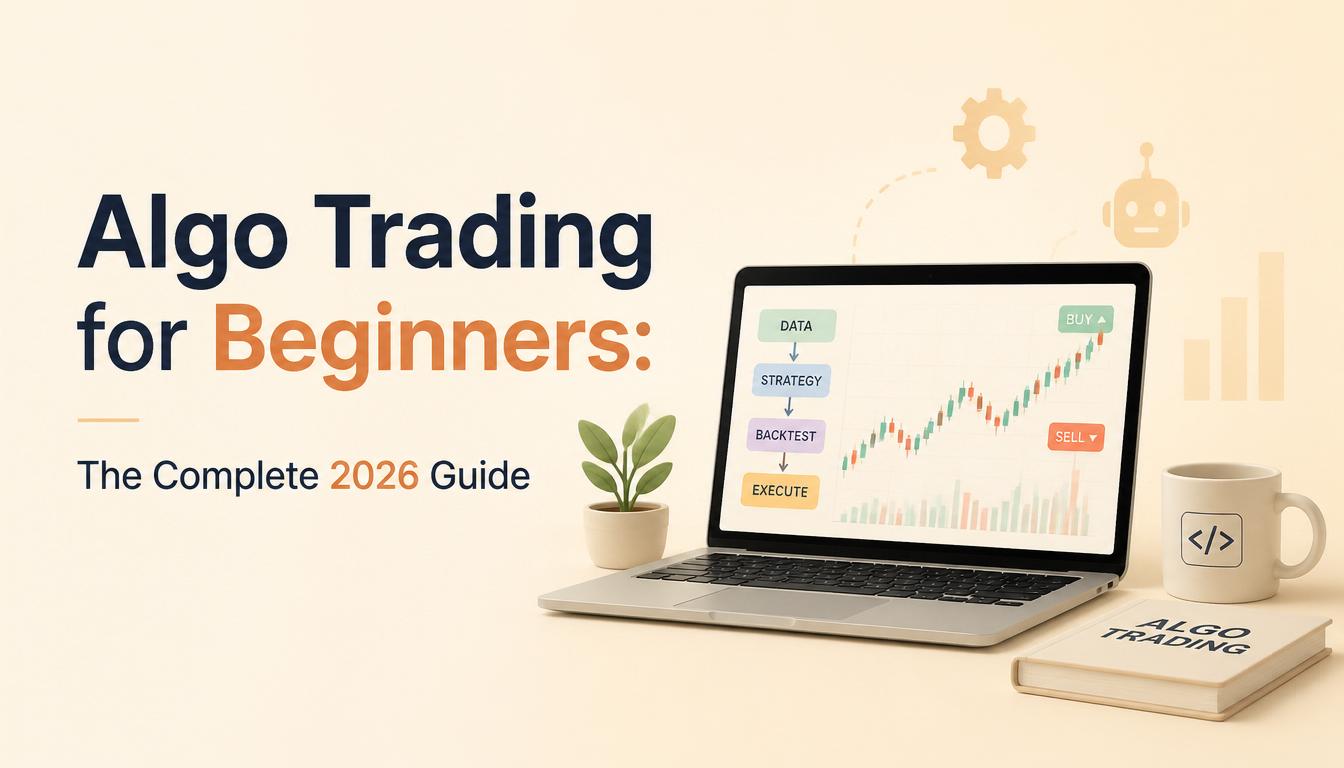
    Algo Trading for Beginners: The Complete 2026 Guide

    Most people picture algorithmic trading as a wall of glowing monitors in a Wall Street tower. The reality in 2026 is far more ordinary: a laptop, a free API key, and a few dozen lines of Python. Algo trading for beginners has never been more accessible — yet the gap between “running a bot” and “running a profitable bot” still trips up almost everyone who starts.

    This complete guide walks you through the whole picture: what algorithmic trading is, how it actually works, the tools you need, and the discipline that separates the people who last from the people who blow up in month one.

    Table of Contents

    What is algo trading?

    Algorithmic trading means using a computer program to place trades according to rules you define in advance. You write the logic once — “buy when this condition is true, sell when that one is” — and the software executes it tirelessly, without emotion, fatigue, or second-guessing.

    That last part matters more than beginners expect. Most trading losses come from human behavior: panic selling, revenge trading, holding a loser too long. A bot does exactly what it’s told, every time. The catch is that it will follow a bad rule just as faithfully as a good one.

    A beginner reviewing a trading bot dashboard and Python script on a laptop, illustrating algo trading for beginners

    How algorithmic trading actually works

    Every algo trading system, from a hobbyist’s script to a hedge fund’s engine, runs the same basic loop:

    1. Collect data. Pull live or historical prices from a broker or exchange.
    2. Generate a signal. Apply your rule to decide buy, sell, or hold.
    3. Execute the order. Send it to the broker through an API.
    4. Manage the position. Track stops, targets, and exits.
    5. Log everything. Record what happened so you can review and improve.

    Institutions handle over 80% of equity trades this way, according to industry estimates cited by QuantVPS. The difference between them and you isn’t the loop — it’s the quality of the rules and the rigor of the testing.

    Why algo trading for beginners is booming in 2026

    The 2020s have been defined by the democratization of this field. Cloud computing, API-first brokers, and a flood of free educational content mean an individual can now run strategies that once required a quant team. That shift is why algo trading for beginners has gone mainstream.

    The numbers reflect it. Retail traders are now the fastest-growing segment of the algorithmic trading market, which industry analysts size at roughly $20 billion in 2026. Commission-free brokers and no-minimum accounts have removed the financial gatekeeping that kept beginners out a decade ago.

    The tools you need to begin

    You need surprisingly little to start. Here’s the core stack for algo trading for beginners:

    • A broker with an API and paper trading. Alpaca is the friendliest on-ramp in 2026; Interactive Brokers is the power-user standard.
    • Python. The dominant language, thanks to libraries like Pandas, NumPy, and backtesting frameworks such as backtrader.
    • A development environment. A Jupyter Notebook for experiments, then a simple script for live runs.
    • Historical data. Free sources cover most beginner needs.

    Notice what’s missing: an expensive course, a “guaranteed” signal service, or a five-figure account. Treat anyone selling those with caution.

    Your first strategy, step by step

    Resist the urge to build something clever. Your first strategy exists to teach you the workflow, not to make money.

    Start with a moving-average crossover. Buy when a short-term average rises above a long-term average, and sell when it drops back below. Now turn it into code in four steps:

    1. Fetch a year of daily prices for one asset.
    2. Calculate a 50-day and a 200-day moving average.
    3. Mark each day as buy, sell, or hold based on the crossover.
    4. Tally the results and compare them to simply holding the asset.

    If you can run that end to end, you understand more than most people who only talk about trading bots.

    Backtesting without fooling yourself

    Backtesting runs your strategy against past data to estimate how it would have performed. It’s essential, and it’s a minefield.

    Three traps catch nearly every beginner:

    • Overfitting — tuning parameters until the backtest looks perfect, then watching it fail live.
    • Look-ahead bias — accidentally using information your strategy wouldn’t have had at the time.
    • Survivorship bias — testing only on assets that still exist, which hides past disasters.

    As the team at QuantifiedStrategies emphasizes, a clean backtest must include realistic fees and slippage. A strategy showing 2% monthly gains can become a loser once you subtract trading costs. Test on data the strategy has never seen, and assume live results will be worse than the screen suggests.

    Risk management is the real edge

    Here’s the truth experienced traders learn the hard way: survival beats brilliance. No strategy is complete without explicit risk controls.

    The standard rules are simple and worth following from day one:

    • Risk only 1–2% of your account per trade.
    • Use stop-loss orders on every position.
    • Set a daily loss limit that shuts the bot off automatically.
    • Add circuit breakers so a code bug can’t drain the account.

    These rules feel boring next to a clever strategy. They are also the reason some traders are still trading after five years while others quit in five weeks. Protect the account first. Profit can only come from an account that still exists.

    Common algo trading mistakes for beginners

    Most beginners fail for predictable reasons, not exotic ones:

    • Going live too fast, before weeks of clean paper trading.
    • Skipping risk limits, so one bad day erases months of gains.
    • Trusting a backtest blindly, ignoring fees and overfitting.
    • Copying a bot they don’t understand, leaving them helpless when it breaks.
    • Chasing complexity, when a simple, well-tested rule would serve better.

    Avoid these, and you’re already ahead of most people who start.

    How long until algo trading for beginners pays off?

    This is the question nobody selling a course wants to answer honestly. The realistic timeline is months, not days.

    Plan for three to six months of learning before you trade real money with any seriousness. The first month goes to Python basics and your first working backtest. The next few months go to testing strategies, paper trading, and — most importantly — learning what doesn’t work. That negative knowledge is worth as much as any winning rule.

    Even then, expect your first live year to be about survival rather than profit. Most beginners lose money early. The ones who stick around treat that period as tuition, not failure. They keep position sizes tiny, log every trade, and review their mistakes weekly.

    Set your expectations here and you’ll avoid the trap that ends most journeys: quitting after a fast loss that you mistook for proof the whole thing was a scam. Algo trading for beginners rewards patience far more than it rewards cleverness.

    FAQ

    Is algo trading good for beginners? Yes, as a learning path — but not as a get-rich-quick scheme. Beginners should expect a learning curve of several months before trading real money seriously.

    Do I need to know how to code for algo trading? Not to start. No-code platforms like 3Commas and Pionex let you configure bots through a dashboard. But basic Python dramatically expands what you can build.

    How much money do I need? You can learn and backtest for free. To trade live, see our guide on how much money you need to start algo trading — and only use money you can afford to lose.

    Can algo trading be profitable? It can, but profit is far from guaranteed. Most beginners lose money in year one. The realistic goal early on is competence and capital preservation.

    What’s the best first strategy? A moving-average crossover. It’s simple enough to understand fully, which is exactly why it’s a good teacher.

    Key takeaways

    • Algo trading for beginners is accessible — a laptop, Python, and a free broker API are enough to start.
    • Every system runs the same loop: data, signal, execution, management, logging.
    • Your first strategy should be simple. Learn the workflow before chasing returns.
    • Backtesting lies if you let it. Guard against overfitting, look-ahead, and survivorship bias.
    • Risk management is the real edge. Position sizing and loss limits keep you in the game.

    Want a head start? Download our free Algo Trading Starter Kit: a beginner-friendly PDF roadmap, a ready-to-run Python bot template, and our broker comparison cheat sheet. Get instant access → and join 12,000+ traders learning to automate the smart way.

  • How to Start Algo Trading in 2026: A Beginner’s Roadmap

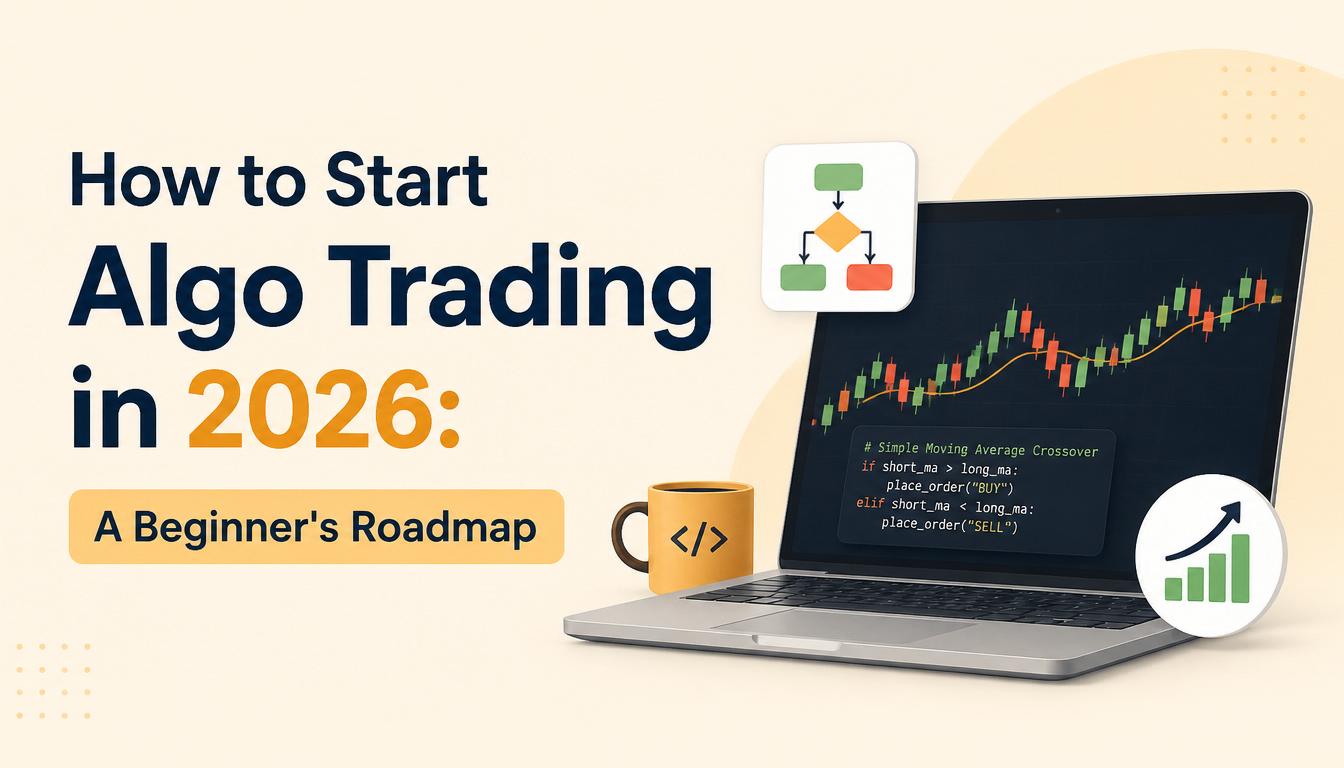
    How to Start Algo Trading in 2026: A Beginner’s Roadmap

    Five years ago, building a trading bot meant wrestling with clunky APIs and a five-figure brokerage minimum. In 2026, you can wire up your first automated strategy on a free paper-trading account in an afternoon. The barrier to entry has collapsed. The barrier to making money, though, has not. This guide shows you how to start algo trading the right way — the tools, the realistic costs, your first strategy, and the mistakes that quietly drain most beginner accounts.

    By the end, you’ll have a concrete roadmap instead of a vague ambition.

    Table of Contents

    What algo trading actually is

    Algorithmic trading — “algo trading” for short — means handing your trading rules to software that runs them automatically. Instead of staring at charts and clicking buy, you define a precise rule. For example: “buy when the 50-day moving average crosses above the 200-day.” A program then executes it for you, around the clock, without hesitation or fear.

    This isn’t a fringe activity anymore. The global algorithmic trading market reached roughly $20 billion in 2026, according to Mordor Intelligence. Retail traders — people like you, not hedge funds — are now the fastest-growing segment, at around 38% of the market. Tools once locked behind institutional doors are a free API call away.

    A laptop showing a candlestick chart beside Python code, illustrating how to start algo trading at home

    Do you need to know how to code?

    Short answer: not to start, but it helps enormously.

    There are two paths. The first is no-code platforms like 3Commas, Pionex, or Cryptohopper. You configure pre-built bots through a dashboard. They’re a gentle on-ramp, and they’re fine for learning the mechanics. The second path is writing your own code, usually in Python. This is where serious, flexible algo trading lives.

    Why Python? Because the ecosystem is unmatched. Libraries like Pandas (data handling), NumPy (math), and backtrader or zipline (backtesting) do the heavy lifting. You write strategy logic, not plumbing. If you’ve never coded, you can learn enough Python to build a simple bot in a few weekends. That effort pays off, because no-code platforms always cap what you can express.

    The realistic cost to start algo trading

    Here’s the honest math, because hype merchants love to skip it.

    • Software and data: $0 to start. Paper-trading accounts, historical price data, and the core Python libraries are all free.
    • Brokerage minimum: $0 with Alpaca, which offers a developer-friendly API and commission-free stock trading. Interactive Brokers, the institutional favorite, has historically expected around $10,000 for full features.
    • Real trading capital: This is the real question, and it deserves its own answer. See our guide on how much money you need to start algo trading. The short version: begin with money you can afford to lose entirely.

    So you can learn and test for free. You only need capital when you’re ready to trade live — and you should not rush that day.

    Step 1: Pick your tools

    To start algo trading, you need three things: a broker with an API, a language, and a place to run your code.

    • A broker with an API and a paper account. Alpaca is the most beginner-friendly choice in 2026. Interactive Brokers is the power-user option. For crypto, exchanges like Binance and Bybit expose robust APIs.
    • A language and libraries. Python, plus Pandas and a backtesting library. We compare the options in best programming language for trading.
    • An environment. Use a Jupyter Notebook to experiment. Then move to a simple script you can run on a cheap cloud server once you go live.

    Resist the urge to buy an expensive course or a “guaranteed” bot before you’ve placed a single paper trade. The tools above cost nothing.

    Step 2: Build your first strategy

    Your first strategy should be almost embarrassingly simple. The goal isn’t profit. It’s learning the full loop, end to end.

    A classic starting point is the moving-average crossover. You buy when a short-term average crosses above a long-term average, and sell when it crosses back below. It’s not a money printer, and that’s the point. It’s simple enough that you can reason about every trade it makes.

    Write the rule in plain English first. Then translate it into code that does four things: fetch historical prices, compute the two averages, generate buy and sell signals, and record the results. Get that loop working, and you’ll understand more than most people who only talk about algo trading.

    Step 3: Backtest before you risk a cent

    Backtesting means running your strategy against historical data to see how it would have performed. It’s essential. It’s also where beginners fool themselves most badly.

    The trap is overfitting: tuning your strategy until it looks brilliant on past data. In reality, you’ve just memorized noise. The research here is sobering. Studies of large cohorts of backtested strategies find that in-sample metrics like the Sharpe ratio have almost no predictive power for live results — correlations often fall below 0.05, as documented in work on optimal trading rules. A backtest showing 2% monthly returns can flip to a loss once you subtract realistic slippage and fees.

    So treat a great backtest with suspicion, not celebration. Test on data your strategy has never seen. Include fees and slippage. Assume reality will be worse than your screen suggests.

    Step 4: Paper trade, then go live small

    Once your strategy survives backtesting, run it on a paper-trading account: live market data, fake money. This catches the problems a backtest can’t. Bad fills. API rate limits. Your code crashing at 3 a.m.

    Only after weeks of clean paper trading should you go live. Even then, start with an amount so small that losing it is a cheap lesson — many traders begin with a few hundred dollars and risk well under 1% of it per trade. Add logging and alerts so you know instantly when something breaks. Set a hard daily loss limit that shuts the bot off automatically. Protect your API keys like passwords, and never commit them to a public repository. The professionals who blow up usually do it on operational failures, not bad strategy ideas. Knight Capital is the cautionary tale: it lost $440 million in 45 minutes from a botched software deployment.

    Mistakes that kill beginner accounts

    Most beginners don’t fail because their strategy is bad. They fail because of avoidable errors:

    • They skip validation. Over 80% of retail traders lose money, often because they never properly test a strategy before trusting it with real cash.
    • They over-optimize. Chasing a perfect backtest produces a strategy that fits the past and breaks in the present.
    • They ignore costs. Slippage and fees turn paper winners into real losers.
    • They go big too soon. A large early loss ends most trading careers before they begin.
    • They chase someone else’s bot. A strategy you don’t understand is one you can’t fix when it breaks.

    Avoid these five, and you’re already ahead of the majority.

    FAQ

    Is algo trading profitable for beginners? It can be, but rarely quickly. Most beginners lose money in their first year while they learn. A realistic year-one goal is competence — and not blowing up your account. Profit comes after that.

    How much money do I need to start algo trading? You can learn and backtest for $0. To trade live, many brokers have no minimum. Even so, deploy only money you can afford to lose. See our dedicated guide for the full breakdown.

    Can I start algo trading without knowing how to code? Yes, through no-code platforms like 3Commas or Pionex. But learning basic Python dramatically expands what you can build, and it’s worth the effort.

    Is algo trading legal? Yes. For retail traders on regulated brokers, it’s completely legal. You’re simply automating orders you could place by hand.

    How long before I’m making money? Plan for 6 to 12 months of learning before consistent results. Treat anyone promising faster with deep skepticism.

    Key takeaways

    • You can start algo trading for free. Paper accounts, market data, and Python libraries cost nothing.
    • Code is optional to begin, essential to grow. Python is the language to learn.
    • Your first strategy should be simple. Master the full loop before chasing complexity.
    • Backtesting lies if you let it. Guard against overfitting, and always include costs.
    • Go live small. Operational discipline matters more than a clever strategy.

    Ready to build your first bot? Grab our free Algo Trading Starter Kit: a step-by-step PDF checklist, a Python moving-average bot template, and our beginner broker comparison. Get instant access → and join 12,000+ traders learning to automate the smart way.

  • Quantitative Trading: How to Build Your Own Algorithmic Trading Business in 2026

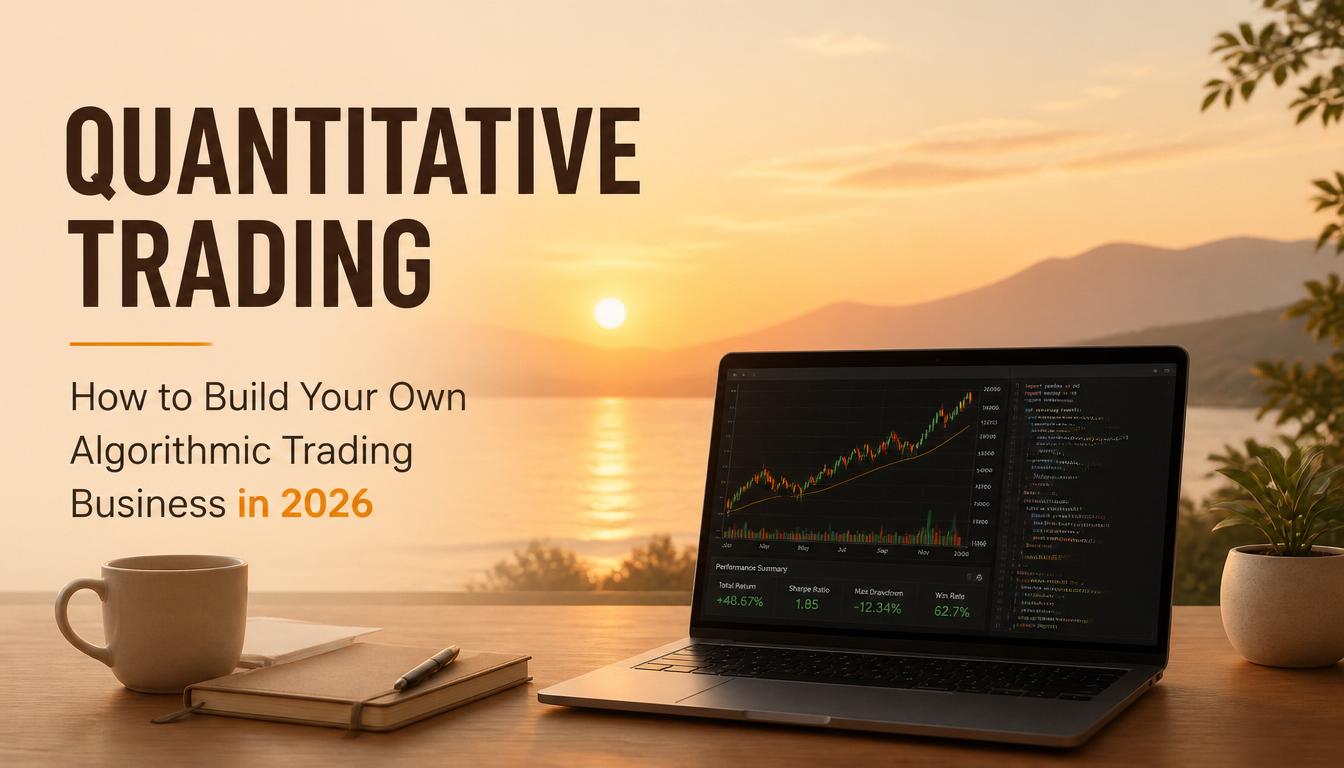
    Quantitative Trading: How to Build Your Own Algorithmic Trading Business in 2026

    Meta description: A practical, end-to-end blueprint for building your own quant trading business in 2026 — strategy, tech stack, capital, legal structure, and the realistic path. (159 chars)

    Table of Contents

    1. Is this actually realistic? A blunt assessment
    2. The four pillars of a quant trading business
    3. Phase 1: Become a profitable trader (before anything else)
    4. Phase 2: Build the technical stack
    5. Phase 3: Validate with real money (paper trading isn’t enough)
    6. Phase 4: Choose your business structure
    7. Phase 5: Raise capital — or stay proprietary
    8. The hidden costs nobody warns you about
    9. A realistic 18-month roadmap
    10. FAQ
    11. Key takeaways

    Is This Actually Realistic? A Blunt Assessment

    Let’s start with the awkward truth.

    The phrase “quantitative trading: how to build your own algorithmic trading business” is the literal title of the second edition of Ernie Chan’s well-known Wiley book, and the book is excellent. But it’s also a decade-plus old in its core thesis, and the landscape has shifted in two opposing directions since: the barrier to entry has collapsed, while the bar for sustained profitability has risen sharply. Wiley

    Today, anyone with a laptop, $5K, and a broker API can run an algorithmic trading bot by tomorrow morning. That’s genuinely new. But the people you’re competing against — Renaissance, Two Sigma, Citadel, Jane Street, plus thousands of well-funded prop shops — have only gotten faster, smarter, and better-capitalized.

    So the realistic answer is: yes, you can build a quant trading business as an independent operator. Thousands of people do. But it will not look like a hedge fund out of a movie, and your edge will not come from competing on speed or data scale. It will come from operating in niches the big players ignore, executing patiently, and treating it as a real business rather than a get-rich-quick project.

    This guide is structured as a practical build plan — strategy, tech, capital, and legal structure — with realistic costs and a phased timeline.


    The Four Pillars of a Quant Trading Business

    Before getting tactical, it helps to see what you’re actually building. A functional quant trading business has four pillars:

    1. A profitable, validated strategy — the alpha source
    2. A reliable technical stack — research, backtesting, execution, monitoring
    3. Sufficient capital — your own, or someone else’s (which changes everything legally)
    4. A legal/operational wrapper — sole proprietor, LLC, prop firm, CTA, RIA, or hedge fund

    Most aspiring quant traders obsess over pillar one and ignore the other three. That’s why most quant trading businesses fail — not because the strategy didn’t work in backtest, but because the rest of the business wasn’t built.


    Phase 1: Become a Profitable Trader (Before Anything Else)

    This is the phase everyone wants to skip. Don’t.

    Before you incorporate, raise capital, or register with regulators, you need a strategy — or a small portfolio of strategies — that has actually made money in live markets across multiple market regimes. Not a backtest. Not a paper trade. Real P&L, in your own brokerage account, ideally for at least 6–12 months.

    What “a strategy” actually means

    A quant strategy is a hypothesis about market behavior, expressed mathematically, that you’ve tested rigorously. The classic categories include:

    • Mean reversion — assets that move away from their average tend to come back
    • Momentum / trend-following — assets that have been moving in a direction tend to continue
    • Statistical arbitrage — exploiting temporary mispricings between correlated assets
    • Carry / yield — earning the spread between funding costs and yields
    • Event-driven — trading around earnings, index rebalances, macro releases
    • Market-making — providing liquidity and capturing the bid-ask spread

    For an independent operator, mean reversion in equities and ETFs or trend-following in futures are the most accessible starting points. They’re well-studied, work across regimes (most of the time), and don’t require institutional-grade infrastructure.

    Skills you’ll need

    To do this seriously, you need working competence in:

    • Python (with pandas, NumPy, statsmodels, scikit-learn, and a backtesting framework like backtrader, vectorbt, or zipline-reloaded)
    • Statistics and probability — at minimum, regression, hypothesis testing, time-series basics
    • Market microstructure — order types, slippage, transaction costs, exchange mechanics
    • Risk management — position sizing, drawdown control, leverage, the Kelly criterion

    You don’t need a PhD. You do need to put in the hours. Most successful retail quants describe a 1–2 year period of full-time learning before consistent profitability.

    The backtest discipline

    This is where almost everyone fails. A good backtest:

    • Uses point-in-time data (no survivorship or look-ahead bias)
    • Includes realistic transaction costs and slippage
    • Reports walk-forward or out-of-sample performance, not just in-sample
    • Tests across multiple market regimes (bull, bear, high-vol, low-vol)
    • Reports proper risk metrics: Sharpe ratio, Sortino, max drawdown, drawdown duration, hit rate, expectancy

    A strategy that looks great on a single backtest of 2015–2024 SPY data tells you almost nothing. A strategy that holds up under walk-forward validation across 20 years, multiple asset classes, and reasonable cost assumptions is worth taking to live trading.


    Phase 2: Build the Technical Stack

    A modern retail quant stack has four layers, and each has good off-the-shelf options.

    Data

    You need historical data for research and live data for execution. Common sources:

    • Free / cheap: Yahoo Finance (yfinance), Alpha Vantage, Polygon free tier, broker-provided feeds
    • Paid retail: Polygon, IEX Cloud, Norgate Data (for futures), QuantConnect’s bundled data
    • Institutional: Refinitiv, Bloomberg, FactSet (rarely necessary at this stage)

    A common beginner mistake is paying for institutional data before you have a working strategy. Don’t. Start with free or cheap data, validate the idea, then upgrade.

    Research and backtesting environment

    The dominant choice is Python in Jupyter notebooks for research, with a more structured backtesting library for validation. Python has become the dominant language in retail and much of institutional quantitative work. Libraries like pandas, NumPy, scikit-learn, PyTorch, and vectorbt make data handling and strategy development accessible. C++ remains standard where latency matters, particularly in high-frequency strategies. NURP –

    For most independent operators, Python is enough. You only need C++ if you’re competing on latency, which you almost certainly aren’t.

    Execution platform

    Your broker and its API matter more than people realize. Options:

    • Interactive Brokers — gold standard for breadth (stocks, options, futures, FX, global markets), excellent API, supports family-and-friends programs
    • Alpaca — commission-free equity trading, modern REST API, popular with retail algo traders
    • TradeStation, NinjaTrader, Tradier — good for futures and active retail traders
    • QuantConnect — full cloud research and execution platform with integrated brokers
    • Crypto: Coinbase, Kraken, Binance, Bybit — depending on jurisdiction

    Monitoring and operations

    Once you’re live, you need basic ops infrastructure:

    • A reliable VPS or cloud server (AWS, DigitalOcean, dedicated VPS) so your bot isn’t tied to your laptop
    • Logging and alerting — at minimum, email/SMS alerts when something breaks
    • Kill switch — a way to flatten positions immediately if the algo misbehaves
    • Daily P&L reconciliation between your records and your broker

    Regulators expect this even for institutional traders: algorithm governance must include automated and manual controls to prevent runaway algorithms or erroneous trades — position limits, velocity controls, loss limits, manual kill switch, automated kill switch, and pre-trade risk checks. You should build the retail version of this for yourself regardless of regulatory status. One runaway algo can wipe out a year of returns in an afternoon. Terms


    Phase 3: Validate With Real Money (Paper Trading Isn’t Enough)

    Paper trading is useful for finding obvious bugs, but it’s a poor predictor of live performance for two reasons:

    1. No real slippage or fills. Your paper engine assumes you got the price you wanted. In live markets, you often don’t.
    2. No emotional skin in the game. It’s easy to follow your system in simulation. Following it after a 15% drawdown of real money is a different psychological exercise.

    The right move after backtesting is small live trading — sometimes called “production paper” — with real money at meaningfully smaller size than your eventual target. Run it for at least three months. Track the gap between expected and realized performance. Diagnose every divergence.

    Only after this phase do you have a strategy worth scaling — or, more importantly, worth raising outside capital around.


    Phase 4: Choose Your Business Structure

    This is where “trading” turns into a “business.” The right structure depends on one question: are you trading your own money, or someone else’s?

    Trading only your own money

    If you’re trading proprietary capital — your savings, no outside investors — the legal overhead is minimal. Trading as an individual is quite simple — it really doesn’t require anything in terms of regulation aside from a brokerage account and capital. QuantInsti

    You should still consider forming an LLC for:

    • Liability protection
    • Cleaner tax treatment (especially if you qualify for trader tax status)
    • Separation of personal and business finances
    • Credibility if you eventually want to raise outside capital

    Cost: $50–$500 to form, plus a registered agent if you’re not in your home state.

    Trading other people’s money (US-specific)

    This is where it gets complicated, and where most people underestimate the work. Your options:

    Family and friends program (Interactive Brokers) — A common starting point. The Interactive Brokers family and friends program enables a trader to manage up to 15 accounts without having to register as an investment advisor. Caps and conditions apply, but it’s the lowest-friction way to manage outside capital. QuantStart

    Commodity Trading Advisor (CTA) — If you trade futures, options on futures, or retail forex for clients, you typically need to register as a CTA with the CFTC and join the NFA. The National Futures Association (NFA) is the self-regulatory organization for the U.S. derivatives industry, and all CTAs must be NFA members before commencing business. CTAs typically use Limited Power of Attorney to trade client accounts, which means clients keep custody — a meaningful regulatory simplification. Terms

    Registered Investment Adviser (RIA) — Required if you advise others on securities (equities, ETFs, options on securities) for compensation. Registration is with the SEC (over ~$110M AUM) or your state (under that). It’s a meaningful undertaking — SEC Rule 204-2 (Books and Records) requires RIAs to maintain emails, client communications, trade confirmations, and advisory materials for 5 years — and most independent operators hire a compliance consultant to set this up. Terms

    Hedge fund (LP/LLC structure) — Pooling outside capital into a fund. The most flexible but also the most expensive structure. Legal setup runs $30K–$75K+ in attorney fees, plus ongoing audit, admin, and compliance costs that easily exceed $100K/year. Generally not worth doing until you have $5M+ in committed capital.

    Prop firm — Trading proprietary capital, often firm-provided. Traders at prop funds trade the firm’s capital, rather than money from retail and institutional investors. This isn’t really “your business” in the traditional sense, but modern remote prop firms (FTMO, Topstep, Funding Pips, etc.) offer a hybrid path: you trade their capital after passing an evaluation, split profits, no client management. QuantStart

    If you’re outside the US, the analogous structures exist (FCA in the UK, AFSL in Australia, MAS in Singapore, etc.) but the threshold logic is similar.


    Phase 5: Raise Capital — Or Stay Proprietary

    This is the most underappreciated strategic decision in the business.

    The proprietary path

    You trade only your own money. Forever, or until you choose to raise. Advantages:

    • No client management, no fundraising, no compliance overhead
    • 100% of returns are yours
    • You can run strategies (high-vol, niche, illiquid) that wouldn’t suit outside investors
    • You can shut down, pivot, or take a year off

    Disadvantages:

    • Your AUM is capped by your savings rate and returns
    • No management or performance fees to smooth income
    • Slower wealth-building unless your strategy is exceptional

    The capital-raising path

    You raise outside money — friends/family, accredited investors, eventually institutions. Advantages:

    • AUM (and fees) compound faster than your trading P&L alone
    • Forces operational discipline early
    • Track record can be packaged for larger allocators down the line

    Disadvantages:

    • Significant legal, compliance, and operational overhead
    • Investor reporting, redemptions, marketing
    • Career risk during drawdowns — your money will leave at the worst possible moment

    A common pragmatic path: start proprietary for 12–24 months, build a real audited track record, then either (a) take in family-and-friends accounts via a CTA structure, or (b) get allocated by a multi-strategy fund or family office that liked your numbers.


    The Hidden Costs Nobody Warns You About

    A few line items that consistently surprise new operators:

    • Data subscriptions: $0 to several thousand dollars per month once you start needing point-in-time fundamentals, options chains, or alternative data
    • VPS / cloud infrastructure: $50–$500/month for a reliable setup
    • Legal and accounting: LLC formation, trader tax status filings, possibly fund formation later — easily $5K–$20K in year one if you go beyond a sole proprietorship
    • Compliance consulting (if you go RIA/CTA): $10K–$50K to set up, then $1K–$5K/month ongoing
    • Brokerage minimums and margin requirements: PDT rules require $25K minimum for active equity day trading in the US; futures and options have their own margin schedules
    • Your own time valued honestly: 12–24 months at near-full-time effort before reliable income

    The “$5K and a laptop” version exists, but the serious business build typically requires $25K–$100K of personal runway in the first year before fees and trading P&L can sustain it.


    A Realistic 18-Month Roadmap

    Here’s a concrete timeline that mirrors how most successful independent quant operations actually get built.

    Months 1–3: Foundation Learn Python, pandas, and the basics of market microstructure. Pick one strategy family (e.g., equity mean reversion). Set up Interactive Brokers or Alpaca paper account. Start reading — Ernie Chan, Lopez de Prado, Marcos’s Advances in Financial Machine Learning, Robert Carver’s Systematic Trading.

    Months 4–6: First strategy Build, backtest, and rigorously validate your first real strategy. Properly. Walk-forward, transaction costs, multiple regimes. Be ruthless about overfitting.

    Months 7–9: Small live trading Deploy with real money at small size ($5K–$25K). Build monitoring, logging, and kill-switch infrastructure. Track every divergence between backtest and live performance.

    Months 10–12: Scale and second strategy If the first strategy is performing, scale it. Start researching a second, ideally uncorrelated strategy. Form an LLC if you haven’t already.

    Months 13–15: Operational maturity Move to a VPS-hosted setup. Implement automated daily reporting. Establish proper bookkeeping. Consider trader tax status with your CPA.

    Months 16–18: Strategic decision By now you have ~12 months of audited live returns. Decide: stay proprietary, take family-and-friends accounts (CTA registration), or pitch a multi-strategy fund for an allocation.

    The traders who succeed are the ones who treat the first 18 months as building the business, not as chasing returns.


    FAQ

    How much money do I need to start? For a proprietary single-trader setup, $25K–$50K is a realistic floor — it lets you trade meaningful size, pass any pattern day trader thresholds, and survive normal drawdowns without ruin. You can technically start smaller, but the math gets brutal once you account for fixed costs.

    Do I need to register with the SEC or CFTC? Only if you’re managing other people’s money. Trading purely your own capital requires no registration in the US beyond standard brokerage and tax obligations. The moment you take outside funds for compensation, the rules change quickly.

    Is the Ernie Chan book still worth reading? Yes. The second edition of Ernie Chan’s Quantitative Trading includes updated backtests, Python and R code examples, and new material on machine learning techniques. It’s not the most technically deep book in the genre, but for understanding how to operate as an independent quant, it remains one of the better starting points. Wiley

    How long until I’m profitable? Be honest: most people who try this never become consistently profitable. Of those who do, 1–3 years of focused work is typical before reliable, scalable returns. Anyone promising a faster path is selling something.

    Should I use AI / machine learning from the start? No. Start with simple, interpretable rule-based strategies. Add ML only after you understand why your simpler strategies work and where they fail. ML accelerates good research and amplifies bad research equally.

    Can I do this part-time? Research and strategy development, yes. Running a live trading business across multiple markets while holding a full-time job — possible but harder, especially with intraday strategies. End-of-day, weekly, or longer-horizon systems are much more compatible with part-time operation.

    What’s the biggest reason quant businesses fail? Not strategy failure. It’s running out of personal runway before the business matures, or scaling outside capital before having a robust enough operation to survive a normal drawdown. Treat it as a business build, not a trading challenge.


    Key Takeaways

    • Building your own quantitative trading business in 2026 is genuinely feasible for independent operators — but it’s a business build, not a side project.
    • The four pillars are strategy, technology, capital, and legal structure — neglect any one and the business fails.
    • Get profitable trading your own money first. Outside capital amplifies whatever you bring to it, including problems.
    • Your tech stack should match your stage: Python, a retail broker API, and cloud hosting are enough for almost any independent operator’s first two years.
    • Choose your legal structure based on whose money you’re trading — sole proprietor or LLC for prop, CTA for managed futures, RIA for securities advisory, hedge fund only at scale.
    • Budget 12–24 months of personal runway, $25K–$100K of capital and operating costs, and the assumption that your first strategy probably won’t be your durable one.
    • Ernie Chan’s book of the same title is still the canonical practitioner reference — pair it with Robert Carver’s Systematic Trading and Marcos López de Prado’s Advances in Financial Machine Learning for a well-rounded foundation.

    The realistic path is unglamorous: build one validated strategy, deploy it cleanly, document everything, survive your first drawdown, then expand. The traders who treat it that way are the ones still trading in five years.

  • AI Trading vs Algorithmic Trading vs Quantitative Trading: What’s Actually Different (And Which One Should You Learn First?)

    AI Trading vs Algorithmic Trading vs Quantitative Trading: What’s Actually Different (And Which One Should You Learn First?)

    Meta description: AI trading, algo trading, and quant trading sound interchangeable but solve different problems. Here’s the clear, practical breakdown — with examples. (157 chars)

    Table of Contents

    1. Why these three terms get confused
    2. Quantitative trading: the “what to trade and why”
    3. Algorithmic trading: the “how to execute it”
    4. AI trading: the “let the model figure it out”
    5. The stack analogy: how the three actually fit together
    6. Side-by-side comparison
    7. Which one should you learn first?
    8. Real-world examples from the top quant firms
    9. Common pitfalls and misconceptions
    10. FAQ
    11. Key takeaways

    Why These Three Terms Get Confused

    If you’ve spent any time on finance Twitter, quant subreddits, or YouTube, you’ve probably seen “quant trading,” “algo trading,” and “AI trading” used as if they’re synonyms. They aren’t — but the confusion is understandable, because the same firm often does all three at once.

    Here’s the headline difference, stated plainly:

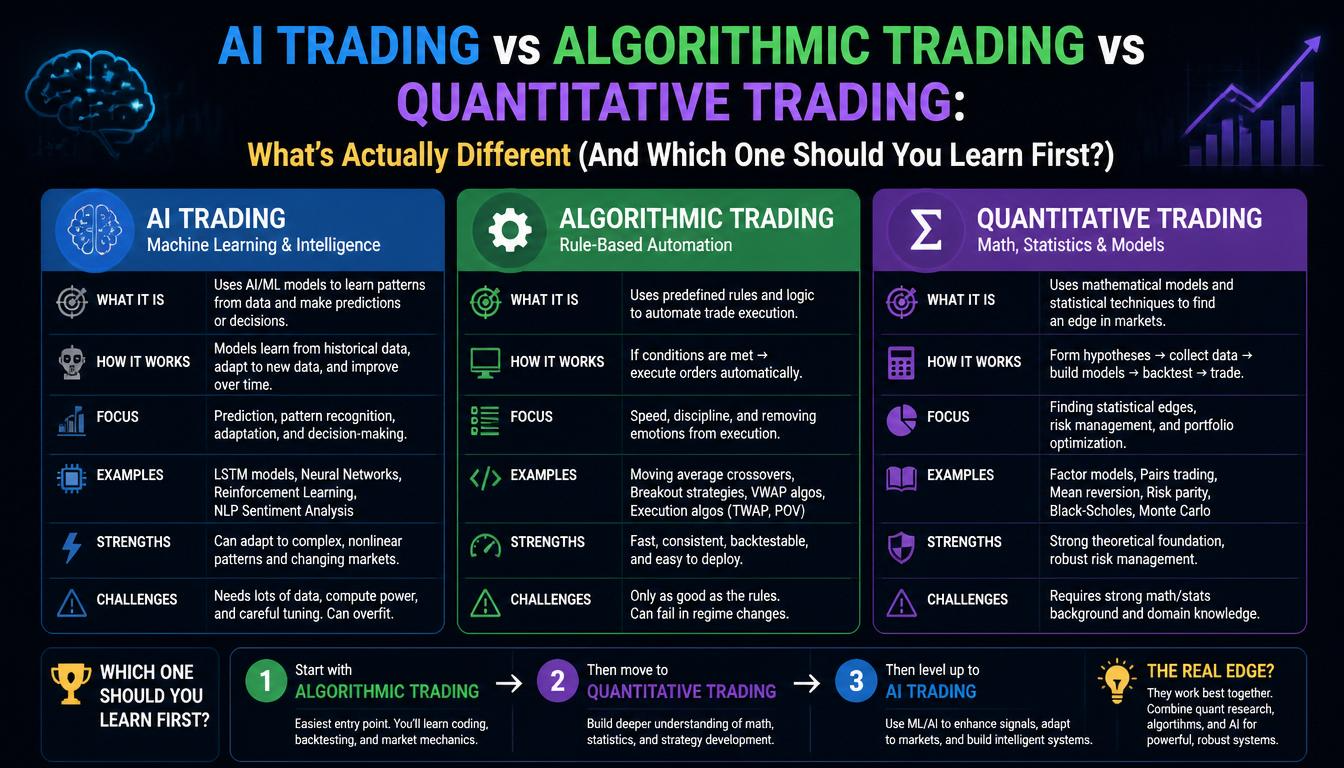
    • Quantitative trading is about deciding what to trade, using math and statistics.
    • Algorithmic trading is about executing trades automatically, using pre-defined rules.
    • AI trading is about learning what to trade, using machine learning models that adapt to data.

    They are layers, not competitors. A serious modern trading operation usually combines all three. But conceptually they live in different places, and if you’re trying to break into the field, knowing which one you’re actually studying matters a lot.

    The scale is also worth grounding. Algorithmic execution now dominates modern markets — Coalition Greenwich found that electronic trading platforms captured 44% of buy-side U.S. equities order flow in 2023, with approximately 37% of overall volume executed through algorithms and/or smart order routers. The global algorithmic trading market was estimated at USD 21.06 billion in 2024 and is projected to reach USD 42.99 billion by 2030, growing at a CAGR of 12.9%, with AI and machine learning integration cited as a primary growth driver. So the categories aren’t academic — they’re where the money is. GreenwichGrand View Research

    Let’s go through them one at a time.


    Quantitative Trading: The “What to Trade and Why”

    Quantitative trading (or “quant trading”) is the discipline of using mathematics, statistics, and large datasets to identify trading opportunities. A quant’s job is essentially to find an edge — a statistically significant pattern in market data that can be exploited for profit.

    A quant doesn’t necessarily care about how the trade gets placed. They care about whether the strategy works. Their core questions are:

    • What variables predict future price movement?
    • Is the pattern statistically significant, or is it noise?
    • Does the edge survive out-of-sample testing?
    • What’s the risk-adjusted expected return?

    To get there, quants build mathematical models — often involving regression analysis, time-series econometrics, stochastic calculus, and increasingly machine learning. They lean heavily on programming languages like Python, R, C++, and Java, and on disciplines like probability theory and linear algebra.

    A classic example: a quant model might observe that gold tends to rally after weak U.S. job reports, using 10 years of data to confirm the edge. That insight — derived from data, validated statistically — is the strategy. Whether the resulting trade is then placed manually by a trader or executed by an algorithm is a separate question. Gomoon

    This is why quantitative trading is sometimes called systematic trading: the decisions come from a system, not from intuition.


    Algorithmic Trading: The “How to Execute It”

    Algorithmic trading — also called algo trading or automated trading — is the use of computer programs to execute trades automatically based on pre-defined rules.

    The defining feature of an algo is that it’s deterministic: given the same input, it always produces the same output. The rules are explicit and human-designed. Classic examples include:

    • VWAP/TWAP execution — slicing a large order across the day to match volume-weighted or time-weighted average price
    • Moving-average crossovers — buying when a short-term average crosses above a long-term average
    • Statistical arbitrage pairs trades — buying one asset and shorting a correlated one when their spread diverges
    • Smart order routing — fragmenting an order across multiple exchanges to find the best price

    Algos are about speed, precision, and removing emotion. They don’t decide what to trade in any sophisticated sense — they execute what they’ve been told to execute. As one practitioner notes, algos don’t care if the strategy is complex or simple — they just run the logic with precision. Gomoon

    Importantly, algorithmic trading does not require AI or even particularly advanced statistics. A simple rule like “if RSI < 30, buy 100 shares” is technically an algorithmic strategy. That’s why algo trading is the most accessible of the three for retail traders — platforms like MetaTrader, NinjaTrader, and various crypto bots let you deploy rule-based strategies without a PhD.


    AI Trading: The “Let the Model Figure It Out”

    AI trading is where things get more recent — and more interesting. Instead of writing explicit rules, AI trading uses machine learning models that learn patterns from data.

    The key difference: a traditional algo says, “if X then Y.” An AI model says, “given everything I’ve seen, here’s the probability of Y given X” — and it updates that estimate as it sees more data.

    The techniques sitting under “AI trading” include:

    • Supervised learning — predicting next-day returns, volatility, or direction
    • Deep learning — using neural networks to find non-linear patterns in market and alternative data
    • Reinforcement learning — letting an agent discover trading policies by maximizing reward over time
    • Natural language processing (NLP) — extracting signal from news, earnings transcripts, social media, and SEC filings
    • Computer vision — analyzing satellite imagery, shipping traffic, and parking-lot data

    AI trading also relies heavily on alternative data — non-traditional inputs like credit card transactions, geolocation pings, web-scraped product prices, and sentiment from social platforms. Two Sigma, for instance, feeds vast amounts of data — including news articles, satellite images, and financial reports — into their machine-learning models to make informed predictions. DigitalDefynd

    The trade-off is significant. AI models can capture relationships that no human would think to code — but they’re often opaque (“black box”), prone to overfitting, and harder to debug when they fail. When a traditional algo breaks, you can read the code. When an AI model breaks, you might not know why it stopped working.


    The Stack Analogy: How the Three Actually Fit Together

    Here’s the mental model that ties it all together. Think of trading as a three-layer stack:

    Layer 1 — Strategy (Quantitative): What’s the edge? What pattern, anomaly, or relationship will we exploit? This is where math, statistics, and increasingly ML do their work.

    Layer 2 — Intelligence (AI): How do we discover and refine that edge? Traditional quants might use regression and hand-crafted features. AI-driven quants let models learn the features themselves from larger, messier datasets.

    Layer 3 — Execution (Algorithmic): Once we’ve decided to trade, how do we actually place the orders? This is pure algo trading — order routing, slicing, latency optimization, exchange-side mechanics.

    In practice, a quantitative model generates a trading signal, and an algorithmic system then places the order — splitting it across exchanges, adjusting for liquidity, and managing execution speed. Gomoon

    So when someone says “I want to learn quant trading,” they usually mean Layer 1 (and increasingly Layer 2). When they say “I want to build a trading bot,” they usually mean Layer 3 with a simple Layer 1 strategy bolted on. And when they say “AI trading,” they mean Layer 2 — typically being applied to enhance Layer 1.


    Side-by-Side Comparison

    DimensionQuantitative TradingAlgorithmic TradingAI Trading
    Primary purposeFind the edgeExecute trades efficientlyLearn the edge from data
    Decision logicMath + statistics, rule-basedExplicit, human-coded rulesLearned from data, often opaque
    Skill requirementsStatistics, math, programmingProgramming, market structureML, data engineering, statistics
    AdaptabilityRe-calibrated periodicallyStatic unless rewrittenContinuously learns / retrains
    Common techniquesRegression, factor models, stat arbVWAP, TWAP, smart order routing, MA crossoversDeep learning, RL, NLP, computer vision
    InterpretabilityHighVery highOften low
    Retail accessibilityMediumHighLow-to-medium
    Typical riskModel misspecificationLogic bugs, latencyOverfitting, data leakage, black-box failure

    Which One Should You Learn First?

    If you’re new and trying to figure out where to start, here’s an honest guide:

    Start with algorithmic trading if you want hands-on experience fast. The barrier is low. You can build a moving-average crossover bot on a free platform in a weekend. You’ll learn market mechanics, order types, slippage, and backtesting — all of which you need regardless of where you go next.

    Move into quantitative trading if you want to understand why strategies work. This is where you study statistics, time-series analysis, factor investing, and risk modeling. It’s slower to produce results but builds genuine intuition. Python with libraries like pandas, NumPy, statsmodels, and backtrader is the standard starting toolkit.

    Layer on AI trading once you have a working knowledge of both. AI without quant fundamentals is dangerous — you’ll build models that look great in backtests and fail catastrophically in production. Most overfitting disasters come from people who jumped to machine learning before learning what a stationary time series is.

    A reasonable learning sequence:

    1. Build a simple rule-based algo (e.g. on Python with backtrader or QuantConnect)
    2. Learn proper backtesting, walk-forward validation, and risk metrics
    3. Study factor investing and statistical arbitrage
    4. Add ML carefully — start with linear models, then trees, then deep learning
    5. Explore reinforcement learning and alternative data only after the foundations are solid

    Real-World Examples From the Top Quant Firms

    The biggest names in systematic trading illustrate how these layers blend in practice.

    Renaissance Technologies, founded by mathematician Jim Simons in 1982, is the archetypal quant firm. Its secretive Medallion Fund has earned an estimated annualized return of 35% since 1982. Renaissance famously hires PhDs in mathematics, physics, and signal processing rather than traditional Wall Street traders, and unifies its research under a single integrated model. GitHub

    Two Sigma, founded in 2001 and managing US$70 billion in AUM as of 2025, is the clearest example of AI-driven quant. The firm uses a variety of technological methods, including artificial intelligence, machine learning, and distributed computing, for its trading strategies. Performance has been strong — Two Sigma achieved strong double-digit gains in 2024 using algorithm-driven strategies, with the Spectrum fund returning 10.9% and Absolute Return Enhanced posting 14.3%. Wikipedia + 2

    Citadel sits at the intersection of all three. The firm employs reinforcement learning models to optimize trading strategies, using AI to learn the best policies to maximize returns while minimizing risks, while Citadel Securities — its market-making arm — operates massive algorithmic execution infrastructure for high-frequency trading. Medium

    D.E. Shaw, Jane Street, and Jump Trading round out the top tier, each blending quantitative research with sophisticated algorithmic execution and increasingly AI-driven model development.

    The consistent pattern: every leading firm uses quant strategy + algorithmic execution + AI-driven research as complementary pieces, not competing approaches.


    Common Pitfalls and Misconceptions

    A few mistakes that come up constantly:

    “AI trading is just better algo trading.” No. AI trading is harder to interpret, more data-hungry, and easier to overfit. It’s a different tool with different failure modes. When a rule-based algo fails, you read the rule. When an AI model fails, you might never fully know why.

    “Quant trading guarantees high returns because it’s mathematical.” Math doesn’t beat markets; edges do. Markets adapt, edges decay, and quant strategies can underperform for years. Renaissance is famous because it’s extraordinary — most quant funds don’t post 35% annualized returns.

    “I need a PhD to do any of this.” For top hedge funds, often yes. For learning the craft and trading retail capital, no. The mathematics gets deep quickly, but the entry point doesn’t require it.

    “More data and a fancier model will fix my backtest.” Almost never. Most retail-built strategies fail because of look-ahead bias, survivorship bias, or overfitting — not because the model wasn’t deep enough.


    FAQ

    Is AI trading a subset of algorithmic trading? Technically yes — any automated trade is algorithmic — but conceptually it’s useful to keep them separate. Algo trading typically refers to deterministic rule-based execution; AI trading refers to learned, adaptive decision-making. The mechanism is automated in both cases, but the source of the decisions is fundamentally different.

    Can a retail trader realistically do AI trading? You can experiment with it, but compete with institutional AI? Not really. The biggest funds spend billions on data, infrastructure, and talent. Retail AI trading is best treated as a learning exercise or a way to enhance personal strategies — not a path to consistent alpha against firms like Two Sigma.

    What’s the difference between quantitative trading and high-frequency trading (HFT)? HFT is a subset of algorithmic trading focused on extremely fast execution — milliseconds or microseconds — usually exploiting tiny, short-lived price inefficiencies. Quant trading is broader and includes strategies that hold positions for weeks or months. Many quant firms do HFT, but most quant trading isn’t HFT.

    Do I need to know C++ to do this? Only if you’re going into HFT or ultra-low-latency execution at a major firm. For most quant and AI trading, Python is the dominant language, with R as a secondary option.

    Which is most profitable for an individual? Honestly, none of them are reliably profitable for individuals without significant work. The most realistic path for a retail trader is a simple, well-tested rule-based algo strategy applied to a market they understand deeply. AI trading at retail scale is mostly aspirational.

    Is algo trading legal? Yes, in nearly all major markets, though heavily regulated. The SEC, FINRA, ESMA, and other regulators have specific rules around market manipulation, order-to-trade ratios, and systemic risk for algorithmic and high-frequency strategies.


    Key Takeaways

    • Quantitative trading is about identifying statistically valid trading edges using math and data.
    • Algorithmic trading is about executing trades automatically using pre-defined rules.
    • AI trading is about using machine learning to discover and adapt strategies that traditional rule-based approaches would miss.
    • They’re complementary layers, not alternatives. The top firms — Renaissance, Two Sigma, Citadel, D.E. Shaw — use all three.
    • For a beginner, start with rule-based algo trading, build statistical foundations through quant work, and add AI techniques only after the basics are solid.
    • Algorithmic execution dominates modern markets, accounting for an estimated 60–75% of U.S. equity trading volume, and the AI-driven slice of that share is growing fastest.

    The terms will keep getting used loosely. But now, when someone tells you they’re “doing AI trading,” you’ll know exactly which layer of the stack they’re actually working on — and which questions to ask next.


    Want me to adapt this into a different format (Word doc, Medium post, LinkedIn article) or write a follow-up piece on a specific sub-topic — e.g., “How to actually build your first quant strategy in Python” or “Why most AI trading backtests are lying to you”?

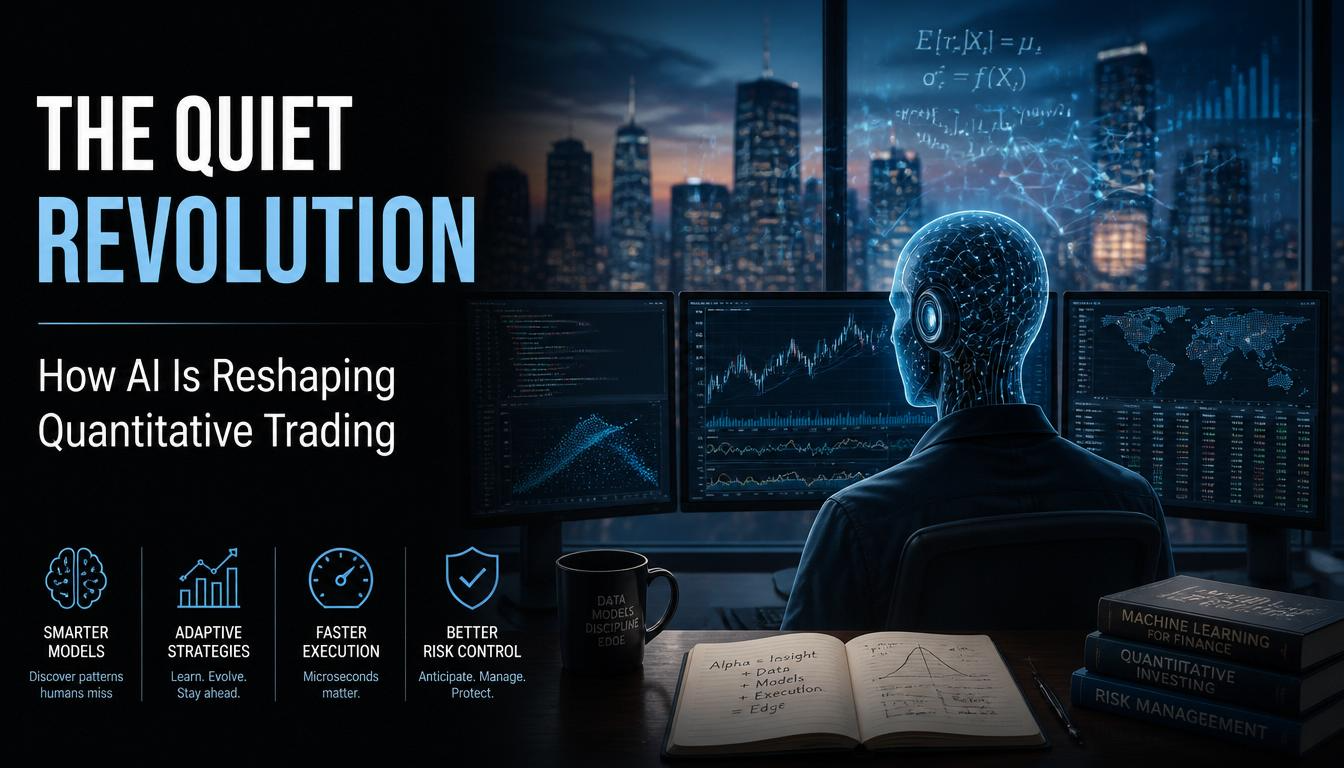
  • The Quiet Revolution: How AI Is Reshaping Quantitative Trading

    The Quiet Revolution: How AI Is Reshaping Quantitative Trading

    In the spring of 2024, a Bank of England survey returned a number that would have been unthinkable a decade earlier: 75% of financial firms now deploy some form of AI in their operations, and among large banks, insurers, and asset managers, the figure hits 100%. The quantitative trading world, long defined by mathematicians in quiet rooms building factor models and running regressions, has crossed a threshold. What began as rule-based automation — if the 50-day moving average crosses the 200-day, buy — has become something far more fluid: systems that learn, adapt, and form convictions from data no human analyst could ever process.

    This is not a story about machines replacing human traders. It is a story about what happens when the tools of modern artificial intelligence — deep neural networks, reinforcement learning, large language models — meet a domain that has always been, at its core, a signal extraction problem. Financial markets generate an ocean of data every second. Prices, volumes, order-book microstructure, news headlines, earnings call transcripts, satellite images of parking lots, shipping-container counts at ports. The question has always been: what matters? AI is fundamentally changing which signals get found, how portfolios get built, and what it means to have an edge.

    From Linear Regression to Neural Architecture

    Classical quantitative finance was built on a foundation of linear models and econometric assumptions. Factor investing — the idea that stocks can be explained by exposure to a handful of systematic drivers like momentum, value, size, and quality — powered decades of hedge fund returns. The models were interpretable, their assumptions well-understood, and their limitations well-known: they could not capture nonlinear relationships, regime changes, or the kind of complex interaction effects that real markets exhibit.

    Machine learning changed the terms of engagement. Where a linear regression sees a straight line, a gradient-boosted tree sees branching decision boundaries. A neural network sees layered representations. The shift is not merely about accuracy — it is about modeling the world as it actually behaves: nonlinear, path-dependent, and governed by feedback loops that econometrics was never designed to handle.

    Consider the limit order book, the real-time record of every bid and ask sitting at every price level in an exchange. A single liquid stock might generate millions of order-book events in a day — cancellations, amendments, executions — each encoding micro-information about the intentions of market participants. A human trader cannot read this firehose. A deep learning model can. Recent research has applied transformer architectures and state-space models to order-book data, treating the stream of messages as a sequence-modeling problem not unlike natural language. The model learns the grammar of market microstructure: which patterns of order flow precede price moves, which configurations signal the presence of an informed trader, which cancellations are genuine and which are spoofing.

    The results are striking. Research published in 2025 demonstrated that LSTM-based neural networks applied to cryptocurrency portfolios achieved a Sharpe ratio of 2.975 with a profit percentage of 94.86% in backtesting — numbers that would make any portfolio manager sit up. A Sharpe ratio above 1.0 is generally considered good; above 2.0 is excellent; approaching 3.0 is the territory where systematic strategies begin to look almost too good to be true. Whether such performance survives the transition from backtest to live trading is an open question — and a deeply contested one — but the direction of travel is unmistakable.

    Reinforcement Learning and the Quest for Adaptive Strategy

    If supervised learning is about recognizing patterns in historical data, reinforcement learning is about learning to act in an environment where every action changes the state of the world. That makes it a natural fit for trading, where placing an order moves the market, taking profit alters the portfolio, and the optimal action at any moment depends on what you have already done and what the market has already absorbed.

    Reinforcement learning agents learn by trial and error in simulated environments, receiving rewards for profitable actions and penalties for losses. Over millions of simulated trading days, they develop policies — mappings from market states to actions — that no human designed and no static rule book could encode. The most advanced implementations use actor-critic architectures, where one network (the actor) proposes trades and another (the critic) evaluates them, both improving together through experience.

    The approach has found particularly fertile ground in derivatives hedging. The classic Black-Scholes framework gives a clean, closed-form answer for how to hedge an option: delta-hedge continuously, rebalancing as the underlying moves. But reality intrudes. Transaction costs eat into returns. Markets gap. Volatility is not constant. Deep distributional reinforcement learning models, such as D4PG with quantile regression, have been deployed by quantitative hedge funds to learn hedging policies that directly optimize risk-adjusted returns under real-world frictions, measuring Value-at-Risk and Conditional Value-at-Risk across different volatility regimes. These models do not merely approximate the theoretical hedge — they discover strategies that a human options trader might recognize as experience-hardened intuition, but backed by statistical rigor the trader could never articulate.

    Portfolio management, too, is being reimagined through reinforcement learning. Traditional mean-variance optimization asks: given expected returns and a covariance matrix, what is the optimal allocation? A reinforcement learning agent asks a more fundamental question: given a stream of market data and a goal, what sequence of trades maximizes terminal wealth while respecting risk constraints? Multi-agent frameworks take this further, assigning separate learning agents to different asset classes or sectors and letting them coordinate — or compete — toward a shared portfolio objective. The result is a system that can shift allocations not according to a fixed rebalancing schedule but in response to the texture of the market itself.

    The Language of Markets: LLMs and Sentiment at Scale

    For most of quantitative finance’s history, the information that moved markets was divided into two categories. Hard data — prices, volumes, economic statistics — could be modeled mathematically. Soft data — Fed chair speeches, earnings call nuance, geopolitical tension, the tone of a CEO’s shareholder letter — belonged to the domain of human judgment. Quantitative traders got prices and fundamentals; discretionary traders got narrative and sentiment. The wall between them was high.

    Large language models have started to dismantle it. The same architectures that power ChatGPT and Claude — transformer models trained on vast corpora of text — can be fine-tuned on financial language and deployed to read the textual universe that human analysts struggle to keep up with. Every earnings call transcript, every SEC filing, every Federal Reserve statement, every news article from every wire service, every post on financial social media — the volume is staggering, and it is all rich with signal for a model that can parse it.

    FinBERT, a BERT model fine-tuned specifically on financial text, was an early milestone. More recently, models like FinGPT have added dissemination-awareness and context-enrichment, understanding not just what a news item says but how it is spreading through information networks and what it means in the context of the company’s recent history. A 2025 benchmark study comparing LLMs against classical sentiment analysis approaches found that the large language models outperformed in the vast majority of cases — not marginally, but decisively.

    The frontier is moving beyond simple sentiment classification — positive, negative, neutral — toward something more subtle. Modern systems extract structured signals from unstructured text: the probability that a central bank will hike rates, inferred from the linguistic patterns in speeches; the degree of uncertainty in a management team’s forward guidance, measured by the ratio of hedging language to declarative statements; the implied correlation between two companies based on the co-occurrence patterns in analyst reports. These are signals that existed before but could not be systematically harvested. LLMs are turning soft data into hard data at industrial scale.

    The architecture for deploying these models is evolving rapidly. Quantized versions of large language models — QF-LLM and similar approaches — reduce the memory footprint and inference cost to the point where real-time sentiment monitoring becomes practical even for smaller funds. Retrieval-Augmented Generation, or RAG, lets systems ground their analysis in up-to-date financial databases rather than relying on training data that may be months old. Multi-LLM ensemble approaches, like FinSentLLM, combine the judgments of several models to produce sentiment forecasts more robust than any single model could deliver.

    The Alternative Data Revolution

    The public-market data that everyone can see — price, volume, fundamentals — has been arbitraged to near-death. The edges that remain lie in data that is public in principle but difficult to process at scale, or data that was never traditionally considered financial information at all.

    Satellite imagery of retail parking lots, analyzed by computer vision models, can estimate foot traffic at major chains before quarterly earnings are released. Natural language processing of shipping manifests and port congestion data can anticipate supply-chain disruptions that will show up in earnings three months later. Geolocation data from mobile phones can track consumer behavior patterns with a granularity that official statistics cannot match. Credit card transaction panels, web scraping of product prices, social media sentiment aggregated across millions of posts — each of these is a dataset that, properly cleaned and modeled, can generate alpha.

    The technical challenge is immense. Alternative datasets are messy, biased, irregularly sampled, and often enormous. A single satellite imagery provider might generate terabytes of new images daily. The skill is not in having the data — it is in engineering the pipeline that ingests it, cleans it, extracts features from it, and connects those features to financial outcomes without overfitting. This is where modern AI toolchains shine: convolutional neural networks for image data, transformer architectures for text, graph neural networks for supply-chain relationships, all orchestrated through cloud infrastructure that can scale to the data’s size.

    The modern quantitative trading system might incorporate over 200 factors spanning momentum, value, quality, market microstructure, sentiment, and alternative data — each one a hypothesis about what predicts returns, each one requiring rigorous statistical validation, and each one competing for a place in a portfolio that must balance signal decay against transaction costs. Feature engineering — the art and science of transforming raw data into predictive inputs — remains critical even in the age of deep learning. The best systems combine both: automatically learned representations from neural networks alongside hand-crafted features that encode domain knowledge about how markets work.

    High-Frequency Trading and the Speed Frontier

    No discussion of AI in quantitative trading is complete without confronting high-frequency trading, or HFT — the domain where speed itself is the strategy. As of 2026, HFT accounts for approximately 72% to 78% of all US equity trading volume. The trades are held for microseconds to milliseconds. The edge is not in predicting where a stock will be in a week; it is in being the first to react to an order-flow imbalance, an exchange-route latency differential, or a cross-asset correlation breakdown.

    AI’s role in HFT is constrained by a hard physical limit: inference time. A deep neural network that takes 10 milliseconds to produce a prediction is useless in a world where the competition is making decisions in 800 nanoseconds. The AI models used in HFT are necessarily small, specialized, and often implemented directly in hardware — FPGAs running lightweight gradient-boosted trees or compact fully-connected networks, optimized to the level of individual logic gates. The heavy lifting of model development happens offline, in simulation, where deep learning can explore the space of possible strategies; what gets deployed to the live trading path is a distilled, hardened version stripped of everything that costs a microsecond.

    This hardware-software co-design is one of the least visible but most expensive frontiers in quantitative finance. A top-tier HFT firm might spend tens of millions of dollars on microwave towers, custom FPGA boards, and the engineering talent to program them — all for an advantage measured in nanoseconds. AI is not separate from this arms race; it is the brains, and the hardware is the body.

    The Problem That Won’t Go Away: Overfitting and Decay

    Every quantitative researcher learns the same lesson eventually, usually the hard way: a backtest is a story you tell yourself about what might have happened, not a guarantee of what will happen. AI amplifies both the promise and the peril. A neural network with millions of parameters, trained on terabytes of data and optimized across thousands of hyperparameter combinations, can find patterns that are statistically significant in the training set and completely meaningless out of sample. The financial literature is littered with papers reporting spectacular Sharpe ratios that vanish the moment the strategy goes live.

    The problem is structural. Financial data is not like ImageNet. The data-generating process is non-stationary: the statistical properties of markets change over time as participants adapt, regulations shift, and macroeconomic regimes transition. A model trained on the low-volatility bull market of 2012–2019 may be catastrophically wrong in the volatile, rate-driven market of 2022–2023. The market is the ultimate adversarial environment, because every profitable strategy, once discovered and deployed, changes the very patterns it was designed to exploit. The strategy becomes part of the market, and the market adapts.

    The best quant funds treat model decay as a first-order concern, not an afterthought. They monitor performance degradation continuously, retrain on rolling windows, maintain ensembles of models trained on different regimes, and build kill-switches that deactivate strategies when their signal quality drops below a threshold. They treat models as perishable goods, not durable assets — a mindset fundamentally different from the “train once, deploy forever” approach that works in other AI domains.

    Regulation and the Black Box Problem

    When a linear regression says a stock should go up because it is cheap relative to its peers, a regulator can understand the reasoning. When a deep neural network with 50 million parameters produces the same conclusion, the reasoning is impenetrable — even to the people who built it. This is the black box problem, and it is attracting increasingly serious regulatory attention.

    The Bank for International Settlements highlighted AI’s dual nature in financial stability — “tremendous opportunity, serious risk” — in its June 2025 financial stability report. The concern is not merely about individual firms losing money on bad models. It is about systemic risk: the possibility that dozens of independently developed AI trading systems, trained on similar data and optimized for similar objectives, might all converge on the same behavior at the same moment — herding into the same positions, fleeing the same assets in a stress event, amplifying rather than dampening market dislocations.

    The regulatory response is still taking shape, but the direction is clear. Explainability requirements are likely to tighten. Model risk management frameworks, already standard at large banks, will need to evolve to accommodate non-linear, non-interpretable models. Stress testing may need to account for the possibility that AI agents, not human panic, could be the transmission mechanism for the next flash crash.

    This is not an argument against AI in trading. It is an argument that AI in trading is now systemically important, and systemically important things get regulated. The firms that thrive will be those that build not just the most accurate models, but the most robust ones — models that can explain themselves, models that degrade gracefully under stress, models embedded in governance structures that satisfy both regulators and internal risk committees.

    The Shifting Competitive Landscape

    One of the quieter transformations AI has brought to quantitative trading is who gets to play. A decade ago, building a systematic trading operation required hiring PhDs in physics and mathematics, leasing server rooms, and negotiating expensive data-feed contracts with exchanges. The barrier to entry was high enough that only well-capitalized hedge funds and bank desks could compete.

    That barrier is crumbling. Cloud computing puts institutional-grade infrastructure within reach of a small team. Open-source machine learning frameworks — PyTorch, TensorFlow, scikit-learn — are free and world-class. Alternative data vendors sell curated datasets to anyone with a subscription budget. Pre-trained language models can be fine-tuned on a single GPU. The result is a Cambrian explosion of small quantitative funds, many of them running AI-native strategies from the start rather than bolting machine learning onto a traditional factor-investing chassis.

    This democratization is not without tension. The largest firms still have advantages that are hard to replicate: proprietary datasets that no vendor sells, the ability to co-locate servers inside exchange data centers, teams of dozens of researchers attacking the same problem from different angles, and the capital to survive drawdowns that would wipe out a smaller competitor. But the gap is narrower than it has ever been, and it continues to narrow. The edge is shifting from who has the most data to who uses it most intelligently — and intelligence, in the age of open-source AI, is more evenly distributed than capital.

    What Comes Next

    The pace of change in AI makes prediction hazardous, but several trajectories are already visible.

    Multi-agent systems, where specialized AI agents handle different aspects of the trading problem — one for signal generation, another for execution, a third for risk management — and coordinate through structured communication, are moving from research papers to production. The vision is a trading desk where the strategist, the trader, and the risk manager are all AI agents, overseen by a human who intervenes only when the system flags an anomaly or a regime change.

    Generative AI is entering the quant workflow itself. Researchers are using large language models not just to analyze market sentiment but to generate hypotheses, write code for backtesting, and summarize research literature. A quant might describe a trading idea in natural language and have an LLM translate it into a Python backtesting script, run it against historical data, and produce a summary of the results — all in minutes rather than days. This collapses the cycle time from idea to test, which in quantitative finance is the fundamental unit of research productivity.

    Quantum computing for portfolio optimization remains experimental as of 2026, but the theoretical case is compelling. Constrained portfolio optimization — the problem of selecting the best combination of thousands of assets subject to risk, turnover, and exposure constraints — is computationally hard in ways that map naturally to quantum circuits. If and when practical quantum advantage arrives for this class of problem, the consequences for portfolio construction could be transformative. The prudent assumption, for now, is that quantum is a decade away but worth watching closely.

    The most important trend may be the one that gets the least attention: AI is making quantitative trading less purely quantitative. The old caricature of the quant as someone who believes only in numbers — who dismisses narrative, sentiment, and qualitative judgment as noise — is becoming obsolete. The new quant is someone who builds systems that integrate all available information, structured and unstructured, numerical and textual, historical and real-time, into a single coherent view of the market. AI is not replacing human judgment; it is expanding what judgment can be based on.

    The Edge That Endures

    Markets evolve. Models decay. Technology advances. The quantitative traders who thrive in 2026 will not be running the same strategies in 2027. The edge that endures is not any particular model or dataset — it is the capacity to keep learning, to adapt the research pipeline as the tools improve, to ask better questions as the answers to the old ones get priced in.

    What makes this moment different from previous waves of technological change in finance is the rate of improvement in the tools themselves. The AI models available to a quant today are qualitatively more capable than those available two years ago, and the models that will be available in two years will make today’s look primitive. A trading operation that treats AI as a static toolkit — something you install and use — will find itself behind within a quarter. An operation that treats AI as a moving frontier — something you continuously integrate, experiment with, and push against — has a chance.

    That is the quiet revolution. Not that AI can trade — that part is already settled. But that AI is changing what it means to be a quantitative trader, and the change is just getting started.
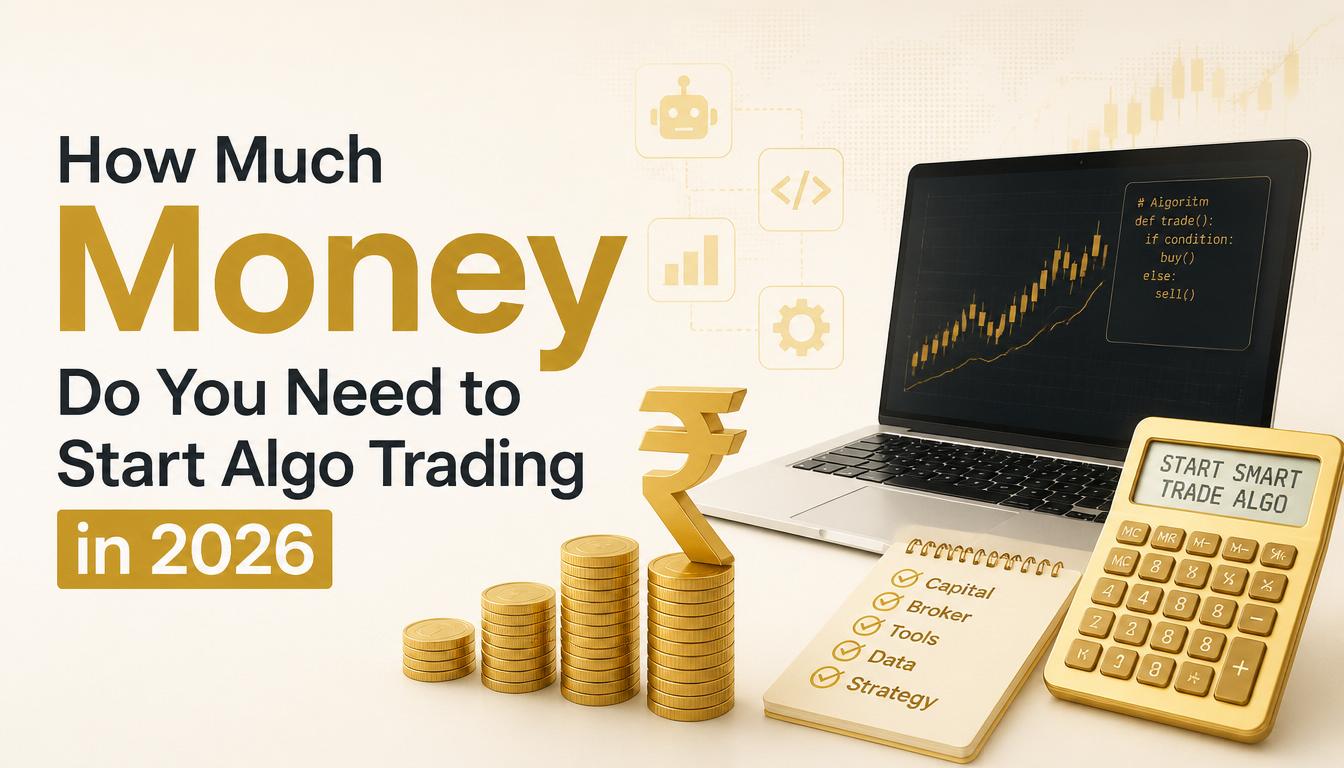
  • Best AI Video Generators in 2026: From Raw Idea to Finished Video

    Best AI Video Generators in 2026: From Raw Idea to Finished Video

    Two years ago, AI video was a party trick. You’d type a prompt, wait four minutes, and get back a wobbly six-second clip of a dog that had too many legs. It was impressive in the way that a toddler drawing a recognisable face is impressive — you could see where it was going, but you wouldn’t put it in a client deliverable.

    That version of AI video is dead. What replaced it is something closer to a production department you can rent by the second.

    The tools available right now can generate true 4K footage with synchronised audio, maintain character consistency across multiple shots, handle complex camera movements, and produce output that genuinely holds up in professional contexts. The gap between AI-generated video and traditionally shot footage hasn’t fully closed, but for a growing number of use cases — social content, product demos, explainer videos, ad creative — it’s close enough that the economics have already flipped.

    But here’s the thing most “best AI video generator” articles won’t tell you: picking the right generation model is only one piece of the puzzle. A raw AI clip isn’t a finished video. You still need a script, a voice, sound design, editing, and possibly upscaling. The real question isn’t “which generator is best?” — it’s “which combination of tools gets me from an idea in my head to a finished video I can actually publish?”

    That’s what this guide covers.

    The Generators: Where Your Footage Comes From

    The generation landscape has settled into clear tiers, and each model has carved out a distinct identity. Rather than ranking them on some abstract quality score, here’s what each one is actually best at and what it will cost you.

    Google Veo 3.1 — The Technical Leader

    Veo 3.1 is the most complete video model on the market right now. It generates native 4K at up to 60 frames per second with synchronised audio — ambient sound, dialogue, sound effects — all produced in a single generation pass. No other model matches that combination of resolution and integrated audio quality.

    Where Veo really pulls ahead is versatility. It supports text-to-video, image-to-video, and video-to-video extension, which means you can generate an initial clip and then extend it by additional seconds, building longer sequences iteratively. For teams that need to construct scenes rather than just generate one-shot clips, that extension capability changes the workflow entirely.

    The trade-off is price. Fast mode runs around $0.15 per second of generated video. Standard mode — the tier you want for final deliverables — costs roughly $0.40 per second. A thirty-second clip in standard mode costs about twelve dollars. That adds up quickly if you’re iterating, which is why most production teams use Veo for their final render and draft on cheaper models first.

    If your workflow already lives inside Google’s ecosystem — Drive, YouTube Studio, Google Ads — Veo integrates natively, which removes a surprising amount of friction from the publish step.

    Kling 3.0 — The Workhorse

    Built by Kuaishou, the Chinese short-video giant, Kling has quietly become the most practical choice for high-volume production. The model hit $100 million in annual recurring revenue within ten months of launch, largely because it nails the two things that matter most for working creators: consistency and cost.

    Kling excels at photorealistic human characters. It includes a built-in face-locking system that lets you upload reference images and maintain that character’s appearance across unlimited generations — different angles, different lighting, different expressions. For anyone producing a series of videos that need to feature the same person, that consistency alone justifies choosing Kling over competitors where you’re rolling the dice on character stability every time you hit generate.

    Pricing sits around $0.10 per second, making it the cheapest premium model available. A thirty-second video costs roughly three dollars. For social media teams producing dozens of clips per week, that price difference against Veo or Sora isn’t trivial — it’s the difference between a viable workflow and an unsustainable one.

    The latest version — Kling 3.0 Omni — also handles native audio with lip-sync in five languages and a shared audio timeline across multi-shot sequences. The audio quality doesn’t quite match Veo’s, but it’s good enough for social content and most marketing use cases.

    Runway Gen-4.5 — The Creative Director’s Choice

    Runway occupies a different position in the market. Where Veo wins on technical specs and Kling wins on price, Runway wins on control. It offers the most granular creative toolkit of any generator: cinematic camera choreography, performance capture, reference image controls for brand consistency, and in-context video-to-video transformation.

    For agencies and studios that need to match a specific visual brief — a brand’s colour palette, a particular camera style, a specific mood — Runway is the tool that gets closest to letting you direct the AI rather than just prompting it. The distinction matters. A prompt says “make me a video of X.” Runway’s controls let you say “make me a video of X, shot on a 35mm lens, with a slow dolly push, warm colour grade, and this exact character wearing this exact outfit.”

    Pricing uses a credit system that works out to roughly $0.12 per second on paid plans, with a subscription starting around $15 per month. The learning curve is steeper than Kling or Veo — there are more knobs to turn — but for users who want that control, nothing else comes close.

    Seedance 2.0 — The Dark Horse

    Seedance has been climbing the rankings fast, and for good reason. Its standout feature is motion transfer: you upload a reference video showing how a character should move, and Seedance replicates that motion with remarkable accuracy. Complex choreography, sports movements, subtle gestures — it handles physical performance in a way that other generators still struggle with.

    The model also excels at cinematic camera movement and dynamic physics. In blind creator tests, Seedance clips frequently get mistaken for footage from established models that cost twice as much. For image-to-video workflows specifically — where you start with a still and want to bring it to life — Seedance is arguably the strongest option available.

    Pricing is competitive, and the audio capabilities are solid, particularly for lip-sync on talking-head content. The main limitation is ecosystem: Seedance doesn’t have the integration depth of Veo or the editing toolkit of Runway. It does one thing — generate excellent footage from images and motion references — and it does it very well.

    A Note on Sora

    OpenAI’s Sora deserves a mention, but with a caveat. The Sora web and app interfaces were shut down in April 2026, and the API is scheduled to follow in September. The model still produces impressive footage — strong physics, cinematic storytelling, solid character consistency — but building a production pipeline on a tool with a published end-of-life date is a risk most teams shouldn’t take. If you already have Sora workflows, plan a migration to Veo, Kling, or Runway. If you’re starting fresh, start elsewhere.

    Beyond Generation: The Tools That Complete the Pipeline

    Here’s where most comparison articles stop. They rank the generators, pick a winner, and call it a day. But anyone who’s actually produced video content knows that raw footage — AI-generated or otherwise — is maybe 40% of the finished product. The rest is script, voice, sound, editing, and finishing.

    The good news: AI has eaten into every one of those steps too.

    Scripting and Planning

    LTX Studio is the closest thing to an end-to-end AI production platform. You can go from a text prompt to a complete storyboard with scene breakdowns, camera directions, character definitions, and shot lists — all before you generate a single frame of video. It supports character consistency across scenes, shared assets, and collaborative editing within the same workspace. Think of it as pre-production in a browser tab.

    InVideo AI takes a different approach. Its agent-based workflow handles the entire pipeline from a single text input: it writes the script, selects or generates visuals, adds voiceover, and assembles the edit. You describe what you want in plain English — “a two-minute explainer about vertical AI SaaS for LinkedIn” — and the agent produces a complete video. The output isn’t going to win any film festivals, but for high-volume social content where speed matters more than cinematic polish, it’s remarkably effective.

    For writers who prefer more control over the script itself, using Claude or ChatGPT to draft and refine a video script before feeding it into a generation tool remains the simplest and most flexible approach. Write the script, break it into scenes, describe each scene as a generation prompt, and assemble the results.

    Voice and Audio

    ElevenLabs dominates AI voice generation. The voice cloning is eerily accurate, the emotional range has improved dramatically, and it supports dozens of languages with natural-sounding delivery. For explainer videos, narrated content, or any format that needs a professional voiceover without booking a voice actor, ElevenLabs is the default choice.

    Kling 3.0 Omni, Veo 3.1, and Seedance 2.0 all generate native audio alongside video now — dialogue, ambient sound, and background music in a single pass. The quality varies, and purists will still prefer to generate silent video and layer audio separately for maximum control. But for social content where speed trumps perfection, native audio generation saves an entire production step.

    For sound effects and ambient audio, dedicated libraries like Epidemic Sound or Artlist still outperform AI-generated alternatives for anything that needs to feel polished and intentional.

    Editing and Assembly

    Descript has evolved from a transcription tool into a genuine AI-powered editing platform. The core concept — edit video by editing text — remains brilliant. You see your video as a transcript, cut words, and the video cuts with them. Add Studio Sound for AI noise removal, and you’ve got clean audio from almost any source. For talking-head and narrated content, it’s the fastest editing workflow available.

    CapCut is the volume play. It’s free, it’s fast, it has auto-captions, templates, and enough AI-powered features (background removal, voice effects, auto-reframe for different aspect ratios) to handle most social media editing needs without opening a professional NLE. Most creators producing daily or weekly content for TikTok, Reels, or Shorts are using CapCut or something very similar.

    Adobe Premiere Pro and DaVinci Resolve remain the professional standard for anything complex. Both have added AI features — Premiere’s AI-powered scene detection and auto-colour, Resolve’s Magic Mask for rotoscoping and neural engine for colour matching — but they’re editing suites that happen to include AI, not AI-first tools. If your final output needs professional-grade finishing, colour grading, or multi-track audio mixing, you’ll end up here regardless of where you generated the footage.

    Upscaling and Finishing

    Topaz Video AI is the quiet essential. It doesn’t generate anything — it makes your existing footage better. Upscaling, noise reduction, motion deblur, frame interpolation for smooth slow-motion. If you’re working with AI-generated clips that came out at 720p or 1080p and need to deliver at 4K, Topaz handles the upscale with minimal artefacts. At $299 as a one-time purchase (no subscription), it pays for itself quickly for anyone producing video regularly.

    Multi-Model Hubs

    One trend worth flagging: platforms like fal.ai, WaveSpeed, and Upsampler aggregate multiple generation models under a single interface and billing system. Instead of maintaining separate subscriptions to Veo, Kling, Runway, and Seedance, you access all of them through one dashboard with pay-per-use pricing.

    This matters because the honest answer to “which generator should I use?” is increasingly “it depends on the shot.” A cinematic landscape might look best from Veo. A talking-head scene might work better from Kling. A stylised motion sequence might shine on Seedance. Multi-model hubs let you pick the right tool for each clip without the overhead of managing four different accounts.

    Putting It Together: Two Sample Workflows

    The Fast Workflow (Solo Creator, Social Content)

    Write a brief script or bullet points. Feed it into InVideo AI or describe the scenes to an LLM. Generate clips using Kling (cheapest, fast, good enough for social). Add voice with ElevenLabs or use Kling’s native audio. Edit and add captions in CapCut. Publish. Total cost per video: roughly $5–$15 depending on length. Total time: under an hour.

    The Quality Workflow (Agency, Client Deliverable)

    Develop a full script and storyboard in LTX Studio. Generate hero shots in Veo 3.1 Standard for maximum quality. Use Kling for B-roll and secondary footage to manage costs. Record or generate voiceover through ElevenLabs. Edit in Premiere Pro or DaVinci Resolve. Upscale any sub-4K clips through Topaz. Colour grade and finish. Total cost per video: $50–$200 depending on length and iteration. Total time: half a day to a full day, versus the week-plus it would have taken with traditional production.

    What to Watch for Next

    Native audio is quickly becoming table stakes rather than a differentiator. By the end of 2026, expect every major generator to include synchronised sound as a default feature.

    Clip duration is stretching. Most generators still top out at eight to fifteen seconds per clip, but iterative extension (generating a clip, then extending it) is making longer sequences viable without stitching together disconnected shots.

    Character consistency across scenes — the ability to maintain the same person’s appearance, clothing, and mannerisms across an entire video — is the current frontier. Kling and Runway lead here, but every major model is racing to solve it because it’s the unlock that turns AI video from “cool clips” into “actual storytelling.”

    And open-source models, particularly Wan 2.6 and its successors, are closing the quality gap with commercial tools. If you have a GPU with 24GB or more of VRAM, you can run competitive video generation locally at zero marginal cost. That’s not practical for most people today, but the trajectory is clear.

    The Bottom Line

    There is no single best AI video generator in 2026. There is a best generator for your specific use case, budget, and workflow. If forced to pick defaults: Veo 3.1 for maximum quality, Kling 3.0 for best value, Runway Gen-4.5 for creative control, and Seedance 2.0 for motion and image-to-video work.

    But the bigger insight is that the generator is just one link in a chain. The teams producing the best AI video right now aren’t the ones with the fanciest model — they’re the ones who’ve built a complete pipeline from idea to published video, using the right tool at each step, and iterating fast enough that the cost of experimentation is basically zero.

    That pipeline — script to generation to voice to edit to finish — is the actual product. The individual tools are just components. Pick the components that fit your workflow, your budget, and your quality bar, and start building.

  • AI Agents in 2026: The Shift From Chatbots to Digital Coworkers

    Something strange happened in enterprise software over the past twelve months. The conversation about AI agents stopped being theoretical. Nobody at industry conferences is asking “what is an AI agent?” anymore. The questions have gotten sharper, more specific, and far more interesting: How do you price an agent that replaces a $95,000-a-year workflow? What happens when one agent spawns another agent and nobody can trace the decision chain? Who’s liable when an autonomous system approves a transaction it shouldn’t have?

    That shift — from curiosity to operational reality — is the story of AI agents in 2026. And if you’re building software, running a business, or just trying to understand where technology is actually heading (as opposed to where LinkedIn influencers say it’s heading), this is the category worth paying attention to.

    What Changed, and Why It Matters Now

    A year ago, most AI agents were glorified chatbots with a few API connections bolted on. They could answer questions, maybe draft an email, occasionally pull data from a spreadsheet. Useful, sure. But nobody was restructuring their operations around them.

    That era is over. The agents being deployed today don’t just respond to prompts — they observe, plan, execute multi-step workflows, use external tools, and loop back to correct their own mistakes. Think of the difference between asking someone a question and hiring someone to manage a process. That’s the gap that just closed.

    The numbers tell part of the story. Over 80% of technical teams have moved past the planning stage into active testing or production deployment. Nearly six in ten organisations now have agents running in live environments. And the market itself is on a trajectory that analysts project will grow from under $10 billion today to over $250 billion within the next decade.

    But raw market projections don’t capture what’s actually happening on the ground. What’s happening on the ground is that companies are discovering agents can do things that traditional automation never could — because agents don’t need a rigid script. They adapt.

    Where Agents Are Actually Working (Not Just Demoing)

    The gap between demo and deployment has always been the graveyard of enterprise technology. Plenty of tools look brilliant in a sales presentation and collapse the moment they encounter messy, real-world data. So where are AI agents actually delivering?

    Operations and workflow orchestration is the biggest deployment category. An agent that reviews incoming requests, classifies urgency, identifies the right approver, checks for missing information, sends follow-ups, and escalates when deadlines slip — that’s not a hypothetical. That’s running in production at dozens of companies right now. The agent handles the process; humans handle the judgement calls.

    Customer service has moved well beyond scripted chatbots. Sierra, which builds AI agents for enterprise customer support, is serving more than 40% of the Fortune 50. Their agents don’t just answer FAQs — they access account data, process changes, and resolve issues end-to-end. The economics are compelling: companies paying $8 to $15 per human-handled support interaction are seeing agent-handled interactions cost a fraction of that, with comparable satisfaction scores.

    Software development is arguably the most visible category. Coding agents like Claude Code and Cursor don’t just autocomplete lines of code — they read entire repositories, understand project architecture, implement features across multiple files, run tests, and iterate on failures. Claude Code alone is now responsible for roughly 4% of all public commits on GitHub. That’s not a tool. That’s a team member.

    Healthcare administration is a quieter but potentially larger story. Mayo Clinic has piloted AI agents to automate scheduling, documentation, and back-office administrative work. Oxford University Hospitals built agents that summarise patient charts, determine cancer staging, and draft treatment plans for tumour boards. The clinical staff focus on patients; the agents handle the paperwork that was eating their days alive.

    Drug discovery is being reshaped at the research layer. Genentech built agent ecosystems on cloud infrastructure to automate complex research workflows, freeing scientists to concentrate on the creative and interpretive work that actually leads to breakthroughs.

    The Pricing Question Nobody Has Solved

    Here’s where things get genuinely interesting — and genuinely messy. Traditional SaaS charges per seat, per month. But an AI agent doesn’t occupy a seat. It might replace half a workflow that three people share, or it might handle a volume of work that fluctuates wildly from week to week. Per-seat pricing doesn’t map onto what agents actually do.

    The industry is experimenting with three models, and none of them have clearly won.

    The first is subscription with usage caps — a flat monthly fee that includes a certain volume of agent actions, with overages billed on top. This is familiar to buyers and easy to budget for, but it creates awkward incentives. If the agent gets better and handles more volume, the customer pays more for the same outcome.

    The second is outcome-based pricing — charging per resolved ticket, per processed application, per completed workflow. This aligns the vendor’s incentive with the customer’s value, which sounds elegant in theory. In practice, it requires airtight definitions of what counts as a “resolution” and creates unpredictable revenue for the vendor.

    The third, and the one gaining the most traction in 2026, is a hybrid model — a base subscription that provides a revenue floor, plus per-outcome fees above a certain threshold. This gives vendors predictable income and gives buyers a sense that they’re paying for results rather than idle software.

    The companies that figure out pricing first will have a meaningful advantage, because the current confusion is slowing enterprise adoption. Procurement teams know how to approve a $50,000 annual software license. They don’t know how to approve an open-ended commitment that might cost $20,000 one month and $120,000 the next.

    The Security Problem That Keeps CISOs Awake

    If pricing is the unsolved business problem, security is the unsolved technical one — and it’s arguably more urgent.

    Traditional software security is built around a simple model: humans authenticate, software executes within defined permissions, and audit logs track who did what. AI agents break every part of that model. An agent isn’t a human, but it needs access to systems that were designed for human users. It makes decisions, but those decisions emerge from probabilistic models rather than deterministic code. It can be manipulated through prompt injection — instructions hidden in data that trick the agent into doing something its operators never intended.

    The data from 2026 is sobering. Only about 14% of organisations report that all their AI agents went into production with full security and IT approval. That means the vast majority of deployed agents are operating with incomplete oversight. A quarter of deployed agents can create and task other agents, which means the chain of accountability becomes nearly impossible to trace once you’re more than one layer deep.

    The U.S. federal government has taken notice. The National Institute of Standards and Technology issued a formal request for information on AI agent security earlier this year, specifically flagging the risks of agents that operate with little to no human oversight and interact with critical infrastructure.

    What does responsible agent security actually look like? The emerging consensus centres on three principles. First, treat every agent as an identity — the same way you’d onboard an employee, with specific permissions, access controls, and audit trails. Second, enforce minimum necessary scope: the agent should only access the systems and data it needs for its assigned workflow, nothing more. Third, build kill switches and human approval gates into any workflow where the stakes are high enough that a mistake would cause real damage.

    Companies that treat agent security as an afterthought are building on sand. The ones that build governance into the architecture from day one are the ones that enterprise buyers will trust enough to hand over their critical workflows.

    Multi-Agent Systems: When One Agent Isn’t Enough

    The next frontier — already in early production at some organisations — is multi-agent architectures, where specialised agents collaborate to complete workflows that would be too complex for any single agent.

    Picture a lead qualification pipeline. A research agent gathers company and contact data from public sources. A scoring agent evaluates the lead against ideal customer profile criteria. A writing agent drafts personalised outreach. An orchestration agent coordinates the sequence, handles exceptions, and routes the final output to the right salesperson. Each agent is focused and specialised. Together, they run a process that used to require a team of SDRs and hours of manual work.

    This is not science fiction. Tools like n8n, LangChain, AutoGen, and CrewAI are enabling these multi-agent workflows today, and the patterns are becoming repeatable. The sophistication is growing quickly — but so is the complexity of managing, debugging, and securing these systems when something goes sideways.

    The practical advice from teams already running multi-agent systems is consistent: start with a single-agent workflow that handles one task extremely well. Prove reliability. Then add a second agent when specialisation clearly improves the outcome. Don’t design a multi-agent orchestra before you’ve built a single instrument that plays in tune.

    What This Means If You’re Building (or Buying)

    For founders and builders, the opportunity is in vertical agents — systems designed for a specific industry with deep domain knowledge, proprietary data, and tight integration into existing workflows. Generic agent platforms will struggle against the foundation model providers (OpenAI, Anthropic, Google) who can ship similar capabilities for free. But an agent that understands the specific compliance requirements of community banking, or the documentation standards of behavioural health, or the inspection workflows of commercial real estate — that’s defensible. The big players won’t bother building it, and the generic tools can’t match the depth.

    For enterprise buyers, the most important thing you can do right now is pick one high-volume, structured workflow and deploy an agent against it. Not a flashy demo. Not a company-wide transformation initiative. One workflow. Measure the outcome. Learn what breaks. Then expand. The organisations getting the most value from agents in 2026 are the ones that started small, proved ROI on a single process, and scaled from evidence rather than ambition.

    For everyone else — and honestly, this includes most of us — the practical takeaway is that AI agents are about to become as routine as email. Not because the technology is mature (it isn’t), and not because every deployment succeeds (they don’t). But because the gap between what agents can do and what businesses need done is narrowing fast enough that ignoring the category is no longer a viable strategy.

    The era of simple prompts is ending. The era of AI that actually does things — plans, executes, adjusts, and delivers outcomes — is just getting started. The companies and individuals who figure out how to work with these systems, rather than just talk about them, will have an edge that compounds every quarter.

    And that edge is already showing up in the numbers.

  • Vertical AI SaaS Ideas: Where the Real Money Is Hiding in 2026

    General-purpose AI is a bloodbath. OpenAI, Google, Anthropic, and Meta are spending tens of billions on foundation models that commoditise every horizontal use case you can think of. Writing assistants, generic chatbots, all-purpose summarisers — these categories are already collapsing under the weight of free alternatives built on top of the same underlying models. Chegg went from a $14 billion market cap to under $200 million. Stack Overflow lost half its traffic. Jasper slashed its own internal valuation by 20%.

    The lesson is clear: if a general-purpose LLM can replicate your core function for free, your business is dead on arrival.

    But there’s a parallel story that gets far less attention. While horizontal AI tools implode, vertical AI SaaS companies — products built to solve specific problems in specific industries — are growing faster than almost any software category in history. Harvey, the legal AI platform, hit $190 million in ARR. Sierra, which builds AI agents for customer service, reached $150 million ARR in just eight quarters. The vertical SaaS market alone has crossed $157 billion and is growing two to three times faster than horizontal SaaS.

    The opportunity isn’t in building another ChatGPT wrapper. It’s in finding the overlooked corners of the economy where professionals are still drowning in manual work, where the workflows are too specialised for generic tools to handle, and where regulatory complexity creates a natural moat that keeps the big players from casually entering.

    Here are five verticals where the gap between the pain and the available solutions is widest.

    Legal Document Generation

    Law firms generate millions of documents every year — contracts, briefs, motions, compliance filings, disclosure letters — and the overwhelming majority of this output follows predictable patterns within each practice area. Yet most firms still rely on associates manually adapting precedent documents, a process that’s slow, expensive, and error-prone.

    The opportunity isn’t in building a general document drafter. It’s in owning the full pipeline for a specific document type within a specific jurisdiction. Think: commercial lease agreements that automatically extract and benchmark the 40-plus data points property lawyers actually care about, flagging non-standard clauses against market norms and integrating directly with practice management systems like Clio or PracticePanther.

    Harvey has proven that law firms will pay premium prices for AI that understands legal language deeply enough to trust. But Harvey is going wide across the profession. The gap is in the narrow verticals within legal: immigration filing preparation, family law financial disclosure automation, construction lien compliance, or regulatory submission packages for specific agencies. Each of these is a multi-million dollar niche with workflows too specialised for Harvey or any general tool to own completely.

    Real Estate Virtual Assistants

    Real estate is one of the last major industries where the primary mode of business communication is still phone calls and text messages between agents, buyers, lenders, inspectors, and title companies. The transaction coordination alone — managing timelines, chasing signatures, scheduling inspections, confirming contingency deadlines — buries agents in administrative work that earns them nothing.

    A vertical AI assistant for real estate isn’t a chatbot on a website. It’s an agent that sits inside the transaction workflow: monitoring MLS data, auto-generating comparative market analyses, managing showing schedules, following up with leads based on their behaviour patterns, and coordinating the eighteen-step closing process without the agent needing to manually track every deadline.

    The defensibility here comes from integration depth. An AI assistant that connects to the MLS, the CRM, the e-signature platform, the lender portal, and the title company’s system simultaneously becomes infrastructure that’s painful to rip out. Real estate technology is famously fragmented — dozens of regional MLS systems, hundreds of brokerages with different tech stacks — which is exactly why big tech hasn’t bothered. That fragmentation is your moat.

    The underserved sub-niches are even more compelling: commercial real estate investment analysis, property management maintenance triage (routing tenant requests to the right vendor at the right priority), and short-term rental dynamic pricing and guest communication. Each could sustain a standalone SaaS business.

    Healthcare Documentation

    Physicians spend more time on documentation than on patient care. That’s not an exaggeration — studies consistently show that for every hour of direct clinical work, doctors spend roughly two hours on electronic health records and administrative tasks. The result is epidemic burnout, reduced care quality, and a healthcare system that’s haemorrhaging its most expensive resource: clinician time.

    AI-powered clinical documentation tools are already a growing category. Products like Abridge, Suki, and Nuance’s Dragon Medical use voice recognition and natural language processing to transcribe patient encounters into structured notes. But the market remains deeply fragmented by specialty, and most existing tools are built for primary care workflows.

    The overlooked opportunities live in the specialties. Behavioural health documentation has unique requirements around treatment plans, progress notes, and insurance pre-authorisation that generic tools handle poorly. Veterinary medicine — a $2.1 billion software market growing at 9% annually — uses entirely different drug databases, anatomical references, and billing codes, yet gets almost zero attention from healthcare AI startups because the human medicine market looks bigger on paper. Dental practices, physical therapy clinics, and allied health providers each have documentation workflows distinct enough to justify a dedicated product.

    The regulatory dimension creates a natural moat here. HIPAA compliance, specialty-specific coding accuracy, and integration with EHR systems like Epic, Cerner, or Athenahealth require deep domain knowledge that generic AI tools simply don’t have. Getting it wrong doesn’t just annoy users — it creates legal liability.

    ESG Compliance Analysis

    Environmental, Social, and Governance reporting has gone from a nice-to-have corporate initiative to a regulatory mandate in most major economies. The EU’s Corporate Sustainability Reporting Directive now covers roughly 50,000 companies. The SEC has introduced climate disclosure rules. Australia, Singapore, and the UK have each rolled out their own frameworks. The result is a compliance landscape so fragmented and fast-moving that most companies are scrambling to keep up using spreadsheets and consultants.

    This is exactly the kind of problem vertical AI was made for. ESG compliance requires monitoring regulatory changes across multiple jurisdictions, collecting data from dozens of internal systems, mapping that data to the correct reporting framework, identifying gaps, and generating disclosures that meet precise formatting and content requirements. It’s high-volume, high-complexity, and high-stakes — but the underlying patterns are learnable.

    The specific gap is in mid-market companies. Large enterprises hire teams of ESG consultants and buy platforms like Persefoni or Watershed. Small companies often fall below the reporting threshold. But mid-market firms — 500 to 5,000 employees — face the same regulatory obligations with a fraction of the resources. An AI-native platform that automates data collection from existing systems, maps it to applicable frameworks, flags compliance gaps, and drafts reporting language could charge $2,000 to $10,000 per month and find a massive, underserved market.

    Supply chain ESG compliance is an even more overlooked sub-niche. Companies are increasingly liable for the environmental and labour practices of their suppliers, but most have no automated way to assess, monitor, or document supplier compliance.

    Fraud Detection for Mid-Market Financial Services

    Fraud detection in banking is dominated by legacy players like NICE Actimize, SAS, and FICO — enterprise-grade platforms designed for the largest financial institutions, priced accordingly, and requiring months of implementation. Community banks, credit unions, regional insurers, and mid-size payment processors face the same fraud threats but lack the budget or the technical staff to deploy these systems.

    The vertical AI opportunity is building fraud detection that’s designed from the ground up for these smaller institutions. Not a watered-down enterprise product, but a purpose-built platform that accounts for their specific transaction patterns, regulatory reporting requirements, and operational constraints. A credit union processing $500 million in annual transactions has fundamentally different fraud patterns than JPMorgan, and a tool trained on community banking data will outperform a generic model on that institution’s specific risk profile.

    Adjacent niches are equally promising: insurance claims fraud for regional carriers, accounts payable fraud detection for mid-market companies (where invoice manipulation and vendor impersonation are rampant), and healthcare claims compliance analysis, where AI tools review billing patterns to flag irregularities before they trigger audits.

    The Playbook for Picking a Vertical

    The five ideas above share a common anatomy. Each targets an industry where manual work is still the norm, where regulatory complexity creates switching costs, where generic AI tools fall short because they lack domain-specific data and workflow integration, and where the big players have chosen to ignore the niche because the adjacent market looks bigger.

    If you’re evaluating your own vertical AI idea, the framework is straightforward. First, identify a single, specific workflow — not a category — where professionals spend hours on repetitive tasks that follow recognisable patterns. Second, verify that the pain is severe enough that companies will pay meaningful subscription fees, not just nice-to-have money. Third, confirm that the problem requires domain-specific data, integrations, or regulatory knowledge that a general-purpose model can’t replicate by default. And finally, check that the incumbent solutions are either outdated, overpriced for the segment you’re targeting, or simply nonexistent.

    The window is open. Vertical AI SaaS is where solo founders and small teams can build $500K to $5M ARR businesses within 12 to 18 months — and unlike horizontal AI, these businesses have real moats, real margins, and real staying power.