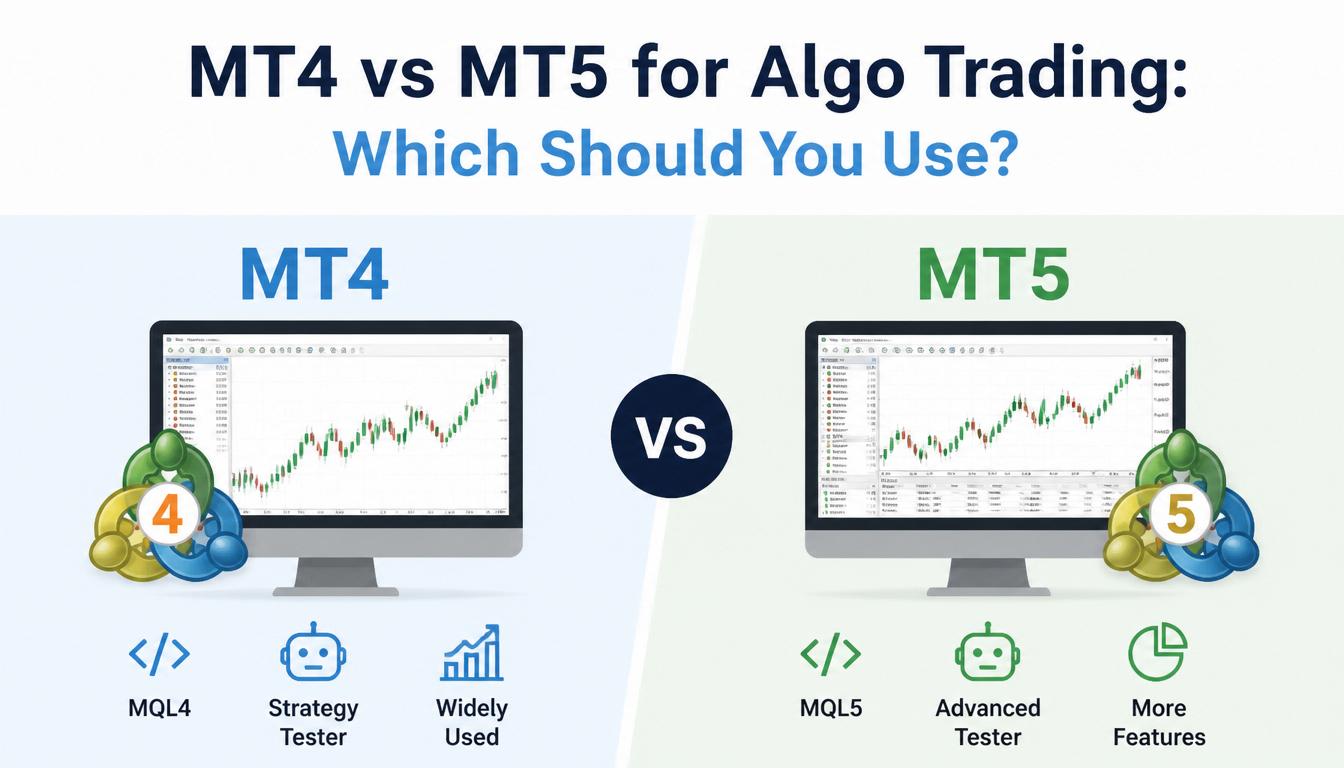
For two decades, MetaTrader 4 was the default home of retail automated trading. Then MetaTrader 5 arrived, the industry slowly shifted, and in 2026 the question is no longer academic: MetaQuotes has stopped selling new MT4 licenses. So in the MT4 vs MT5 debate for algo trading, which platform should you actually build on?
The short answer is MT5 — but the reasons matter, especially if you have legacy EAs on MT4. This guide compares the two on everything that affects an algorithmic trader: backtesting, programming language, asset support, execution speed, and the EA ecosystem, then covers what migration involves.
The verdict up front
For algorithmic trading in 2026, MetaTrader 5 is the better choice. Its multi-threaded backtesting, more capable MQL5 language, multi-asset support, and lower-latency execution make it the stronger platform for building and testing strategies. The main reason to still touch MT4 is a legacy EA that only exists in MQL4.
If you’re starting fresh, build on MT5. If you’re maintaining old systems, read the migration section before you commit. The rest of this comparison explains why MT5 wins each round.

MT4 vs MT5 at a glance
| Factor | MT4 | MT5 |
|---|---|---|
| Backtesting | Single-threaded | Multi-threaded, multi-currency |
| Language | MQL4 (simpler, limited) | MQL5 (advanced, OOP) |
| Assets | Mainly forex | Forex, stocks, futures |
| Execution | 32-bit | 64-bit, lower latency |
| EA library | Largest (legacy) | Growing, modern |
| Future | Licenses discontinued | Actively developed |
Backtesting: the biggest difference
For an algo trader, this is the headline. MT4’s strategy tester is single-threaded; MT5’s is multi-threaded and multi-currency, with far more data options. The practical impact is enormous.
As MQL5 community benchmarks show, 3–5x speed improvements in optimization are achievable, and the gap widens at scale. A complex genetic optimization that takes 48 hours on MT4 can finish in about 15 minutes using MT5’s Cloud Network. When you’re iterating on a strategy, that’s the difference between testing one idea a day and testing dozens. Winner: MT5, decisively.
MQL4 vs MQL5: the programming language
EAs are written in MetaQuotes’ MQL language, and the versions differ. MQL4 is simpler but more limited. MQL5 is more advanced and versatile, with proper object-oriented programming features that make complex algorithms and indicators easier to build.
For a beginner writing a basic moving-average EA, MQL4’s simplicity can feel friendlier. But for anything sophisticated — multi-asset logic, complex risk modules, reusable components — MQL5’s structure pays off. Winner: MT5 for serious development; MT4 only for the simplest scripts.
Asset class support
MT4 was built for forex and mostly stays there. MT5 is a true multi-asset platform, supporting forex, stocks, and futures from one interface.
If your automated strategy only trades currency pairs, this may not matter. But if you want one platform to run forex and equity or futures strategies, MT5 is the only option of the two. Winner: MT5.
Execution speed
MT5 is a 64-bit, multi-threaded application, while MT4 is older 32-bit software. That architecture lets MT5 process price updates and order executions with lower latency, especially during high-volatility periods when speed matters most.
For most retail strategies trading on minute or hourly timeframes, the difference is modest. For anything latency-sensitive, MT5’s modern engine is the safer foundation. Winner: MT5.
The EA ecosystem
This is MT4’s one genuine advantage. Because it dominated for so long, MT4 still hosts the largest library of existing EAs — thousands of legacy robots and indicators built over fifteen-plus years.
MT5’s library is smaller but growing fast, and all new serious development targets it. So MT4 wins on sheer back-catalogue, but that catalogue is aging and increasingly unsupported. Winner: MT4 on quantity today, MT5 on the future.
Why MT4 is being phased out
The decision is partly being made for you. As industry analysts note, MetaQuotes has ceased selling new MT4 licenses and limited its support for the platform. Brokers now face higher maintenance costs and security risks keeping MT4 alive. That pressure is pushing the whole industry toward MT5.
Practically, that means MT4’s days are numbered. Building a new automated trading operation on a platform with discontinued licenses and shrinking support is a technical risk you don’t need to take. Winner: MT5.
Should you migrate?
It depends on what you have. Starting fresh? Build on MT5 — there’s no good reason to begin on a phased-out platform. Running profitable legacy MT4 EAs? Don’t rush. MQL4 code doesn’t run on MT5 unchanged; it needs porting to MQL5, which is real work and can introduce subtle behavior changes (backtests can even differ between the two).
The sensible path: keep stable MT4 systems running while they perform, but develop anything new in MT5, and plan an eventual migration before broker support for MT4 fully dries up.
MT5 features that matter for algo trading
Beyond the headline MT4 vs MT5 differences, a few MT5 features are worth knowing because they directly help an automated trader.
The economic calendar is built in. MT5 ships with an integrated calendar of news events. Your EA can read it and, for example, stand down around high-impact releases. MT4 has no native equivalent.
More timeframes and order types. MT5 offers 21 timeframes versus MT4’s 9, plus additional pending-order types. That gives a strategy finer control over both its signals and its entries.
Depth of Market (DOM). MT5 shows the order book for instruments that support it. For strategies that care about liquidity and order flow, that visibility is useful and simply absent on MT4.
A built-in MQL5 community and cloud. MT5 connects directly to the MQL5 marketplace, signals, and the cloud testing network. The cloud is what makes those massive optimization speed-ups possible, renting distributed computing power on demand.
Native multi-asset accounting. Because MT5 was designed for stocks and futures as well as forex, it handles different instrument types cleanly in one account. For a trader running strategies across asset classes, that’s a structural convenience MT4 was never built to provide.
None of these single-handedly decides the MT4 vs MT5 question — the backtesting speed does that — but together they make MT5 the more capable home for a serious automated operation.
Getting started with MT5 for algo trading
If the MT4 vs MT5 verdict points you to MT5, here’s how to begin without wasted steps.
First, pick a broker that offers MT5 and supports automated trading. Most major forex and CFD brokers now do, and many include a demo account. Open the demo first. You want to test EAs with fake money before risking real capital, and MT5’s demo behaves like the live platform.
Second, learn the strategy tester. It’s the single most valuable tool for an algo trader, and MT5’s multi-threaded version is where the platform earns its keep. Run your EA across both trending and ranging historical periods, and always include realistic spreads and slippage. A backtest that ignores costs lies to you.
Third, set up a VPS. A virtual private server keeps your EA running 24/5 with low latency, independent of whether your home computer is on. For any serious automated strategy, this is not optional — a missed signal because your laptop slept can erase a week of gains.
Finally, start small and supervise. Deploy on a small live account once the demo results hold up. Then monitor it. An EA is a tool you watch, not a machine you abandon. Set a maximum drawdown at which you switch it off, and respect that limit without exception.
The bigger picture beyond MetaTrader
One honest caveat for context. While MetaTrader still dominates retail forex automation, the cutting edge is moving. New development increasingly favors cTrader for execution and TradingView for research, with Python powering the new wave of AI-driven funds.
MetaTrader remains the right starting point for most retail algo traders — the ecosystem and broker support are unmatched. But if you’re investing years into a skill set, know that Python and modern platforms are where the field is heading. Our guide to the best programming language for trading covers that path.
FAQ
Is MT4 or MT5 better for algo trading? MT5, clearly. It offers multi-threaded backtesting (3–5x faster), the more capable MQL5 language, multi-asset support, and lower-latency execution. MT4’s only edge is its larger legacy EA library.
Can I run my MT4 EA on MT5? Not directly. MQL4 code must be ported to MQL5, which is real development work and can subtly change behavior. Test thoroughly after any migration.
Why are brokers dropping MT4? MetaQuotes stopped selling new MT4 licenses and limited support, raising brokers’ maintenance costs and security risks. The industry is steadily consolidating on MT5.
Is MT5 harder to learn than MT4? Slightly, because MQL5 is more advanced. But for serious algo development, that power is an advantage, and the platforms feel broadly similar to use.
Should a beginner start on MT4 or MT5? MT5. There’s no reason to learn a phased-out platform, and MT5’s faster backtesting alone makes learning more productive.
Is MQL5 hard to learn if I know MQL4? There’s a learning curve, since MQL5 is more object-oriented and structured. But the concepts transfer, and the added structure pays off for anything beyond a simple script. Most MQL4 developers adapt within a few weeks.
Can I run the same EA on both MT4 and MT5? Not without porting. An MQL4 EA must be rewritten in MQL5 to run on MT5, and behavior can differ subtly afterward. Always re-test a ported EA thoroughly before trusting it with real money.
Does MT5 cost more than MT4? For traders, both are free to download — your broker provides them. The cost difference falls on brokers, where MT4’s discontinued licenses and higher maintenance are pushing the industry toward MT5.
Is MT5 backtesting really more accurate than MT4? It can be. MT5’s tester supports real tick data and multi-currency testing, which models real conditions more faithfully than MT4’s single-threaded, single-symbol approach. Just remember that even a perfect backtest doesn’t guarantee live results — include spreads and slippage, and test out-of-sample either way.
Do most brokers still support MT4 in 2026? Many do, but the trend is clearly away from it. With MetaQuotes no longer selling new MT4 licenses and trimming support, brokers are steadily steering clients to MT5. If you’re choosing now, pick a broker with strong MT5 support so you’re not stranded on a platform that’s being wound down.
Key takeaways
- In the MT4 vs MT5 debate for algo trading, MT5 is the clear winner in 2026.
- MT5’s multi-threaded backtesting is 3–5x faster — the single biggest advantage for strategy development.
- MQL5 is more capable, MT5 is multi-asset, and its execution is lower-latency.
- MT4’s only real edge is its large legacy EA library — but licenses are discontinued and support is shrinking.
- Start fresh on MT5; migrate legacy MT4 systems deliberately, not in a panic.
Setting up your automated trading? Our free Algo Trading Starter Kit includes an MT5 setup guide, a backtesting checklist, and our broker comparison. Grab it free → and build on the platform with a future, not a sunset.
Leave a Reply