Tag: expert advisors

  • Forex Algo Trading for Beginners: The Complete 2026 Guide

    Forex Algo Trading for Beginners: The Complete 2026 Guide

    Forex is the deepest, most mature retail market for automation — and that’s both a gift and a trap. The gift: every tool, every strategy, every tutorial you could need already exists in 2026. The trap: that same maturity means a swamp of overhyped products, fake screenshots, and “guaranteed” robots that bleed accounts. This pillar guide is the honest, beginner’s roadmap through forex algo trading — what to learn, what to ignore, and exactly how to ship your first automated trade.

    We’ll walk through the platforms, the major strategies, the EA ecosystem, the Python alternative, and a practical first-90-days plan. By the end, you should know precisely where to start, what to spend, and which signals tell you you’re on the right path versus heading off a cliff.

    What forex algo trading actually is

    Forex algo trading means handing your trading rules to software that executes them automatically. You define a precise rule — “buy EUR/USD when the 50-period moving average crosses above the 200-period” — and the program does it for you, around the clock, without hesitation, fear, or fatigue.

    The market for this is enormous and mature. Forex trades 24 hours a day, five days a week, with the deepest liquidity of any retail market. The retail forex automation ecosystem in 2026 has decades of development behind it, with the MetaTrader platforms hosting more existing algorithms than any other retail trading environment.

    Why forex is friendly to automation

    A few structural features make forex unusually friendly to bots, and understanding them tells you why forex algo trading is such a popular path for retail traders.

    It trades 24 hours a day, five days a week, across global sessions, so a system can work while you sleep without the weekend gaps that complicate stocks. It’s extraordinarily liquid, especially in the major pairs, meaning tight spreads and clean fills for automated orders. And it’s driven by quantifiable forces — interest rates, economic releases, and clear technical levels — that translate neatly into rules a program can follow.

    The double-edged extra is leverage. Forex’s wide leverage availability lets small accounts run meaningful automated strategies, but it magnifies losses just as fast as gains. Respect leverage and forex is a superb proving ground for automation; ignore it and it’s the fastest way to blow an account.

    A beginner setting up an Expert Advisor on MetaTrader, illustrating forex algo trading for beginners

    The two main paths: EAs and Python

    There are two practical paths into forex algo trading for beginners, and both are valid in 2026.

    Path A: Expert Advisors (EAs) on MetaTrader. EAs are automated programs written in MQL4 (for MT4) or MQL5 (for MT5) that run directly on your charts. You can buy or download thousands of them, or code your own. This is the dominant retail path because the ecosystem is enormous, the barrier to entry is low (you don’t need to write code to use a pre-built EA), and brokers natively support the platforms.

    Path B: Python with a broker API. As Python tutorials note, before you worry about learning MQL, you can code your bot in Python and connect via API. Most brokers offer Python APIs for their MT4/MT5 platforms, and dedicated developer-first brokers (Alpaca, IG, OANDA) are explicitly Python-friendly. Pandas and NumPy form the core development environment.

    For beginners, Path A is the gentler start because you can use existing EAs without coding. Path B is more flexible long-term and integrates with the broader algorithmic and machine-learning toolchain. Many traders end up doing both.

    Choosing your platform: MT4, MT5, cTrader

    The three main platforms differ in important ways for automation.

    MetaTrader 4 (MT4) is the legacy giant. It hosts the largest library of existing EAs (thousands, going back fifteen-plus years), but MetaQuotes has stopped selling new MT4 licenses and limited support, pushing the industry to MT5. Don’t build new systems on MT4.

    MetaTrader 5 (MT5) is the modern successor. Multi-threaded backtesting (3–5x faster than MT4), the more capable MQL5 language, multi-asset support, and lower-latency execution make it the right choice for new automated traders. Our MT4 vs MT5 deep dive covers the comparison in full.

    cTrader is a modern alternative used by some specialist brokers (Pepperstone, IC Markets), with a cleaner interface and the cAlgo development environment. For traders who plan to grow into more advanced automation, cTrader is worth knowing about.

    For beginners in 2026, start on MT5. It’s actively developed, has growing community resources, and won’t strand you on a phased-out platform.

    The strategies beginners should consider

    Forex algo trading for beginners works best with a few specific, well-understood strategies. The full breakdown is in our best forex strategies for automation guide, but the beginner-friendly shortlist is:

    Trend following. A moving-average crossover EA is the classic starting point — simple, automatable, forgiving. Buy when a fast MA crosses above a slow MA, sell when it crosses back. Currencies trend on macro forces like rate cycles, giving trend systems room to work.

    Range and mean reversion. When a pair isn’t trending, it’s often ranging. A simple EA that buys near the bottom of a band and sells near the top can harvest the chop, though it needs a stop-loss outside the range for breakout protection.

    Avoid scalping, news trading, and any martingale system as a beginner. Scalping demands infrastructure most beginners don’t have. News trading is too risky early. Martingale bots produce smooth curves until they catastrophically don’t. Stick to trend following while you learn.

    How Expert Advisors work

    An EA is a script that runs on your MT5 chart and executes a strategy in code. The mechanics are simple in concept: the EA reads market data, applies its rule, places orders through the broker, and manages positions.

    Both MT4 and MT5 offer robust backtesting tools, letting you test EA performance against historical data before risking real money. This is non-negotiable. Test thoroughly, including realistic spreads, slippage, and commission, before any EA touches a live account.

    The catch worth knowing: EAs written for MT4 are not compatible with MT5 due to MQL4 vs MQL5 differences. If you buy an EA, confirm which platform it targets.

    The Python alternative

    If you’re comfortable with code (or want to learn), Python is the flexible alternative. Install Python and an IDE, add Pandas and NumPy, and connect to your broker’s API. The MetaTrader5 Python library lets you query MT5 directly from Python without writing MQL5 — a popular hybrid where you build strategy logic in Python and use MT5 for execution.

    Python’s strengths are the libraries it unlocks. You can backtest with backtrader or zipline, model with scikit-learn, and incorporate machine learning or sentiment analysis far more easily than MQL5 allows. Our best programming language for trading guide covers why Python remains the dominant choice for serious algo trading.

    Choosing a broker for forex algo trading

    Three factors matter: automation support, spreads, and reliability.

    For MT4/MT5 EA traders, PepperstoneIC Markets, and IG are consistently strong. For Python-first developers, OANDA and IG offer mature, well-documented APIs. Our best brokers with API access guide ranks the field in detail.

    Beyond features, two practical checks: confirm the broker permits automated trading on your account type (most do, but some restrict it), and verify their typical spreads on the pairs you’ll trade. A broker with wide spreads will quietly eat your strategy’s edge.

    Your first 90 days: a step-by-step plan

    A realistic timeline that won’t blow up your account:

    Days 1–14: Learn. Open a free MT5 demo account with a reputable broker. Read the MT5 documentation, watch a few introductory tutorials, and learn the interface. No trading yet — just orientation.

    Days 15–30: First EA on demo. Install a simple, free moving-average crossover EA from the MQL5 marketplace. Run it on EUR/USD on the demo account. Watch how it behaves. Don’t change parameters yet; just observe.

    Days 31–60: Backtest properly. Use MT5’s strategy tester on the same EA. Include spreads and slippage. Test across both trending and ranging historical periods. Document what works and what doesn’t.

    Days 61–75: Paper trade extended. Run the EA on the demo for two more weeks. Confirm live behavior matches what the backtest suggested. Note any divergences — that’s where reality lives.

    Days 76–90: First live trade with tiny capital. Open a small live account (a few hundred dollars). Deploy the same EA with conservative lot sizes — 1–2% risk per trade. Monitor daily. Expect issues. Document every problem.

    After 90 days you’ve either built a foundation for serious forex algo trading for beginners, or you’ve learned cheaply that this isn’t for you. Either outcome is a win.

    How to spot a scam EA

    The single most important defensive skill in forex algo trading. The EA marketplace is full of scams; learn to filter them.

    Demand verified live results. A reputable EA shows a third-party-verified live track record on Myfxbook or FX Blue. Backtest-only results are usually overfitting; screenshots from “real accounts” mean nothing.

    Walk away from guaranteed-return claims. No legitimate EA guarantees profit. The claim itself is the disqualification.

    Avoid black boxes. If the seller won’t describe the EA’s strategy in plain English, assume it’s a martingale or grid bot dressed up to look fancier. Both produce smooth equity curves until a single sustained trend triggers a catastrophic losing streak.

    Be skeptical of MQL5 ratings. Even high MQL5 user ratings can be inflated by review incentives, so a near-perfect score isn’t proof of performance. Use ratings as a starting point for research, not a verdict.

    Our best forex EA guide covers the vetting process in depth.

    Mistakes that derail forex algo trading for beginners

    Five errors account for most beginner blowups:

    • Skipping the demo phase. Going live before the EA proves itself on demo wastes the cheapest learning time available.
    • Over-leveraging. Leverage magnifies bad trades exactly as fast as good ones. Stick to 1–2% risk per trade on small accounts.
    • Buying a black-box EA without verified live results. This is how most beginner forex algo trading accounts die.
    • No VPS. A VPS keeps the EA running 24/5 with low latency, independent of whether your computer is on. Run a serious EA from a home laptop and you’ll miss signals to a sleeping machine.
    • Set-and-forget mentality. EAs need supervision. Set a maximum drawdown at which you switch the bot off, and respect it.

    Avoid these five and the median outcome of forex algo trading for beginners shifts from “loses fast” to “learns cheaply.”

    Realistic expectations

    Set the bar honestly before you start.

    Most realistic EAs earn 5–25% monthly with controlled risk, while anything above 40% monthly usually comes with high drawdown. Conservative trend-following systems sit at the lower end with steadier curves. The fantasy returns advertised on YouTube (100% in a month, doubling your account by Friday) are red flags, not benchmarks.

    Beyond returns, plan for 6–12 months of learning before consistent results, and treat the first live year as tuition. Most beginners lose money in year one while they learn. The ones who become competent automated traders treat that period as the price of admission, not failure.

    FAQ

    Is forex algo trading good for beginners? Yes, as a learning path, especially using pre-built EAs on MT5 demo accounts. It’s a poor “get rich quick” path. Expect months of learning before consistent profitability.

    Do I need to know how to code? Not to start. Pre-built EAs let you run automated strategies without writing code. Learning some Python (or MQL5) significantly expands what you can build, but it isn’t required initially.

    What does it cost to start? Very little. MT5 is free from your broker. Demo accounts are free. Quality EAs range from free (community ones) to a few hundred dollars (one-time purchases). A VPS for running EAs costs roughly $20–40/month. You can be fully set up for well under $100/month plus your trading capital.

    Which broker is best for forex algo trading for beginners? Pepperstone for MT5 EAs, IG for Python-friendly automation, OANDA for tutorial-rich Python development. All offer demo accounts and beginner-friendly setup.

    How long until I’m profitable? Plan for 6–12 months of learning before consistent results. Treat your first live year as tuition. The forex algo trading for beginners path rewards patience far more than cleverness.

    Key takeaways

    • Forex is the most mature market for retail algo trading — the ecosystem and tools are unmatched.
    • Two main paths: Expert Advisors on MT5 (gentler start) and Python via broker APIs (more flexible long-term).
    • Start on MT5, not MT4 — MetaQuotes has stopped selling MT4 licenses, and MT5’s backtesting is 3–5x faster.
    • Trend following is the right beginner strategy — simple, automatable, forgiving. Avoid scalping, news, and martingale.
    • Plan for 6–12 months of learning before profit. Demo first, paper trade, then go live small with strict risk controls.

    Ready to start? Our free Algo Trading Starter Kit includes a 90-day beginner roadmap, an MT5 setup guide, a backtesting checklist, and links to vetted EAs and brokers. Grab it free → and skip the months most beginners waste choosing tools instead of building.

  • Best Forex Strategies for Automation in 2026, Ranked

    Best Forex Strategies for Automation in 2026, Ranked

    Forex has the deepest, most mature automation ecosystem in retail trading — and that maturity means a clear hierarchy has emerged. Some strategies translate beautifully into Expert Advisors. Others sound great in theory and bleed in practice. This guide ranks the forex strategies for automation that actually deliver in 2026, with honest numbers and the failure modes most marketing skips.

    We’ve ordered six strategies by automation fit: how well they suit being run by a bot, how forgiving they are of imperfect execution, and how dependent they are on conditions you can verify in advance. There’s a clear top choice for beginners, plus the right answer for every other style of trader.

    How we ranked the best forex strategies for automation

    Three filters decide whether a strategy belongs on this list. Automation fit — does the strategy reduce cleanly to rules a bot can follow without judgment? Trend following passes easily; news trading is harder. Robustness — does it work across a reasonable range of conditions, or is it a fragile fit to one regime? Risk control — can you bound drawdown sensibly, or does the strategy require leverage that risks blowups?

    Strategies that score well on all three rank higher. Strategies that fail any single one fall toward the bottom or get cut entirely. This is also why our strategies to avoid section is half the value of the guide.

    At a glance: the comparison table

    StrategyBest marketDifficultyRisk control
    Trend followingTrending pairsBeginnerHigh
    BreakoutVolatile, post-consolidationIntermediateModerate
    Range / mean reversionQuiet, ranging pairsIntermediateModerate
    ScalpingLiquid majors, low spreadsAdvancedDemanding
    Carry tradeStable rate differentialsIntermediateModerate
    News tradingAround releasesAdvancedChallenging
    A MetaTrader screen showing six forex strategies running as EAs, illustrating the best forex strategies for automation

    #1 Trend following

    Trend following is the top strategy for automated forex, and most experts agree. The logic is simple: identify a directional move and ride it until it reverses. A moving-average crossover — buy when a fast MA crosses above a slow MA, sell when it crosses back — is the classic beginner implementation, and it’s a real strategy, not a toy.

    Why trend following wins for automation. The rules are unambiguous and execute identically every time, with no judgment calls. Currencies, driven by slow macro forces like rate cycles, can trend for weeks or months, giving trend systems room to work. And the failure mode (whipsaws in choppy markets) is bounded by the stop-loss — you don’t blow up, you just take small repeated losses while waiting for the next trend.

    Best for: Beginners and most traders who want a rules-based, automatable strategy with controllable downside. The same logic that powers our momentum bot guide applies here directly.

    #2 Breakout trading

    Breakout strategies aim to catch a new move the moment price decisively clears a key level. Common variants include the Opening Range Breakout (ORB), which marks the high and low of a session’s opening range and trades the break beyond it, and consolidation-break systems that fire when price escapes a tightening range.

    Volume is the usual confirmation: a breakout on heavy volume holds more reliably than one on a quiet day. Modern EAs increasingly add machine learning to filter genuine breakouts from noise and to adjust stop-losses dynamically. Session timing matters too — breakouts at the London or New York open have very different behavior from breakouts in the quiet Asian session.

    Best for: Intermediate traders who can tolerate a lower win rate for occasional large gains, especially around active sessions. See breakout EA reviews for currently-rated options.

    #3 Range and mean reversion

    When a pair isn’t trending, it’s often ranging — oscillating between support and resistance. Range strategies bet that price will revert toward the middle of the band, buying near the bottom and selling near the top. The forex cousin of crypto’s grid logic.

    The mechanics use Bollinger Bands, RSI, or statistical z-scores to flag overextended conditions. The trade-off is identical to grids in any market: when a range finally breaks, a mean-reversion bot keeps fading the move and bleeds. A stop-loss outside the range and a filter to detect a genuine breakout are non-negotiable. See our mean reversion strategy guide for the deeper mechanics.

    Best for: Intermediate traders comfortable with indicators and willing to monitor regime shifts.

    #4 Scalping

    Scalping is a short-term strategy focused on capturing profits from many small price fluctuations, frequently opening and closing trades within seconds or minutes. It’s the strategy that benefits most from automation, because no human can scalp consistently at that pace.

    The 2026 leader among scalping EAs is the AI Scalper Pro 2026, cited for AI-driven noise filtering, low drawdown, and consistency across conditions. Whether you run that or another, scalping EAs typically prioritize per-trade risk at 0.5% or less, with breakeven triggers activating after 10 pips in profit to lock gains, and tight news filters to avoid trading through major releases.

    Scalping is the unforgiving end of the spectrum — high trade frequency means fees and spreads decide outcomes. Use raw-spread brokers like IC Markets (covered in best brokers with API access) and treat fee structure as part of the strategy.

    Best for: Advanced traders with proper infrastructure who understand the brutal cost-sensitivity.

    #5 Carry trade

    The carry trade is uniquely a forex play. It profits from the interest-rate differential between two currencies: you hold a higher-yielding currency against a lower-yielding one and earn the daily interest (swap), regardless of price movement.

    It’s slower and income-oriented rather than active. Modern automated carry systems use AI to optimize positions by weighing interest-rate differentials, volatility forecasts, and geopolitical risk. The danger: an adverse currency move can wipe out months of accumulated interest in days. Carry works best with conservative sizing and a watchful eye on central-bank policy — when the rate environment shifts, the trade can reverse fast.

    Best for: Patient, income-minded traders who watch macro carefully.

    #6 News trading

    Forex reacts violently to economic releases — rate decisions, inflation prints, jobs reports. News strategies aim to trade those spikes, and automation has a genuine, structural edge here: AI systems can parse a release and execute within milliseconds while a human is still reading the headline.

    It’s also the highest-risk strategy on this list. Spreads widen dramatically around news, slippage spikes, and a surprise can whip price both directions before settling. News trading rewards fast, well-tested systems with built-in news filters and punishes anyone improvising. Most prop firms (with one or two exceptions) ban it outright, which tells you how much risk it carries.

    Best for: Advanced traders with dedicated infrastructure and well-tested news-handling EAs.

    Realistic returns from automated forex strategies

    Calibrate expectations before deploying anything. Most realistic EAs earn 5–25% monthly with controlled risk, while anything above 40% monthly usually comes with high drawdown that catches up sooner or later.

    Within that range, conservative trend-following or carry setups typically sit at the lower end with steadier curves. Scalping and breakout EAs can land higher in good conditions but with bigger drawdowns. Aiming for 8–15% monthly with controlled drawdown is a sensible target for an experienced automated trader; targeting more usually means accepting risk you can’t fully see.

    The fantasy returns — 100% in a month, “doubling your account in a week” — are red flags. They come from leveraged bets that mostly blew up, from selective screenshots, or from outright fabrication.

    The strategies to avoid

    Knowing what doesn’t work is half the discipline. Three categories destroy more forex accounts than any others.

    Martingale and grid bots dressed as “AI.” Many forex bots marketed as AI-powered are nothing of the sort — they’re martingale or grid systems that double down on losing positions. They produce gorgeous smooth equity curves for months, then a single sustained trend triggers a losing streak that wipes out every gain. The smooth curve is a hidden time bomb.

    Black-box EAs. Any EA that won’t explain its strategy in plain English is one you can’t fix when it breaks. Walk away.

    “Guaranteed return” EAs. No legitimate strategy guarantees returns. The claim itself is the disqualification.

    Avoid these three categories and you’ve dodged the bulk of EA losses, before any analysis of which legitimate strategy to choose.

    Choosing the right one for you

    Match the strategy to your situation. Beginner? Trend following — simple, automatable, forgiving. Experienced and ranging market? Mean reversion. Want big moves? Breakout, ideally paired with momentum follow-through. Cost-sensitive and technical? Scalping with a raw-spread broker. Patient and macro-aware? Carry. Advanced with infrastructure? News, if you must.

    Don’t try to run all six. Pick one, learn how it behaves across a few months of real conditions, and add a second only when you genuinely understand the first.

    FAQ

    What is the best forex strategy for automation? Trend following, for most traders. It has the cleanest rule set, the most forgiving failure mode, and the longest track record of automation success. Breakout and mean reversion are strong alternatives for specific market conditions.

    Are automated forex strategies profitable? They can be, with realistic expectations. Most well-run EAs earn 5–25% monthly with controlled risk. Anything advertising consistently more is usually hiding leverage or martingale risk.

    Can I run multiple forex strategies for automation at once? Yes, and many serious traders do. The combination of trend following with mean reversion is particularly effective because the two cover opposite market regimes.

    What’s the safest forex automation strategy? Trend following on majors with conservative sizing and a strict stop-loss. The clean rule set and bounded downside make it the natural starting point.

    Which strategy should I avoid? Martingale systems and any bot that doubles down on losers — they produce smooth curves until a single sustained trend wipes them out. Also avoid any “guaranteed return” EA.

    Which pairs work best for these forex strategies for automation? Major pairs — EUR/USD, GBP/USD, USD/JPY — are the natural fit for most automated strategies. They offer the tightest spreads and deepest liquidity, so bots get clean fills. Exotic pairs carry wider spreads that can quietly swallow a strategy’s edge.

    Are these forex strategies for automation suitable for small accounts? Yes, with conservative leverage and proper sizing. Trend following and range systems suit small accounts especially well because their trade frequency is low. Avoid scalping on small accounts — fees and spreads compound against you faster than the strategy can earn.

    Key takeaways

    • The best forex strategies for automation in 2026 are trend following, breakout, range/mean reversion, scalping, carry trade, and news trading.
    • Trend following wins overall for its simplicity, automation fit, and bounded downside.
    • Realistic returns are 5–25% monthly with controlled risk — anything more usually hides leverage.
    • Avoid martingale, black-box, and “guaranteed-return” EAs — they account for most of the losses in the EA marketplace.
    • Match strategy to market regime and start with one — don’t collect strategies, master one.

    Ready to automate? Our free Algo Trading Starter Kit includes an EA evaluation checklist, the best forex EA shortlist, and our MT4 vs MT5 guide for picking a platform. Grab it free → and pick a strategy you can actually verify.

  • MT4 vs MT5 for Algo Trading: Which Should You Use?

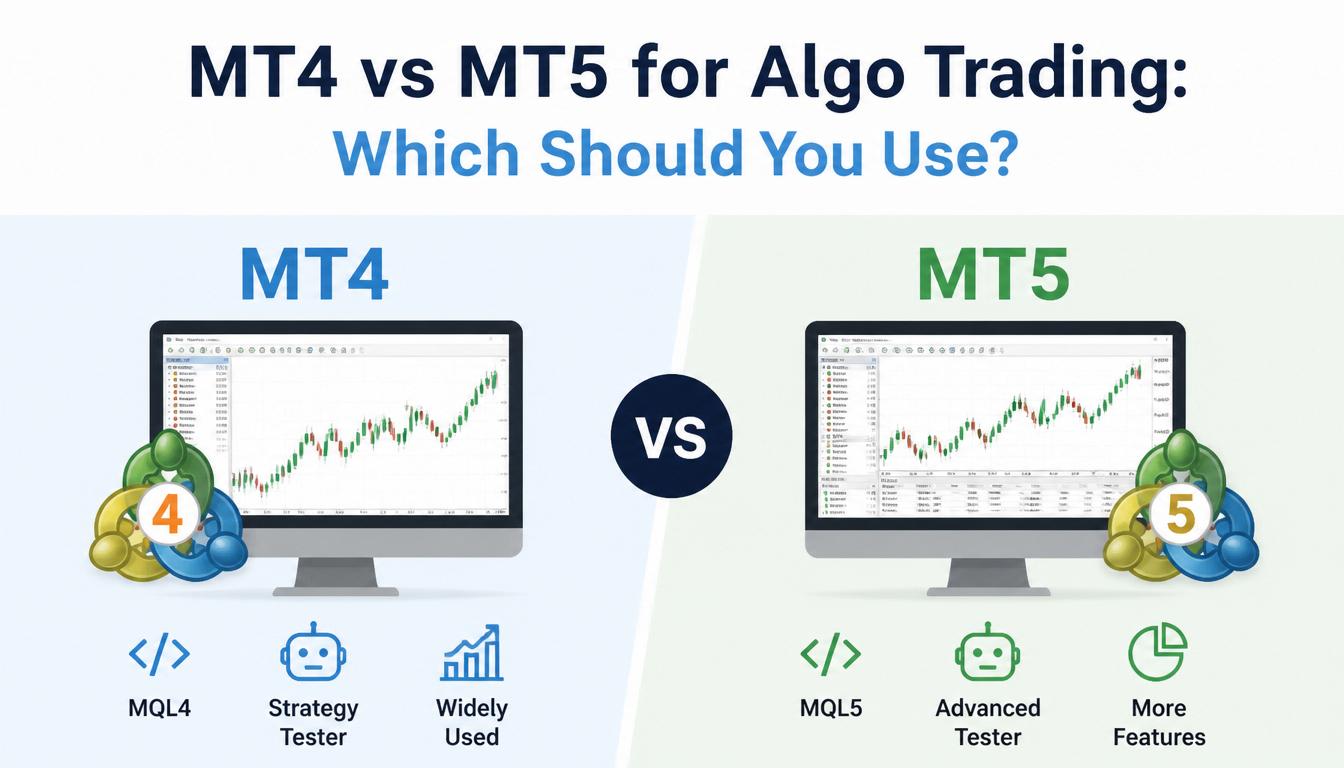
    MT4 vs MT5 for Algo Trading: Which Should You Use?

    For two decades, MetaTrader 4 was the default home of retail automated trading. Then MetaTrader 5 arrived, the industry slowly shifted, and in 2026 the question is no longer academic: MetaQuotes has stopped selling new MT4 licenses. So in the MT4 vs MT5 debate for algo trading, which platform should you actually build on?

    The short answer is MT5 — but the reasons matter, especially if you have legacy EAs on MT4. This guide compares the two on everything that affects an algorithmic trader: backtesting, programming language, asset support, execution speed, and the EA ecosystem, then covers what migration involves.

    The verdict up front

    For algorithmic trading in 2026, MetaTrader 5 is the better choice. Its multi-threaded backtesting, more capable MQL5 language, multi-asset support, and lower-latency execution make it the stronger platform for building and testing strategies. The main reason to still touch MT4 is a legacy EA that only exists in MQL4.

    If you’re starting fresh, build on MT5. If you’re maintaining old systems, read the migration section before you commit. The rest of this comparison explains why MT5 wins each round.

    A side-by-side of the MT4 and MT5 strategy testers, illustrating MT4 vs MT5 for algo trading

    MT4 vs MT5 at a glance

    FactorMT4MT5
    BacktestingSingle-threadedMulti-threaded, multi-currency
    LanguageMQL4 (simpler, limited)MQL5 (advanced, OOP)
    AssetsMainly forexForex, stocks, futures
    Execution32-bit64-bit, lower latency
    EA libraryLargest (legacy)Growing, modern
    FutureLicenses discontinuedActively developed

    Backtesting: the biggest difference

    For an algo trader, this is the headline. MT4’s strategy tester is single-threaded; MT5’s is multi-threaded and multi-currency, with far more data options. The practical impact is enormous.

    As MQL5 community benchmarks show3–5x speed improvements in optimization are achievable, and the gap widens at scale. A complex genetic optimization that takes 48 hours on MT4 can finish in about 15 minutes using MT5’s Cloud Network. When you’re iterating on a strategy, that’s the difference between testing one idea a day and testing dozens. Winner: MT5, decisively.

    MQL4 vs MQL5: the programming language

    EAs are written in MetaQuotes’ MQL language, and the versions differ. MQL4 is simpler but more limited. MQL5 is more advanced and versatile, with proper object-oriented programming features that make complex algorithms and indicators easier to build.

    For a beginner writing a basic moving-average EA, MQL4’s simplicity can feel friendlier. But for anything sophisticated — multi-asset logic, complex risk modules, reusable components — MQL5’s structure pays off. Winner: MT5 for serious development; MT4 only for the simplest scripts.

    Asset class support

    MT4 was built for forex and mostly stays there. MT5 is a true multi-asset platform, supporting forex, stocks, and futures from one interface.

    If your automated strategy only trades currency pairs, this may not matter. But if you want one platform to run forex and equity or futures strategies, MT5 is the only option of the two. Winner: MT5.

    Execution speed

    MT5 is a 64-bit, multi-threaded application, while MT4 is older 32-bit software. That architecture lets MT5 process price updates and order executions with lower latency, especially during high-volatility periods when speed matters most.

    For most retail strategies trading on minute or hourly timeframes, the difference is modest. For anything latency-sensitive, MT5’s modern engine is the safer foundation. Winner: MT5.

    The EA ecosystem

    This is MT4’s one genuine advantage. Because it dominated for so long, MT4 still hosts the largest library of existing EAs — thousands of legacy robots and indicators built over fifteen-plus years.

    MT5’s library is smaller but growing fast, and all new serious development targets it. So MT4 wins on sheer back-catalogue, but that catalogue is aging and increasingly unsupported. Winner: MT4 on quantity today, MT5 on the future.

    Why MT4 is being phased out

    The decision is partly being made for you. As industry analysts noteMetaQuotes has ceased selling new MT4 licenses and limited its support for the platform. Brokers now face higher maintenance costs and security risks keeping MT4 alive. That pressure is pushing the whole industry toward MT5.

    Practically, that means MT4’s days are numbered. Building a new automated trading operation on a platform with discontinued licenses and shrinking support is a technical risk you don’t need to take. Winner: MT5.

    Should you migrate?

    It depends on what you have. Starting fresh? Build on MT5 — there’s no good reason to begin on a phased-out platform. Running profitable legacy MT4 EAs? Don’t rush. MQL4 code doesn’t run on MT5 unchanged; it needs porting to MQL5, which is real work and can introduce subtle behavior changes (backtests can even differ between the two).

    The sensible path: keep stable MT4 systems running while they perform, but develop anything new in MT5, and plan an eventual migration before broker support for MT4 fully dries up.

    MT5 features that matter for algo trading

    Beyond the headline MT4 vs MT5 differences, a few MT5 features are worth knowing because they directly help an automated trader.

    The economic calendar is built in. MT5 ships with an integrated calendar of news events. Your EA can read it and, for example, stand down around high-impact releases. MT4 has no native equivalent.

    More timeframes and order types. MT5 offers 21 timeframes versus MT4’s 9, plus additional pending-order types. That gives a strategy finer control over both its signals and its entries.

    Depth of Market (DOM). MT5 shows the order book for instruments that support it. For strategies that care about liquidity and order flow, that visibility is useful and simply absent on MT4.

    A built-in MQL5 community and cloud. MT5 connects directly to the MQL5 marketplace, signals, and the cloud testing network. The cloud is what makes those massive optimization speed-ups possible, renting distributed computing power on demand.

    Native multi-asset accounting. Because MT5 was designed for stocks and futures as well as forex, it handles different instrument types cleanly in one account. For a trader running strategies across asset classes, that’s a structural convenience MT4 was never built to provide.

    None of these single-handedly decides the MT4 vs MT5 question — the backtesting speed does that — but together they make MT5 the more capable home for a serious automated operation.

    Getting started with MT5 for algo trading

    If the MT4 vs MT5 verdict points you to MT5, here’s how to begin without wasted steps.

    First, pick a broker that offers MT5 and supports automated trading. Most major forex and CFD brokers now do, and many include a demo account. Open the demo first. You want to test EAs with fake money before risking real capital, and MT5’s demo behaves like the live platform.

    Second, learn the strategy tester. It’s the single most valuable tool for an algo trader, and MT5’s multi-threaded version is where the platform earns its keep. Run your EA across both trending and ranging historical periods, and always include realistic spreads and slippage. A backtest that ignores costs lies to you.

    Third, set up a VPS. A virtual private server keeps your EA running 24/5 with low latency, independent of whether your home computer is on. For any serious automated strategy, this is not optional — a missed signal because your laptop slept can erase a week of gains.

    Finally, start small and supervise. Deploy on a small live account once the demo results hold up. Then monitor it. An EA is a tool you watch, not a machine you abandon. Set a maximum drawdown at which you switch it off, and respect that limit without exception.

    The bigger picture beyond MetaTrader

    One honest caveat for context. While MetaTrader still dominates retail forex automation, the cutting edge is moving. New development increasingly favors cTrader for execution and TradingView for research, with Python powering the new wave of AI-driven funds.

    MetaTrader remains the right starting point for most retail algo traders — the ecosystem and broker support are unmatched. But if you’re investing years into a skill set, know that Python and modern platforms are where the field is heading. Our guide to the best programming language for trading covers that path.

    FAQ

    Is MT4 or MT5 better for algo trading? MT5, clearly. It offers multi-threaded backtesting (3–5x faster), the more capable MQL5 language, multi-asset support, and lower-latency execution. MT4’s only edge is its larger legacy EA library.

    Can I run my MT4 EA on MT5? Not directly. MQL4 code must be ported to MQL5, which is real development work and can subtly change behavior. Test thoroughly after any migration.

    Why are brokers dropping MT4? MetaQuotes stopped selling new MT4 licenses and limited support, raising brokers’ maintenance costs and security risks. The industry is steadily consolidating on MT5.

    Is MT5 harder to learn than MT4? Slightly, because MQL5 is more advanced. But for serious algo development, that power is an advantage, and the platforms feel broadly similar to use.

    Should a beginner start on MT4 or MT5? MT5. There’s no reason to learn a phased-out platform, and MT5’s faster backtesting alone makes learning more productive.

    Is MQL5 hard to learn if I know MQL4? There’s a learning curve, since MQL5 is more object-oriented and structured. But the concepts transfer, and the added structure pays off for anything beyond a simple script. Most MQL4 developers adapt within a few weeks.

    Can I run the same EA on both MT4 and MT5? Not without porting. An MQL4 EA must be rewritten in MQL5 to run on MT5, and behavior can differ subtly afterward. Always re-test a ported EA thoroughly before trusting it with real money.

    Does MT5 cost more than MT4? For traders, both are free to download — your broker provides them. The cost difference falls on brokers, where MT4’s discontinued licenses and higher maintenance are pushing the industry toward MT5.

    Is MT5 backtesting really more accurate than MT4? It can be. MT5’s tester supports real tick data and multi-currency testing, which models real conditions more faithfully than MT4’s single-threaded, single-symbol approach. Just remember that even a perfect backtest doesn’t guarantee live results — include spreads and slippage, and test out-of-sample either way.

    Do most brokers still support MT4 in 2026? Many do, but the trend is clearly away from it. With MetaQuotes no longer selling new MT4 licenses and trimming support, brokers are steadily steering clients to MT5. If you’re choosing now, pick a broker with strong MT5 support so you’re not stranded on a platform that’s being wound down.

    Key takeaways

    • In the MT4 vs MT5 debate for algo trading, MT5 is the clear winner in 2026.
    • MT5’s multi-threaded backtesting is 3–5x faster — the single biggest advantage for strategy development.
    • MQL5 is more capable, MT5 is multi-asset, and its execution is lower-latency.
    • MT4’s only real edge is its large legacy EA library — but licenses are discontinued and support is shrinking.
    • Start fresh on MT5; migrate legacy MT4 systems deliberately, not in a panic.

    Setting up your automated trading? Our free Algo Trading Starter Kit includes an MT5 setup guide, a backtesting checklist, and our broker comparison. Grab it free → and build on the platform with a future, not a sunset.

  • Best Forex EA 2026: Top Expert Advisors Ranked & Reviewed

    Best Forex EA 2026: Top Expert Advisors Ranked & Reviewed

    Search “best forex EA” and you’ll wade through a swamp of fake screenshots, rented Lamborghinis, and robots promising 1,000% a year. Let’s be blunt before we rank anything: there is no magic EA that prints money. The best expert advisors are tools. They can give you an edge when configured properly and run with disciplined risk management. Even then, none are risk-free.

    With that honesty established, some EAs are far better than others. This guide explains how to separate a credible expert advisor from a scam, the criteria that actually predict performance, and the top forex EAs worth considering in 2026.

    First: how to spot a scam EA

    Before any ranking, learn the filter that protects your money. The single most important factor in choosing the best forex EA is whether the developer provides real, verified live trading statistics — not backtests, not screenshots, but a third-party-verified live track record (typically on Myfxbook or FX Blue).

    Red flags that should make you walk away:

    • Backtest-only results. A flawless backtest with no verified live record usually means overfitting.
    • Guaranteed returns or “no-loss” claims. Markets don’t work that way.
    • Hidden strategy. If the EA won’t explain its logic, assume it’s a martingale or grid bot that doubles down on losers until it blows up.
    • Review-incentive ratings. Even high MQL5 scores can be inflated by review incentives, so weigh them carefully.

    Pass an EA through this filter first. Most fail it.

    A MetaTrader chart running an expert advisor with a verified Myfxbook track record, illustrating the best forex EA

    How we evaluate the best forex EA options

    The EAs below are framed around the criteria that genuinely predict real-world performance, drawn from how the major EA rating services rank them: verified live performance first, then drawdown and risk managementlength of track recordtransparency of strategy, and platform compatibility (MT4/MT5). Note that we’re describing categories and contenders, not promising any of them will profit for you — configuration, broker, and market conditions all matter.

    At a glance: top expert advisors

    EAKnown forModelWatch-out
    Forex Gold InvestorBalanced, verified resultsOne-time purchaseGold-focused volatility
    Happy GoldLongest track record (since 2013)PaidPast results ≠ future
    Quantum QueenHighest MQL5 rating (4.98)PaidRatings can be incentivized
    Dark Venus / Dark DioneTeam-backed, VIP supportPaid + communityDione carries higher volatility

    Forex Gold Investor — most balanced

    Forex Gold Investor is frequently cited as the most balanced option among popular EAs. Its appeal is a combination retail traders rarely get: a one-time purchase (no endless subscription), solid verified results, and a strategy that’s relatively straightforward to understand.

    Focused on gold (XAU/USD), it benefits from that market’s strong trends but also inherits its volatility, so position sizing matters. For traders who want a transparent, fairly priced EA with a real track record, it’s a sensible starting point.

    Happy Gold — longest track record

    Track record length matters because surviving many market regimes is itself evidence. Happy Gold stands out for having one of the longest histories among active EAs, with a record stretching back to 2013.

    A decade-plus of live operation doesn’t guarantee future profit — nothing does — but an EA that has weathered multiple cycles is inherently more credible than a six-month wonder with a glossy backtest. Treat longevity as a meaningful, if imperfect, signal of robustness.

    Quantum Queen — highest-rated (with caveats)

    Quantum Queen carries the highest user rating on MQL5 (4.98/5) with strong community feedback. That makes it one of the most visible EAs of 2026.

    The caveat is important and we’ll state it plainly: MQL5 ratings can be influenced by review incentives, so a near-perfect score isn’t proof of performance. Use the rating as a starting point for research, not a verdict. Demand the verified live record before trusting any capital to it — the same standard you’d apply to any EA.

    The Dark Venus series — team-backed

    The Dark Venus series suits traders who want a tested setup with ongoing support. Dark Venus leads for those who value a team-backed product with continued development and a VIP community, while its sibling Dark Dione has shown the strongest early live results — though it also carries the most volatility of the group.

    That volatility trade-off is the lesson in miniature: higher early returns usually come with bigger swings. Match the variant to your risk tolerance, not to whichever number looks biggest.

    What the best forex EA can and can’t do

    It helps to set expectations precisely, because the marketing never does.

    A good EA can do several real things. It can execute a tested strategy without emotion, around the clock, far faster than you could by hand. It can enforce risk rules you’d be tempted to override in the moment. And it can free you from staring at charts during the London and New York sessions. Those are genuine, valuable benefits.

    A good EA cannot do the things the scams promise. It can’t guarantee profit. It can’t adapt to a market regime it was never designed for. And it can’t turn a losing strategy into a winning one — it only executes faster. The best forex EA is a disciplined executor of a sound plan, nothing more and nothing less.

    This framing protects you. Once you accept that an EA is a tool and not an oracle, the absurd claims become easy to dismiss, and the realistic question takes over: does this EA execute a strategy with a genuine, verified edge? That’s the only question worth asking.

    Free vs paid EAs

    You’ll find both free and paid expert advisors, and price alone tells you little about quality.

    Free EAs are great for learning. You can study the code, see how a strategy is built, and test it on a demo account at zero cost. The risk is that free EAs are often abandoned, unsupported, or — worse — hide a martingale strategy that looks fine until it blows up. Paid EAs may come with support, updates, and (sometimes) a verified track record, but the price tag is no guarantee of profit; plenty of expensive EAs are overfit junk.

    The deciding factor is never the cost. It’s the verified live track record and the transparency of the strategy. A free EA with a real, public Myfxbook history beats a $500 black box every time. Judge the evidence, not the invoice.

    Realistic returns from a forex EA

    Let’s anchor expectations, because this is where EA buyers get hurt most. The ads show 50% months. Reality is quieter.

    A solid, well-run EA targets modest, compounding returns. Think low single digits to maybe low double digits per month in good conditions, with losing months mixed in. Any EA advertising consistent 30%, 50%, or 100% monthly gains is either curve-fit to the past or an outright scam. High advertised returns almost always hide high risk — usually a martingale that’s one bad streak from zero.

    Drawdown matters as much as return. An EA that makes 8% a month but periodically draws down 40% is far more dangerous than one making 3% with a 10% max drawdown. The second is something you can actually live with and keep running. The first will scare you into switching it off at the worst moment. When you read an EA’s verified track record, look at the depth of its drawdowns first, returns second.

    Treat the realistic picture as good news, not bad. A genuine EA returning a steady few percent a month, compounding over years, is a real edge most traders never achieve. The fantasy numbers are the trap. The modest, durable ones are the goal.

    How to deploy an EA safely

    Owning a good EA is half the battle; running it well is the rest.

    1. Verify the live track record on Myfxbook before buying.
    2. Backtest it yourself on quality data, including spreads and slippage.
    3. Demo-trade it for weeks on your broker — execution differs between brokers.
    4. Start on a small live account with conservative lot sizes.
    5. Use a VPS so the EA runs 24/5 without your computer being on, and monitor it.
    6. Kill-switch rules: set a max drawdown at which you turn it off, no exceptions.

    An EA is not “set and forget.” It’s a tool you supervise.

    FAQ

    What is the best forex EA in 2026? There’s no single best — it depends on your risk tolerance and broker. Forex Gold Investor is often cited as the most balanced for its one-time purchase and verified results, but every EA must be validated against its live track record.

    Are forex EAs profitable? They can be, when configured properly and run with strict risk management — but none are risk-free or guaranteed. Most EAs sold online fail the verified-live-results test entirely.

    How do I know if an EA is a scam? Demand third-party-verified live results (Myfxbook/FX Blue). Walk away from backtest-only proof, guaranteed-return claims, or any EA that hides its strategy.

    Do I need a VPS to run an EA? Strongly recommended. A VPS keeps the EA running 24/5 with low latency, independent of your home computer, which matters for consistent execution.

    Is a one-time-purchase EA better than a subscription? Not inherently, but a one-time purchase avoids recurring costs eating into returns. Judge by the verified track record and transparency first, pricing model second.

    What return should I expect from the best forex EA? Realistically, modest compounding returns — low single digits to maybe low double digits per month in good conditions, with losing months mixed in. Any EA advertising consistent 30%+ monthly gains is almost certainly overfit or a scam.

    Do EAs work on MT4 or MT5? Both. EAs are written in MQL4 for MT4 or MQL5 for MT5. New development increasingly targets MT5 for its faster backtesting and multi-asset support, but plenty of proven EAs still run on MT4.

    How much does a good forex EA cost? Prices range widely — from free community EAs to one-time purchases of a few hundred dollars to monthly subscriptions. Price is a poor quality signal on its own. A free EA with a verified live track record beats an expensive black box, so judge the evidence before the invoice.

    Do I need a VPS to run a forex EA? It’s strongly recommended. A VPS keeps your EA running 24/5 with low latency, independent of whether your home computer is on or connected. For consistent execution — especially around active sessions and news — a cheap VPS is one of the best small investments an EA trader can make.

    Key takeaways

    • There is no magic EA — the best forex EA is a tool that needs proper configuration and risk management.
    • Demand verified live results; backtest-only proof and guaranteed returns are red flags.
    • Top contenders include Forex Gold Investor (balanced), Happy Gold (longevity), Quantum Queen (popular, with rating caveats), and the Dark Venus series.
    • A long track record is a meaningful, imperfect signal of robustness.
    • Deploy on a VPS, demo first, start small, and set a hard drawdown kill-switch.

    Want to vet EAs like a pro? Our free Algo Trading Starter Kit includes an EA due-diligence checklist, a Myfxbook verification guide, and our broker and prop-firm comparison. Grab it free → and never buy a robot on a screenshot again.

  • Forex Trading Strategies for Automation: A 2026 Guide

    Forex Trading Strategies for Automation: A 2026 Guide

    Forex is the world’s largest and most mature market for automated trading, and it isn’t close. Decades before crypto bots existed, foreign-exchange traders were running automated systems on MetaTrader, and that head start shows: the tooling, the strategy libraries, and the funnel infrastructure are all more developed here than anywhere else. If you want to automate, forex trading strategies are some of the most battle-tested options available.

    This is a practical guide, not a ranked listicle. We’ll start with what actually makes forex different for automation, tour the major strategy types that work, walk through the MT4/MT5 ecosystem you’ll likely use, and end with the honest warnings most “AI EA” sellers skip.

    What this guide covers

    What makes forex suited to automation

    A few structural features make forex unusually friendly to bots. It trades 24 hours a day, five days a week, across global sessions. A system can work while you sleep, without the weekend gaps that complicate stocks. It’s also extraordinarily liquid, especially in the major pairs, which means tight spreads and clean fills for automated orders. And it’s driven by quantifiable forces — interest rates, economic releases, and clear technical levels. Those translate neatly into rules a program can follow.

    Leverage is the double-edged extra. It lets small accounts run meaningful automated forex trading strategies, but it magnifies losses just as fast as gains. Respect it, and forex is a superb proving ground for automation. Ignore it, and it’s the fastest way to blow an account.

    A MetaTrader chart running an expert advisor across forex pairs, illustrating automated forex trading strategies

    The MT4/MT5 expert advisor ecosystem

    You can’t discuss forex automation without MetaTrader. MT4 and MT5 host the largest ecosystem of ready-made algorithms and third-party tools in retail trading. They let you deploy automated forex trading strategies without programming from scratch, drawing on a marketplace of thousands of bots.

    The automated programs are called Expert Advisors (EAs) — bots written in the MQL language that run directly on your charts. You can buy or download thousands of them from the MQL5 marketplace, or code your own. This maturity is a genuine advantage: proven strategies, deep documentation, and a vast community. It’s also a hazard, because the same marketplace is full of overfit, dangerous EAs sold with fantasy backtests. The ecosystem gives you everything — including plenty of ways to lose money fast.

    Trend-following strategies

    Trend following is the best starting point for automated forex, and most experts agree. The logic is simple: identify a directional move and ride it until it reverses. A moving-average crossover is the classic beginner version — buy when a fast average crosses above a slow one, and sell when it crosses back.

    It works in forex because currencies are driven by slow-moving macro forces like rate cycles, so they can trend for weeks or months. The trade-off is familiar. Trend systems get chopped up in sideways markets, taking small repeated losses while they wait for a real move. The same momentum logic that beats buy-and-hold applies here — the edge is often in disciplined exits, not perfect entries.

    Breakout and session strategies

    Breakout strategies aim to catch a new move the moment price decisively clears a key level. In forex, these are often tied to sessions. An Opening Range Breakout (ORB) system, for instance, marks the high and low of a session’s opening range and trades the break beyond it. Specialized EAs exist to automate these time-based setups.

    Session timing matters because forex volatility concentrates around the London and New York opens and their overlap. A breakout system that fires during those liquid, active windows behaves very differently from one running through the quiet Asian afternoon. Tying a strategy to the right session is half of making it work.

    Range and mean-reversion strategies

    When a pair isn’t trending, it’s often ranging — oscillating between support and resistance. Range strategies bet that price will revert toward the middle of that band, buying near the bottom and selling near the top.

    This is the forex cousin of the mean reversion strategy, and it suits the long, quiet consolidation phases that frustrate trend followers. The danger is identical, too: when a range finally breaks, a mean-reversion bot keeps fading the move and bleeds. A stop-loss outside the range and a filter to detect a genuine breakout are non-negotiable.

    Carry trade strategies

    The carry trade is uniquely a forex play. It profits from the interest-rate differential between two currencies: you hold a higher-yielding currency against a lower-yielding one and earn the daily interest (swap), regardless of price movement.

    It’s a slower, income-oriented strategy rather than an active one. Modern automated versions go further: AI can dynamically optimize carry positions by weighing interest-rate differentials, volatility forecasts, and geopolitical risk. The risk is real, though. An adverse currency move can wipe out months of accumulated interest in days, so carry works best with conservative sizing and a close eye on central-bank policy.

    News trading strategies

    Forex reacts violently to economic releases — rate decisions, inflation prints, jobs reports. News strategies aim to trade those spikes, and this is an area where automation has a genuine, structural edge. AI systems that parse a release and execute within milliseconds can act long before a human finishes reading the headline.

    It’s also high-risk. Spreads widen dramatically around news, slippage spikes, and a surprise can whip price both directions before settling. News trading rewards fast, well-tested systems and punishes anyone improvising. For most retail traders, it’s an advanced strategy to approach carefully, if at all.

    The martingale and grid warning

    Here is the warning the EA marketplaces won’t put in bold. As seasoned forex automation writers caution, many forex bots marketed as “AI-powered” are nothing of the sort — they’re martingale or grid systems that double down on losing positions.

    These produce gorgeous, smooth equity curves for months, which is exactly what makes them so easy to sell. Then a single sustained trend against the position triggers a losing streak that wipes out every gain and then some. The smooth curve was never skill; it was a hidden time bomb. Before deploying any EA, understand the underlying logic. If it adds to losers or refuses to explain how it trades, walk away — no matter how good the track record looks.

    Choosing among the forex trading strategies

    With several options on the table, how do you pick? Match the strategy to the market and to yourself.

    Start with the market. Is the pair trending or ranging? Trend-following and breakout systems want direction and momentum. Range and mean-reversion systems want quiet consolidation. Running the wrong one in the wrong regime is the most common way these forex trading strategies fail.

    Then match your temperament and time. Trend following is the gentlest entry point — simple rules, infrequent trades, forgiving of imperfect timing. Carry trading suits patient, income-minded traders who watch central banks. News trading demands speed and nerve, so leave it until you’re experienced. Breakout and range systems sit in between.

    A practical path for most beginners looks like this. Learn a trend-following EA first on a demo account. Get comfortable with how it behaves through both trends and chop. Only then add a second strategy for the conditions the first handles badly — typically a range system to complement a trend system. That pairing covers most market regimes between them.

    Whatever you choose, never run a strategy you can’t explain. If you can’t say in one sentence why it should make money, you can’t tell whether it’s broken or just having a bad week. Clarity about the edge matters more than any single indicator setting.

    Sessions and pairs: timing your forex trading strategies

    Two practical levers shape every forex system. Pairs: the majors (EUR/USD, GBP/USD, USD/JPY) offer the tightest spreads and cleanest automation, while exotics carry wider spreads that can swallow a strategy’s edge. Stick to liquid majors while you learn. Sessions: match your strategy to the right window — breakout systems thrive around the volatile London and New York opens, while range systems prefer the quieter hours.

    Getting this context right is the difference between a strategy that works in theory and one that works in your account. The same forex trading strategies can win or lose purely based on which pair and session you run them in.

    Backtesting your forex trading strategies

    No forex strategy should go live untested. Every algorithm needs thorough backtesting against historical data to reveal its real performance characteristics and expose its weaknesses before real money is on the line.

    MT4/MT5 include a strategy tester for exactly this, but use it honestly: include spreads, swaps, and slippage, and test across both trending and ranging periods. A system that only worked in last year’s trend will fail the moment conditions change. As with any market, treat a flawless backtest as a warning sign of overfitting, not a guarantee. Then paper trade on a demo account — MetaTrader makes this easy — before committing live capital.

    FAQ

    What is the best forex trading strategy for beginners? Trend following, usually via a moving-average crossover. It’s simple to understand, easy to automate on MT4/MT5, and forgiving of imperfect timing — the standard recommended starting point.

    What are Expert Advisors? EAs are automated trading programs written in MQL that run on MT4 or MT5 charts. They execute forex trading strategies for you and can be bought, downloaded, or coded yourself.

    Are forex trading bots profitable? They can be with a sound strategy and disciplined risk management. But many marketplace bots are overfit or hidden martingale systems, so understanding the underlying logic matters more than the advertised returns.

    Is MT4 or MT5 better for automated trading? Both host huge EA ecosystems. MT5 is newer with more features and asset classes; MT4 still has the largest library of existing EAs. For pure forex automation, either works — pick what your broker supports best.

    Why are martingale forex bots dangerous? They double down on losing trades, producing smooth returns until one sustained adverse trend triggers a catastrophic losing streak that erases months of gains. Avoid any bot that adds to losers.

    What are the best forex pairs for automated strategies? The majors — EUR/USD, GBP/USD, USD/JPY — are best. They offer the tightest spreads and deepest liquidity, so bots get clean fills. Exotic pairs carry wider spreads that can swallow a strategy’s edge, so stick to majors while you learn.

    Do automated forex strategies work on a small account? Yes. Forex leverage lets small accounts run meaningful positions, and most strategies scale down fine. But leverage cuts both ways, so size conservatively — a small account with reckless leverage blows up fastest.

    Key takeaways

    • Forex is the most mature market for automation, with the deepest tooling and the MT4/MT5 EA ecosystem.
    • Trend following is the best starting strategy; breakout, range, carry, and news systems each suit specific conditions.
    • The MT4/MT5 ecosystem is powerful but full of overfit EAs — understand any bot before running it.
    • Beware martingale and grid bots sold as “AI” — smooth curves that eventually blow up.
    • Match pair and session to your strategy, and backtest honestly with spreads and swaps before going live.

    Want to automate forex the safe way? Our free Algo Trading Starter Kit includes an EA vetting checklist, a backtesting worksheet, and our broker and prop-firm comparison. Download it free → and build a forex system on proven rules, not marketplace hype.