Tag: AI agents

  • AI Agents in 2026: The Shift From Chatbots to Digital Coworkers

    Something strange happened in enterprise software over the past twelve months. The conversation about AI agents stopped being theoretical. Nobody at industry conferences is asking “what is an AI agent?” anymore. The questions have gotten sharper, more specific, and far more interesting: How do you price an agent that replaces a $95,000-a-year workflow? What happens when one agent spawns another agent and nobody can trace the decision chain? Who’s liable when an autonomous system approves a transaction it shouldn’t have?

    That shift — from curiosity to operational reality — is the story of AI agents in 2026. And if you’re building software, running a business, or just trying to understand where technology is actually heading (as opposed to where LinkedIn influencers say it’s heading), this is the category worth paying attention to.

    What Changed, and Why It Matters Now

    A year ago, most AI agents were glorified chatbots with a few API connections bolted on. They could answer questions, maybe draft an email, occasionally pull data from a spreadsheet. Useful, sure. But nobody was restructuring their operations around them.

    That era is over. The agents being deployed today don’t just respond to prompts — they observe, plan, execute multi-step workflows, use external tools, and loop back to correct their own mistakes. Think of the difference between asking someone a question and hiring someone to manage a process. That’s the gap that just closed.

    The numbers tell part of the story. Over 80% of technical teams have moved past the planning stage into active testing or production deployment. Nearly six in ten organisations now have agents running in live environments. And the market itself is on a trajectory that analysts project will grow from under $10 billion today to over $250 billion within the next decade.

    But raw market projections don’t capture what’s actually happening on the ground. What’s happening on the ground is that companies are discovering agents can do things that traditional automation never could — because agents don’t need a rigid script. They adapt.

    Where Agents Are Actually Working (Not Just Demoing)

    The gap between demo and deployment has always been the graveyard of enterprise technology. Plenty of tools look brilliant in a sales presentation and collapse the moment they encounter messy, real-world data. So where are AI agents actually delivering?

    Operations and workflow orchestration is the biggest deployment category. An agent that reviews incoming requests, classifies urgency, identifies the right approver, checks for missing information, sends follow-ups, and escalates when deadlines slip — that’s not a hypothetical. That’s running in production at dozens of companies right now. The agent handles the process; humans handle the judgement calls.

    Customer service has moved well beyond scripted chatbots. Sierra, which builds AI agents for enterprise customer support, is serving more than 40% of the Fortune 50. Their agents don’t just answer FAQs — they access account data, process changes, and resolve issues end-to-end. The economics are compelling: companies paying $8 to $15 per human-handled support interaction are seeing agent-handled interactions cost a fraction of that, with comparable satisfaction scores.

    Software development is arguably the most visible category. Coding agents like Claude Code and Cursor don’t just autocomplete lines of code — they read entire repositories, understand project architecture, implement features across multiple files, run tests, and iterate on failures. Claude Code alone is now responsible for roughly 4% of all public commits on GitHub. That’s not a tool. That’s a team member.

    Healthcare administration is a quieter but potentially larger story. Mayo Clinic has piloted AI agents to automate scheduling, documentation, and back-office administrative work. Oxford University Hospitals built agents that summarise patient charts, determine cancer staging, and draft treatment plans for tumour boards. The clinical staff focus on patients; the agents handle the paperwork that was eating their days alive.

    Drug discovery is being reshaped at the research layer. Genentech built agent ecosystems on cloud infrastructure to automate complex research workflows, freeing scientists to concentrate on the creative and interpretive work that actually leads to breakthroughs.

    The Pricing Question Nobody Has Solved

    Here’s where things get genuinely interesting — and genuinely messy. Traditional SaaS charges per seat, per month. But an AI agent doesn’t occupy a seat. It might replace half a workflow that three people share, or it might handle a volume of work that fluctuates wildly from week to week. Per-seat pricing doesn’t map onto what agents actually do.

    The industry is experimenting with three models, and none of them have clearly won.

    The first is subscription with usage caps — a flat monthly fee that includes a certain volume of agent actions, with overages billed on top. This is familiar to buyers and easy to budget for, but it creates awkward incentives. If the agent gets better and handles more volume, the customer pays more for the same outcome.

    The second is outcome-based pricing — charging per resolved ticket, per processed application, per completed workflow. This aligns the vendor’s incentive with the customer’s value, which sounds elegant in theory. In practice, it requires airtight definitions of what counts as a “resolution” and creates unpredictable revenue for the vendor.

    The third, and the one gaining the most traction in 2026, is a hybrid model — a base subscription that provides a revenue floor, plus per-outcome fees above a certain threshold. This gives vendors predictable income and gives buyers a sense that they’re paying for results rather than idle software.

    The companies that figure out pricing first will have a meaningful advantage, because the current confusion is slowing enterprise adoption. Procurement teams know how to approve a $50,000 annual software license. They don’t know how to approve an open-ended commitment that might cost $20,000 one month and $120,000 the next.

    The Security Problem That Keeps CISOs Awake

    If pricing is the unsolved business problem, security is the unsolved technical one — and it’s arguably more urgent.

    Traditional software security is built around a simple model: humans authenticate, software executes within defined permissions, and audit logs track who did what. AI agents break every part of that model. An agent isn’t a human, but it needs access to systems that were designed for human users. It makes decisions, but those decisions emerge from probabilistic models rather than deterministic code. It can be manipulated through prompt injection — instructions hidden in data that trick the agent into doing something its operators never intended.

    The data from 2026 is sobering. Only about 14% of organisations report that all their AI agents went into production with full security and IT approval. That means the vast majority of deployed agents are operating with incomplete oversight. A quarter of deployed agents can create and task other agents, which means the chain of accountability becomes nearly impossible to trace once you’re more than one layer deep.

    The U.S. federal government has taken notice. The National Institute of Standards and Technology issued a formal request for information on AI agent security earlier this year, specifically flagging the risks of agents that operate with little to no human oversight and interact with critical infrastructure.

    What does responsible agent security actually look like? The emerging consensus centres on three principles. First, treat every agent as an identity — the same way you’d onboard an employee, with specific permissions, access controls, and audit trails. Second, enforce minimum necessary scope: the agent should only access the systems and data it needs for its assigned workflow, nothing more. Third, build kill switches and human approval gates into any workflow where the stakes are high enough that a mistake would cause real damage.

    Companies that treat agent security as an afterthought are building on sand. The ones that build governance into the architecture from day one are the ones that enterprise buyers will trust enough to hand over their critical workflows.

    Multi-Agent Systems: When One Agent Isn’t Enough

    The next frontier — already in early production at some organisations — is multi-agent architectures, where specialised agents collaborate to complete workflows that would be too complex for any single agent.

    Picture a lead qualification pipeline. A research agent gathers company and contact data from public sources. A scoring agent evaluates the lead against ideal customer profile criteria. A writing agent drafts personalised outreach. An orchestration agent coordinates the sequence, handles exceptions, and routes the final output to the right salesperson. Each agent is focused and specialised. Together, they run a process that used to require a team of SDRs and hours of manual work.

    This is not science fiction. Tools like n8n, LangChain, AutoGen, and CrewAI are enabling these multi-agent workflows today, and the patterns are becoming repeatable. The sophistication is growing quickly — but so is the complexity of managing, debugging, and securing these systems when something goes sideways.

    The practical advice from teams already running multi-agent systems is consistent: start with a single-agent workflow that handles one task extremely well. Prove reliability. Then add a second agent when specialisation clearly improves the outcome. Don’t design a multi-agent orchestra before you’ve built a single instrument that plays in tune.

    What This Means If You’re Building (or Buying)

    For founders and builders, the opportunity is in vertical agents — systems designed for a specific industry with deep domain knowledge, proprietary data, and tight integration into existing workflows. Generic agent platforms will struggle against the foundation model providers (OpenAI, Anthropic, Google) who can ship similar capabilities for free. But an agent that understands the specific compliance requirements of community banking, or the documentation standards of behavioural health, or the inspection workflows of commercial real estate — that’s defensible. The big players won’t bother building it, and the generic tools can’t match the depth.

    For enterprise buyers, the most important thing you can do right now is pick one high-volume, structured workflow and deploy an agent against it. Not a flashy demo. Not a company-wide transformation initiative. One workflow. Measure the outcome. Learn what breaks. Then expand. The organisations getting the most value from agents in 2026 are the ones that started small, proved ROI on a single process, and scaled from evidence rather than ambition.

    For everyone else — and honestly, this includes most of us — the practical takeaway is that AI agents are about to become as routine as email. Not because the technology is mature (it isn’t), and not because every deployment succeeds (they don’t). But because the gap between what agents can do and what businesses need done is narrowing fast enough that ignoring the category is no longer a viable strategy.

    The era of simple prompts is ending. The era of AI that actually does things — plans, executes, adjusts, and delivers outcomes — is just getting started. The companies and individuals who figure out how to work with these systems, rather than just talk about them, will have an edge that compounds every quarter.

    And that edge is already showing up in the numbers.

  • Vertical AI SaaS Ideas: Where the Real Money Is Hiding in 2026

    General-purpose AI is a bloodbath. OpenAI, Google, Anthropic, and Meta are spending tens of billions on foundation models that commoditise every horizontal use case you can think of. Writing assistants, generic chatbots, all-purpose summarisers — these categories are already collapsing under the weight of free alternatives built on top of the same underlying models. Chegg went from a $14 billion market cap to under $200 million. Stack Overflow lost half its traffic. Jasper slashed its own internal valuation by 20%.

    The lesson is clear: if a general-purpose LLM can replicate your core function for free, your business is dead on arrival.

    But there’s a parallel story that gets far less attention. While horizontal AI tools implode, vertical AI SaaS companies — products built to solve specific problems in specific industries — are growing faster than almost any software category in history. Harvey, the legal AI platform, hit $190 million in ARR. Sierra, which builds AI agents for customer service, reached $150 million ARR in just eight quarters. The vertical SaaS market alone has crossed $157 billion and is growing two to three times faster than horizontal SaaS.

    The opportunity isn’t in building another ChatGPT wrapper. It’s in finding the overlooked corners of the economy where professionals are still drowning in manual work, where the workflows are too specialised for generic tools to handle, and where regulatory complexity creates a natural moat that keeps the big players from casually entering.

    Here are five verticals where the gap between the pain and the available solutions is widest.

    Legal Document Generation

    Law firms generate millions of documents every year — contracts, briefs, motions, compliance filings, disclosure letters — and the overwhelming majority of this output follows predictable patterns within each practice area. Yet most firms still rely on associates manually adapting precedent documents, a process that’s slow, expensive, and error-prone.

    The opportunity isn’t in building a general document drafter. It’s in owning the full pipeline for a specific document type within a specific jurisdiction. Think: commercial lease agreements that automatically extract and benchmark the 40-plus data points property lawyers actually care about, flagging non-standard clauses against market norms and integrating directly with practice management systems like Clio or PracticePanther.

    Harvey has proven that law firms will pay premium prices for AI that understands legal language deeply enough to trust. But Harvey is going wide across the profession. The gap is in the narrow verticals within legal: immigration filing preparation, family law financial disclosure automation, construction lien compliance, or regulatory submission packages for specific agencies. Each of these is a multi-million dollar niche with workflows too specialised for Harvey or any general tool to own completely.

    Real Estate Virtual Assistants

    Real estate is one of the last major industries where the primary mode of business communication is still phone calls and text messages between agents, buyers, lenders, inspectors, and title companies. The transaction coordination alone — managing timelines, chasing signatures, scheduling inspections, confirming contingency deadlines — buries agents in administrative work that earns them nothing.

    A vertical AI assistant for real estate isn’t a chatbot on a website. It’s an agent that sits inside the transaction workflow: monitoring MLS data, auto-generating comparative market analyses, managing showing schedules, following up with leads based on their behaviour patterns, and coordinating the eighteen-step closing process without the agent needing to manually track every deadline.

    The defensibility here comes from integration depth. An AI assistant that connects to the MLS, the CRM, the e-signature platform, the lender portal, and the title company’s system simultaneously becomes infrastructure that’s painful to rip out. Real estate technology is famously fragmented — dozens of regional MLS systems, hundreds of brokerages with different tech stacks — which is exactly why big tech hasn’t bothered. That fragmentation is your moat.

    The underserved sub-niches are even more compelling: commercial real estate investment analysis, property management maintenance triage (routing tenant requests to the right vendor at the right priority), and short-term rental dynamic pricing and guest communication. Each could sustain a standalone SaaS business.

    Healthcare Documentation

    Physicians spend more time on documentation than on patient care. That’s not an exaggeration — studies consistently show that for every hour of direct clinical work, doctors spend roughly two hours on electronic health records and administrative tasks. The result is epidemic burnout, reduced care quality, and a healthcare system that’s haemorrhaging its most expensive resource: clinician time.

    AI-powered clinical documentation tools are already a growing category. Products like Abridge, Suki, and Nuance’s Dragon Medical use voice recognition and natural language processing to transcribe patient encounters into structured notes. But the market remains deeply fragmented by specialty, and most existing tools are built for primary care workflows.

    The overlooked opportunities live in the specialties. Behavioural health documentation has unique requirements around treatment plans, progress notes, and insurance pre-authorisation that generic tools handle poorly. Veterinary medicine — a $2.1 billion software market growing at 9% annually — uses entirely different drug databases, anatomical references, and billing codes, yet gets almost zero attention from healthcare AI startups because the human medicine market looks bigger on paper. Dental practices, physical therapy clinics, and allied health providers each have documentation workflows distinct enough to justify a dedicated product.

    The regulatory dimension creates a natural moat here. HIPAA compliance, specialty-specific coding accuracy, and integration with EHR systems like Epic, Cerner, or Athenahealth require deep domain knowledge that generic AI tools simply don’t have. Getting it wrong doesn’t just annoy users — it creates legal liability.

    ESG Compliance Analysis

    Environmental, Social, and Governance reporting has gone from a nice-to-have corporate initiative to a regulatory mandate in most major economies. The EU’s Corporate Sustainability Reporting Directive now covers roughly 50,000 companies. The SEC has introduced climate disclosure rules. Australia, Singapore, and the UK have each rolled out their own frameworks. The result is a compliance landscape so fragmented and fast-moving that most companies are scrambling to keep up using spreadsheets and consultants.

    This is exactly the kind of problem vertical AI was made for. ESG compliance requires monitoring regulatory changes across multiple jurisdictions, collecting data from dozens of internal systems, mapping that data to the correct reporting framework, identifying gaps, and generating disclosures that meet precise formatting and content requirements. It’s high-volume, high-complexity, and high-stakes — but the underlying patterns are learnable.

    The specific gap is in mid-market companies. Large enterprises hire teams of ESG consultants and buy platforms like Persefoni or Watershed. Small companies often fall below the reporting threshold. But mid-market firms — 500 to 5,000 employees — face the same regulatory obligations with a fraction of the resources. An AI-native platform that automates data collection from existing systems, maps it to applicable frameworks, flags compliance gaps, and drafts reporting language could charge $2,000 to $10,000 per month and find a massive, underserved market.

    Supply chain ESG compliance is an even more overlooked sub-niche. Companies are increasingly liable for the environmental and labour practices of their suppliers, but most have no automated way to assess, monitor, or document supplier compliance.

    Fraud Detection for Mid-Market Financial Services

    Fraud detection in banking is dominated by legacy players like NICE Actimize, SAS, and FICO — enterprise-grade platforms designed for the largest financial institutions, priced accordingly, and requiring months of implementation. Community banks, credit unions, regional insurers, and mid-size payment processors face the same fraud threats but lack the budget or the technical staff to deploy these systems.

    The vertical AI opportunity is building fraud detection that’s designed from the ground up for these smaller institutions. Not a watered-down enterprise product, but a purpose-built platform that accounts for their specific transaction patterns, regulatory reporting requirements, and operational constraints. A credit union processing $500 million in annual transactions has fundamentally different fraud patterns than JPMorgan, and a tool trained on community banking data will outperform a generic model on that institution’s specific risk profile.

    Adjacent niches are equally promising: insurance claims fraud for regional carriers, accounts payable fraud detection for mid-market companies (where invoice manipulation and vendor impersonation are rampant), and healthcare claims compliance analysis, where AI tools review billing patterns to flag irregularities before they trigger audits.

    The Playbook for Picking a Vertical

    The five ideas above share a common anatomy. Each targets an industry where manual work is still the norm, where regulatory complexity creates switching costs, where generic AI tools fall short because they lack domain-specific data and workflow integration, and where the big players have chosen to ignore the niche because the adjacent market looks bigger.

    If you’re evaluating your own vertical AI idea, the framework is straightforward. First, identify a single, specific workflow — not a category — where professionals spend hours on repetitive tasks that follow recognisable patterns. Second, verify that the pain is severe enough that companies will pay meaningful subscription fees, not just nice-to-have money. Third, confirm that the problem requires domain-specific data, integrations, or regulatory knowledge that a general-purpose model can’t replicate by default. And finally, check that the incumbent solutions are either outdated, overpriced for the segment you’re targeting, or simply nonexistent.

    The window is open. Vertical AI SaaS is where solo founders and small teams can build $500K to $5M ARR businesses within 12 to 18 months — and unlike horizontal AI, these businesses have real moats, real margins, and real staying power.

  • AI Agents in 2026: From Hype to Production — What Founders and Builders Need to Know

    Something strange happened between late 2025 and early 2026. The conversation around AI agents stopped being about “what if” and became about “how.” In boardrooms, developer channels, and startup pitch decks, the question shifted almost overnight: not whether agents will transform software, but which architecture, which framework, and what guardrails will get them into production without blowing up.

    The numbers tell part of the story. The global AI agents market hit roughly $10.9 billion in 2026, up from $7.6 billion the year before — a 43% single-year jump that makes the early cloud migration look leisurely by comparison. Grand View Research projects the market reaching $50.3 billion by 2030 at a 45.8% CAGR, and some analysts extend that line all the way to $236 billion by 2034. AI startups raised $202 billion in 2025 alone, a 75% increase year-over-year, with 55 startups closing rounds of $100 million or more. Gartner expects that by the end of 2026, 40% of enterprise applications will embed task-specific AI agents.

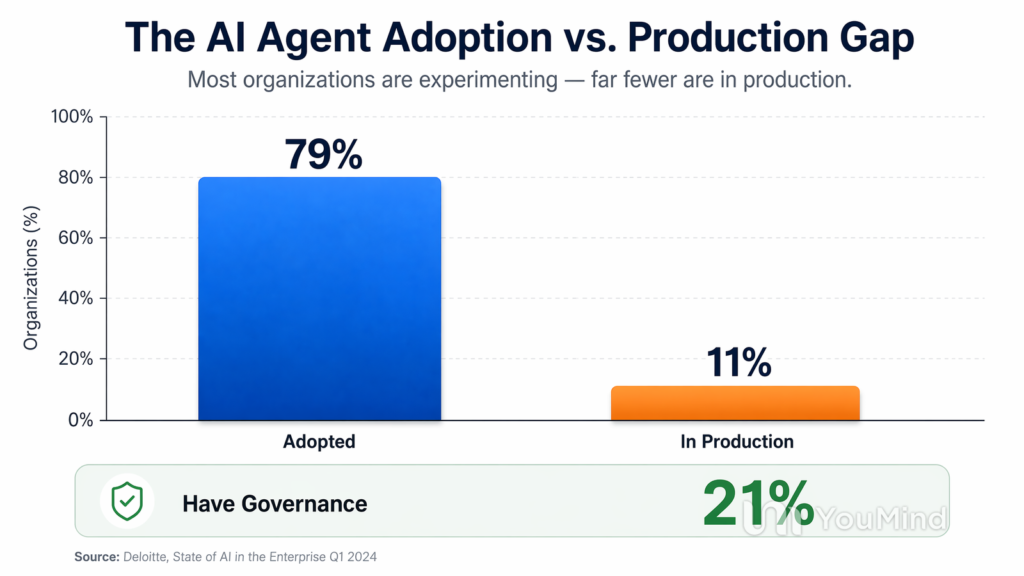
    But numbers only get you so far. Beneath the market enthusiasm sits a more interesting — and more honest — reality: enterprises are adopting AI agents at an astonishing 79% rate, yet only 11% have them running in production. That gap is not a footnote. It is the defining tension of the agentic moment.

    The Gap Is the Story

    Almost four in five enterprises have experimented with or deployed AI agents in some form. But only one in nine is running them in production. Only 21% of companies have a mature governance model for agents, according to Deloitte’s State of AI 2026 report. And here is the stat that should keep founders up at night: 88% of organizations deploying agents report security incidents, and one in eight security breaches now involve agentic systems. Only 23% of enterprises have agent-specific security frameworks in place.

    What does this tell us? The technology has raced ahead of the operating model. Building an agent that works in a demo is straightforward — every major framework can get you there in an afternoon. Building one that runs reliably in production, handles edge cases gracefully, and doesn’t create new attack surfaces is an entirely different discipline. Most teams are still in the demo phase because the gap between “it works” and “it’s safe to deploy” is larger than anyone anticipated.

    This is, oddly, good news for startups and builders who are paying attention. The gap is where value gets created. If everyone were already in production, the opportunity would be commoditized. The fact that 68% of enterprises are still figuring out the bridge from pilot to production means there is enormous room for tools, platforms, and practices that close it.

    What an AI Agent Actually Is in 2026

    If you have been following the space, you have probably noticed that the word “agent” has been stretched to the breaking point. Every chatbot wrapper, every RAG pipeline, every prompt template now calls itself an agent. That ambiguity is not just sloppy marketing — it creates real confusion about what to build and how to evaluate it.

    In 2026, a meaningful definition has crystallized: an AI agent is a system that does not just respond to prompts but can reason, plan, and execute multi-step goals autonomously within a defined environment. The key words are plan, execute, and autonomously. A single-turn chatbot is not an agent. A system that calls an API once and formats the response is not an agent. An agent decides what to do next, which tool to use, and whether its own output is good enough — and then loops until the task is done.

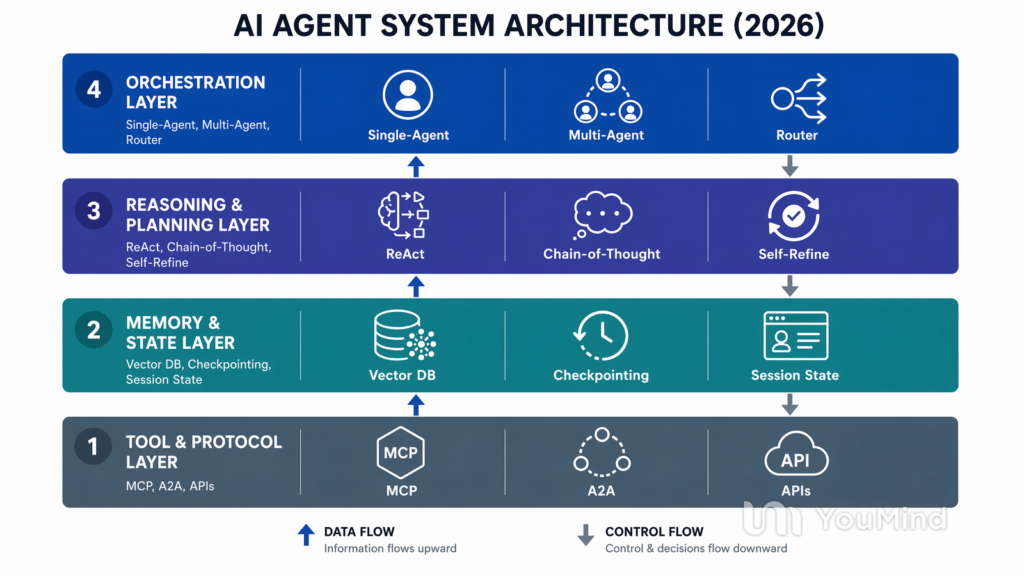
    Under the hood, modern agent systems are composed of four distinct architectural layers.

    The Tool and Protocol Layer sits at the base. This is where agents connect to the outside world — APIs, databases, file systems, and increasingly, standardized protocols like the Model Context Protocol (MCP) and Agent-to-Agent Protocol (A2A). MCP, in particular, has become the closest thing the industry has to a universal connector, removing the need for bespoke integrations for every tool an agent might call. The shift is significant: in 2024, connecting an agent to a new data source meant writing custom glue code. In 2026, you register a tool once through a standard protocol and every compliant agent can discover and use it.

    The Memory and State Layer handles what the agent remembers across turns, sessions, and tasks. This is where things get hard. Vector databases store semantic recall, checkpointing systems (LangGraph’s built-in time-travel debugging is the gold standard here) persist agent state, and session management ensures continuity. The unsolved problem: long-horizon memory. Agents still lose context over dozens of steps, and the compounding error problem — where small mistakes in step three cascade into catastrophic failures by step thirty — remains one of the biggest barriers to production deployment.

    The Reasoning and Planning Layer is where the model decides what to do. The dominant patterns in 2026 are ReAct (Reason + Act, interleaving thought and tool calls), Chain-of-Thought with self-consistency, and increasingly sophisticated self-refinement loops where the agent evaluates its own output and iterates. Reinforcement Learning with Verifiable Rewards (RLVR), popularized by DeepSeek-R1 and now adopted across the industry, has made reasoning models dramatically better at staying on track over multi-step tasks. But even the best models still drift, hallucinate, and get trapped in unproductive loops.

    The Orchestration Layer is the top of the stack — and the most architecturally consequential decision a team will make. This is where you choose between a single-agent system (one model driving the entire workflow), a multi-agent system (specialized agents collaborating on subtasks), or a router pattern (a lightweight model deciding which specialized agent to invoke). Most production systems in 2026 start single-agent and only expand to multi-agent when the task complexity genuinely demands it. The wisdom from teams that have been in production for a year or more is remarkably consistent: start with the simplest architecture that works, and resist the temptation to add agents just because the framework makes it easy.

    The Framework Landscape: Pick Your Fighter

    If architecture is strategy, the framework is your tactical platform. Three frameworks dominate the conversation in 2026, and they are not interchangeable.

    LangGraph has become the default for production deployments. It models agent workflows as directed graphs with conditional edges, which means you get explicit control over every transition, built-in checkpointing for state persistence, and first-class human-in-the-loop interrupt points. Production teams consistently rate it 9/10 on reliability — the highest in the market. The trade-off is a steeper learning curve. You need to understand graph concepts, design state schemas carefully up front, and accept that refactoring those schemas as requirements evolve is a real cost. Teams building for production environments where failures are expensive — financial services, healthcare, compliance-heavy workflows — overwhelmingly choose LangGraph.

    CrewAI wins on developer experience. It abstracts multi-agent coordination behind a role-based DSL: define a researcher agent, a writer agent, a reviewer agent, assign them to a crew with a process type, and you have a working prototype in under twenty lines of Python. The trade-off is control. CrewAI’s abstraction layer is deliberately high, which means fine-grained state management, complex error handling, and conditional routing are harder to achieve. Teams that start with CrewAI for prototyping often migrate to LangGraph when they need production-grade observability. CrewAI’s reliability score in production deployments hovers around 7/10 — improving fast, but still showing tool-call failure modes under load.

    Microsoft AutoGen occupies a distinct niche: conversational multi-agent systems. If your use case involves agents that need to debate, reach consensus, or engage in structured multi-turn dialogue to solve a problem, AutoGen’s conversation primitive is the most natural fit. Its GroupChat manager routes messages between specialized agents, and the framework handles turn-taking, speaker selection, and conversation termination. The trade-off is structure: AutoGen outputs are inherently less predictable than graph-based approaches because conversations are open-ended. Production teams using AutoGen typically add custom guardrails — timeouts, turn limits, referee agents — to prevent unproductive loops.

    A fourth contender worth watching: OpenAgents, which is currently the only framework with native support for both MCP and A2A protocols. Protocol-native architecture may become a decisive advantage as the ecosystem standardizes, but the framework’s community is still smaller than the big three.

    The decision framework that experienced teams use is refreshingly straightforward. If your workflow has cycles, branching logic, or requires production-grade observability, use LangGraph. If you need a working prototype by end of day and the workflow is mostly linear, use CrewAI. If you specifically need conversational multi-agent patterns — debate, consensus, sequential dialogue — use AutoGen. And if you are building in the OpenAI ecosystem with no plans to leave, the OpenAI Agents SDK is the path of least resistance.

    The Production Gap: Why 68% of Enterprises Are Stuck

    The chasm between a working demo and a production system is not primarily a technical problem. It is an operational one, with four dimensions.

    Reliability is the most obvious. Agents operating over dozens of steps inevitably drift. A 95% per-step accuracy rate sounds good until you realize that over a 30-step workflow, the probability of completing without error drops to roughly 21%. Production agents need explicit error recovery — checkpointing, retry logic, circuit breakers — and most teams underestimate how much engineering time those patterns consume. As Eduardo Ordax, Principal Generative AI Go-to-Market lead at AWS, puts it: “Today, when people evaluate agent performance, they try to understand the flow and trace of the agents to identify the behavior.” Understanding the behavior comes before fixing it, and most teams are still at the understanding stage.

    Security is the dimension that keeps CISOs awake. Agents with tool access are fundamentally new attack surfaces. Prompt injection — where an attacker embeds malicious instructions in data the agent processes — is not a theoretical concern anymore. MIT Technology Review flagged this as one of the defining AI challenges of 2026. The 88% incident rate among deploying organizations tells you everything: the security model for agents is still being invented, and production deployments are running ahead of their own safety.

    Observability is the infrastructure gap. Tracing an agent’s decision path across multiple LLM calls, tool invocations, and state transitions requires tooling that most organizations do not have. LangSmith and Langfuse have emerged as the leading observability platforms, but integrating them into existing monitoring stacks is non-trivial work. Without observability, debugging agent failures is effectively impossible — you cannot fix what you cannot see.

    Governance is where the organizational rubber meets the road. Only 21% of companies have mature governance frameworks. Who approves an agent’s tool access? What is the escalation path when an agent makes a decision that needs human review? How do you audit an agent’s actions across a six-month span? These are not engineering questions — they are policy questions that require cross-functional alignment between engineering, legal, compliance, and executive leadership. Most organizations have not even started those conversations.

    Where This Is Heading

    The trajectory for the remainder of 2026 and into 2027 is coming into focus, and it points toward three shifts.

    First, persistent agents. Today’s agents are largely stateless — they execute a task and disappear. Persistent agents that maintain context across days or weeks, learn from past interactions, and proactively initiate work are the natural next step. IBM’s Anthony Annunziata sees this accelerating through smaller, domain-specific reasoning models that are easier to fine-tune for particular workflows. The vision: an agent that knows your company’s tool ecosystem, remembers how you resolved the last outage, and can handle the next one with less human intervention.

    Second, protocol convergence. MCP and A2A are not yet universal, but the direction is clear. Standardized tool connectivity removes the largest source of integration friction, which in turn makes agents more composable. When any agent can discover and use any tool through a standard protocol, the bottleneck shifts from “can we connect this?” to “should we connect this, and what are the consequences if it goes wrong?” That is a governance question, and it is harder than the engineering one.

    Third, the composable agent stack. The early pattern of monolithic agent platforms is giving way to modular architectures where organizations mix and match models, frameworks, and protocols based on the specific task. One model for reasoning-heavy work, another for fast tool execution, a third for output validation. The agent stack of 2027 will look less like a single product and more like a carefully curated portfolio — which means the integration and orchestration layer becomes the most valuable piece of the puzzle.

    What This Means for Builders and Founders

    If you are building in or around the agent space right now, a few principles hold.

    Start single-agent. Almost every team that jumped straight to multi-agent systems regrets it. The debugging complexity scales non-linearly with each additional agent, and most workflows genuinely do not need the overhead. A well-designed single agent with good tool access and explicit error handling will outperform a sloppy multi-agent system every time.

    Invest in observability from day one. If you cannot trace an agent’s decisions, you cannot trust it. LangSmith, Langfuse, or a custom telemetry layer is not a nice-to-have — it is table stakes for production.

    Build governance into the architecture, not around it. Tool access control, human-in-the-loop checkpoints, and audit logging should be first-class design decisions, not patches applied after a security incident. The 88% incident rate is a warning, not a statistic to ignore.

    Focus on closing the gap. The 79%-to-11% adoption-to-production chasm is where the market opportunity lives. Tools and platforms that help enterprises cross that gap — through better reliability, security, observability, or governance — are solving the hardest and most valuable problem in agentic AI right now.

    The agent revolution is real. The market numbers, the investment flows, and the enterprise behavior all confirm it. But revolutions are messy, and the gap between ambition and operational reality in agentic AI is wider than in any other technology wave of the last decade. That gap is not a reason for skepticism — it is a map of where the work needs to happen. For builders and founders who understand both the technology and the operational discipline required to deploy it safely, 2026 is the year the opportunity opens wide.