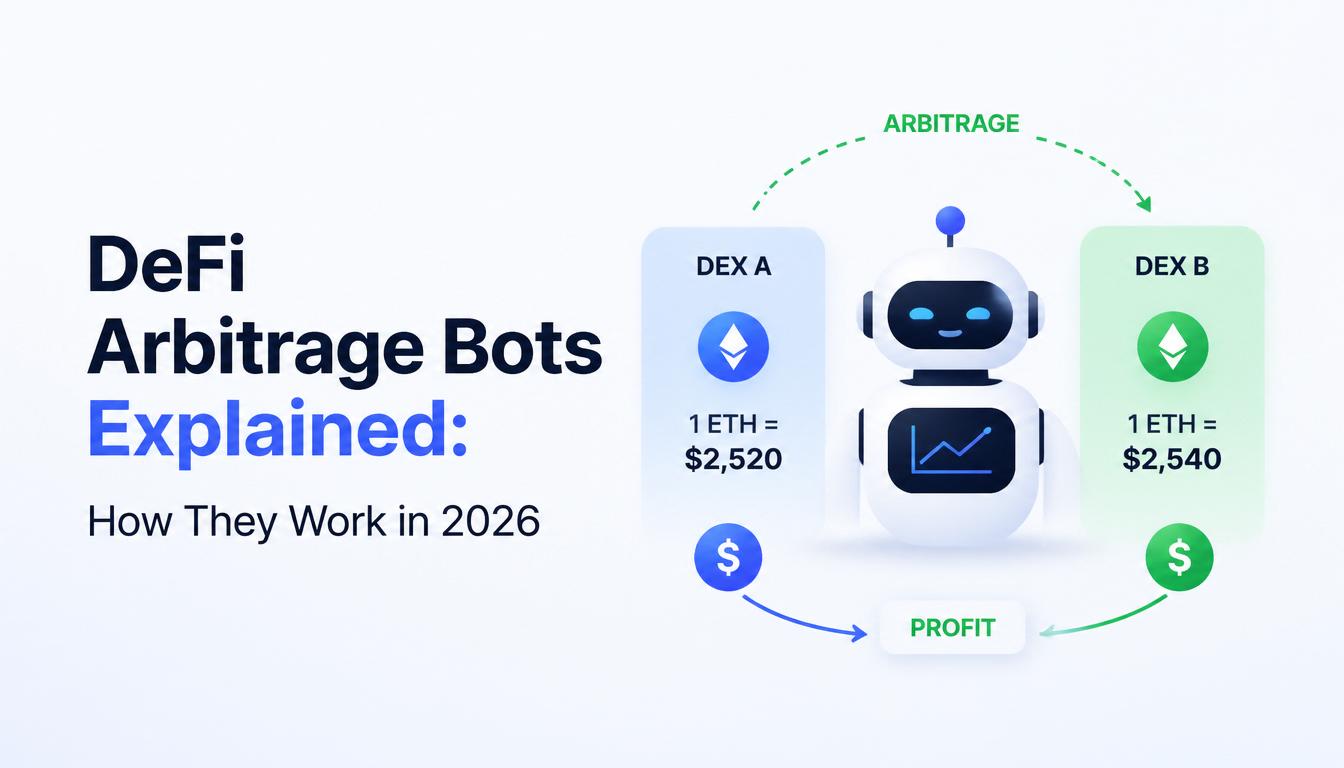
Decentralized finance trades around the clock across dozens of exchanges and a growing number of chains. Prices drift apart by tiny amounts, constantly. Capturing those gaps before they close is a game measured in milliseconds, and it’s almost entirely automated. Welcome to DeFi arbitrage bots — the silent operators behind a meaningful share of on-chain volume.
This guide explains what DeFi arbitrage bots actually do, how they use flash loans to operate without capital of their own, where the real opportunities live in 2026, and what the honest profit picture looks like. No hype, no “instant millionaire” pitches — just how the machinery works.
The core idea
Arbitrage profits from the same asset being priced differently in two places. In DeFi, those places are decentralized exchanges (DEXs) — Uniswap, SushiSwap, Curve, PancakeSwap, and dozens more — across many blockchains. Because each DEX has its own liquidity pool, ETH might be 0.1% cheaper on one exchange than another for a few seconds. A bot that buys cheap and sells expensive in the same transaction pockets that 0.1%, scaled by the amount it can move.
The catch is speed and competition. According to SwapSpace’s overview, DeFi arbitrage is dominated by bots — automated agents scanning the mempool, monitoring prices across DEXs in real time, and executing trades within milliseconds. No human is fast enough to play this game manually.

How DeFi arbitrage bots work, step by step
Every DeFi arbitrage bot runs the same loop, just very fast.
- Monitor. Stream price data and the mempool (pending transactions) from multiple DEXs.
- Detect. Identify a price discrepancy large enough to cover gas fees and yield a profit.
- Compose. Build a single transaction that buys on the cheap DEX and sells on the expensive one.
- Submit. Send the transaction to the network — often through a private relay like Flashbots to avoid being front-run.
- Settle atomically. All steps execute together or not at all, so the bot can’t get stuck holding the wrong side.
That last step is the magic. DeFi arbitrage uses atomic transactions: all trades within a strategy either execute together or the whole thing reverts. The worst case is the bot loses the gas fee, not the trade.
Flash loans: the secret weapon
The most powerful tool in the DeFi arbitrage toolkit is the flash loan. Flash loans provide temporary access to substantial capital without requiring collateral. Lending protocols like Aave and dYdX let you borrow any available amount of tokens within a single transaction, use them for any purpose, and repay the loan plus a small fee before the transaction completes.
That sounds impossible until you remember atomic transactions. If the bot can’t repay the loan by the end of the transaction, the entire thing reverts — borrowed funds included. The lender is never at risk. From the arbitrageur’s perspective, this is leverage without collateral: a bot can capture a $1,000 arbitrage on $10 million of borrowed liquidity, paying back the loan and pocketing the spread, all within one block.
That single mechanism — borrow huge sums, use them, repay them, all in one transaction — is what makes DeFi arbitrage bots economically possible for operators without large balance sheets.
Cross-chain and cross-DEX opportunities
Single-DEX arbitrage is largely solved by giant bots on Ethereum mainnet. The frontier in 2026 is wider.
Cross-DEX arbitrage exploits price differences between exchanges on the same chain — Uniswap vs SushiSwap on Ethereum, for example. Cross-chain arbitrage goes further: trades executed across multiple blockchains, capturing differences between an asset on Ethereum and the same asset on a Layer 2 like Arbitrum or Optimism, or on alternative chains like Solana and BNB Chain. The opportunity is larger, because fewer bots compete across chains, but the complexity is also greater — bridging delays and varying gas costs can erode profits fast.
Cross-DEX bots must account for varying gas costs across different networks. Some DEXs operate on Ethereum mainnet with high fees; others on cheaper Layer 2s or alternative chains. The math has to work after every cost is paid.
A worked example
Numbers make the mechanics click. Imagine ETH trading at $3,000.00 on Uniswap and $3,003.00 on SushiSwap.
A flash-loan arbitrage bot borrows 10,000 USDC from Aave. It uses the borrowed USDC to buy ETH on Uniswap at $3,000.00, receiving roughly 3.33 ETH. It immediately sells that ETH on SushiSwap at $3,003.00, receiving 10,010 USDC. It repays the 10,000 USDC flash loan plus a small fee (typically 0.05–0.09%), pays Ethereum gas, and pockets the difference — maybe $3–$5 net profit, all within one Ethereum block.
That doesn’t sound like much. The point is that the bot does this hundreds or thousands of times per day, on borrowed capital, with downside limited to gas costs when trades fail. Scaled and automated, modest individual profits compound into a real business.
Realistic returns from DeFi arbitrage bots
Cut through the hype: DeFi arbitrage bots are profitable but highly competitive in 2026. Simple arbitrage opportunities on Ethereum mainnet are captured within milliseconds by sophisticated MEV bots. Successful operations typically generate 0.5–3% monthly returns on operational capital — strong for an institutional setup, modest for retail expectations primed by hype.
Profitability in 2026 requires several edges layered together. Private mempool submission through Flashbots prevents front-running. Multi-chain deployment on Layer 2s reduces competition compared to Ethereum mainnet. Gas-optimized contracts preserve more of each capture. A bot that lacks all three competes against teams that have them and loses systematically.
The risks
DeFi arbitrage bots aren’t risk-free; they trade explosive volatility for specific, technical risks.
- Failed transaction gas costs. A reverted transaction still consumes gas. A streak of failed attempts during volatile conditions can bleed real money.
- Smart contract vulnerabilities. Bugs in the protocols you integrate with — or your own bot — can lock or lose funds permanently. DeFi has no chargebacks.
- MEV attacks. Even arbitrage bots get arbitraged. Front-running and sandwich attacks can target your transactions before they confirm. Our MEV bots explained guide details how.
- Slippage exceeding estimates. If a DEX moves between your transaction submission and execution, your profit can vanish.
- Gas price spikes. Network congestion can make a previously profitable opportunity unprofitable in seconds.
- Protocol exploits on the DEXs or lending platforms you depend on.
The trade-off is real: lower price exposure than directional trading, but higher exposure to specifically technical risk.
Can a retail trader run one?
Not really — and that’s the honest answer.
True DeFi arbitrage at the mainnet level is an arms race won by teams with custom infrastructure, deep Solidity expertise, and direct relationships with builders. A solo retail trader will not out-execute them.
What retail traders can do is run simpler cross-exchange or cross-chain arbitrage with less competition — particularly on smaller Layer 2s, newer DEXs, or specific niches. Treat it as a developer project, not a passive income stream. Learn Solidity. Read the open-source bot frameworks. Run on a testnet. Expect to lose money while you learn. If after that the math still works, you have a real business; if not, you’ve still gained skills more valuable than the arbitrage itself.
For most readers, the bigger lesson is that DeFi arbitrage bots set the price floors that other on-chain strategies must respect. Knowing how they work makes you a sharper DeFi user even if you never run one.
Learning to build DeFi arbitrage bots
If you want to actually try this, here’s the realistic learning path. Don’t skip steps; each one filters out a kind of failure.
Step 1: learn Solidity and the EVM. Not at expert level, but enough to read other people’s bot code and understand what it’s doing. Without this, you’re flying blind. CryptoZombies and Solidity-by-example are free starting points.
Step 2: run a public open-source bot on a testnet. Frameworks exist on GitHub for exactly this — fork one, deploy it on a testnet like Sepolia, and watch it. You’ll see how often opportunities appear and how often the bot misses them. This is also where you learn the gas-cost reality.
Step 3: pick a niche. Don’t try to beat the giants on Ethereum mainnet. Pick a smaller Layer 2, a niche DEX, or a cross-chain pair where competition is lighter. The 0.5–3% monthly returns DeFi arbitrage bots target compound only with a real edge somewhere.
Step 4: deploy small on mainnet. Use a tiny amount of real capital — enough to feel the loss if it fails, small enough that it won’t change your life. Run for weeks. Track every reverted transaction, every gas spike, every slippage event. The data here is the curriculum.
Step 5: iterate or quit honestly. Most attempts fail to clear the cost line. That’s not personal failure; it’s an efficient market. If after a real test the numbers don’t work, you’ve gained Solidity skills more valuable than the arbitrage itself.
The hardest part is being honest about step five. Stick a small win in your head and you’ll keep funding losses chasing it. Stick the real numbers in a spreadsheet and the decision makes itself.
FAQ
What are DeFi arbitrage bots? Automated programs that detect and exploit price differences for the same asset across decentralized exchanges, executing buy-and-sell trades within a single atomic transaction.
Are DeFi arbitrage bots profitable? They can be — typically 0.5–3% monthly on operational capital for well-run operations. They’re highly competitive, and the easy opportunities are already captured by professional teams.
Do I need a lot of capital to run one? Not necessarily, thanks to flash loans. Aave and dYdX let bots borrow large sums without collateral within a single transaction, returning the loan automatically if the arbitrage fails.
What is a flash loan? An uncollateralized loan that must be borrowed and repaid within the same blockchain transaction. If the loan isn’t repaid by the end, the entire transaction reverts — so the lender can’t lose funds.
Are DeFi arbitrage bots legal? Yes. They participate in public markets the same way any algorithmic trader does. The legal questions involve specific tactics (like manipulation) rather than arbitrage itself.
What languages are DeFi arbitrage bots written in? The on-chain logic is written in Solidity (or Vyper) and deployed as smart contracts. The off-chain monitoring layer is usually written in Python, JavaScript, Rust, or Go — whichever the developer prefers for scanning the mempool and submitting transactions.
Key takeaways
- DeFi arbitrage bots profit from price gaps across DEXs and chains, executing buys and sells in a single atomic transaction.
- Flash loans let bots access huge capital without collateral, repaying within the same transaction.
- Realistic returns are 0.5–3% monthly for serious operations; the easy opportunities are gone.
- Edges in 2026 come from Flashbots, Layer 2s, and gas-optimized contracts — not raw speed alone.
- Retail traders can’t out-execute pro teams on Ethereum mainnet, but niche cross-chain and Layer-2 opportunities still exist for developers.
Curious about the on-chain landscape? Our free Algo Trading Starter Kit includes a DeFi-arbitrage beginner’s checklist, key glossary, and links to open-source bot frameworks. Grab it free → and learn the machinery whether you ever run one or not.
Leave a Reply