It’s the first question almost everyone asks, and the answer most guides botch by giving a single number. The honest truth is that the money to start algo trading depends entirely on what stage you’re at. Learning costs nothing. Trading live responsibly costs more than the regulatory minimum. And 2026 changed the math in a big way.
This guide breaks the question into the three numbers that actually matter: the cost to learn, the cost to go live, and the cost to trade without blowing up. It also covers the 2026 rule change that just lowered the barrier for everyone.
There is no single price tag. Instead, think in three tiers:
The cost to learn and test — building and backtesting a strategy.
The cost to go live — the broker’s minimum to place real trades.
The cost to trade responsibly — enough capital that risk management actually works.
Most beginners confuse the second number with the third, and that mistake is exactly how small accounts get wiped out. Getting the money to start algo trading right means respecting all three tiers, not just the cheapest one.
Cost to learn: basically zero
Here’s the good news. The entire learning phase is effectively free.
Paper-trading accounts, historical market data, and the core Python libraries — Pandas, NumPy, backtesting frameworks — all cost nothing. You can build a strategy, backtest it across years of data, and run it on simulated money without risking a cent. Brokers like Alpaca even offer free paper trading with a developer-friendly API.
Spend weeks here. The cheapest mistakes are the ones you make with fake money.
The 2026 game-changer: PDT rule eliminated
For two decades, U.S. day traders faced a hard wall: the Pattern Day Trader rule, which required $25,000 in your account to day trade actively. That barrier just fell.
On April 14, 2026, the SEC approved FINRA’s elimination of the Pattern Day Trader designation, removing the $25,000 minimum, as reported by QuantInsti. The change rolls out across U.S. brokers starting June 4, 2026. In its place, the standard Regulation T margin minimum of roughly $2,000 applies, though individual brokers may set higher internal minimums.
The practical effect is huge for automated strategies. If you’d backtested an intraday system but couldn’t run it live without $25k, you can now test it with far less.
How much money to start algo trading live
So what should you actually fund your account with? It depends on the strategy and your risk tolerance, but here are realistic guideposts:
$2,000 — the new regulatory floor. Possible, but tight.
$5,000–$10,000 — a reasonable range to run an intraday strategy where the 1–2%-per-trade rule still leaves room for meaningful positions.
$25,000+ — comfortable for strategies needing larger positions or more simultaneous trades.
The key principle: your account must be large enough that risking 1–2% per trade is still a position worth taking, but small enough that losing the whole thing wouldn’t change your life.
Money to start algo trading: crypto vs stocks vs forex
The money to start algo trading also depends on which market you pick. Capital needs vary widely.
Crypto has the lowest barrier. Many exchanges let you start with under $100, and there’s no PDT-style rule. The trade-off is higher volatility and weaker regulation.
Stocks historically carried the PDT wall, now largely gone. The new ~$2,000 minimum makes automated equity strategies viable on small accounts.
Forex allows small starting balances and high leverage — which cuts both ways, amplifying losses as easily as gains.
Match the market to your capital and your risk appetite, not to whichever one an affiliate ad is pushing hardest.
Why the minimum is a trap
This is the part the hype skips. A regulatory minimum is permission to trade, not a recommendation.
Starting at exactly $2,000 means a single bad week can shrink your account below the point where proper position sizing is possible. Undercapitalized accounts force traders to over-risk each trade just to chase meaningful returns. That is precisely how beginners blow up. As regulators and brokers both stress, the minimum is a floor, not a target.
So treat the money to start algo trading as working capital, not a lottery ticket. Fund your account with cash you can afford to lose entirely — and enough of it that discipline is actually possible.
FAQ
What is the absolute minimum to start algo trading? To learn and backtest, $0. To trade live, as little as ~$2,000 in the U.S. after the PDT rule change — though crypto lets you start with far less.
Did the PDT rule really get eliminated in 2026? Yes. The SEC approved removing the $25,000 Pattern Day Trader minimum, with the change rolling out from June 4, 2026, replaced by the standard ~$2,000 margin minimum.
Is $1,000 enough to start algo trading? For crypto, yes. For U.S. stocks, it’s below most brokers’ practical thresholds and leaves little room for risk management. Treat it as a learning amount.
How much money should a beginner risk per trade? 1–2% of the account. This single rule does more to keep beginners alive than any strategy.
Do I need money to learn algo trading at all? No. The entire build-and-backtest phase is free using paper accounts and open-source tools.
Key takeaways
The money to start algo trading isn’t one number — separate learning, going live, and trading responsibly.
Learning is free. Paper trading and open-source tools cost nothing.
2026 removed the $25k PDT wall, dropping the U.S. live minimum to roughly $2,000.
A realistic responsible range is $5,000–$10,000 for most intraday strategies.
The minimum is a trap. Undercapitalized accounts force over-risking. Fund what you can afford to lose.
Plan your first account the smart way. Download our free Algo Trading Starter Kit: a capital-planning worksheet, a Python bot template, and our broker comparison. Get instant access → and join 12,000+ traders automating without the guesswork.
Meta description: AI trading, algo trading, and quant trading sound interchangeable but solve different problems. Here’s the clear, practical breakdown — with examples. (157 chars)
Table of Contents
Why these three terms get confused
Quantitative trading: the “what to trade and why”
Algorithmic trading: the “how to execute it”
AI trading: the “let the model figure it out”
The stack analogy: how the three actually fit together
Side-by-side comparison
Which one should you learn first?
Real-world examples from the top quant firms
Common pitfalls and misconceptions
FAQ
Key takeaways
Why These Three Terms Get Confused
If you’ve spent any time on finance Twitter, quant subreddits, or YouTube, you’ve probably seen “quant trading,” “algo trading,” and “AI trading” used as if they’re synonyms. They aren’t — but the confusion is understandable, because the same firm often does all three at once.
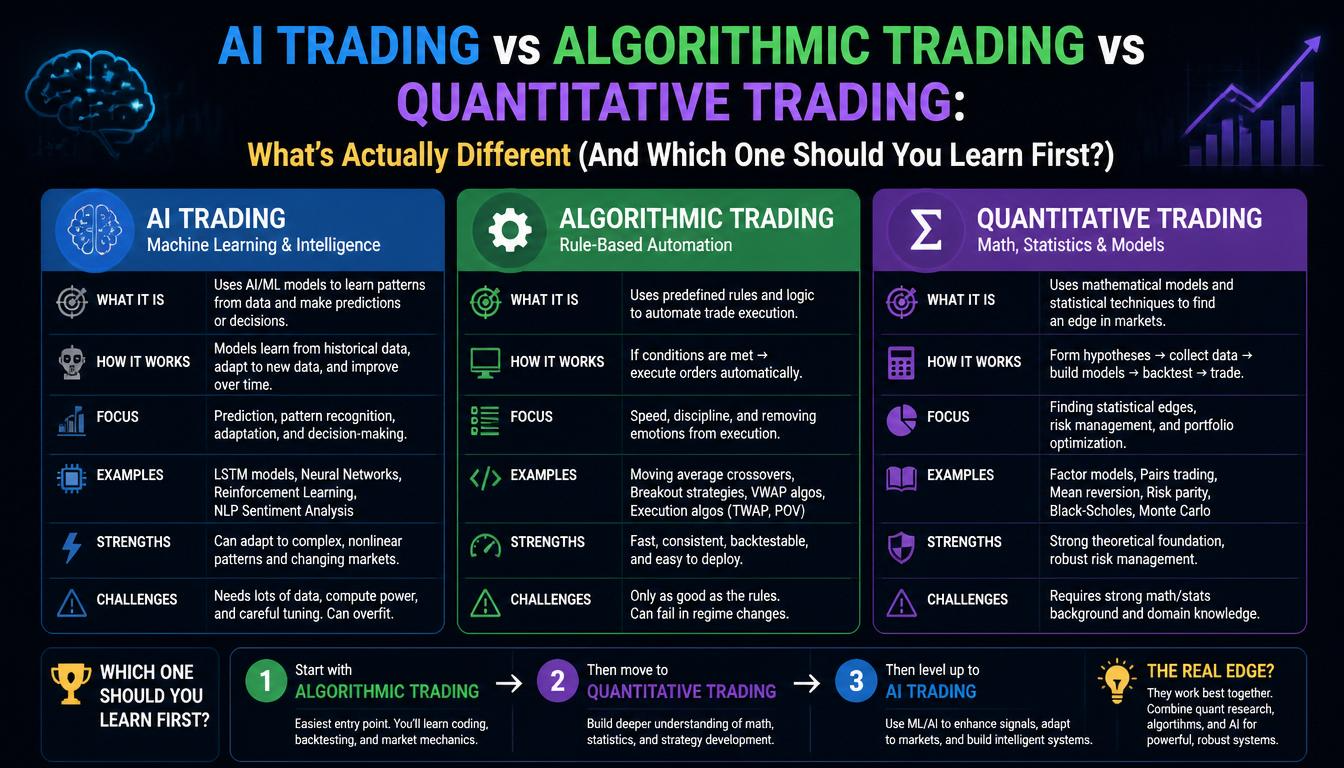
Here’s the headline difference, stated plainly:
Quantitative trading is about deciding what to trade, using math and statistics.
Algorithmic trading is about executing trades automatically, using pre-defined rules.
AI trading is about learning what to trade, using machine learning models that adapt to data.
They are layers, not competitors. A serious modern trading operation usually combines all three. But conceptually they live in different places, and if you’re trying to break into the field, knowing which one you’re actually studying matters a lot.
The scale is also worth grounding. Algorithmic execution now dominates modern markets — Coalition Greenwich found that electronic trading platforms captured 44% of buy-side U.S. equities order flow in 2023, with approximately 37% of overall volume executed through algorithms and/or smart order routers. The global algorithmic trading market was estimated at USD 21.06 billion in 2024 and is projected to reach USD 42.99 billion by 2030, growing at a CAGR of 12.9%, with AI and machine learning integration cited as a primary growth driver. So the categories aren’t academic — they’re where the money is. GreenwichGrand View Research
Let’s go through them one at a time.
Quantitative Trading: The “What to Trade and Why”
Quantitative trading (or “quant trading”) is the discipline of using mathematics, statistics, and large datasets to identify trading opportunities. A quant’s job is essentially to find an edge — a statistically significant pattern in market data that can be exploited for profit.
A quant doesn’t necessarily care about how the trade gets placed. They care about whether the strategy works. Their core questions are:
What variables predict future price movement?
Is the pattern statistically significant, or is it noise?
Does the edge survive out-of-sample testing?
What’s the risk-adjusted expected return?
To get there, quants build mathematical models — often involving regression analysis, time-series econometrics, stochastic calculus, and increasingly machine learning. They lean heavily on programming languages like Python, R, C++, and Java, and on disciplines like probability theory and linear algebra.
A classic example: a quant model might observe that gold tends to rally after weak U.S. job reports, using 10 years of data to confirm the edge. That insight — derived from data, validated statistically — is the strategy. Whether the resulting trade is then placed manually by a trader or executed by an algorithm is a separate question. Gomoon
This is why quantitative trading is sometimes called systematic trading: the decisions come from a system, not from intuition.
Algorithmic Trading: The “How to Execute It”
Algorithmic trading — also called algo trading or automated trading — is the use of computer programs to execute trades automatically based on pre-defined rules.
The defining feature of an algo is that it’s deterministic: given the same input, it always produces the same output. The rules are explicit and human-designed. Classic examples include:
VWAP/TWAP execution — slicing a large order across the day to match volume-weighted or time-weighted average price
Moving-average crossovers — buying when a short-term average crosses above a long-term average
Statistical arbitrage pairs trades — buying one asset and shorting a correlated one when their spread diverges
Smart order routing — fragmenting an order across multiple exchanges to find the best price
Algos are about speed, precision, and removing emotion. They don’t decide what to trade in any sophisticated sense — they execute what they’ve been told to execute. As one practitioner notes, algos don’t care if the strategy is complex or simple — they just run the logic with precision. Gomoon
Importantly, algorithmic trading does not require AI or even particularly advanced statistics. A simple rule like “if RSI < 30, buy 100 shares” is technically an algorithmic strategy. That’s why algo trading is the most accessible of the three for retail traders — platforms like MetaTrader, NinjaTrader, and various crypto bots let you deploy rule-based strategies without a PhD.
AI Trading: The “Let the Model Figure It Out”
AI trading is where things get more recent — and more interesting. Instead of writing explicit rules, AI trading uses machine learning models that learn patterns from data.
The key difference: a traditional algo says, “if X then Y.” An AI model says, “given everything I’ve seen, here’s the probability of Y given X” — and it updates that estimate as it sees more data.
The techniques sitting under “AI trading” include:
Supervised learning — predicting next-day returns, volatility, or direction
Deep learning — using neural networks to find non-linear patterns in market and alternative data
Reinforcement learning — letting an agent discover trading policies by maximizing reward over time
Natural language processing (NLP) — extracting signal from news, earnings transcripts, social media, and SEC filings
Computer vision — analyzing satellite imagery, shipping traffic, and parking-lot data
AI trading also relies heavily on alternative data — non-traditional inputs like credit card transactions, geolocation pings, web-scraped product prices, and sentiment from social platforms. Two Sigma, for instance, feeds vast amounts of data — including news articles, satellite images, and financial reports — into their machine-learning models to make informed predictions. DigitalDefynd
The trade-off is significant. AI models can capture relationships that no human would think to code — but they’re often opaque (“black box”), prone to overfitting, and harder to debug when they fail. When a traditional algo breaks, you can read the code. When an AI model breaks, you might not know why it stopped working.
The Stack Analogy: How the Three Actually Fit Together
Here’s the mental model that ties it all together. Think of trading as a three-layer stack:
Layer 1 — Strategy (Quantitative): What’s the edge? What pattern, anomaly, or relationship will we exploit? This is where math, statistics, and increasingly ML do their work.
Layer 2 — Intelligence (AI): How do we discover and refine that edge? Traditional quants might use regression and hand-crafted features. AI-driven quants let models learn the features themselves from larger, messier datasets.
Layer 3 — Execution (Algorithmic): Once we’ve decided to trade, how do we actually place the orders? This is pure algo trading — order routing, slicing, latency optimization, exchange-side mechanics.
In practice, a quantitative model generates a trading signal, and an algorithmic system then places the order — splitting it across exchanges, adjusting for liquidity, and managing execution speed. Gomoon
So when someone says “I want to learn quant trading,” they usually mean Layer 1 (and increasingly Layer 2). When they say “I want to build a trading bot,” they usually mean Layer 3 with a simple Layer 1 strategy bolted on. And when they say “AI trading,” they mean Layer 2 — typically being applied to enhance Layer 1.
Side-by-Side Comparison
Dimension
Quantitative Trading
Algorithmic Trading
AI Trading
Primary purpose
Find the edge
Execute trades efficiently
Learn the edge from data
Decision logic
Math + statistics, rule-based
Explicit, human-coded rules
Learned from data, often opaque
Skill requirements
Statistics, math, programming
Programming, market structure
ML, data engineering, statistics
Adaptability
Re-calibrated periodically
Static unless rewritten
Continuously learns / retrains
Common techniques
Regression, factor models, stat arb
VWAP, TWAP, smart order routing, MA crossovers
Deep learning, RL, NLP, computer vision
Interpretability
High
Very high
Often low
Retail accessibility
Medium
High
Low-to-medium
Typical risk
Model misspecification
Logic bugs, latency
Overfitting, data leakage, black-box failure
Which One Should You Learn First?
If you’re new and trying to figure out where to start, here’s an honest guide:
Start with algorithmic trading if you want hands-on experience fast. The barrier is low. You can build a moving-average crossover bot on a free platform in a weekend. You’ll learn market mechanics, order types, slippage, and backtesting — all of which you need regardless of where you go next.
Move into quantitative trading if you want to understand why strategies work. This is where you study statistics, time-series analysis, factor investing, and risk modeling. It’s slower to produce results but builds genuine intuition. Python with libraries like pandas, NumPy, statsmodels, and backtrader is the standard starting toolkit.
Layer on AI trading once you have a working knowledge of both. AI without quant fundamentals is dangerous — you’ll build models that look great in backtests and fail catastrophically in production. Most overfitting disasters come from people who jumped to machine learning before learning what a stationary time series is.
A reasonable learning sequence:
Build a simple rule-based algo (e.g. on Python with backtrader or QuantConnect)
Learn proper backtesting, walk-forward validation, and risk metrics
Study factor investing and statistical arbitrage
Add ML carefully — start with linear models, then trees, then deep learning
Explore reinforcement learning and alternative data only after the foundations are solid
Real-World Examples From the Top Quant Firms
The biggest names in systematic trading illustrate how these layers blend in practice.
Renaissance Technologies, founded by mathematician Jim Simons in 1982, is the archetypal quant firm. Its secretive Medallion Fund has earned an estimated annualized return of 35% since 1982. Renaissance famously hires PhDs in mathematics, physics, and signal processing rather than traditional Wall Street traders, and unifies its research under a single integrated model. GitHub
Two Sigma, founded in 2001 and managing US$70 billion in AUM as of 2025, is the clearest example of AI-driven quant. The firm uses a variety of technological methods, including artificial intelligence, machine learning, and distributed computing, for its trading strategies. Performance has been strong — Two Sigma achieved strong double-digit gains in 2024 using algorithm-driven strategies, with the Spectrum fund returning 10.9% and Absolute Return Enhanced posting 14.3%. Wikipedia + 2
Citadel sits at the intersection of all three. The firm employs reinforcement learning models to optimize trading strategies, using AI to learn the best policies to maximize returns while minimizing risks, while Citadel Securities — its market-making arm — operates massive algorithmic execution infrastructure for high-frequency trading. Medium
D.E. Shaw, Jane Street, and Jump Trading round out the top tier, each blending quantitative research with sophisticated algorithmic execution and increasingly AI-driven model development.
The consistent pattern: every leading firm uses quant strategy + algorithmic execution + AI-driven research as complementary pieces, not competing approaches.
Common Pitfalls and Misconceptions
A few mistakes that come up constantly:
“AI trading is just better algo trading.” No. AI trading is harder to interpret, more data-hungry, and easier to overfit. It’s a different tool with different failure modes. When a rule-based algo fails, you read the rule. When an AI model fails, you might never fully know why.
“Quant trading guarantees high returns because it’s mathematical.” Math doesn’t beat markets; edges do. Markets adapt, edges decay, and quant strategies can underperform for years. Renaissance is famous because it’s extraordinary — most quant funds don’t post 35% annualized returns.
“I need a PhD to do any of this.” For top hedge funds, often yes. For learning the craft and trading retail capital, no. The mathematics gets deep quickly, but the entry point doesn’t require it.
“More data and a fancier model will fix my backtest.” Almost never. Most retail-built strategies fail because of look-ahead bias, survivorship bias, or overfitting — not because the model wasn’t deep enough.
FAQ
Is AI trading a subset of algorithmic trading? Technically yes — any automated trade is algorithmic — but conceptually it’s useful to keep them separate. Algo trading typically refers to deterministic rule-based execution; AI trading refers to learned, adaptive decision-making. The mechanism is automated in both cases, but the source of the decisions is fundamentally different.
Can a retail trader realistically do AI trading? You can experiment with it, but compete with institutional AI? Not really. The biggest funds spend billions on data, infrastructure, and talent. Retail AI trading is best treated as a learning exercise or a way to enhance personal strategies — not a path to consistent alpha against firms like Two Sigma.
What’s the difference between quantitative trading and high-frequency trading (HFT)? HFT is a subset of algorithmic trading focused on extremely fast execution — milliseconds or microseconds — usually exploiting tiny, short-lived price inefficiencies. Quant trading is broader and includes strategies that hold positions for weeks or months. Many quant firms do HFT, but most quant trading isn’t HFT.
Do I need to know C++ to do this? Only if you’re going into HFT or ultra-low-latency execution at a major firm. For most quant and AI trading, Python is the dominant language, with R as a secondary option.
Which is most profitable for an individual? Honestly, none of them are reliably profitable for individuals without significant work. The most realistic path for a retail trader is a simple, well-tested rule-based algo strategy applied to a market they understand deeply. AI trading at retail scale is mostly aspirational.
Is algo trading legal? Yes, in nearly all major markets, though heavily regulated. The SEC, FINRA, ESMA, and other regulators have specific rules around market manipulation, order-to-trade ratios, and systemic risk for algorithmic and high-frequency strategies.
Key Takeaways
Quantitative trading is about identifying statistically valid trading edges using math and data.
Algorithmic trading is about executing trades automatically using pre-defined rules.
AI trading is about using machine learning to discover and adapt strategies that traditional rule-based approaches would miss.
They’re complementary layers, not alternatives. The top firms — Renaissance, Two Sigma, Citadel, D.E. Shaw — use all three.
For a beginner, start with rule-based algo trading, build statistical foundations through quant work, and add AI techniques only after the basics are solid.
Algorithmic execution dominates modern markets, accounting for an estimated 60–75% of U.S. equity trading volume, and the AI-driven slice of that share is growing fastest.
The terms will keep getting used loosely. But now, when someone tells you they’re “doing AI trading,” you’ll know exactly which layer of the stack they’re actually working on — and which questions to ask next.
Want me to adapt this into a different format (Word doc, Medium post, LinkedIn article) or write a follow-up piece on a specific sub-topic — e.g., “How to actually build your first quant strategy in Python” or “Why most AI trading backtests are lying to you”?