Something strange happened between late 2025 and early 2026. The conversation around AI agents stopped being about “what if” and became about “how.” In boardrooms, developer channels, and startup pitch decks, the question shifted almost overnight: not whether agents will transform software, but which architecture, which framework, and what guardrails will get them into production without blowing up.
The numbers tell part of the story. The global AI agents market hit roughly $10.9 billion in 2026, up from $7.6 billion the year before — a 43% single-year jump that makes the early cloud migration look leisurely by comparison. Grand View Research projects the market reaching $50.3 billion by 2030 at a 45.8% CAGR, and some analysts extend that line all the way to $236 billion by 2034. AI startups raised $202 billion in 2025 alone, a 75% increase year-over-year, with 55 startups closing rounds of $100 million or more. Gartner expects that by the end of 2026, 40% of enterprise applications will embed task-specific AI agents.
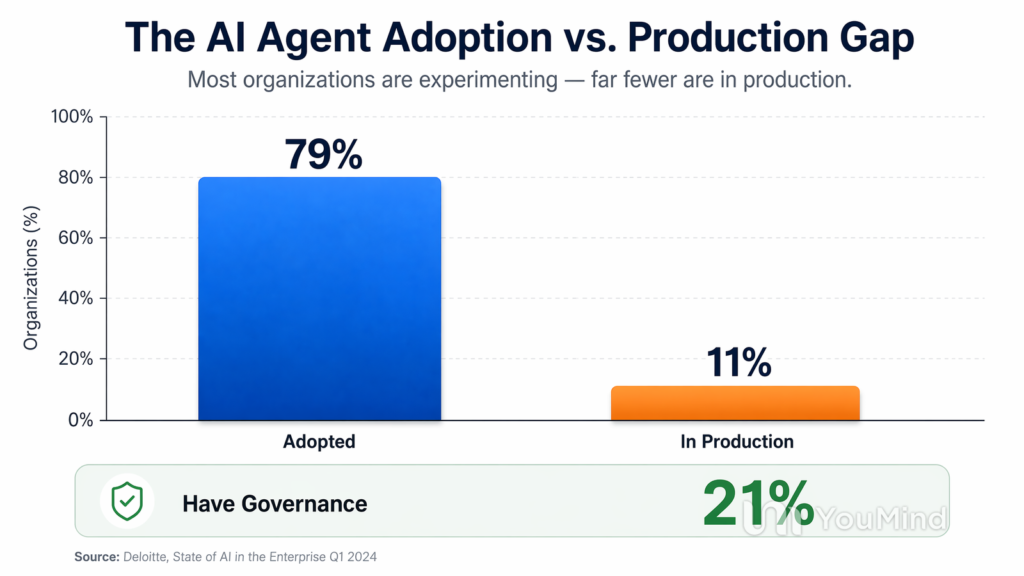
But numbers only get you so far. Beneath the market enthusiasm sits a more interesting — and more honest — reality: enterprises are adopting AI agents at an astonishing 79% rate, yet only 11% have them running in production. That gap is not a footnote. It is the defining tension of the agentic moment.
The Gap Is the Story
Almost four in five enterprises have experimented with or deployed AI agents in some form. But only one in nine is running them in production. Only 21% of companies have a mature governance model for agents, according to Deloitte’s State of AI 2026 report. And here is the stat that should keep founders up at night: 88% of organizations deploying agents report security incidents, and one in eight security breaches now involve agentic systems. Only 23% of enterprises have agent-specific security frameworks in place.
What does this tell us? The technology has raced ahead of the operating model. Building an agent that works in a demo is straightforward — every major framework can get you there in an afternoon. Building one that runs reliably in production, handles edge cases gracefully, and doesn’t create new attack surfaces is an entirely different discipline. Most teams are still in the demo phase because the gap between “it works” and “it’s safe to deploy” is larger than anyone anticipated.
This is, oddly, good news for startups and builders who are paying attention. The gap is where value gets created. If everyone were already in production, the opportunity would be commoditized. The fact that 68% of enterprises are still figuring out the bridge from pilot to production means there is enormous room for tools, platforms, and practices that close it.
What an AI Agent Actually Is in 2026
If you have been following the space, you have probably noticed that the word “agent” has been stretched to the breaking point. Every chatbot wrapper, every RAG pipeline, every prompt template now calls itself an agent. That ambiguity is not just sloppy marketing — it creates real confusion about what to build and how to evaluate it.
In 2026, a meaningful definition has crystallized: an AI agent is a system that does not just respond to prompts but can reason, plan, and execute multi-step goals autonomously within a defined environment. The key words are plan, execute, and autonomously. A single-turn chatbot is not an agent. A system that calls an API once and formats the response is not an agent. An agent decides what to do next, which tool to use, and whether its own output is good enough — and then loops until the task is done.
Under the hood, modern agent systems are composed of four distinct architectural layers.
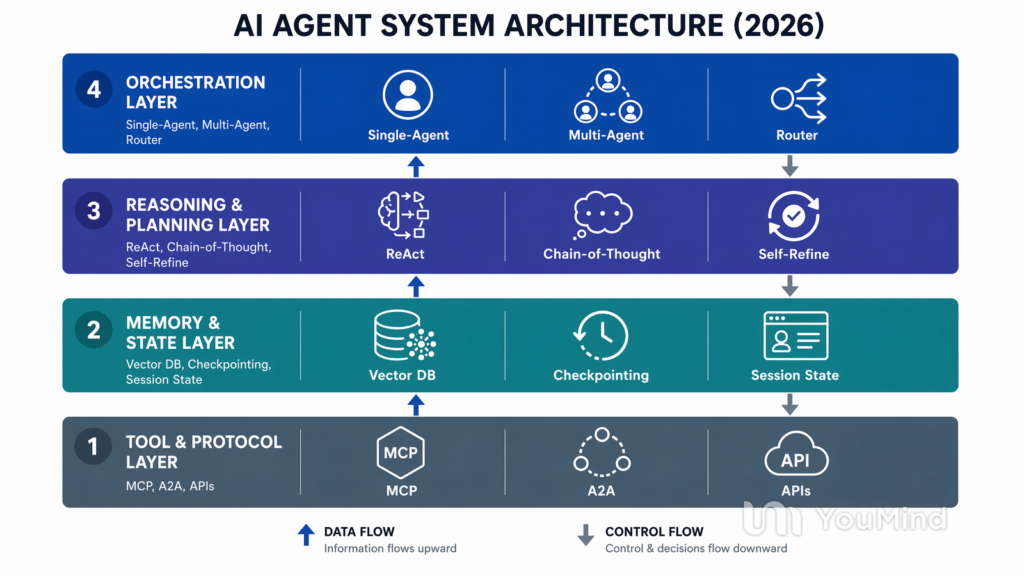
The Tool and Protocol Layer sits at the base. This is where agents connect to the outside world — APIs, databases, file systems, and increasingly, standardized protocols like the Model Context Protocol (MCP) and Agent-to-Agent Protocol (A2A). MCP, in particular, has become the closest thing the industry has to a universal connector, removing the need for bespoke integrations for every tool an agent might call. The shift is significant: in 2024, connecting an agent to a new data source meant writing custom glue code. In 2026, you register a tool once through a standard protocol and every compliant agent can discover and use it.
The Memory and State Layer handles what the agent remembers across turns, sessions, and tasks. This is where things get hard. Vector databases store semantic recall, checkpointing systems (LangGraph’s built-in time-travel debugging is the gold standard here) persist agent state, and session management ensures continuity. The unsolved problem: long-horizon memory. Agents still lose context over dozens of steps, and the compounding error problem — where small mistakes in step three cascade into catastrophic failures by step thirty — remains one of the biggest barriers to production deployment.
The Reasoning and Planning Layer is where the model decides what to do. The dominant patterns in 2026 are ReAct (Reason + Act, interleaving thought and tool calls), Chain-of-Thought with self-consistency, and increasingly sophisticated self-refinement loops where the agent evaluates its own output and iterates. Reinforcement Learning with Verifiable Rewards (RLVR), popularized by DeepSeek-R1 and now adopted across the industry, has made reasoning models dramatically better at staying on track over multi-step tasks. But even the best models still drift, hallucinate, and get trapped in unproductive loops.
The Orchestration Layer is the top of the stack — and the most architecturally consequential decision a team will make. This is where you choose between a single-agent system (one model driving the entire workflow), a multi-agent system (specialized agents collaborating on subtasks), or a router pattern (a lightweight model deciding which specialized agent to invoke). Most production systems in 2026 start single-agent and only expand to multi-agent when the task complexity genuinely demands it. The wisdom from teams that have been in production for a year or more is remarkably consistent: start with the simplest architecture that works, and resist the temptation to add agents just because the framework makes it easy.
The Framework Landscape: Pick Your Fighter
If architecture is strategy, the framework is your tactical platform. Three frameworks dominate the conversation in 2026, and they are not interchangeable.
LangGraph has become the default for production deployments. It models agent workflows as directed graphs with conditional edges, which means you get explicit control over every transition, built-in checkpointing for state persistence, and first-class human-in-the-loop interrupt points. Production teams consistently rate it 9/10 on reliability — the highest in the market. The trade-off is a steeper learning curve. You need to understand graph concepts, design state schemas carefully up front, and accept that refactoring those schemas as requirements evolve is a real cost. Teams building for production environments where failures are expensive — financial services, healthcare, compliance-heavy workflows — overwhelmingly choose LangGraph.
CrewAI wins on developer experience. It abstracts multi-agent coordination behind a role-based DSL: define a researcher agent, a writer agent, a reviewer agent, assign them to a crew with a process type, and you have a working prototype in under twenty lines of Python. The trade-off is control. CrewAI’s abstraction layer is deliberately high, which means fine-grained state management, complex error handling, and conditional routing are harder to achieve. Teams that start with CrewAI for prototyping often migrate to LangGraph when they need production-grade observability. CrewAI’s reliability score in production deployments hovers around 7/10 — improving fast, but still showing tool-call failure modes under load.
Microsoft AutoGen occupies a distinct niche: conversational multi-agent systems. If your use case involves agents that need to debate, reach consensus, or engage in structured multi-turn dialogue to solve a problem, AutoGen’s conversation primitive is the most natural fit. Its GroupChat manager routes messages between specialized agents, and the framework handles turn-taking, speaker selection, and conversation termination. The trade-off is structure: AutoGen outputs are inherently less predictable than graph-based approaches because conversations are open-ended. Production teams using AutoGen typically add custom guardrails — timeouts, turn limits, referee agents — to prevent unproductive loops.
A fourth contender worth watching: OpenAgents, which is currently the only framework with native support for both MCP and A2A protocols. Protocol-native architecture may become a decisive advantage as the ecosystem standardizes, but the framework’s community is still smaller than the big three.
The decision framework that experienced teams use is refreshingly straightforward. If your workflow has cycles, branching logic, or requires production-grade observability, use LangGraph. If you need a working prototype by end of day and the workflow is mostly linear, use CrewAI. If you specifically need conversational multi-agent patterns — debate, consensus, sequential dialogue — use AutoGen. And if you are building in the OpenAI ecosystem with no plans to leave, the OpenAI Agents SDK is the path of least resistance.
The Production Gap: Why 68% of Enterprises Are Stuck
The chasm between a working demo and a production system is not primarily a technical problem. It is an operational one, with four dimensions.
Reliability is the most obvious. Agents operating over dozens of steps inevitably drift. A 95% per-step accuracy rate sounds good until you realize that over a 30-step workflow, the probability of completing without error drops to roughly 21%. Production agents need explicit error recovery — checkpointing, retry logic, circuit breakers — and most teams underestimate how much engineering time those patterns consume. As Eduardo Ordax, Principal Generative AI Go-to-Market lead at AWS, puts it: “Today, when people evaluate agent performance, they try to understand the flow and trace of the agents to identify the behavior.” Understanding the behavior comes before fixing it, and most teams are still at the understanding stage.
Security is the dimension that keeps CISOs awake. Agents with tool access are fundamentally new attack surfaces. Prompt injection — where an attacker embeds malicious instructions in data the agent processes — is not a theoretical concern anymore. MIT Technology Review flagged this as one of the defining AI challenges of 2026. The 88% incident rate among deploying organizations tells you everything: the security model for agents is still being invented, and production deployments are running ahead of their own safety.
Observability is the infrastructure gap. Tracing an agent’s decision path across multiple LLM calls, tool invocations, and state transitions requires tooling that most organizations do not have. LangSmith and Langfuse have emerged as the leading observability platforms, but integrating them into existing monitoring stacks is non-trivial work. Without observability, debugging agent failures is effectively impossible — you cannot fix what you cannot see.
Governance is where the organizational rubber meets the road. Only 21% of companies have mature governance frameworks. Who approves an agent’s tool access? What is the escalation path when an agent makes a decision that needs human review? How do you audit an agent’s actions across a six-month span? These are not engineering questions — they are policy questions that require cross-functional alignment between engineering, legal, compliance, and executive leadership. Most organizations have not even started those conversations.
Where This Is Heading
The trajectory for the remainder of 2026 and into 2027 is coming into focus, and it points toward three shifts.
First, persistent agents. Today’s agents are largely stateless — they execute a task and disappear. Persistent agents that maintain context across days or weeks, learn from past interactions, and proactively initiate work are the natural next step. IBM’s Anthony Annunziata sees this accelerating through smaller, domain-specific reasoning models that are easier to fine-tune for particular workflows. The vision: an agent that knows your company’s tool ecosystem, remembers how you resolved the last outage, and can handle the next one with less human intervention.
Second, protocol convergence. MCP and A2A are not yet universal, but the direction is clear. Standardized tool connectivity removes the largest source of integration friction, which in turn makes agents more composable. When any agent can discover and use any tool through a standard protocol, the bottleneck shifts from “can we connect this?” to “should we connect this, and what are the consequences if it goes wrong?” That is a governance question, and it is harder than the engineering one.
Third, the composable agent stack. The early pattern of monolithic agent platforms is giving way to modular architectures where organizations mix and match models, frameworks, and protocols based on the specific task. One model for reasoning-heavy work, another for fast tool execution, a third for output validation. The agent stack of 2027 will look less like a single product and more like a carefully curated portfolio — which means the integration and orchestration layer becomes the most valuable piece of the puzzle.
What This Means for Builders and Founders
If you are building in or around the agent space right now, a few principles hold.
Start single-agent. Almost every team that jumped straight to multi-agent systems regrets it. The debugging complexity scales non-linearly with each additional agent, and most workflows genuinely do not need the overhead. A well-designed single agent with good tool access and explicit error handling will outperform a sloppy multi-agent system every time.
Invest in observability from day one. If you cannot trace an agent’s decisions, you cannot trust it. LangSmith, Langfuse, or a custom telemetry layer is not a nice-to-have — it is table stakes for production.
Build governance into the architecture, not around it. Tool access control, human-in-the-loop checkpoints, and audit logging should be first-class design decisions, not patches applied after a security incident. The 88% incident rate is a warning, not a statistic to ignore.
Focus on closing the gap. The 79%-to-11% adoption-to-production chasm is where the market opportunity lives. Tools and platforms that help enterprises cross that gap — through better reliability, security, observability, or governance — are solving the hardest and most valuable problem in agentic AI right now.
The agent revolution is real. The market numbers, the investment flows, and the enterprise behavior all confirm it. But revolutions are messy, and the gap between ambition and operational reality in agentic AI is wider than in any other technology wave of the last decade. That gap is not a reason for skepticism — it is a map of where the work needs to happen. For builders and founders who understand both the technology and the operational discipline required to deploy it safely, 2026 is the year the opportunity opens wide.