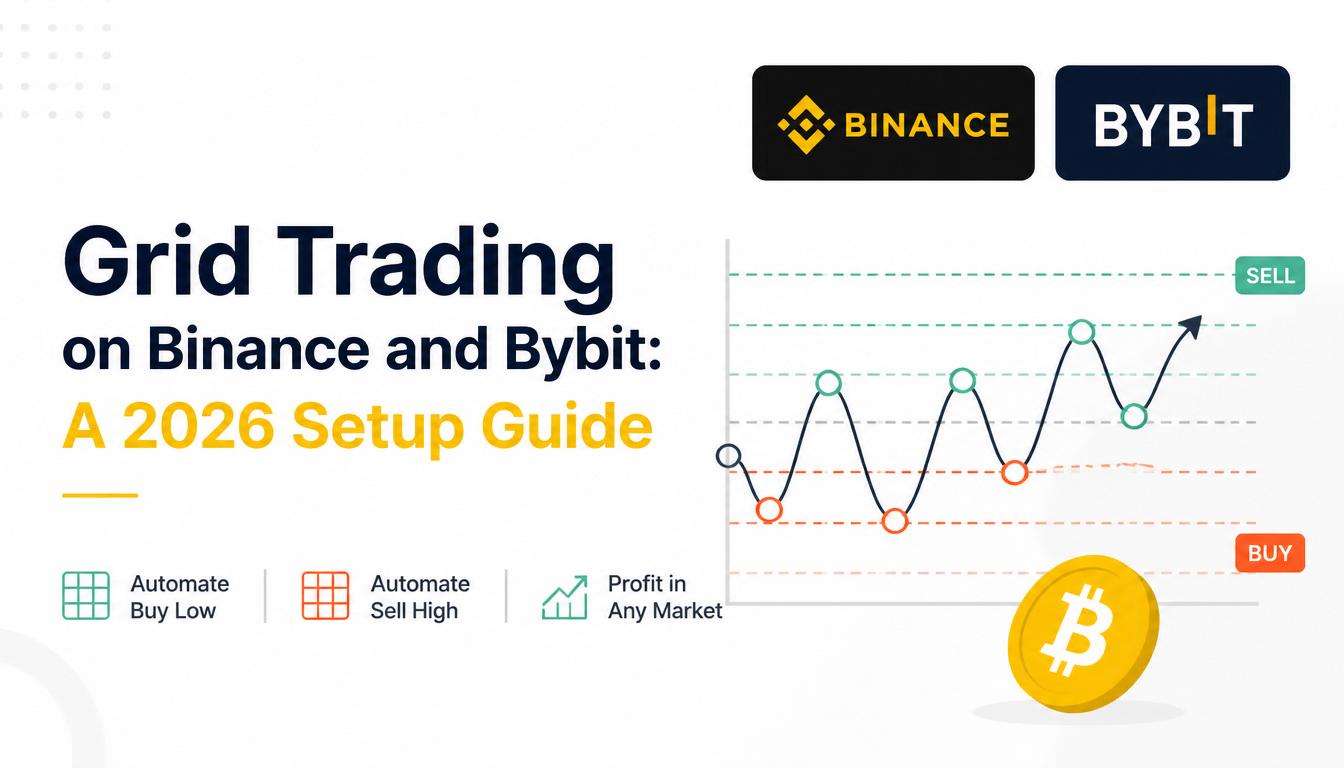
Grid trading is the favorite automated strategy in crypto for a reason — it profits from movement without needing to predict direction. Both Binance and Bybit offer powerful, free native grid bots, and they’re available in just a few clicks. The question isn’t whether you can use them. It’s how to set them up so they actually work.
This is a practical, step-by-step guide to grid trading on Binance and Bybit in 2026 — the exact menus, the best pairs, the right range and spacing, and the common mistakes that turn a sensible bot into a slow drain. Get the setup right and a grid can quietly harvest the sideways markets that frustrate every other strategy.
What you need before you start
Two things, both small. First, a verified account on Binance or Bybit (or both — many traders use both). Second, a clear view of recent price action for the pair you plan to trade, because that view drives every parameter you’ll set.
Read our grid trading strategy guide if you want the deeper theory of why grids work. This one is purely the setup mechanics.

How grid trading works on Binance and Bybit
The mechanics are identical on both platforms. A grid bot places a series of limit buy and sell orders at predetermined price intervals within a defined range. When the price drops to a grid line, the bot buys. When it rises to the next grid line above, the bot sells. The profit on each round trip is the spread between the buy and the sell.
Both platforms charge only standard trading fees — no bot subscription. The setup process is also nearly identical in shape: pick a pair, set a range, choose grid spacing and number, allocate capital, and go. As Bybit’s documentation explains, the bot then runs continuously, replacing orders as they fill.
Step 1: Pick the right pair
The pair decides whether your grid has a chance.
Stick to high-volume, liquid pairs with at least $10M in daily volume. BTC/USDT and ETH/USDT are the classic starting points — deep liquidity, tight spreads, and well-behaved volatility. Major altcoins like SOL/USDT, BNB/USDT, and XRP/USDT also work.
Avoid low-cap meme coins, newly listed tokens, and thin pairs. Their order books are too thin, slippage destroys grid profitability, and a single whale order can wreck your range. The discipline here is half the job.
Step 2: Choose your range
The range is the price band you expect the asset to stay inside while the bot runs.
Look at the last month or two of price action. Identify recent highs and lows. Set your range comfortably inside that band — too narrow and a normal swing escapes it; too wide and your capital spreads thin across levels that rarely trigger.
A useful tactic: anchor the range to support and resistance levels you can see on the chart, not to wishful targets. The grid wants chop within a believable band, not a hope for a breakout.
Step 3: Set the grid spacing and count
This is where most beginners over-tune and under-think.
Grid spacing — the gap between adjacent buy and sell orders — should balance trade frequency against exchange fees. Aim for 0.5–1% spacing depending on the coin’s volatility. Tighter on calmer pairs, wider on choppier ones.
For BTC/USDT with a $20,000 range, 30–50 grid levels is a solid starting point. For altcoins with a smaller dollar range (say $5), 15–25 grids works well. Both Binance and Bybit will suggest defaults based on recent volatility — those defaults are a reasonable starting point until you learn what your specific market wants.
Step 4: Set order size and capital
The bot needs enough capital to place orders at every grid level. Both platforms calculate the minimum based on your range and grid count.
Use money you can afford to lose. Grid trading is durable but not safe — strong trends can leave you accumulating losses on one side. Conservative sizing means you survive the trends that hurt grids most. Start small while you learn how the bot behaves with real money.
Step 5: Add a stop-loss
Both Binance and Bybit let you set a stop-loss outside the grid range. Use it.
This is the single most-skipped step and the leading cause of blown grid accounts. Without a stop, a strong breakout out of your range leaves the grid accumulating an ever-larger underwater position. A stop just outside the range turns a catastrophic loss into a manageable, planned one.
Setting up grid trading on Binance
The exact path on Binance:
- Navigate to Trade → Strategy Trading → Grid Trading (or “Strategy Trading” in the top menu).
- Choose the pair (e.g. BTC/USDT).
- Pick Manual or AI mode. AI mode analyzes the last 7 days of price data and suggests range and grid count — a useful starting point for beginners.
- Set the price range, number of grids, and investment amount.
- Optionally add a stop-loss/take-profit price outside the range.
- Click Create.
The bot starts immediately, placing orders at every grid level. You can monitor performance, pause, or close it from the same screen.
Setting up grid trading on Bybit
Bybit’s flow is similar and famously clean.
- Open the Trading Bot section from the main navigation.
- Choose Spot Grid (or Futures Grid for derivatives).
- Pick the pair.
- Set range, grid count, and investment. Bybit also offers AI parameter suggestions based on recent volatility.
- Add a stop-loss outside the grid.
- Confirm and start.
Bybit supports spot grid, futures grid, and a DCA-grid hybrid — useful for traders who want to accumulate while harvesting chop. The interface is particularly beginner-friendly, which makes Bybit a strong second-platform if you’ve started on Binance.
Common grid trading mistakes
Most grid blowups come from the same handful of errors:
- No stop-loss. The single most common, most expensive mistake.
- Range based on hope. Setting the band where you wish the price would stay, not where it actually trades.
- Grid on a strong trend. Running a neutral grid against an established trend bleeds steadily.
- Over-leverage. Stacking too many levels with too much size, leaving no margin buffer.
- Ignoring fees. A too-tight grid pays fees on every micro-trip and earns almost nothing.
In sideways and choppy markets, grid trading significantly outperforms holding. In strong bull markets, holding usually wins. In bear markets, a grid with a stop-loss loses less than holding. Knowing which regime you’re in is half the skill.
Monitoring and tuning your grid
You set up a grid bot. Then what? “Set and forget” is the marketing line; the reality is light, regular maintenance.
Check weekly, not daily. A working grid doesn’t need babysitting hour-by-hour, but a weekly look catches problems early. The questions are simple. Is price still inside the range? Is the market still ranging or has it started to trend? Are you hitting your fee-vs-profit ratio?
Watch the regime. A grid that thrived in a sideways week can bleed in a trending week. If the price has been pushing one direction steadily for days, pause the bot or widen the range. Continuing to grid a clear trend is the most common mistake in grid trading on Binance and Bybit alike.
Adjust spacing as volatility changes. A grid tuned for quiet markets will churn fees in volatile ones. If the asset’s daily range has doubled, your spacing should probably widen. Both platforms let you stop and re-launch a bot easily — don’t be precious about killing one that no longer fits.
Track real P&L, not paper P&L. A grid showing “profitable trades” can still be losing overall once unrealized losses on the underwater side are counted. Look at total balance, not just closed-trade stats.
Compound the wins. If a grid is profitable across a full cycle of conditions, gradually increase its capital. Don’t add capital after a single hot week — wait for the bot to prove durability.
That weekly check, plus a stop-loss that you actually respect, separates traders who run grids for years from those who blow up in a month.
FAQ
Is grid trading on Binance or Bybit better? Both are excellent and free. Binance has deeper liquidity and more pairs; Bybit has a particularly clean interface. Many traders use both. See our Pionex vs Binance comparison for a third option focused purely on grid bots.
What are the best pairs for grid trading? High-volume majors like BTC/USDT, ETH/USDT, SOL/USDT, BNB/USDT, and XRP/USDT. Avoid low-cap meme coins, newly listed tokens, and anything with under $10M daily volume.
What grid spacing should I use? 0.5–1% between adjacent orders, depending on the coin’s volatility. For BTC/USDT with a $20,000 range, 30–50 grids is a solid starting point.
How long does it take a grid bot to make money? It depends on volatility and how often price oscillates through your range. In choppy markets, profits compound steadily; in dead markets, the bot earns little while fees accrue.
Do I need to monitor a grid bot constantly? No, but check it weekly. Confirm the market is still ranging within your set band, and switch the bot off (or widen the range) if a strong trend emerges.
Can I run multiple grids at once on Binance or Bybit? Yes. Both platforms let you run several grid bots simultaneously on different pairs. Just make sure your total capital allocation across all bots respects your overall risk budget.
Does grid trading on Binance work with futures? Yes — Binance offers a Futures Grid option in the same Strategy Trading section. Bybit also offers Futures Grid. Be careful with leverage: a grid bot on leveraged futures amplifies both wins and losses, so position size very conservatively.
Key takeaways
- Grid trading on Binance and Bybit is free, native, and easy to set up — both platforms offer capable spot and futures grid bots.
- Pick high-volume major pairs; avoid low-cap meme coins.
- Anchor your range to real support and resistance, not hopes.
- Use 0.5–1% spacing with 15–50 grids depending on the pair’s price.
- Always add a stop-loss outside the grid — the single most important safeguard.
Ready to launch your first grid? Our free Algo Trading Starter Kit includes a parameter worksheet for both Binance and Bybit, a stop-loss calculator, and our deep dive on the grid trading strategy. Grab it free → and trade the chop, not the noise.