Two years ago, AI video was a party trick. You’d type a prompt, wait four minutes, and get back a wobbly six-second clip of a dog that had too many legs. It was impressive in the way that a toddler drawing a recognisable face is impressive — you could see where it was going, but you wouldn’t put it in a client deliverable.
That version of AI video is dead. What replaced it is something closer to a production department you can rent by the second.
The tools available right now can generate true 4K footage with synchronised audio, maintain character consistency across multiple shots, handle complex camera movements, and produce output that genuinely holds up in professional contexts. The gap between AI-generated video and traditionally shot footage hasn’t fully closed, but for a growing number of use cases — social content, product demos, explainer videos, ad creative — it’s close enough that the economics have already flipped.
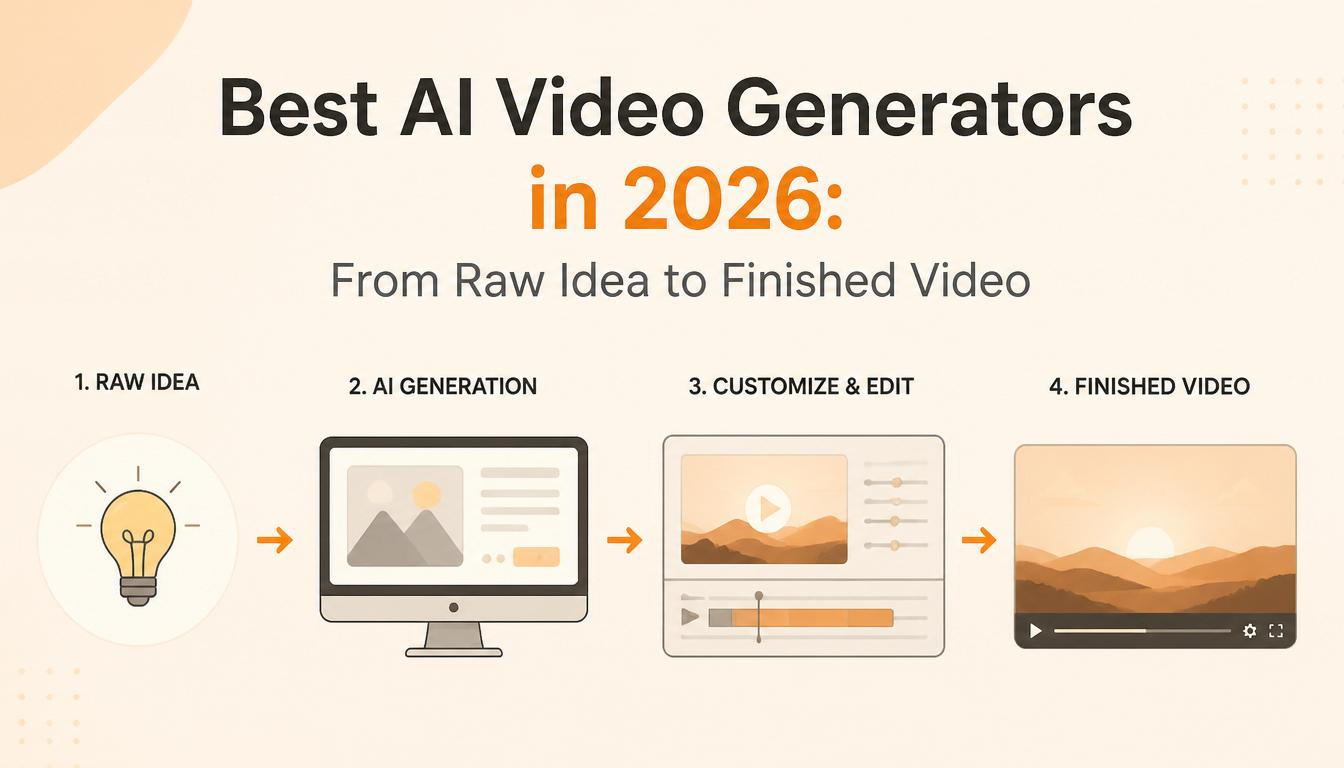
But here’s the thing most “best AI video generator” articles won’t tell you: picking the right generation model is only one piece of the puzzle. A raw AI clip isn’t a finished video. You still need a script, a voice, sound design, editing, and possibly upscaling. The real question isn’t “which generator is best?” — it’s “which combination of tools gets me from an idea in my head to a finished video I can actually publish?”
That’s what this guide covers.
The Generators: Where Your Footage Comes From
The generation landscape has settled into clear tiers, and each model has carved out a distinct identity. Rather than ranking them on some abstract quality score, here’s what each one is actually best at and what it will cost you.
Google Veo 3.1 — The Technical Leader
Veo 3.1 is the most complete video model on the market right now. It generates native 4K at up to 60 frames per second with synchronised audio — ambient sound, dialogue, sound effects — all produced in a single generation pass. No other model matches that combination of resolution and integrated audio quality.
Where Veo really pulls ahead is versatility. It supports text-to-video, image-to-video, and video-to-video extension, which means you can generate an initial clip and then extend it by additional seconds, building longer sequences iteratively. For teams that need to construct scenes rather than just generate one-shot clips, that extension capability changes the workflow entirely.
The trade-off is price. Fast mode runs around $0.15 per second of generated video. Standard mode — the tier you want for final deliverables — costs roughly $0.40 per second. A thirty-second clip in standard mode costs about twelve dollars. That adds up quickly if you’re iterating, which is why most production teams use Veo for their final render and draft on cheaper models first.
If your workflow already lives inside Google’s ecosystem — Drive, YouTube Studio, Google Ads — Veo integrates natively, which removes a surprising amount of friction from the publish step.
Kling 3.0 — The Workhorse
Built by Kuaishou, the Chinese short-video giant, Kling has quietly become the most practical choice for high-volume production. The model hit $100 million in annual recurring revenue within ten months of launch, largely because it nails the two things that matter most for working creators: consistency and cost.
Kling excels at photorealistic human characters. It includes a built-in face-locking system that lets you upload reference images and maintain that character’s appearance across unlimited generations — different angles, different lighting, different expressions. For anyone producing a series of videos that need to feature the same person, that consistency alone justifies choosing Kling over competitors where you’re rolling the dice on character stability every time you hit generate.
Pricing sits around $0.10 per second, making it the cheapest premium model available. A thirty-second video costs roughly three dollars. For social media teams producing dozens of clips per week, that price difference against Veo or Sora isn’t trivial — it’s the difference between a viable workflow and an unsustainable one.
The latest version — Kling 3.0 Omni — also handles native audio with lip-sync in five languages and a shared audio timeline across multi-shot sequences. The audio quality doesn’t quite match Veo’s, but it’s good enough for social content and most marketing use cases.
Runway Gen-4.5 — The Creative Director’s Choice
Runway occupies a different position in the market. Where Veo wins on technical specs and Kling wins on price, Runway wins on control. It offers the most granular creative toolkit of any generator: cinematic camera choreography, performance capture, reference image controls for brand consistency, and in-context video-to-video transformation.
For agencies and studios that need to match a specific visual brief — a brand’s colour palette, a particular camera style, a specific mood — Runway is the tool that gets closest to letting you direct the AI rather than just prompting it. The distinction matters. A prompt says “make me a video of X.” Runway’s controls let you say “make me a video of X, shot on a 35mm lens, with a slow dolly push, warm colour grade, and this exact character wearing this exact outfit.”
Pricing uses a credit system that works out to roughly $0.12 per second on paid plans, with a subscription starting around $15 per month. The learning curve is steeper than Kling or Veo — there are more knobs to turn — but for users who want that control, nothing else comes close.
Seedance 2.0 — The Dark Horse
Seedance has been climbing the rankings fast, and for good reason. Its standout feature is motion transfer: you upload a reference video showing how a character should move, and Seedance replicates that motion with remarkable accuracy. Complex choreography, sports movements, subtle gestures — it handles physical performance in a way that other generators still struggle with.
The model also excels at cinematic camera movement and dynamic physics. In blind creator tests, Seedance clips frequently get mistaken for footage from established models that cost twice as much. For image-to-video workflows specifically — where you start with a still and want to bring it to life — Seedance is arguably the strongest option available.
Pricing is competitive, and the audio capabilities are solid, particularly for lip-sync on talking-head content. The main limitation is ecosystem: Seedance doesn’t have the integration depth of Veo or the editing toolkit of Runway. It does one thing — generate excellent footage from images and motion references — and it does it very well.
A Note on Sora
OpenAI’s Sora deserves a mention, but with a caveat. The Sora web and app interfaces were shut down in April 2026, and the API is scheduled to follow in September. The model still produces impressive footage — strong physics, cinematic storytelling, solid character consistency — but building a production pipeline on a tool with a published end-of-life date is a risk most teams shouldn’t take. If you already have Sora workflows, plan a migration to Veo, Kling, or Runway. If you’re starting fresh, start elsewhere.
Beyond Generation: The Tools That Complete the Pipeline
Here’s where most comparison articles stop. They rank the generators, pick a winner, and call it a day. But anyone who’s actually produced video content knows that raw footage — AI-generated or otherwise — is maybe 40% of the finished product. The rest is script, voice, sound, editing, and finishing.
The good news: AI has eaten into every one of those steps too.
Scripting and Planning
LTX Studio is the closest thing to an end-to-end AI production platform. You can go from a text prompt to a complete storyboard with scene breakdowns, camera directions, character definitions, and shot lists — all before you generate a single frame of video. It supports character consistency across scenes, shared assets, and collaborative editing within the same workspace. Think of it as pre-production in a browser tab.
InVideo AI takes a different approach. Its agent-based workflow handles the entire pipeline from a single text input: it writes the script, selects or generates visuals, adds voiceover, and assembles the edit. You describe what you want in plain English — “a two-minute explainer about vertical AI SaaS for LinkedIn” — and the agent produces a complete video. The output isn’t going to win any film festivals, but for high-volume social content where speed matters more than cinematic polish, it’s remarkably effective.
For writers who prefer more control over the script itself, using Claude or ChatGPT to draft and refine a video script before feeding it into a generation tool remains the simplest and most flexible approach. Write the script, break it into scenes, describe each scene as a generation prompt, and assemble the results.
Voice and Audio
ElevenLabs dominates AI voice generation. The voice cloning is eerily accurate, the emotional range has improved dramatically, and it supports dozens of languages with natural-sounding delivery. For explainer videos, narrated content, or any format that needs a professional voiceover without booking a voice actor, ElevenLabs is the default choice.
Kling 3.0 Omni, Veo 3.1, and Seedance 2.0 all generate native audio alongside video now — dialogue, ambient sound, and background music in a single pass. The quality varies, and purists will still prefer to generate silent video and layer audio separately for maximum control. But for social content where speed trumps perfection, native audio generation saves an entire production step.
For sound effects and ambient audio, dedicated libraries like Epidemic Sound or Artlist still outperform AI-generated alternatives for anything that needs to feel polished and intentional.
Editing and Assembly
Descript has evolved from a transcription tool into a genuine AI-powered editing platform. The core concept — edit video by editing text — remains brilliant. You see your video as a transcript, cut words, and the video cuts with them. Add Studio Sound for AI noise removal, and you’ve got clean audio from almost any source. For talking-head and narrated content, it’s the fastest editing workflow available.
CapCut is the volume play. It’s free, it’s fast, it has auto-captions, templates, and enough AI-powered features (background removal, voice effects, auto-reframe for different aspect ratios) to handle most social media editing needs without opening a professional NLE. Most creators producing daily or weekly content for TikTok, Reels, or Shorts are using CapCut or something very similar.
Adobe Premiere Pro and DaVinci Resolve remain the professional standard for anything complex. Both have added AI features — Premiere’s AI-powered scene detection and auto-colour, Resolve’s Magic Mask for rotoscoping and neural engine for colour matching — but they’re editing suites that happen to include AI, not AI-first tools. If your final output needs professional-grade finishing, colour grading, or multi-track audio mixing, you’ll end up here regardless of where you generated the footage.
Upscaling and Finishing
Topaz Video AI is the quiet essential. It doesn’t generate anything — it makes your existing footage better. Upscaling, noise reduction, motion deblur, frame interpolation for smooth slow-motion. If you’re working with AI-generated clips that came out at 720p or 1080p and need to deliver at 4K, Topaz handles the upscale with minimal artefacts. At $299 as a one-time purchase (no subscription), it pays for itself quickly for anyone producing video regularly.
Multi-Model Hubs
One trend worth flagging: platforms like fal.ai, WaveSpeed, and Upsampler aggregate multiple generation models under a single interface and billing system. Instead of maintaining separate subscriptions to Veo, Kling, Runway, and Seedance, you access all of them through one dashboard with pay-per-use pricing.
This matters because the honest answer to “which generator should I use?” is increasingly “it depends on the shot.” A cinematic landscape might look best from Veo. A talking-head scene might work better from Kling. A stylised motion sequence might shine on Seedance. Multi-model hubs let you pick the right tool for each clip without the overhead of managing four different accounts.
Putting It Together: Two Sample Workflows
The Fast Workflow (Solo Creator, Social Content)
Write a brief script or bullet points. Feed it into InVideo AI or describe the scenes to an LLM. Generate clips using Kling (cheapest, fast, good enough for social). Add voice with ElevenLabs or use Kling’s native audio. Edit and add captions in CapCut. Publish. Total cost per video: roughly $5–$15 depending on length. Total time: under an hour.
The Quality Workflow (Agency, Client Deliverable)
Develop a full script and storyboard in LTX Studio. Generate hero shots in Veo 3.1 Standard for maximum quality. Use Kling for B-roll and secondary footage to manage costs. Record or generate voiceover through ElevenLabs. Edit in Premiere Pro or DaVinci Resolve. Upscale any sub-4K clips through Topaz. Colour grade and finish. Total cost per video: $50–$200 depending on length and iteration. Total time: half a day to a full day, versus the week-plus it would have taken with traditional production.
What to Watch for Next
Native audio is quickly becoming table stakes rather than a differentiator. By the end of 2026, expect every major generator to include synchronised sound as a default feature.
Clip duration is stretching. Most generators still top out at eight to fifteen seconds per clip, but iterative extension (generating a clip, then extending it) is making longer sequences viable without stitching together disconnected shots.
Character consistency across scenes — the ability to maintain the same person’s appearance, clothing, and mannerisms across an entire video — is the current frontier. Kling and Runway lead here, but every major model is racing to solve it because it’s the unlock that turns AI video from “cool clips” into “actual storytelling.”
And open-source models, particularly Wan 2.6 and its successors, are closing the quality gap with commercial tools. If you have a GPU with 24GB or more of VRAM, you can run competitive video generation locally at zero marginal cost. That’s not practical for most people today, but the trajectory is clear.
The Bottom Line
There is no single best AI video generator in 2026. There is a best generator for your specific use case, budget, and workflow. If forced to pick defaults: Veo 3.1 for maximum quality, Kling 3.0 for best value, Runway Gen-4.5 for creative control, and Seedance 2.0 for motion and image-to-video work.
But the bigger insight is that the generator is just one link in a chain. The teams producing the best AI video right now aren’t the ones with the fanciest model — they’re the ones who’ve built a complete pipeline from idea to published video, using the right tool at each step, and iterating fast enough that the cost of experimentation is basically zero.
That pipeline — script to generation to voice to edit to finish — is the actual product. The individual tools are just components. Pick the components that fit your workflow, your budget, and your quality bar, and start building.