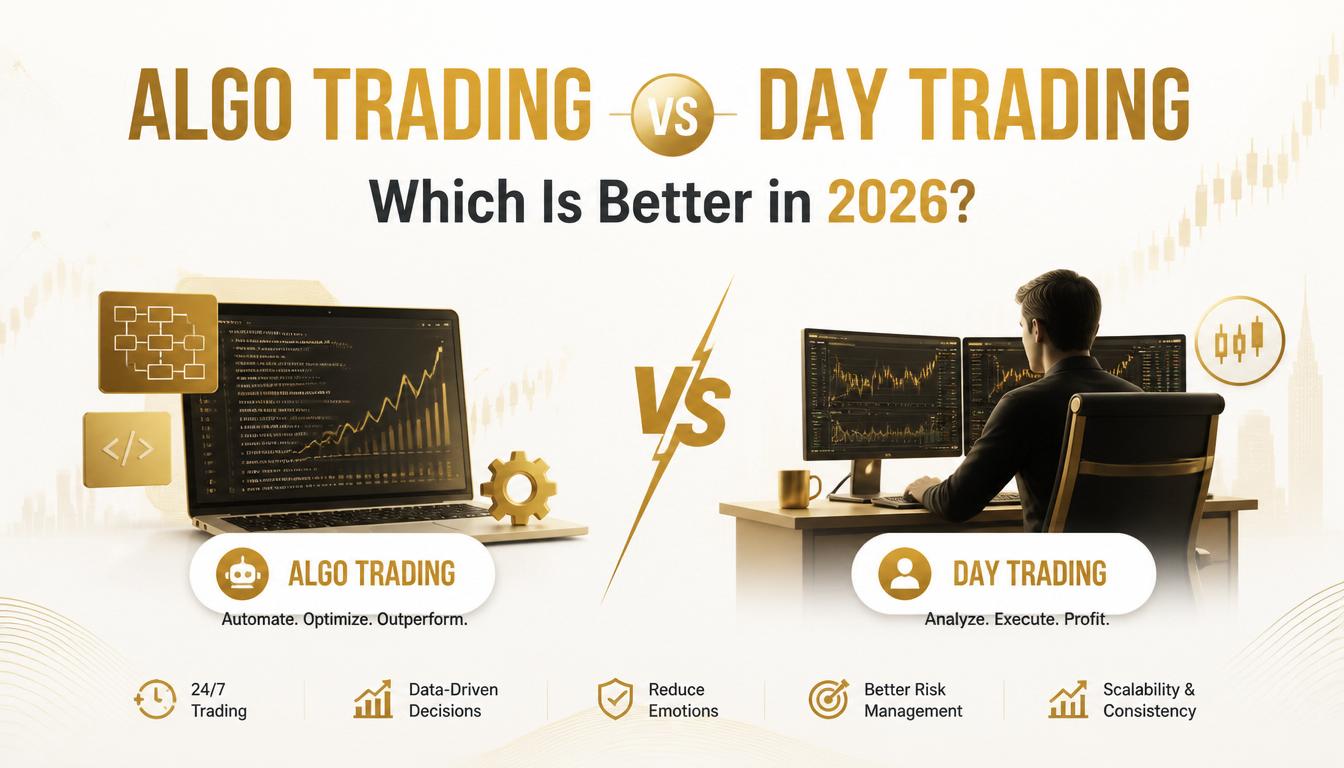
Picture two traders at 9:30 a.m. One stares at six monitors, finger hovering over the buy button, reacting to every tick. The other has already left for the gym — their code is handling the open. That image captures the heart of the algo trading vs day trading debate. In 2026, the gap between the two approaches is wider than ever.
So which one actually wins? The honest answer depends on your temperament, your skills, and how much you value your time. This guide breaks down the real differences — speed, success rates, costs, and stress — so you can decide which fits you, rather than which sounds cooler.
Table of Contents
- The core difference
- Algo trading vs day trading: side by side
- Speed and execution
- Success rates: what the data says
- Emotion, discipline, and stress
- Costs and barriers to entry
- Algo trading vs day trading: who should choose which?
- Common myths about both
- Can you do both?
- FAQ
- Key takeaways
The core difference
Day trading is manual. A human watches the market, makes decisions in real time, and clicks to enter and exit positions within the same day. The edge comes from skill, intuition, and the ability to read context that no rulebook fully captures.
Algorithmic trading is automated. You define the rules in advance, and software executes them — often faster than any human could react. The edge comes from speed, consistency, and the removal of emotion from the moment of decision.
Everything else in the algo trading vs day trading comparison flows from that single split: human judgment in the moment versus rules written ahead of time.

Algo trading vs day trading: side by side
Here’s the comparison at a glance before we dig into each row.
| Factor | Algo Trading | Day Trading |
|---|---|---|
| Execution | Automated, millisecond-fast | Manual, human reaction time |
| Emotion | Removed at decision time | Constant battle |
| Skill needed | Coding + strategy design | Chart reading + discipline |
| Time per day | Low once deployed | High, screen-bound |
| Adaptability | Rigid to its rules | Flexible to news and context |
| Scalability | Trades many markets at once | Limited by human attention |
| Main failure mode | Overfitting a backtest | Emotional, impulsive trades |
Neither column is strictly “better.” They fail differently and they win differently.
Speed and execution
This is the one area where the contest isn’t close. Algorithmic systems execute in milliseconds, capturing price moves a human would miss entirely. As WealthArc notes, this speed lets bots profit from even the smallest fluctuations. They act on opportunities the instant those appear.
A day trader simply cannot compete on raw speed. By the time you see a setup, process it, and click, the algorithm has already acted — possibly thousands of times. If your strategy depends on being first, automation wins by default.
Success rates: what the data says
Here’s where the numbers get interesting. Roughly 60% of retail algorithmic traders post positive annual returns, compared to a sobering 5–10% success rate among manual day traders, according to data summarized by TradingView Hub.
That sounds like a knockout for automation — but read it carefully. The algo figure reflects people who got far enough to deploy a tested system, a group that already self-selects for discipline. It does not mean a beginner who buys a bot has a 60% shot. The same research notes a roughly 90% first-year failure rate for those who jump in unprepared.
In other words, automation raises the ceiling, but only for traders who put in the work first.
Emotion, discipline, and stress
Day trading is a psychological grind. Fear, greed, and fatigue erode good judgment, and most manual losses trace back to emotional decisions rather than bad analysis. Holding screens for hours is genuinely exhausting.
Algorithmic trading removes emotion from the moment of execution — the bot never panics or revenge-trades. But it doesn’t remove emotion entirely. You still have to resist switching off a strategy during a drawdown. You also have to resist tinkering with rules that already work. The discipline simply moves from the trade itself to the decision to trust your system.
Costs and barriers to entry
The cost profiles differ sharply.
- Day trading needs little more than a broker account and a charting platform. Until recently, U.S. day traders faced the $25,000 Pattern Day Trader minimum. That rule was eliminated in 2026, lowering the barrier dramatically.
- Algo trading can start free for learning, but running serious systems carries an annual cost floor — data feeds, servers, and tools — often estimated in the low thousands of dollars per year.
Day trading is cheaper to begin. Algo trading front-loads a learning and infrastructure cost in exchange for scalability later.
Algo trading vs day trading: who should choose which?
There’s no universal winner, but there are clear fits.
Choose day trading if you enjoy active decision-making, can stay disciplined under pressure, want to start cheaply, and can dedicate hours to screen time. Human adaptability shines when reacting to breaking news or unusual conditions a bot wasn’t programmed for.
Choose algo trading if you can code (or will learn), prefer a systematic approach, want to reclaim your time, and value consistency over intuition. It rewards people who treat trading like engineering.
Honestly assess your temperament. An impulsive person often does better letting a bot enforce the rules. A sharp, disciplined reader of markets may do worse by automating away their edge.
Common myths about both
A few myths distort this whole debate. Clearing them up makes the choice easier.
Myth 1: Bots make money while you sleep. They execute while you sleep. Whether they make money depends entirely on the strategy and the market. A bad rule loses money around the clock, too.
Myth 2: Day trading is gambling. Skilled, disciplined day traders treat it as a probabilities game with strict risk limits. The gambling label fits the impulsive crowd, not the professionals.
Myth 3: Algo trading is only for math PhDs. Strong quant skills help, but a beginner can build a simple, working bot with basic Python. The barrier is lower than the mystique suggests.
Myth 4: One approach is universally superior. As the comparison above shows, they win and fail in different conditions. The right choice depends on you, not on which one sounds more advanced.
Strip away the myths and the algo trading vs day trading decision becomes a practical question of fit, not a search for a magic answer.
Can you do both?
Yes, and many serious traders do. A common hybrid path is to develop your edge manually first — learning to read markets and manage risk — then automate the repetitive parts once the strategy is proven. The manual experience makes you a better bot builder, because you understand what your rules are actually trying to capture.
The algo trading vs day trading choice isn’t always permanent. Plenty of traders start manual, automate gradually, and end up running both in parallel.
FAQ
Is algo trading better than day trading? On speed and measured success rates, algo trading leads — about 60% of retail algo traders are profitable versus 5–10% of manual day traders. But automation rewards preparation; an unprepared beginner can fail at either.
Is day trading dead in 2026? No. Human adaptability still matters, especially around news and unusual conditions. Day trading remains viable for disciplined, skilled traders — it’s just facing more automated competition.
Which is cheaper to start, algo or day trading? Day trading. It needs only a broker and charting tools, and the $25k PDT minimum was removed in 2026. Algo trading carries ongoing data and infrastructure costs once you go live.
Do I need to code for algo trading? For serious systems, yes — usually Python. No-code platforms exist, but they cap what you can build compared to writing your own logic.
Can a beginner win at either? Not quickly. Both require months of learning. The fastest path to failure in the algo trading vs day trading world is skipping that preparation.
Key takeaways
- Algo trading vs day trading comes down to rules-ahead-of-time versus judgment-in-the-moment.
- Automation wins on speed and measured success rates (~60% vs 5–10% profitable), but only for prepared traders.
- Day trading is cheaper to start and more adaptable to news and context.
- Emotion is the day trader’s enemy; overfitting is the algo trader’s.
- You can do both — many traders learn manually, then automate a proven edge.
Not sure which path fits you? Grab our free Algo Trading Starter Kit: a self-assessment to match your temperament to a style, a Python bot template, and our broker comparison. Get instant access → and join 12,000+ traders choosing their approach with clear eyes.