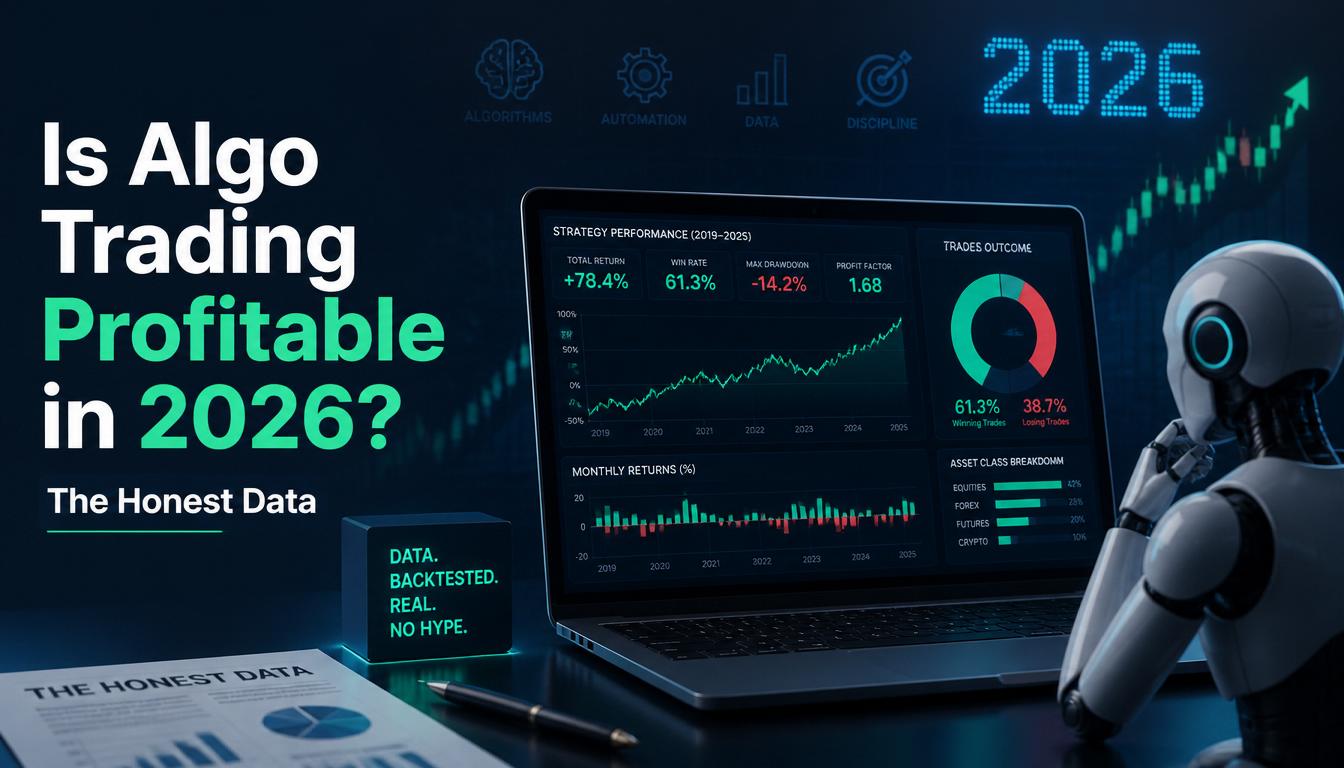
It’s the question every aspiring trader types into a search bar at midnight: is algo trading profitable, or is it just a high-tech way to lose money faster? The internet answers with two extremes. One side promises passive riches. The other shouts “it’s all a scam.” The truth, backed by real data, sits in a more useful middle.
Yes, algo trading can be profitable. But the people who actually profit look very different from the ones who buy a bot and hope. This guide lays out the real numbers — success rates, return ranges, costs, and the traits that separate the winners — so you can judge your own odds honestly.
Table of Contents
- The short, honest answer
- Is algo trading profitable? The success-rate data
- What returns are actually realistic
- The costs nobody advertises
- Why most strategies fail
- Is algo trading profitable across different markets?
- The traits of the profitable 10%
- How to tilt the odds in your favor
- FAQ
- Key takeaways
The short, honest answer
Algo trading is profitable for a minority of disciplined, well-prepared traders and unprofitable for the rushing majority. The software itself doesn’t create profit — it executes a strategy. A good strategy with sound risk management can compound steadily; a weak one just loses money more efficiently.
So the real question isn’t whether algo trading can be profitable. It demonstrably can. The question is whether you will put in the work the profitable minority did.

Is algo trading profitable? The success-rate data
Let’s start with the headline number. Around 60% of retail algorithmic traders post positive annual returns, according to data summarized by TradingView Hub. Stacked against the 5–10% success rate of manual day traders, that looks like a strong endorsement of automation.
But there’s a catch hidden in the framing. That 60% describes people who reached the stage of deploying a tested system — a group that already self-selected for discipline and skill. For newcomers who jump in unprepared, the same body of research points to a brutal 90% first-year failure rate.
So is algo trading profitable? For the prepared, the odds are genuinely good. For the impatient, they’re terrible. Both facts are true at once.
What returns are actually realistic
Forget the screenshots of 500% months. Grounded figures look like this:
- Beginners: roughly 5–15% annually once they have a working, tested system.
- Experienced traders with proven strategies: often 15–25% annually.
- Retail traders using algorithmic strategies have seen average returns improve by about 23% versus discretionary trading, per the same research.
These are good, compounding returns — not lottery wins. Anyone promising consistent double-digit monthly gains is selling something. Realistic profitability is a marathon of small edges, not a sprint to riches.
The costs nobody advertises
Profitability is revenue minus costs, and the costs are where beginners get ambushed.
Running a serious algo operation carries an annual cost floor estimated between $1,200 and $6,000 — covering market data feeds, cloud servers, and software tools. On top of that sit trading costs: commissions, fees, and slippage that quietly erode every strategy’s edge.
There’s also a time cost. Building genuine competency realistically takes 6 to 18 months of dedicated study. If your strategy only earns 10% a year on a small account, those fixed costs can swallow the entire profit. Scale matters, and undercapitalized traders often lose to costs alone.
Why most strategies fail
The single biggest profit-killer is overfitting — tuning a strategy until it looks perfect on historical data, then watching it collapse live.
The evidence here is damning. Quantopian’s study of 888 algorithmic strategies found that backtest Sharpe ratios had near-zero predictive power for live returns, as discussed by QuantStart. Worse, the more a trader optimized to fit the past, the worse the live performance. Over-optimized strategies can lose up to 80% of their backtested profits when deployed.
Add the 2-to-5-year strategy half-life — edges decay as markets adapt — and you see why “set and forget” is a myth. Profitable traders constantly research, retest, and replace fading strategies.
Is algo trading profitable across different markets?
Profitability also depends on where you trade. The same strategy logic behaves very differently across asset classes, and each market has its own profit drivers and traps.
Crypto is the most volatile, which cuts both ways. High swings create more opportunity for short-term strategies like grid and momentum bots, but they also magnify losses and slippage. Fees vary widely between exchanges, and thin order books can wreck a backtest’s assumptions. Many beginners find their first profits here — and lose them just as fast.
Stocks and ETFs are more stable and better regulated, with deeper data history for backtesting. After the 2026 removal of the $25,000 Pattern Day Trader minimum, automated equity strategies became viable on far smaller accounts. The trade-off is that liquid, heavily-traded names attract serious institutional competition.
Forex offers high liquidity and the leverage that many automated systems are built around. That leverage is exactly why undercapitalized traders blow up — it amplifies both the edge and the mistakes. The mature MT4/MT5 ecosystem makes deployment easy, which is a double-edged convenience.
So can it be profitable in any of them? It can be in all three, but the realistic returns and risks shift with each. Match the market to your capital, your tolerance for volatility, and the strategy you can actually test well.
The traits of the profitable 10%
If roughly 10% survive and profit, what do they share? The data points to a clear profile.
People with backgrounds in engineering, statistics, computer science, or mathematics have a measurable head start. A 2024 QuantConnect survey found that 68% of their profitable users held STEM degrees. That doesn’t mean a non-STEM trader can’t win. It means the work rewards specific skills: statistical rigor, skepticism toward noise, and comfort with code. All three are learnable without a degree.
Beyond credentials, the profitable share clear habits. They keep ruthless backtesting hygiene. They size positions conservatively. They research constantly. And they treat year one as tuition rather than payday.
How to tilt the odds in your favor
You can’t guarantee profit, but you can move yourself toward the winning 10%:
- Learn the statistics first. Understand overfitting, out-of-sample testing, and slippage before you trust any backtest.
- Start with a simple, robust strategy. Complexity hides overfitting.
- Test out-of-sample and include all costs. Assume live results will be worse than the screen.
- Size positions conservatively. Survival enables compounding; a blowup ends it.
- Keep researching. Expect to replace strategies as their edge decays.
Do these, and “is algo trading profitable?” stops being a gamble and becomes a question of execution.
FAQ
Is algo trading actually profitable for retail traders? For a prepared minority, yes — about 60% of those who deploy tested systems are profitable. For unprepared beginners, the first-year failure rate is around 90%.
How much can I realistically make? Beginners with a working system see roughly 5–15% annually; experienced traders often reach 15–25%. Monthly-doubling claims are red flags.
Why do so many algo traders lose money? Mostly overfitting. Backtests look great, then fail live — over-optimized strategies can lose up to 80% of their paper profits in real markets.
Do I need a STEM degree to profit? No, but it helps. 68% of profitable users in one survey had STEM backgrounds, because the work rewards statistical rigor and coding skill — both learnable without a degree.
How long until algo trading becomes profitable? Plan for 6 to 18 months of study before consistent profits, and treat your first live year as a learning cost.
Key takeaways
- Is algo trading profitable? Yes — for the prepared minority, not the rushing majority.
- ~60% of deployed retail algo traders profit, but the first-year failure rate is ~90%.
- Realistic returns are 5–25% annually, not monthly miracles.
- Costs ($1,200–$6,000/year) and overfitting are the biggest profit-killers.
- The winning 10% share rigor, conservative sizing, and constant research.
Want to join the profitable minority? Download our free Algo Trading Starter Kit: a backtesting-hygiene checklist, a Python strategy template, and our broker comparison. Get instant access → and join 12,000+ traders learning to automate with rigor, not hope.