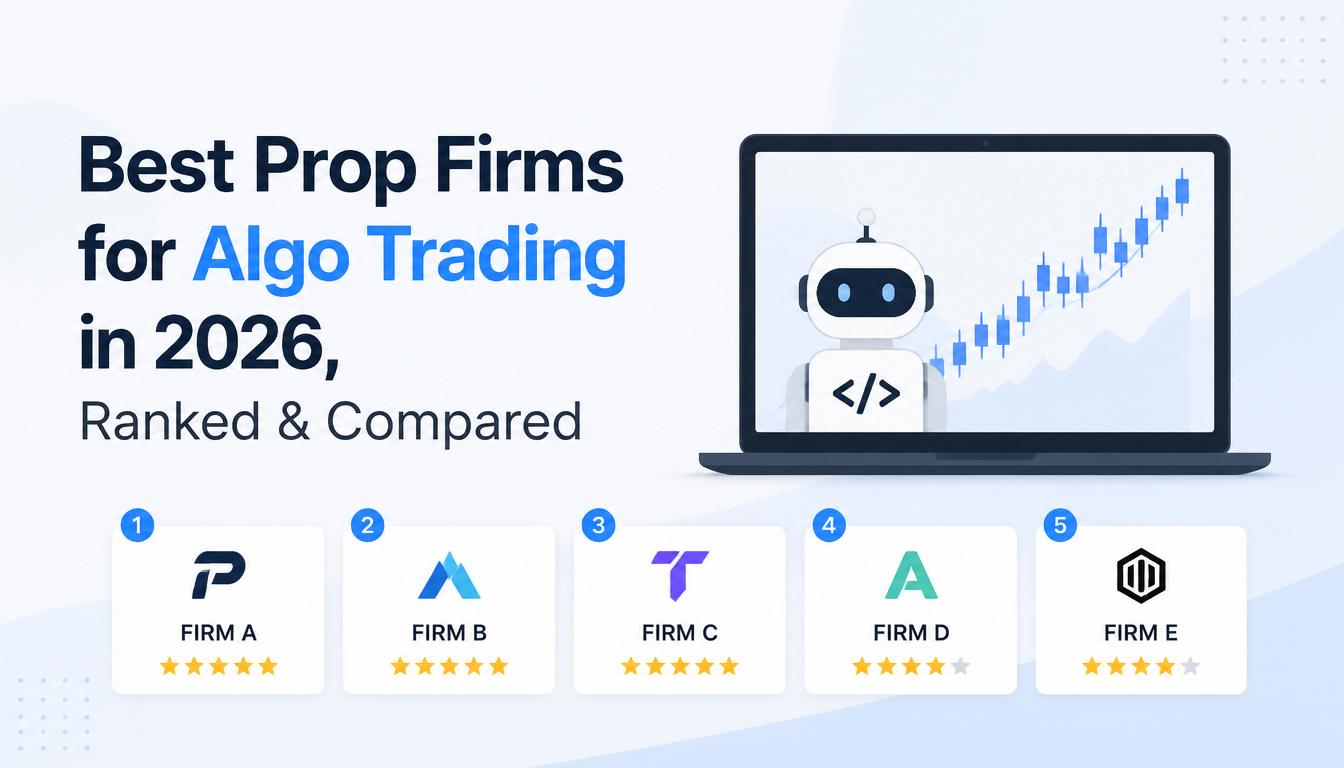
Trading firm capital instead of your own is the most capital-efficient path in trading — you pay an evaluation fee, pass a challenge, and trade a funded account keeping most of the profit. For algo traders, the catch is that not every firm allows bots, and the ones that do attach rules you must read carefully. Pick the wrong firm and your EA gets your account banned on a technicality.
This guide ranks the best prop firms for algo trading in 2026 — which ones genuinely welcome EAs and automated strategies, their profit splits and rules, and the specific tactics (like latency arbitrage) that most firms prohibit. Get the match right, and a tested algorithm can scale far beyond your personal capital.
How prop firms work for algo traders
A proprietary trading firm funds traders who prove themselves. You pay an evaluation fee and pass a challenge. That means hitting a profit target without breaching the drawdown limits. Pass, and you get a funded account, splitting profits with the firm — often 80–95% in your favor.
For an algo trader, the appeal is obvious. Instead of slowly growing a small personal account, you risk an evaluation fee to access far larger capital. If your bot has a genuine, tested edge — ideally with a strong Sharpe ratio — this is the most efficient way to scale it. The risk is the fee itself, so only attempt a challenge with a strategy you’ve validated.

How we ranked these prop firms for algo trading
We scored each firm on four factors: EA/bot permissions (how freely automation is allowed), profit split and rules, payout reliability, and platform support (MT4/MT5, cTrader, TradeLocker). EA permissions carry the most weight, because a generous split is worthless if your strategy isn’t allowed to run. Rankings draw on current prop-firm-with-EA reviews and reported payout records.
Always confirm permissions for the specific program you buy — some account types within a firm restrict automation even when others allow it.
At a glance: the comparison table
| Firm | Best for | EA support | Profit split | Platforms |
|---|---|---|---|---|
| FundedNext | Overall algo trading | Full (bots, EAs, indicators) | Up to 95% | MT5, cTrader |
| FTMO | Reputation | Allowed (with limits) | Up to 90% | MT4, MT5, cTrader |
| The5ers | Scaling | Allowed (Hyper Growth) | Up to 100% (scaled) | MT5 |
| Apex Trading Fund | Unrestricted EAs | Unrestricted | High | Multiple |
| Hola Prime | Fast payouts | Pro/Prime challenges | High | Multiple |
#1 FundedNext — best overall for algos
FundedNext takes the top spot for algorithmic traders. It fully supports EAs, bots, and indicators on MT5 and cTrader, offers profit splits up to 95% (with 15% even during evaluations), and runs flexible rules that suit automated systems.
That combination — generous splits, broad automation support, and modern platforms — makes it the most algo-friendly mainstream firm in 2026. For a trader with a tested bot, it’s the strongest default choice.
Pros: Full EA/bot support, up to 95% split, evaluation-phase profit share, modern platforms. Cons: Still has standard challenge rules to respect. Best for: Most algo traders. View FundedNext →
#2 FTMO — best established reputation
FTMO is the most recognized name in the space, with a long payout history and trader trust. It permits EAs and cBots, which makes it viable for automation — but it draws clear lines.
FTMO prohibits latency arbitrage, tick scalping, manipulative order flow, and coordinated copy networks. For a normal trend, grid, or mean-reversion bot, that’s no problem. For anything exploiting speed or feed gaps, it’s off-limits. If reputation and reliability top your list, FTMO is the safe, established pick.
Pros: Strong reputation, reliable payouts, EA/cBot support, multi-platform. Cons: Strict prohibited-strategy list; not for speed-based bots. Best for: Algo traders who value a proven, trusted firm. View FTMO →
#3 The5ers — best for scaling
The5ers is built around growth. Its Hyper Growth program allows EA trading across most account types and is designed to scale your capital aggressively as you perform, with profit splits that can reach 100% at the top of the scaling ladder.
For an algo trader confident in a durable edge, the appeal is compounding firm capital over time rather than chasing a one-off payout. It rewards consistency, which suits a well-tested automated system.
Pros: Aggressive scaling, high splits, EA-friendly Hyper Growth program. Cons: Scaling rewards patience — not a quick-cash route. Best for: Algo traders focused on growing capital over time. View The5ers →
#4 Apex Trading Fund — best for unrestricted EAs
Apex Trading Fund stands out by letting traders use EAs without restrictions, alongside instant funding options, high profit splits, and support for forex, crypto, and indices.
If your strategy chafes against the prohibited-tactic lists at stricter firms, Apex’s openness is the draw. Fewer restrictions means fewer ways to accidentally breach a rule with an automated system — though you still owe it to yourself to read the fine print.
Pros: Unrestricted EAs, instant funding options, multi-asset, high splits. Cons: Newer/less established than FTMO; verify current terms. Best for: Traders whose bots don’t fit stricter firms’ rules. View Apex →
#5 Hola Prime — best for fast payouts
Hola Prime has built a reputation for fast payouts and transparency, supporting automated trading in forex and futures on Pro and Prime challenges, with trader-focused features across 175+ countries.
When you’re trading firm capital, getting paid quickly and predictably matters as much as the split. Hola Prime’s payout speed and broad availability make it a strong pick for international algo traders.
Pros: Fast payouts, transparent, wide country support, EA-friendly programs. Cons: EA support tied to specific (Pro/Prime) challenges — confirm before buying. Best for: International traders who prioritize quick, reliable payouts. View Hola Prime →
What most prop firms prohibit
Even EA-friendly firms ban certain tactics. Know these before you deploy:
- High-frequency trading (HFT) — restricted by most firms.
- Latency arbitrage — exploiting feed speed gaps; near-universally banned.
- Tick scalping — ultra-fast scalping that games execution.
- Manipulative order flow — spoofing-style tactics.
- Coordinated copy networks — running identical trades across many accounts.
The pattern: firms welcome legitimate automated strategies but ban anything that games their execution or risk model. A normal trend, grid, or mean-reversion bot is fine; a speed-exploit bot is not.
How to pass a challenge with an EA
Choosing among prop firms for algo trading is only half the job. Passing the evaluation is the other half, and automation changes how you approach it.
The biggest risk in any challenge is the drawdown limit, not the profit target. Most traders fail by breaching the daily or overall loss cap, not by missing the goal. So configure your EA conservatively for the evaluation. Cap risk at well under 1% per trade, and set a hard daily loss limit inside the bot that sits comfortably above the firm’s breach level. It’s better to pass slowly than to fail fast.
Next, match your EA to the firm’s rules before you buy. If your bot scalps ticks or exploits news latency, most firms will disqualify it — pick a firm like Apex that allows unrestricted EAs, or change the strategy. Confirm the platform too: most prop firms for algo trading run MT4, MT5, or cTrader, so your EA must be compatible.
Then backtest against the exact challenge parameters. Simulate the profit target and drawdown cap on historical data. If your EA can’t pass the evaluation in a backtest, it won’t pass live. Finally, run the EA on the firm’s demo or trial if offered, because execution and spreads differ between brokers, and an EA tuned elsewhere can behave differently on the firm’s feed.
Treated this way, a prop firm challenge becomes a measured, testable exercise rather than a gamble — exactly the kind of problem a disciplined algo trader is built to solve.
Are prop firms worth it for algo traders?
It’s a fair question, and the honest answer is: it depends on whether your algorithm is genuinely good.
If you have a tested, profitable bot, prop firms for algo trading are one of the most efficient paths in the business. You risk an evaluation fee — often a few hundred dollars — instead of funding a large account yourself. Pass, and you trade five or six figures of firm capital, keeping most of the profit. The leverage on your own capital is enormous.
If your algorithm is unproven, the math flips. Evaluation fees are real money, and a weak strategy fails challenges repeatedly, bleeding fees with nothing to show. The firms profit from that churn. So the route rewards the prepared and punishes the hopeful, much like trading itself.
There’s also a discipline benefit worth naming. A challenge’s strict drawdown rules force good risk habits. Many traders find that building an EA to pass a prop evaluation makes them more disciplined overall, because the rules don’t allow the sloppy over-risking that wrecks personal accounts. Used well, a prop firm is both a capital source and a training ground.
The clear winner
For most algo traders in 2026, FundedNext is the best prop firm — full EA and bot support, up to 95% splits, profit share even during evaluation, and modern platforms. It’s the strongest all-round match for automated trading.
Choose FTMO if you prioritize a proven reputation, The5ers if you want to scale capital over time, and Apex if your strategy needs unrestricted EAs. Whichever you pick, confirm EA permissions for the exact program — and only buy a challenge with a strategy you’ve genuinely tested.
FAQ
Which prop firms allow algo trading and EAs? Many do in 2026, including FundedNext, FTMO, The5ers, Apex Trading Fund, and Hola Prime. Always confirm permissions for the specific program, since some account types restrict automation.
Does FTMO allow EAs? Yes, FTMO permits EAs and cBots, but it prohibits latency arbitrage, tick scalping, manipulative order flow, and coordinated copy trading. Standard automated strategies are fine.
What’s the best prop firm for algo trading? For most traders, FundedNext — it fully supports bots and EAs, offers up to 95% profit splits, and runs flexible, automation-friendly rules on MT5 and cTrader.
Can I run a high-frequency bot at a prop firm? Generally no. Most firms restrict HFT and latency-based strategies. Prop firms suit legitimate automated strategies, not speed-exploitation tactics.
Are prop firm challenges worth it for algo traders? They can be very efficient if you have a tested, profitable algorithm — you risk an evaluation fee instead of full capital, then trade firm money at a high profit split. They’re a poor bet for unvalidated strategies, where repeated failed challenges just bleed fees with nothing to show for them.
Key takeaways
- The best prop firms for algo trading in 2026 include FundedNext, FTMO, The5ers, Apex, and Hola Prime.
- FundedNext is the overall winner — full EA/bot support, up to 95% splits, modern platforms.
- Prop firms let a tested algorithm trade large firm capital for the price of an evaluation fee.
- Most firms ban HFT, latency arbitrage, and tick scalping — legitimate strategies are welcome, speed exploits are not.
- Always confirm EA permissions for the specific program before buying a challenge.
Ready to get funded? Our free Algo Trading Starter Kit includes a prop-firm rule-comparison sheet, an evaluation-prep checklist, and our guide to passing a challenge with an EA. Grab it free → and scale a tested strategy on firm capital instead of slowly grinding up a small account of your own.