Search “algo trading strategies” and you’ll find a thousand exotic-sounding systems promising the moon. Strip away the hype and the field narrows fast. A handful of approaches have survived decades of real markets because they exploit durable behavior — not curve-fit noise. This guide ranks the five algo trading strategies that genuinely work in 2026. For each, you’ll learn how it makes money and who it suits.
These aren’t secret formulas. They’re the proven workhorses that professionals and serious retail traders actually deploy — and that you can learn, test, and automate yourself.

What you’ll learn
- How we picked these strategies
- At a glance: the five strategies
- #1 Momentum / trend following
- #2 Mean reversion
- #3 Grid trading
- #4 Arbitrage
- #5 Breakout trading
- The hybrid reality of modern algo trading strategies
- How to choose your first algo trading strategy
- Algo trading strategies to avoid
- How to backtest any strategy
- Do you need to code these strategies?
- FAQ
- Key takeaways
How we picked these strategies
Three filters: each strategy must have a clear, logical edge (a reason it works beyond a pretty backtest), a track record across market regimes, and be realistically automatable by an individual trader. That rules out the black-box “AI” systems that can’t explain why they trade — and keeps the workhorses that have earned their place.
At a glance: the five strategies
| Strategy | Profits from | Best market | Difficulty |
|---|---|---|---|
| Momentum / trend | Persistent trends | Trending | Beginner |
| Mean reversion | Overreactions snapping back | Range-bound | Intermediate |
| Grid trading | Sideways volatility | Choppy | Beginner |
| Arbitrage | Price gaps between markets | Any (fleeting) | Advanced |
| Breakout | New trends starting | Volatile | Intermediate |
#1 Momentum / trend following
The most battle-tested of all algo trading strategies. Momentum buys what’s rising and sells what’s falling, betting that trends persist long enough to ride.
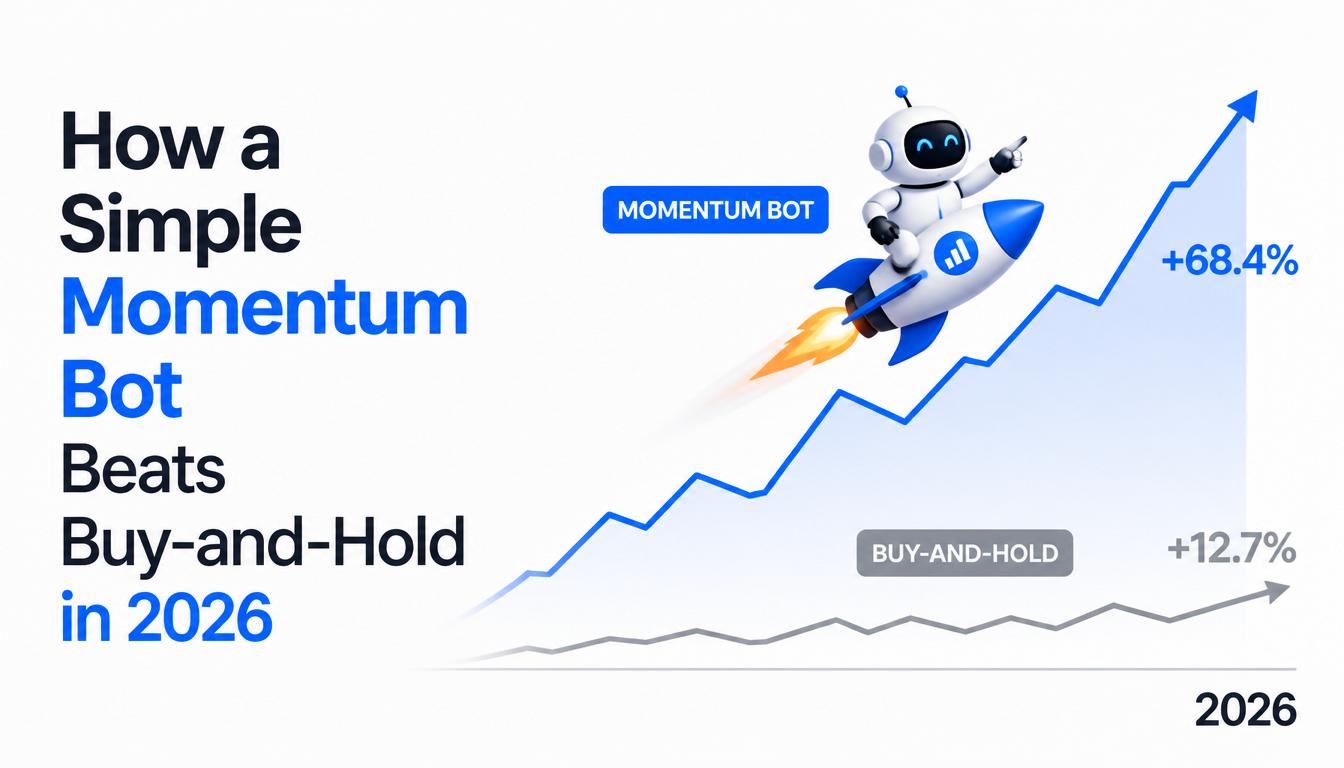
It works because trends often form after institutional accumulation or macro catalysts. As Snap Innovations notes, that behavior shows up consistently across equities, crypto, and forex. Trend-following systems typically win only 35–45% of trades. But their winners dwarf their losers, producing positive expectancy over time. Our deep dive on how a simple momentum bot beats buy-and-hold shows the rules in action.
Best for: Beginners. The rules are simple, automatable, and forgiving of imperfect timing.
#2 Mean reversion
The mirror image of momentum. Mean reversion bets that after an extreme move, price snaps back toward its average — you buy fear and sell greed.
Implementations use Bollinger Bands, RSI extremes, or statistical z-scores to flag overextended conditions. It’s a cornerstone of the statistical-arbitrage strategies hedge funds run, as our guide to the mean reversion strategy hedge funds use explains. The catch: it works best on stocks and struggles in strongly trending assets like forex.
Best for: Intermediate traders comfortable with indicators and range-bound markets.
#3 Grid trading
A strategy that profits from movement without predicting direction. Grid trading places laddered buy and sell orders across a range, banking small gains on each oscillation.
It thrives in choppy, range-bound markets — exactly the conditions that frustrate trend followers — and it’s a favorite for crypto automation. Its weakness is a strong breakout, which leaves the grid accumulating losses on one side. See our full grid trading strategy guide for the mechanics and a worked example.
Best for: Beginners who want a hands-off bot in sideways markets — with a stop-loss.
#4 Arbitrage
The closest thing to a “free lunch,” and the hardest to capture. Arbitrage exploits price differences for the same asset across markets or related instruments.
Pure arbitrage opportunities are rare and fleeting in 2026. Capturing them increasingly demands colocation servers, cross-exchange APIs, and predictive latency models. That makes it a professional’s game more than a beginner’s. Still, simpler cross-exchange spreads in crypto remain accessible to technically capable retail traders. A coin priced slightly higher on one exchange than another lets you buy low and sell high almost instantly — until fees and transfer times eat the gap. The edge is real but thin, and competition closes it fast.
Best for: Advanced traders with strong infrastructure and low-latency setups.
#5 Breakout trading
Breakout strategies aim to catch a new trend at its birth — entering when price decisively breaks a key level on rising volume.
The appeal is getting in early on a big move. The cost is false breakouts that reverse and stop you out. Modern systems increasingly add machine learning to filter genuine breakouts from noise and to adjust stop-losses dynamically. Volume is the usual confirmation: a breakout on heavy volume is more likely to hold than one on a quiet day. It pairs naturally with momentum — breakout gets you in, momentum keeps you in.
Best for: Intermediate traders who can tolerate a lower win rate for occasional large gains.
The hybrid reality of modern algo trading strategies
Here’s what the “which strategy is best” debate misses: the most consistent performers in 2026 aren’t pure systems at all. They’re hybrids.
The emerging best practice pairs a transparent, well-understood core — usually momentum or mean reversion — with an adaptive layer. That layer detects the market regime and adjusts parameters accordingly, an approach ThinkMarkets highlights for 2026. A mean-reversion bot that knows to stand down when a strong trend forms avoids that strategy’s worst weakness. The lesson: don’t marry one strategy. Understand several, and let conditions dictate which is active.
How to choose your first algo trading strategy
Don’t start with the hardest. Match the strategy to your level and the market you’ll trade:
- Total beginner? Start with momentum — simple rules, forgiving, automatable.
- Trading a sideways market? A grid or mean-reversion approach fits the conditions.
- Strong coder with infrastructure? Arbitrage rewards your edge.
- Want early entries into big moves? Breakout, ideally paired with momentum.
Whichever you pick, the workflow is the same: understand the logic, backtest honestly with fees and slippage, paper trade, then start small. The strategy matters less than the discipline you bring to testing it. Skip that discipline, and even the best strategy on this list will quietly lose money.
Algo trading strategies to avoid
Knowing what doesn’t work is half the battle. A few categories drain more accounts than they fill.
The black-box “AI” bot. If a system can’t tell you why it trades, you can’t fix it when it breaks — and it will break. Opaque neural-net bots sold with screenshots of perfect returns are the classic trap.
The over-optimized backtest. Any strategy tuned until its historical curve looks flawless has usually memorized noise. A backtest Sharpe ratio above 3.0 is a red flag, not a trophy; such systems almost always collapse live.
The “guaranteed signals” subscription. Paid signal groups promising fixed monthly returns sell certainty that markets never provide. If the edge were real, they’d trade it, not sell it.
The martingale doubler. Some strategies double position size after every loss. They show smooth equity curves right up until the single losing streak that wipes the account. Avoid anything whose risk grows as it loses.
The common thread: every reliable strategy has a transparent, explainable edge. If you can’t articulate why it makes money, it probably doesn’t.
How to backtest any strategy
Whichever of these algo trading strategies you choose, the test process decides whether it survives contact with real markets:
- Get clean data covering several years and at least one bear market, so you see how the strategy behaves under stress.
- Code the rules exactly — no peeking at future data, the bias that silently inflates most amateur backtests.
- Include all costs: commissions, spreads, and slippage. A strategy that’s profitable before costs and a loser after is common.
- Test out-of-sample. Reserve recent data the strategy never “saw” during development, and confirm the edge holds there.
- Paper trade the survivor for weeks before risking a cent.
A strategy that clears every step still isn’t guaranteed to profit — but one that skips them is almost guaranteed to fail.
Do you need to code these strategies?
Not always — and the answer shapes which strategy to start with.
Grid trading is the most no-code-friendly. Platforms like Pionex and 3Commas offer built-in grid bots you configure through a dashboard, with no programming required. Momentum and mean reversion sit in the middle. No-code platforms can run simple versions, but writing your own in Python unlocks far more control over the rules. Arbitrage is the exception. Capturing it reliably almost always demands custom code and low-latency infrastructure, which is part of why it’s an advanced strategy.
If you can’t code yet, that’s fine. Start with a grid or a pre-built momentum bot. Learn how the mechanics feel with real, small money first, and add Python later. When you’re ready to build your own, our guide to the best programming language for trading walks through why Python is the obvious first choice.
The key point is simple. A lack of coding skill is not a reason to avoid algo trading strategies altogether. It’s only a reason to pick the ones with mature no-code tools while you learn.
FAQ
What is the most profitable algo trading strategy? There’s no single winner — profitability depends on market conditions. Momentum and trend following have the most durable, cross-market track record. That’s why they top most lists of algo trading strategies.
Which algo trading strategy is best for beginners? Momentum, for its simple, automatable rules. Grid trading is a close second for hands-off sideways markets.
Do these strategies work in crypto? Yes. Momentum, grid, and arbitrage are especially popular in crypto, though its higher volatility raises both the opportunity and the risk.
Can I combine multiple strategies? Yes — and the best modern systems do. Hybrids that switch behavior based on market regime are the 2026 standard among serious traders.
How do I know a strategy actually works? Look for a logical edge plus robust out-of-sample backtests including costs. A great backtest with no explainable edge is usually overfitting.
How many strategies should a beginner run at once? Just one. Master a single strategy end to end — logic, backtest, paper trade, then live — before adding another. Running several untested systems at once multiplies the ways you can lose without teaching you which one actually works.
Are these algo trading strategies legal? Yes. For retail traders on regulated brokers and exchanges, all five are completely legal. You’re automating orders you could place by hand. High-frequency and arbitrage tactics face more scrutiny at the institutional level, but the retail versions are standard practice.
Do I need a lot of money to trade these strategies? No. You can backtest and paper-trade all of them for free, and most work on small live accounts. Arbitrage and some high-frequency variants are the exception — they need more capital and infrastructure to be worthwhile.
Can these strategies make me rich quickly? No. Even the proven ones target steady, compounding edges, not overnight riches. Realistic returns are measured per year, not per week. Treat anyone promising fast riches from a strategy as a warning sign.
Key takeaways
- The proven algo trading strategies are momentum, mean reversion, grid, arbitrage, and breakout.
- Momentum/trend following is the most beginner-friendly and has the strongest cross-market record.
- Mean reversion and grid suit range-bound markets; arbitrage and breakout are more advanced.
- The 2026 edge is hybridization — a transparent core plus regime-aware adaptation.
- Logic + honest backtesting beats complexity. A strategy you can’t explain is one you can’t trust.
Ready to test a strategy for real? Our free Algo Trading Starter Kit includes Python templates for momentum and mean-reversion bots, a backtesting checklist, and our broker comparison. Grab it free → and stop collecting strategies — start testing one.