Pick any crypto trading bot platform in 2026 and you’ll see the same handful of strategies under different names. Strip away the branding and only five core approaches actually power most automated crypto trading: DCA, grid, momentum/trend, arbitrage, and AI. This guide is the practical map — what each strategy does, when to pick it, when not to, and how the choices fit together as part of a real automated operation.
Unlike a ranked listicle, this is a working guide for the trader trying to build, not browse. By the end you should know which crypto trading bot strategies belong in your toolkit, which to avoid, and how to combine them so that something is always earning regardless of market regime.
How to think about crypto trading bot strategies
The first reframe most beginners need: a bot is an executor, not a strategist. As multiple 2026 bot guides emphasize, bots automate execution, not strategy creation. A mediocre strategy executed flawlessly still produces mediocre results.
That means your first decision isn’t “which bot platform” — it’s “which strategy fits this market and my temperament.” The five strategies below differ in what they require from the market, from your capital, and from you. Get that fit right and the platform becomes almost interchangeable; get it wrong and even the best platform won’t save you. Crypto trading bot strategies live or die on that match.

The five core strategies
| Strategy | Profits from | Best market | Difficulty |
|---|---|---|---|
| DCA | Accumulating over time | Any (long-term) | Beginner |
| Grid | Sideways oscillation | Range-bound | Beginner |
| Momentum / trend | Sustained moves | Trending | Beginner–Intermediate |
| Arbitrage | Cross-market gaps | Any (fleeting) | Advanced |
| AI / sentiment | Adaptive signals | Any | Advanced |
Two of these (DCA, grid) are beginner-friendly. Two (arbitrage, AI) are advanced. Momentum sits in between. Most successful automated portfolios mix two or three at any time, not just one.
DCA bots
Dollar-cost averaging is the simplest strategy in this guide and the most reliably useful. A DCA bot buys a fixed dollar amount of an asset on a fixed schedule, ignoring price entirely. Over time, it smooths out volatility — you buy more when prices are low and less when they’re high — by automating something humans almost never do consistently by hand.
The mechanism handles one of trading’s hardest problems: timing. Instead of relying on a perfect entry, the bot spreads entries across time or price levels. As token-management guides note, this can meaningfully reduce the risk of entering all at once, especially in volatile markets. A practical example: $200 a week into a single asset over five weeks accumulated 20.77 tokens at an average $48.15 — about 8% better than dropping $1,000 in on day one in one historical period.
When DCA works. Long-term accumulation of an asset you believe in. Bear markets where your fixed schedule keeps you buying through the fear.
When DCA fails. Assets in terminal decline — you keep buying something that never recovers. DCA reduces timing risk, not asset-selection risk.
Best for: Beginners and long-term believers who want a hands-off, low-stress entry into automated crypto.
Grid bots
A grid bot places a ladder of buy and sell orders at evenly spaced price intervals within a defined range. When the price drops to a buy level, the bot purchases. When it rebounds to the next sell level, the bot sells. The profit is the spread between each buy and sell pair, repeated indefinitely.
In realistic conditions, every time BTC moves $1,000 within the range and returns, a typical grid completes one cycle and captures roughly 0.8–1.2% profit on that level’s capital. If BTC oscillates three or four times per day, the daily returns add up meaningfully over weeks.
When grids work. Sideways or choppy markets with regular oscillation within a recognizable range. High-volume pairs with deep liquidity.
When grids fail. A strong sustained breakout out of the range leaves the grid accumulating losses on one side. A stop-loss outside the grid is non-negotiable, as our grid trading on Binance and Bybit guide explains in detail.
Best for: Traders who want a near-passive bot to harvest crypto’s constant chop.
Momentum and trend-following bots
Trend-following bots aim to enter when momentum is strong and exit when the trend weakens. The simplest version uses moving averages: buy when a fast moving average crosses above a slow one; exit when it crosses back. More advanced variants use RSI, MACD, or breakout rules to confirm signals.
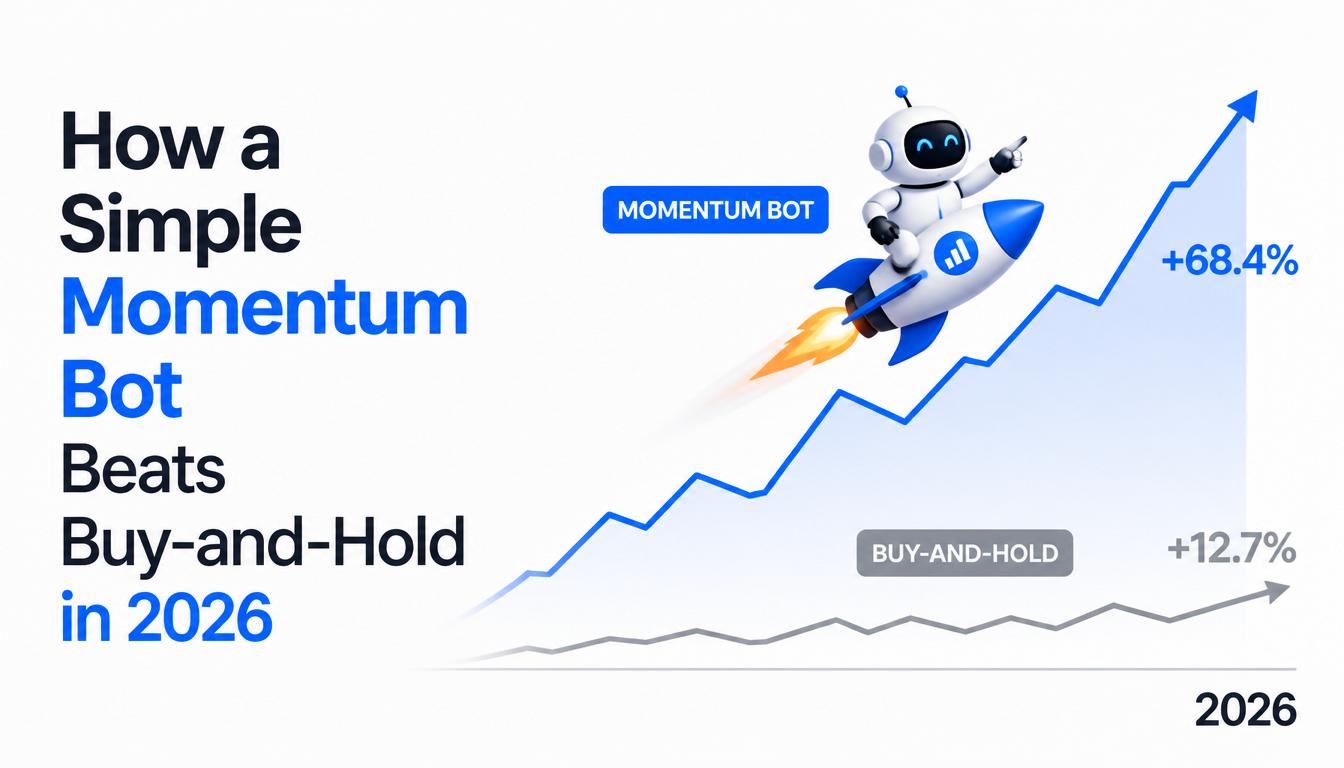
Crypto’s tendency to produce strong, persistent moves rewards trend systems that catch a real run, even though they get whipsawed in choppy markets. As our momentum bot vs buy-and-hold guide shows, the real edge is often drawdown protection — the bot exits during crashes — rather than higher raw returns.
When momentum works. Sustained trends, especially around macro catalysts and major news cycles.
When momentum fails. Range-bound chop, where the bot gets whipsawed by false breakouts.
Best for: Traders who want a rules-based way to ride big moves without sitting through full crashes.
Arbitrage bots
Arbitrage exploits price differences for the same asset across exchanges or related instruments. Buy low on one venue, sell high on another, capture the spread. In crypto, this is almost entirely an algorithmic game — opportunities exist for seconds.
Cross-exchange spot arbitrage is the simplest version retail traders can attempt. More advanced versions include triangular arbitrage (three-way trades on a single exchange), funding-rate arbitrage on perpetual futures, and on-chain DeFi arbitrage — see our DeFi arbitrage bots deep dive for that frontier.
When arbitrage works. Volatile markets with temporary price dislocations, especially after major news. Cross-exchange spreads on newer or less liquid pairs.
When arbitrage fails. When fees, slippage, and transfer times eat the thin margin — which is most of the time on liquid pairs.
Best for: Technically capable traders with fast systems and multi-exchange accounts.
AI and sentiment bots
The newest frontier. AI bots use machine learning and natural language processing to analyze data well beyond what a rule-based bot can — order-book microstructure, social-media sentiment, on-chain whale activity, news flow. The newest agents in 2026 aim to adapt strategies in real time rather than execute a fixed rule.
Cryptohopper’s AI strategy module, for instance, feeds the system 10–20 different indicators and votes on which is currently most effective, automatically switching between trend-following and oscillator-based logic as conditions change. Other entrants like Intellectia and Dash2Trade integrate GPT-class models with sentiment analysis and news parsing.
When AI works. Markets where regimes shift fast and a rigid rule-based bot would lag. Operators who understand what the AI is actually doing under the hood.
When AI fails. Anyone who treats “AI” as a magic word without checking the underlying logic — many products marketed as AI are repackaged grid or martingale bots dressed in modern language.
Best for: Advanced traders comfortable with model-based systems and willing to verify the inner workings.
Matching strategy to market regime
Here’s the meta-insight that separates serious operators from beginners. No single strategy works in every market. The smart play is matching the active bot to the current regime.
Range-bound market? Grids and DCA thrive. Trend bots get chopped up. Trending market? Momentum and trend-following capture the move. Grids accumulate losses on the losing side. High-volatility news cycle? Arbitrage and AI sentiment bots have more to work with. Set rigid grids aside. Quiet market? DCA keeps accumulating. Most others earn little.
The discipline isn’t running every strategy always — it’s recognizing the regime and turning bots on or off accordingly. Many of the best crypto trading bot strategies fail not because they’re flawed but because they’re run in the wrong weather.
Combining bots into a portfolio
A practical setup for a serious automated operation looks like this. A DCA bot quietly accumulates a long-term position in BTC or ETH on a weekly schedule, regardless of conditions. A grid bot runs on a liquid altcoin pair during sideways stretches and gets paused during strong trends. A momentum bot scans for clear breakouts and rides them on a third asset. Optionally, an arbitrage bot picks up smaller wins on cross-exchange spreads.
Each bot has its own capital allocation, its own risk limits, and its own kill-switch. Diversification across strategies and assets means that when any single bot underperforms — because regimes always rotate — the others keep the overall portfolio working. This is the model serious retail operators converge on by their second or third year.
Risk management for any bot
Whichever strategies you run, a few rules apply across the board.
- Risk no more than 1–2% per trade. This is the single most important habit on any bot.
- Always use a stop-loss outside your bot’s working range. For grids especially, this is non-negotiable.
- Set a hard daily loss limit that shuts the bot off automatically. Bots can lose far faster than humans.
- Never enable withdrawals on the API key. Trade-only keys mean a breach can’t drain funds.
- Paper trade for weeks before deploying a new bot live.
These five aren’t optional. They’re the difference between bots that compound modest edges and bots that blow up dramatically.
Platforms that run these strategies
You don’t have to code. Pionex packages 16 built-in bots covering DCA, grid, and more, free with a flat 0.05% trading fee. 3Commas is a rule-based automation platform with 220,000+ users, deep DCA and grid customization, and TradingView signal integration. Bitsgap combines grid, DCA, arbitrage, and rebalancing tools across 15+ exchanges. Cryptohopper leads on AI strategy automation and copy trading. Our best trading bots comparison ranks these head to head.
Code-it-yourself in Python is also a valid path; see our best programming language for trading guide for the case.
Common mistakes
The errors that drain accounts run with surprising consistency across crypto trading bot strategies:
- Running a grid in a trend or a trend bot in chop — wrong tool for the regime.
- Trusting a black-box AI bot you can’t explain in one sentence.
- Over-leveraging to chase faster returns; one bad streak ends the account.
- Skipping the stop-loss, especially on grids and DCA into declining assets.
- Treating any bot as “set and forget.” Regimes change. You must check in.
Avoid these five and you’re already ahead of most automated traders.
FAQ
What are the best crypto trading bot strategies for beginners? DCA and grid bots — both have low transaction costs, simple mechanics, and clear sweet spots. Start with one, learn its behavior across a few weeks, then add a second.
Can I run multiple crypto trading bot strategies at the same time? Yes, and serious operators usually do. The combination of DCA, grid, and momentum across different assets provides natural diversification — when one strategy struggles, others typically still earn.
Do AI crypto trading bots really work? Some do, with real machine-learning models and sentiment analysis. Many “AI” products are marketing dressing on rule-based bots. Demand transparency about the actual logic before trusting one with capital.
Which strategy is most profitable? None universally. Profitability depends on regime. Momentum shines in trends, grid in chop, arbitrage in dislocations. Matching the active strategy to the market matters more than which strategy you favor.
Do I need to code to run these strategies? No. Pionex, 3Commas, Bitsgap, and Cryptohopper all offer no-code interfaces. Coding helps you customize, but it isn’t required to start.
Key takeaways
- Five core crypto trading bot strategies cover most automated crypto trading: DCA, grid, momentum, arbitrage, and AI.
- DCA and grid are the strongest starting points — simple, automatable, forgiving.
- No strategy works in every market; matching strategy to regime is the meta-skill.
- Combine strategies into a portfolio for diversification across regimes.
- Risk discipline is the constant — 1–2% per trade, stop-losses, trade-only API keys, and never set-and-forget.
Ready to build your bot portfolio? Our free Algo Trading Starter Kit includes a strategy-selection matrix, setup checklists for each bot type, and our best trading bots comparison. Grab it free → and run the right strategy in the right market, every time.