Tag: high frequency trading

  • High-Frequency Trading Strategies: A 2026 Reality Check

    High-Frequency Trading Strategies: A 2026 Reality Check

    Let’s start with the conclusion most guides bury at the bottom: you, a retail trader at home, almost certainly cannot run true high-frequency trading. Not because you’re not smart enough, but because HFT is an arms race won with nanoseconds, custom hardware, and real estate inside exchange data centers. Understanding it still matters enormously, though — because these are the systems on the other side of many of your trades, and knowing how they work makes you a sharper trader.

    This is a clear-eyed tour of the major high-frequency trading strategies: what they are, how they make money, and exactly where the line sits between what institutions do and what a retail trader can realistically touch.

    What this guide covers

    What high-frequency trading actually is

    High-frequency trading (HFT) is a form of algorithmic trading defined by extreme speed and volume. Thousands of orders are placed, modified, and cancelled in fractions of a second. The holding period for a position can be milliseconds. The goal isn’t to predict where a stock goes next week. It’s to capture vanishingly small edges, billions of times, faster than anyone else.

    And it dominates. As VT Markets explains, HFT firms account for an estimated 50–60% of total US equity trading volume in 2026. When you buy a share, there’s a strong chance an HFT system is on the other side. These aren’t fringe players — they are the plumbing of modern markets. That scale is why understanding high-frequency trading strategies is worthwhile even if you’ll never run one.

    A data-center server rack beside a millisecond-scale order flow chart, illustrating high-frequency trading strategies

    How HFT took over the markets

    HFT didn’t always rule. In the 1990s, trading was still mostly human. Then exchanges went electronic. Orders that once took seconds now took milliseconds.

    The 2000s lit the fuse. Regulation pushed US markets toward electronic, fragmented venues. That fragmentation created tiny price gaps between exchanges. Fast firms raced to capture them. Speed itself became a product you could buy.

    By the 2010s, the arms race was in full swing. Firms spent fortunes on faster cables and closer servers. One company famously laid a straighter fiber line between Chicago and New York just to shave a few milliseconds. The book Flash Boys then brought the whole practice to public attention.

    Today the trend has only deepened. HFT is the market’s backbone, not its fringe. The edges are smaller, the hardware more extreme, and the competition fiercer. Speed that cost millions a decade ago is now table stakes. That history is why a retail trader can’t simply “start” high-frequency trading. You’re not picking up a strategy. You’re stepping into a thirty-year infrastructure war.

    Market making: the dominant strategy

    The most prevalent of all high-frequency trading strategies is electronic market making. The idea is old; the speed is new.

    A market-making firm simultaneously posts both a buy order (the bid) and a sell order (the ask) for a security, then profits from the tiny spread between them. Buy at the bid, sell at the ask, capture the difference, repeat at enormous scale. In doing so, these firms provide liquidity — they’re standing ready to take the other side of trades, which keeps markets functioning smoothly.

    The edge per trade is microscopic, often a fraction of a cent. The profit comes from doing it across thousands of securities, millions of times a day. It’s a volume business built on speed and inventory management, not on any single brilliant prediction.

    Statistical arbitrage

    Statistical arbitrage hunts temporary pricing inefficiencies between related securities. Think of a stock and the index fund that holds it, or the same stock listed on two different exchanges.

    When the historical price relationship between two such instruments drifts out of line, the algorithm bets it will snap back. It buys the cheap one, sells the rich one, and profits as the relationship reverts. The HFT twist is speed. These dislocations exist for a heartbeat, so the system must detect and act before the gap closes. It’s the same mean-reversion logic retail quants use, run at a pace no human could follow.

    Latency arbitrage

    Latency arbitrage is the most controversial entry on this list, and the one that most directly involves retail infrastructure. It exploits the speed difference between a fast data feed and a slower one.

    Here’s the mechanism. A fast feed receives a price update — say from a big institutional order or a news event. Software detects that a slower broker’s quote hasn’t caught up yet. It then places an order at the stale price before that broker updates, profiting from the difference. The execution window is typically 50–200 milliseconds, with a profit of roughly 0.5–3 pips per trade after spread. It’s pure speed arbitrage, capturing the lag between who knows the new price first.

    Momentum ignition

    Momentum ignition is the most aggressive — and legally fraught — strategy on this list. The concept: trigger a rapid price move, often by firing a burst of orders, to induce other algorithms to pile in, then profit from the move you helped create.

    Because it can shade into market manipulation, momentum ignition sits in a gray-to-black legal zone and draws regulatory scrutiny. We include it for completeness and understanding, not endorsement. Knowing it exists helps explain some of the sudden, inexplicable spikes you’ll occasionally see on a chart.

    The technology arms race

    Here’s why retail can’t simply join in. By 2026, the competitive standard requires latency measured in nanoseconds to microseconds — and achieving that takes a stack most individuals can’t assemble:

    • FPGAs and custom hardware that process market data in dedicated silicon rather than general-purpose code.
    • Co-location — physically placing your servers inside or beside the exchange’s data center to cut the distance light has to travel.
    • Direct market-access feeds that bypass the slower retail data pipelines entirely.
    • Teams of specialized engineers and quants maintaining it all.

    This is an infrastructure war measured in the speed of light through fiber. The barrier isn’t intelligence — it’s millions of dollars of equipment and physical proximity to the exchange.

    Can retail traders use high-frequency trading strategies?

    The honest answer: not true HFT. You cannot out-spec a firm with FPGAs co-located at the exchange, and trying to compete on raw latency is a guaranteed way to lose.

    But the logic behind several of these strategies scales down. You can run market-making-style bots on some crypto exchanges, capturing spread without nanosecond speed. You can run statistical-arbitrage and mean-reversion strategies on longer timeframes where milliseconds don’t decide the outcome. The trick is to borrow the idea while competing on a timeframe where speed isn’t the edge — minutes or hours, not microseconds. That’s a game retail can actually play.

    What you should not do is buy a product promising retail “HFT” returns. Genuine high-frequency trading strategies are inseparable from infrastructure you don’t have, and anyone selling otherwise is trading on the word’s mystique.

    Are high-frequency trading strategies good or bad for markets?

    This is one of the most debated questions in modern finance, and the honest answer is: both, depending on the strategy.

    On the positive side, market-making HFT provides genuine liquidity. It narrows spreads and makes it easier to buy or sell instantly at a fair price. When you get a near-instant fill on a liquid stock at a tight spread, high-frequency trading strategies are part of why. For the everyday investor, that’s a real, if invisible, benefit.

    On the negative side, critics point to fragility. HFT liquidity can vanish in an instant during stress, deepening “flash crash” events where prices gap violently in seconds. And strategies like momentum ignition shade into manipulation, extracting value rather than adding it. Latency arbitrage, too, profits purely from being faster than someone else, which many see as a tax on slower participants rather than a service.

    The balanced view is that HFT made markets cheaper and more liquid in normal times, while adding new forms of instability in abnormal ones. Regulators continue to wrestle with that trade-off. For you, the practical point is simpler: these systems are a permanent feature of the landscape, so the goal is to trade in a way that doesn’t depend on beating them.

    What high-frequency trading strategies mean for you

    Even if you never run one, HFT shapes the market you trade in. Two practical takeaways:

    First, don’t compete on speed. Your edge as a retail trader is patience, flexibility, and timeframes the giants ignore — not reaction time. Trying to scalp micro-moves against HFT market makers is bringing a stopwatch to a photo finish.

    Second, expect the plumbing. Tight spreads on liquid stocks exist partly because market makers compete them down — a benefit to you. But sudden liquidity vanishing in a panic, or strange momentary spikes, often trace back to these systems too. Understanding the machinery makes its behavior less mysterious and your own decisions calmer.

    The bigger lesson is one of mindset. High-frequency trading strategies win by being the fastest. You never will be, and you don’t need to be. Retail traders thrive on the timeframes the giants ignore — the hours, days, and weeks where a good idea, not a fast cable, decides the outcome. Cede the microseconds without a fight, and play the game where your patience, not your hardware, is the edge. That is a contest a disciplined retail trader can actually win.

    FAQ

    What are the main high-frequency trading strategies? The major ones are market making (the most common), statistical arbitrage, latency arbitrage, and momentum ignition — the last of which raises serious legal concerns.

    Can a retail trader do high-frequency trading? Not true HFT. It requires nanosecond latency, FPGAs, and co-location at the exchange. Retail traders can borrow the underlying logic on slower timeframes where speed isn’t the edge.

    How much of the market is high-frequency trading? HFT firms account for an estimated 50–60% of total US equity trading volume in 2026, making them dominant participants.

    Is high-frequency trading legal? Most HFT is legal and even provides liquidity. Momentum ignition is the exception — it can constitute manipulation and draws regulatory scrutiny.

    Is latency arbitrage a threat to retail traders? It mainly exploits speed gaps between professional feeds and slower brokers. As a retail trader, the practical lesson is simply not to compete on speed against systems built for it.

    Why is high-frequency trading so controversial? Because it cuts both ways. Market-making HFT adds liquidity and tightens spreads, which helps ordinary investors. But that liquidity can vanish in a crisis, and tactics like momentum ignition shade into manipulation. Regulators still debate the balance.

    Key takeaways

    • True high-frequency trading strategies are an institutional arms race — won with FPGAs, co-location, and nanosecond latency.
    • The four major strategies are market making, statistical arbitrage, latency arbitrage, and momentum ignition (the last legally fraught).
    • HFT is 50–60% of US equity volume — it’s the market’s plumbing, not a fringe activity.
    • Retail can’t run true HFT, but can borrow the logic on slower timeframes where speed isn’t the deciding edge.
    • Don’t compete on speed. Your retail edge is patience and timeframes the giants ignore.

    Want to trade smart against the machines, not race them? Our free Algo Trading Starter Kit includes strategy templates built for retail-friendly timeframes, a backtesting checklist, and our broker comparison. Grab it free → and play the game you can actually win.
  • Crypto Scalping Bot Strategy: A 2026 Beginner’s Guide

    Crypto Scalping Bot Strategy: A 2026 Beginner’s Guide

    Somewhere right now, a piece of software is opening and closing a Bitcoin position in under a second, pocketing a fraction of a percent, and doing it again. And again. Hundreds of times a day. That’s a crypto scalping bot at work — and it’s one of the most seductive ideas in automated trading. Tiny wins, stacked endlessly, into something big. The dream sells itself.

    The reality is more demanding. A crypto scalping bot can absolutely make money, but the margin between profit and loss is razor-thin, and it’s decided by two unforgiving forces most beginners ignore: fees and latency. This guide shows you how scalping actually works, walks through the brutal math, and tells you honestly what it takes to come out ahead.

    What this guide covers

    What crypto scalping actually is

    Scalping is the art of taking many small profits instead of a few big ones. A scalper doesn’t care where Bitcoin will be next month. It cares where the price will be in the next thirty seconds, and it tries to capture a sliver of that move — 0.2%, maybe 0.5% — before exiting and hunting the next one.

    Crypto is a natural home for this. It trades 24/7, it’s volatile, and its order books update constantly, so there are always tiny dislocations to exploit. No human can scalp effectively, though. The trades are too fast and too frequent. This is automation’s territory by necessity, not preference, which is exactly why the crypto scalping bot exists.

    A fast-updating crypto order book with a scalping bot executing rapid trades, illustrating a crypto scalping bot strategy

    How a crypto scalping bot works

    Strip away the marketing and every crypto scalping bot runs the same tight loop, just very fast:

    1. Ingest data. Stream live order-book and price data from the exchange.
    2. Generate a signal. Apply a rule — an order-book imbalance, a micro-breakout, a short moving-average cross — to decide whether a quick edge exists.
    3. Send the order. Fire the entry the instant the signal triggers.
    4. Exit fast. Take the small profit at a preset target, or cut the loss just as quickly.
    5. Apply risk checks. Cap position size and daily loss so one bad tick can’t wreck the account.

    A scalper bot may execute dozens or hundreds of trades per day this way. That frequency is the whole point — and also the whole problem, because every single trade pays a toll.

    The brutal math of fees

    Here is the part the “1% a day!” screenshots never show you. When you trade hundreds of times a day, fees stop being a footnote and become the main character.

    Consider this: a reasonably good scalping strategy wins about 60% of its trades. Sounds healthy. But research summarized by TradingView Hub found that paper returns of around 1% per day shrink to roughly 0.2% per day in live trading once you subtract exchange fees and spread — an 80% collapse between simulation and reality. The strategy didn’t change. The costs simply ate four-fifths of the edge.

    It gets starker. A CoinMetrics analysis found that only about 12% of micro-spread trading opportunities are actually profitable once fees and latency are accounted for. Eighty-eight percent of the “edges” a naive bot sees are mirages that vanish at the cash register. For a scalping bot, fee structure isn’t a detail — it’s the strategy.

    Why latency makes or breaks you

    The second killer is speed. Scalping profits live in a window measured in milliseconds, and if you’re slow, the window slams shut before you get through it.

    The numbers are unforgiving. When targeting 0.2–0.5% moves, profit margins on micro-spread trades vanish entirely above 200 milliseconds of latency. For reference, human reaction time is 200–250 milliseconds — meaning a human is, by definition, too slow to scalp at all. A competent crypto scalping bot executes in 5–50 milliseconds, and that gap is its entire reason to exist.

    This is why where and how your bot runs matters as much as its logic. A bot on a laggy home connection routing through a slow API is bringing a knife to a gunfight against systems co-located beside the exchange.

    A worked example

    Let’s make the math concrete. Suppose your bot targets a 0.30% move per trade on a futures pair.

    • Gross target: 0.30% per winning trade.
    • Fees: using futures maker orders at 0.02% per side, a round trip costs about 0.04%.
    • Net per win: roughly 0.26%.
    • Losses: on a losing trade you give back your stop, say 0.30%, plus the same 0.04% in fees.

    Now apply a 60% win rate over 100 trades: 60 wins at +0.26% and 40 losses at −0.34%. That nets out to roughly +2.0% across the 100 trades — genuinely good.

    But flip one variable. Use taker orders at 0.05% per side instead of maker, and the round-trip fee jumps to 0.10%. Suddenly each win nets only 0.20% and each loss costs 0.40%, and the same 100 trades barely break even. One fee setting flipped a winner into a coin toss. That sensitivity is the essence of scalping.

    What it takes to actually profit

    Put the pieces together and a profitable crypto scalping bot needs a specific, demanding combination:

    • A genuine edge — a signal with a win rate of at least 57–60%, validated out-of-sample, not curve-fit to last month.
    • Maker-order fees — using limit orders that add liquidity (around 0.02%) instead of taker orders that remove it.
    • Low latency — execution well under 200ms, ideally in the tens of milliseconds, via a fast connection or a cloud server near the exchange.
    • Strict risk control — tight per-trade stops and a hard daily loss limit, because high frequency means errors compound fast.
    • The right market phase — scalping suits liquid, volatile, ranging conditions and struggles in dead or violently trending markets.

    Miss any one of these and the math quietly turns against you. This is not a “set it and forget it” strategy.

    Where a crypto scalping bot wins and loses

    Matching the bot to conditions is half the battle.

    It wins when: the market is liquid and choppy, spreads are tight, volatility is steady, and your execution is fast. High-liquidity majors like BTC and ETH on a low-fee futures venue are the classic playground.

    It loses when: liquidity is thin (slippage explodes), the market is dead (no moves to capture, but fees still accrue), or a violent one-way trend runs your quick exits over. Thin altcoins are especially dangerous — the spread alone can exceed your profit target.

    The honest summary: scalping is the strategy most sensitive to costs and conditions. When everything aligns, it’s beautiful. When it doesn’t, it bleeds quietly.

    Common crypto scalping bot mistakes

    Most scalping failures come from the same handful of errors. Avoid these and you’ve dodged the majority of blown accounts.

    • Trading taker fees. Paying to remove liquidity instead of using maker limit orders can double your costs and flip a winner into a loser. On a high-frequency strategy, the fee tier is not optional.
    • Backtesting without costs. A backtest that ignores fees, spread, and slippage will always look brilliant and always lie. Model every cost before believing a single result.
    • Scalping illiquid altcoins. Thin order books mean wide spreads and ugly slippage. On a low-cap token, the spread alone can exceed your entire profit target.
    • Ignoring latency. Running a crypto scalping bot on a slow home connection guarantees you arrive after the edge is gone. Measure your real latency before going live.
    • No daily loss limit. At hundreds of trades a day, a malfunctioning strategy can bleed fast. A hard daily stop is the circuit breaker that saves the account.
    • Over-optimizing the win rate. Tuning parameters until the backtest hits 70% usually means you’ve fit noise. A robust 58% beats a fragile 70% every time.

    The pattern is clear: scalping punishes carelessness faster than any other strategy, because every mistake is multiplied by your trade count.

    Scalping vs other bot strategies

    It helps to see where scalping sits among automated approaches. A grid bot also trades frequently in small increments, but it’s passive about timing — it just harvests oscillation within a range. A scalping bot is active, hunting specific micro-signals and demanding speed. A momentum bot, by contrast, trades rarely and holds for days, caring nothing about milliseconds.

    That contrast reveals the trade-off. Scalping offers the most frequent feedback and, in theory, the steadiest stream of small wins — but it’s the most cost-sensitive and the most operationally demanding of the lot. If fees, latency, and constant tuning sound exhausting, a grid or momentum approach delivers far more return per unit of effort. Scalping rewards those who genuinely enjoy optimizing a fast machine; for everyone else, a slower strategy is usually the smarter use of capital.

    Getting started without getting burned

    If you want to try it, do it the survivable way:

    1. Start on a paper or testnet account. Prove the logic before risking a cent.
    2. Measure your real latency to the exchange, and pick a low-fee venue with a maker rebate.
    3. Model fees explicitly in every backtest — a strategy that’s profitable before fees and a loser after is the default outcome.
    4. Use a reputable platform if you’re not coding your own; tools like 3Commas, Pionex, and HaasOnline offer scalping presets.
    5. Start tiny and scale slowly, watching whether live results track your backtest. They usually won’t at first.

    Treat the first months as calibration, not income. The traders who survive scalping are the ones who respected the math before the market taught it to them.

    FAQ

    Is a crypto scalping bot profitable? It can be, but only with a real edge (57–60%+ win rate), maker-order fees, low latency, and strict risk control. Without those, fees and slippage usually erase the profit.

    Why do scalping backtests look so much better than live results? Because backtests often ignore real fees, spread, and slippage. Live returns commonly fall around 80% below paper returns once those costs are included.

    Do I need to code to run a crypto scalping bot? Not necessarily. Platforms like Pionex, 3Commas, and HaasOnline offer ready-made scalping bots, though coding your own gives more control over the edge.

    How fast does a scalping bot need to be? Fast. Profit margins on micro-moves disappear above 200ms of latency. Good bots execute in 5–50ms, far beyond human reaction time.

    What’s the biggest mistake scalping beginners make? Ignoring fees. At hundreds of trades a day, the difference between maker and taker fees alone can flip a winning strategy into a losing one.

    Key takeaways

    • A crypto scalping bot captures many tiny, fast profits rather than a few big ones — pure automation territory.
    • Fees are the main character. Paper returns near 1%/day routinely shrink to ~0.2%/day live, and only ~12% of micro-edges survive costs.
    • Latency decides everything. Above 200ms, the edge vanishes; good bots run in 5–50ms.
    • Profit demands a 57–60%+ win rate, maker fees, low latency, and tight risk control — all at once.
    • It’s not passive. Scalping is the most cost- and condition-sensitive strategy in the automated toolkit.

    Want to test a scalping setup safely? Our free Algo Trading Starter Kit includes a fee-and-latency calculator, a paper-trading checklist, and our low-fee exchange comparison. Grab it free → and find out if the math works before you risk real capital.

  • Best Programming Language for Trading in 2026: Ranked

    Best Programming Language for Trading in 2026: Ranked

    Ask ten quants which language to learn and you’ll get ten confident, contradictory answers. The truth is simpler. The best programming language for trading depends on what you’re building. A research notebook, a backtesting engine, and a system firing orders in nanoseconds each reward a different tool. This guide ranks the five that actually matter in 2026. It scores each on the criteria that count and tells you which to learn first.

    No vague “it depends.” You’ll get a clear winner, the situations where another language beats it, and a path to start coding this week.

    How we ranked the best programming language for trading

    Each language is scored on four things that determine real-world fit: ecosystem (libraries and community), execution speedlearning curve, and where it dominates. Ecosystem and learning curve carry the most weight here. For 95% of retail and aspiring algo traders, getting a strategy built and tested matters far more than shaving microseconds off execution.

    Jump to a language

    The quick verdict

    If you’re starting out, learn Python. It wins on every axis that matters to a beginner and most professionals. You get the largest ecosystem, the gentlest learning curve, and enough speed for everything short of high-frequency trading. The other four languages earn their place only in specific situations. We’ll map those out so you know when to reach for them.

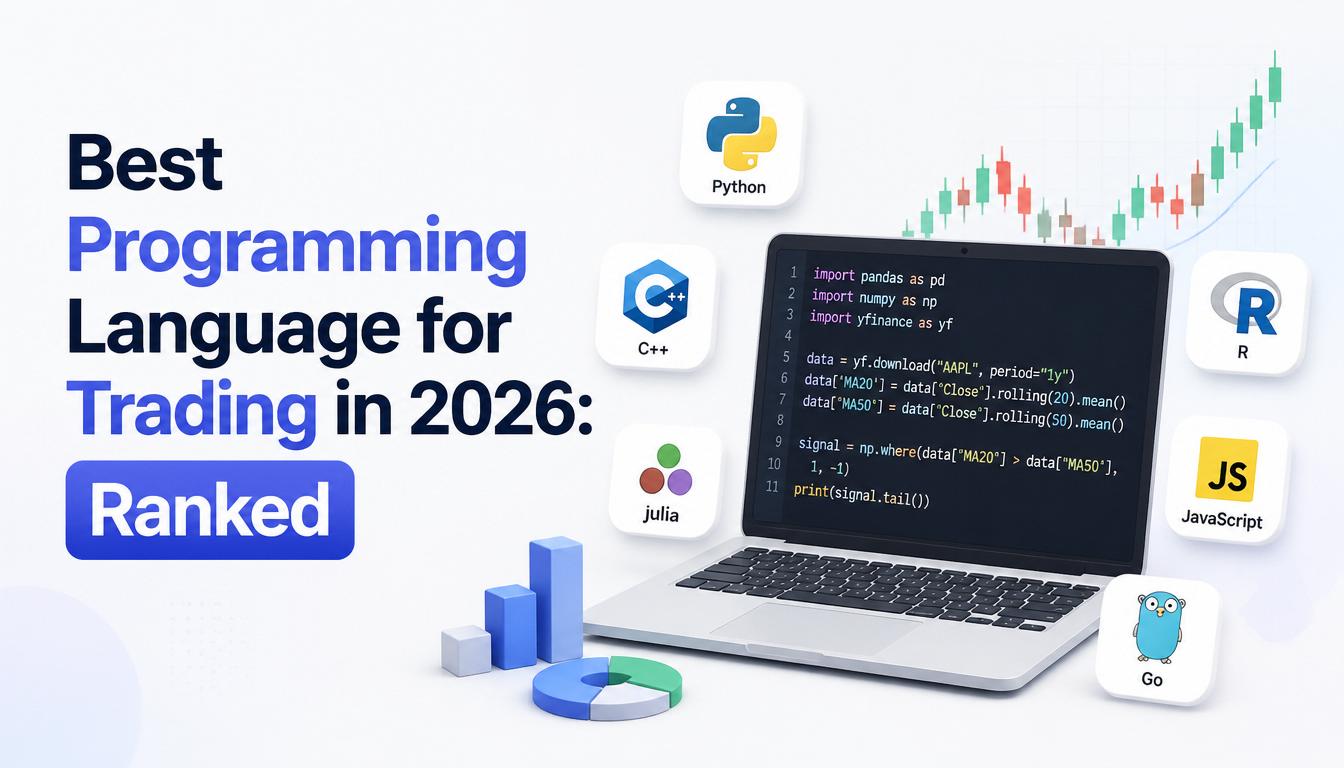
    Code editor showing Python trading strategy beside a ranking chart of the best programming language for trading

    At a glance: the comparison table

    LanguageBest forSpeedLearning curveVerdict
    PythonResearch, backtesting, MLGoodEasyStart here
    C++HFT, ultra-low latencyEliteSteepSpecialists only
    RStatistical researchModerateModerateAnalysts
    Java / C#Enterprise execution systemsVery goodModerateScaling up
    JuliaHigh-speed researchVery goodEasy–moderateOne to watch

    #1 Python — the default winner

    Python is the dominant language for quant research, strategy development, and the entire machine-learning workflow. Its readable syntax pairs with an unmatched scientific stack: NumPy, pandas, scikit-learn, TensorFlow, and PyTorch. That combination lets you focus on the strategy instead of fighting the language.

    Pros: Clear, concise syntax for rapid prototyping; the deepest library ecosystem in finance; a massive community, so every problem you hit has already been answered somewhere.

    Cons: Slower raw execution than C++, so it isn’t built for nanosecond-level high-frequency trading.

    Best for: Beginners, retail algo traders, researchers, and anyone whose edge comes from the idea, not the microsecond. In practice you’ll lean on backtesting libraries like backtrader and Zipline, which have no real equal elsewhere. As QuantStart notes, Python’s productivity advantage is decisive for the research-to-deployment pipeline most traders actually run.

    #2 C++ — the speed king

    C++ is the backbone of professional high-frequency trading. In 2026 there’s still no real alternative for HFT, market-making, and ultra-low-latency arbitrage. Its hardware-level optimization lets systems process orders in nanoseconds.

    Pros: Unmatched execution speed and fine-grained control over memory and hardware.

    Cons: A steep learning curve, and a smaller financial-development community than Python’s. You’ll write far more code to accomplish the same task.

    Best for: Latency-sensitive professionals and firms where being first to the trade is the strategy. For everyone else, it’s overkill — you’d spend months on plumbing a beginner doesn’t need.

    #3 R — the statistician’s tool

    R is built for traders and researchers who want to understand market data deeply. If your focus is statistical precision rather than execution speed, R is arguably the most effective choice.

    Pros: Exceptional for time-series analysis, risk evaluation, and hypothesis testing; richer statistical tooling than Python for certain quant work.

    Cons: Slower performance and weaker production-execution support, so it’s better for research than for live trading.

    Best for: Quant analysts and statistical-arbitrage researchers who live in the data and hand execution to another layer.

    #4 Java / C# — the enterprise workhorse

    Java (and its close cousin C#) is the reliable solution for large-scale, enterprise-grade trading systems, prized for security, portability, and stability under load.

    Pros: Strikes a strong balance between performance, platform independence, and enterprise features; excellent for systems that must run reliably for years.

    Cons: More verbose than Python and lighter on cutting-edge research libraries.

    Best for: Traders scaling a proven strategy into a robust, always-on production system — or developers already fluent in the language.

    #5 Julia — the fast-rising challenger

    Julia is projected to be the fastest-growing language in quant trading, and it’s easy to see why. It combines near-C++ speed with Python-like simplicity, aiming to end the trade-off between fast and friendly.

    Pros: High performance with readable syntax; purpose-built for numerical and scientific computing.

    Cons: A younger, smaller ecosystem than Python’s, so you’ll occasionally hit missing libraries or thinner documentation.

    Best for: Forward-looking researchers who want speed without C++’s pain — and anyone willing to bet on where the field is heading.

    Honorable mentions: Rust and JavaScript

    Two more languages deserve a nod, even if they don’t crack the top five.

    Rust is increasingly paired with or substituted for C++ in low-latency systems. It delivers similar speed with far safer memory handling, which means fewer of the crashes that plague C++ code. Its trading ecosystem is still young, so it’s a specialist choice rather than a starting point. But it’s worth watching as the modern alternative to C++.

    JavaScript (with Node.js) shows up in crypto bots and web-connected dashboards. It’s convenient if you already build web apps, and many exchange APIs have solid JavaScript support. The catch is the thin quantitative library ecosystem. For serious research and backtesting, you’ll still want Python. Treat JavaScript as a glue language, not your analytical core.

    How to choose the best programming language for trading for you

    Match the language to your goal, not to internet hype:

    • You’re a beginner or retail trader → Python. Full stop. It’s the best programming language for trading for the vast majority of people reading this.
    • You need nanosecond execution → C++. But be honest about whether you actually do; almost no retail strategy does.
    • You’re a stats-first researcher → R, with execution handled elsewhere.
    • You’re hardening a strategy into enterprise production → Java or C#.
    • You want tomorrow’s edge today → Julia.

    The wrong move is choosing C++ “because it’s fastest” before you’ve ever shipped a working backtest. Speed you can’t use is not an advantage.

    How long does each take to learn?

    A fair question, since time is the real cost. Here’s a rough guide for someone starting from little or no coding background.

    • Python: weeks to your first working bot. You can write a simple moving-average backtest within a month of focused practice. This is a big part of why it’s the best programming language for trading for beginners.
    • R: a few months to fluency if you’re comfortable with statistics. The syntax is approachable, but its strengths only pay off once you know what to test.
    • Java / C#: several months. The languages are verbose, and production-grade trading code adds its own complexity.
    • Julia: similar to Python for basics, slightly longer in practice because you’ll hit ecosystem gaps and lean on smaller communities for help.
    • C++: the longest road by far — often a year or more before you’re writing safe, performant trading code. The payoff is real, but only for those who genuinely need it.

    The takeaway is blunt. Time-to-first-strategy favors Python so heavily that the choice barely qualifies as a contest for most people.

    Mistakes people make choosing a trading language

    A few avoidable errors send beginners down the wrong path:

    • Optimizing for speed they’ll never use. Picking C++ for a daily or hourly strategy is solving a problem you don’t have.
    • Language-hopping. Jumping between languages instead of getting good at one. Depth beats breadth early on.
    • Choosing by job-posting buzzwords. Hedge-fund listings aren’t your roadmap; your own goals are.
    • Ignoring the ecosystem. A slightly faster language with no backtesting libraries will slow you down, not speed you up.
    • Waiting to feel “ready.” The real mistake is spending weeks choosing instead of building. Pick Python and start.

    Which language should you learn second?

    Once Python feels comfortable and you’ve shipped a few working strategies, a second language can extend your reach. The right pick depends entirely on where you hit a wall.

    Hit a speed wall — your strategy needs faster execution than Python can give? Learn C++ or Rust for the latency-critical piece, and keep Python for research. Hit a statistics wall — you want deeper modeling tools? Add R for the analysis layer. Building toward a robust, always-on production systemJava or C# will serve you well.

    Notice the pattern. You add a second language to solve a specific, concrete problem you’ve actually run into. You don’t collect languages for their own sake. Most traders go years before they truly need a second one, and some never do. Let a real bottleneck — not curiosity or status — decide your next step.

    The polyglot reality

    Here’s the secret the “which language wins” debate misses: most production trading systems aren’t built in one language at all. They’re polyglot — a research stack in Python, an execution layer in Java or C#, and an ultra-low-latency component in C++ or Rust.

    You don’t need that on day one. Start with Python and build something that works. Add a second language only when a real bottleneck demands it. The best programming language for trading is the one that gets you to a tested, live strategy fastest. For almost everyone, that’s Python.

    FAQ

    What is the best programming language for trading beginners? Python, without question. Its gentle syntax and enormous library ecosystem let you build and backtest a strategy faster than any other language.

    Is C++ better than Python for trading? Only for ultra-low-latency, high-frequency systems. For research, backtesting, and the strategies retail traders run, Python’s productivity wins easily.

    Do I need to know multiple languages? Not to start. Most professionals end up polyglot, but you should learn one — Python — well before adding a second.

    Is Julia worth learning for trading in 2026? It’s promising, combining speed and simplicity, and it’s the fastest-growing quant language. But its ecosystem is younger, so start with Python unless you have a specific reason.

    Can I use JavaScript for algo trading? You can, especially for web-connected dashboards and some crypto bots, but it lacks the deep quantitative libraries that make Python the standard.

    Key takeaways

    • The best programming language for trading for most people is Python — easiest to learn, deepest ecosystem, fast enough for nearly everything.
    • C++ wins only for nanosecond-level high-frequency trading, at the cost of a steep learning curve.
    • R suits statistical research; Java/C# suits enterprise execution systems.
    • Julia is the rising challenger — fast and friendly, but with a younger ecosystem.
    • Real systems are polyglot. Start with one language, add others only when a bottleneck forces it.

    Pick a language and start building today. Our free Algo Trading Starter Kit includes a beginner Python setup guide, a ready-to-run bot template, and a roadmap from first script to first live trade. Grab it here → and skip the months most people waste choosing tools instead of building.