Tag: financial markets

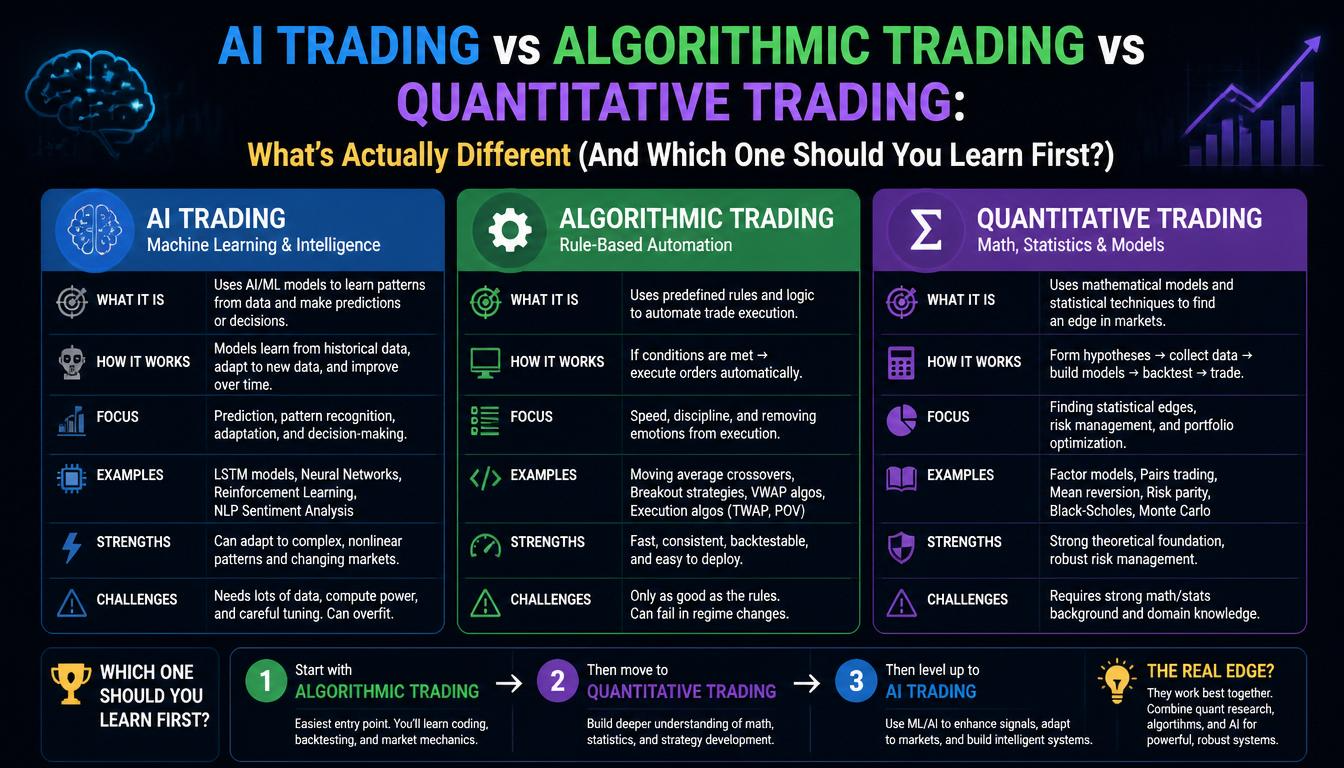
  • AI Trading vs Algorithmic Trading vs Quantitative Trading: What’s Actually Different (And Which One Should You Learn First?)

    AI Trading vs Algorithmic Trading vs Quantitative Trading: What’s Actually Different (And Which One Should You Learn First?)

    Meta description: AI trading, algo trading, and quant trading sound interchangeable but solve different problems. Here’s the clear, practical breakdown — with examples. (157 chars)

    Table of Contents

    1. Why these three terms get confused
    2. Quantitative trading: the “what to trade and why”
    3. Algorithmic trading: the “how to execute it”
    4. AI trading: the “let the model figure it out”
    5. The stack analogy: how the three actually fit together
    6. Side-by-side comparison
    7. Which one should you learn first?
    8. Real-world examples from the top quant firms
    9. Common pitfalls and misconceptions
    10. FAQ
    11. Key takeaways

    Why These Three Terms Get Confused

    If you’ve spent any time on finance Twitter, quant subreddits, or YouTube, you’ve probably seen “quant trading,” “algo trading,” and “AI trading” used as if they’re synonyms. They aren’t — but the confusion is understandable, because the same firm often does all three at once.

    Here’s the headline difference, stated plainly:

    • Quantitative trading is about deciding what to trade, using math and statistics.
    • Algorithmic trading is about executing trades automatically, using pre-defined rules.
    • AI trading is about learning what to trade, using machine learning models that adapt to data.

    They are layers, not competitors. A serious modern trading operation usually combines all three. But conceptually they live in different places, and if you’re trying to break into the field, knowing which one you’re actually studying matters a lot.

    The scale is also worth grounding. Algorithmic execution now dominates modern markets — Coalition Greenwich found that electronic trading platforms captured 44% of buy-side U.S. equities order flow in 2023, with approximately 37% of overall volume executed through algorithms and/or smart order routers. The global algorithmic trading market was estimated at USD 21.06 billion in 2024 and is projected to reach USD 42.99 billion by 2030, growing at a CAGR of 12.9%, with AI and machine learning integration cited as a primary growth driver. So the categories aren’t academic — they’re where the money is. GreenwichGrand View Research

    Let’s go through them one at a time.


    Quantitative Trading: The “What to Trade and Why”

    Quantitative trading (or “quant trading”) is the discipline of using mathematics, statistics, and large datasets to identify trading opportunities. A quant’s job is essentially to find an edge — a statistically significant pattern in market data that can be exploited for profit.

    A quant doesn’t necessarily care about how the trade gets placed. They care about whether the strategy works. Their core questions are:

    • What variables predict future price movement?
    • Is the pattern statistically significant, or is it noise?
    • Does the edge survive out-of-sample testing?
    • What’s the risk-adjusted expected return?

    To get there, quants build mathematical models — often involving regression analysis, time-series econometrics, stochastic calculus, and increasingly machine learning. They lean heavily on programming languages like Python, R, C++, and Java, and on disciplines like probability theory and linear algebra.

    A classic example: a quant model might observe that gold tends to rally after weak U.S. job reports, using 10 years of data to confirm the edge. That insight — derived from data, validated statistically — is the strategy. Whether the resulting trade is then placed manually by a trader or executed by an algorithm is a separate question. Gomoon

    This is why quantitative trading is sometimes called systematic trading: the decisions come from a system, not from intuition.


    Algorithmic Trading: The “How to Execute It”

    Algorithmic trading — also called algo trading or automated trading — is the use of computer programs to execute trades automatically based on pre-defined rules.

    The defining feature of an algo is that it’s deterministic: given the same input, it always produces the same output. The rules are explicit and human-designed. Classic examples include:

    • VWAP/TWAP execution — slicing a large order across the day to match volume-weighted or time-weighted average price
    • Moving-average crossovers — buying when a short-term average crosses above a long-term average
    • Statistical arbitrage pairs trades — buying one asset and shorting a correlated one when their spread diverges
    • Smart order routing — fragmenting an order across multiple exchanges to find the best price

    Algos are about speed, precision, and removing emotion. They don’t decide what to trade in any sophisticated sense — they execute what they’ve been told to execute. As one practitioner notes, algos don’t care if the strategy is complex or simple — they just run the logic with precision. Gomoon

    Importantly, algorithmic trading does not require AI or even particularly advanced statistics. A simple rule like “if RSI < 30, buy 100 shares” is technically an algorithmic strategy. That’s why algo trading is the most accessible of the three for retail traders — platforms like MetaTrader, NinjaTrader, and various crypto bots let you deploy rule-based strategies without a PhD.


    AI Trading: The “Let the Model Figure It Out”

    AI trading is where things get more recent — and more interesting. Instead of writing explicit rules, AI trading uses machine learning models that learn patterns from data.

    The key difference: a traditional algo says, “if X then Y.” An AI model says, “given everything I’ve seen, here’s the probability of Y given X” — and it updates that estimate as it sees more data.

    The techniques sitting under “AI trading” include:

    • Supervised learning — predicting next-day returns, volatility, or direction
    • Deep learning — using neural networks to find non-linear patterns in market and alternative data
    • Reinforcement learning — letting an agent discover trading policies by maximizing reward over time
    • Natural language processing (NLP) — extracting signal from news, earnings transcripts, social media, and SEC filings
    • Computer vision — analyzing satellite imagery, shipping traffic, and parking-lot data

    AI trading also relies heavily on alternative data — non-traditional inputs like credit card transactions, geolocation pings, web-scraped product prices, and sentiment from social platforms. Two Sigma, for instance, feeds vast amounts of data — including news articles, satellite images, and financial reports — into their machine-learning models to make informed predictions. DigitalDefynd

    The trade-off is significant. AI models can capture relationships that no human would think to code — but they’re often opaque (“black box”), prone to overfitting, and harder to debug when they fail. When a traditional algo breaks, you can read the code. When an AI model breaks, you might not know why it stopped working.


    The Stack Analogy: How the Three Actually Fit Together

    Here’s the mental model that ties it all together. Think of trading as a three-layer stack:

    Layer 1 — Strategy (Quantitative): What’s the edge? What pattern, anomaly, or relationship will we exploit? This is where math, statistics, and increasingly ML do their work.

    Layer 2 — Intelligence (AI): How do we discover and refine that edge? Traditional quants might use regression and hand-crafted features. AI-driven quants let models learn the features themselves from larger, messier datasets.

    Layer 3 — Execution (Algorithmic): Once we’ve decided to trade, how do we actually place the orders? This is pure algo trading — order routing, slicing, latency optimization, exchange-side mechanics.

    In practice, a quantitative model generates a trading signal, and an algorithmic system then places the order — splitting it across exchanges, adjusting for liquidity, and managing execution speed. Gomoon

    So when someone says “I want to learn quant trading,” they usually mean Layer 1 (and increasingly Layer 2). When they say “I want to build a trading bot,” they usually mean Layer 3 with a simple Layer 1 strategy bolted on. And when they say “AI trading,” they mean Layer 2 — typically being applied to enhance Layer 1.


    Side-by-Side Comparison

    DimensionQuantitative TradingAlgorithmic TradingAI Trading
    Primary purposeFind the edgeExecute trades efficientlyLearn the edge from data
    Decision logicMath + statistics, rule-basedExplicit, human-coded rulesLearned from data, often opaque
    Skill requirementsStatistics, math, programmingProgramming, market structureML, data engineering, statistics
    AdaptabilityRe-calibrated periodicallyStatic unless rewrittenContinuously learns / retrains
    Common techniquesRegression, factor models, stat arbVWAP, TWAP, smart order routing, MA crossoversDeep learning, RL, NLP, computer vision
    InterpretabilityHighVery highOften low
    Retail accessibilityMediumHighLow-to-medium
    Typical riskModel misspecificationLogic bugs, latencyOverfitting, data leakage, black-box failure

    Which One Should You Learn First?

    If you’re new and trying to figure out where to start, here’s an honest guide:

    Start with algorithmic trading if you want hands-on experience fast. The barrier is low. You can build a moving-average crossover bot on a free platform in a weekend. You’ll learn market mechanics, order types, slippage, and backtesting — all of which you need regardless of where you go next.

    Move into quantitative trading if you want to understand why strategies work. This is where you study statistics, time-series analysis, factor investing, and risk modeling. It’s slower to produce results but builds genuine intuition. Python with libraries like pandas, NumPy, statsmodels, and backtrader is the standard starting toolkit.

    Layer on AI trading once you have a working knowledge of both. AI without quant fundamentals is dangerous — you’ll build models that look great in backtests and fail catastrophically in production. Most overfitting disasters come from people who jumped to machine learning before learning what a stationary time series is.

    A reasonable learning sequence:

    1. Build a simple rule-based algo (e.g. on Python with backtrader or QuantConnect)
    2. Learn proper backtesting, walk-forward validation, and risk metrics
    3. Study factor investing and statistical arbitrage
    4. Add ML carefully — start with linear models, then trees, then deep learning
    5. Explore reinforcement learning and alternative data only after the foundations are solid

    Real-World Examples From the Top Quant Firms

    The biggest names in systematic trading illustrate how these layers blend in practice.

    Renaissance Technologies, founded by mathematician Jim Simons in 1982, is the archetypal quant firm. Its secretive Medallion Fund has earned an estimated annualized return of 35% since 1982. Renaissance famously hires PhDs in mathematics, physics, and signal processing rather than traditional Wall Street traders, and unifies its research under a single integrated model. GitHub

    Two Sigma, founded in 2001 and managing US$70 billion in AUM as of 2025, is the clearest example of AI-driven quant. The firm uses a variety of technological methods, including artificial intelligence, machine learning, and distributed computing, for its trading strategies. Performance has been strong — Two Sigma achieved strong double-digit gains in 2024 using algorithm-driven strategies, with the Spectrum fund returning 10.9% and Absolute Return Enhanced posting 14.3%. Wikipedia + 2

    Citadel sits at the intersection of all three. The firm employs reinforcement learning models to optimize trading strategies, using AI to learn the best policies to maximize returns while minimizing risks, while Citadel Securities — its market-making arm — operates massive algorithmic execution infrastructure for high-frequency trading. Medium

    D.E. Shaw, Jane Street, and Jump Trading round out the top tier, each blending quantitative research with sophisticated algorithmic execution and increasingly AI-driven model development.

    The consistent pattern: every leading firm uses quant strategy + algorithmic execution + AI-driven research as complementary pieces, not competing approaches.


    Common Pitfalls and Misconceptions

    A few mistakes that come up constantly:

    “AI trading is just better algo trading.” No. AI trading is harder to interpret, more data-hungry, and easier to overfit. It’s a different tool with different failure modes. When a rule-based algo fails, you read the rule. When an AI model fails, you might never fully know why.

    “Quant trading guarantees high returns because it’s mathematical.” Math doesn’t beat markets; edges do. Markets adapt, edges decay, and quant strategies can underperform for years. Renaissance is famous because it’s extraordinary — most quant funds don’t post 35% annualized returns.

    “I need a PhD to do any of this.” For top hedge funds, often yes. For learning the craft and trading retail capital, no. The mathematics gets deep quickly, but the entry point doesn’t require it.

    “More data and a fancier model will fix my backtest.” Almost never. Most retail-built strategies fail because of look-ahead bias, survivorship bias, or overfitting — not because the model wasn’t deep enough.


    FAQ

    Is AI trading a subset of algorithmic trading? Technically yes — any automated trade is algorithmic — but conceptually it’s useful to keep them separate. Algo trading typically refers to deterministic rule-based execution; AI trading refers to learned, adaptive decision-making. The mechanism is automated in both cases, but the source of the decisions is fundamentally different.

    Can a retail trader realistically do AI trading? You can experiment with it, but compete with institutional AI? Not really. The biggest funds spend billions on data, infrastructure, and talent. Retail AI trading is best treated as a learning exercise or a way to enhance personal strategies — not a path to consistent alpha against firms like Two Sigma.

    What’s the difference between quantitative trading and high-frequency trading (HFT)? HFT is a subset of algorithmic trading focused on extremely fast execution — milliseconds or microseconds — usually exploiting tiny, short-lived price inefficiencies. Quant trading is broader and includes strategies that hold positions for weeks or months. Many quant firms do HFT, but most quant trading isn’t HFT.

    Do I need to know C++ to do this? Only if you’re going into HFT or ultra-low-latency execution at a major firm. For most quant and AI trading, Python is the dominant language, with R as a secondary option.

    Which is most profitable for an individual? Honestly, none of them are reliably profitable for individuals without significant work. The most realistic path for a retail trader is a simple, well-tested rule-based algo strategy applied to a market they understand deeply. AI trading at retail scale is mostly aspirational.

    Is algo trading legal? Yes, in nearly all major markets, though heavily regulated. The SEC, FINRA, ESMA, and other regulators have specific rules around market manipulation, order-to-trade ratios, and systemic risk for algorithmic and high-frequency strategies.


    Key Takeaways

    • Quantitative trading is about identifying statistically valid trading edges using math and data.
    • Algorithmic trading is about executing trades automatically using pre-defined rules.
    • AI trading is about using machine learning to discover and adapt strategies that traditional rule-based approaches would miss.
    • They’re complementary layers, not alternatives. The top firms — Renaissance, Two Sigma, Citadel, D.E. Shaw — use all three.
    • For a beginner, start with rule-based algo trading, build statistical foundations through quant work, and add AI techniques only after the basics are solid.
    • Algorithmic execution dominates modern markets, accounting for an estimated 60–75% of U.S. equity trading volume, and the AI-driven slice of that share is growing fastest.

    The terms will keep getting used loosely. But now, when someone tells you they’re “doing AI trading,” you’ll know exactly which layer of the stack they’re actually working on — and which questions to ask next.


    Want me to adapt this into a different format (Word doc, Medium post, LinkedIn article) or write a follow-up piece on a specific sub-topic — e.g., “How to actually build your first quant strategy in Python” or “Why most AI trading backtests are lying to you”?
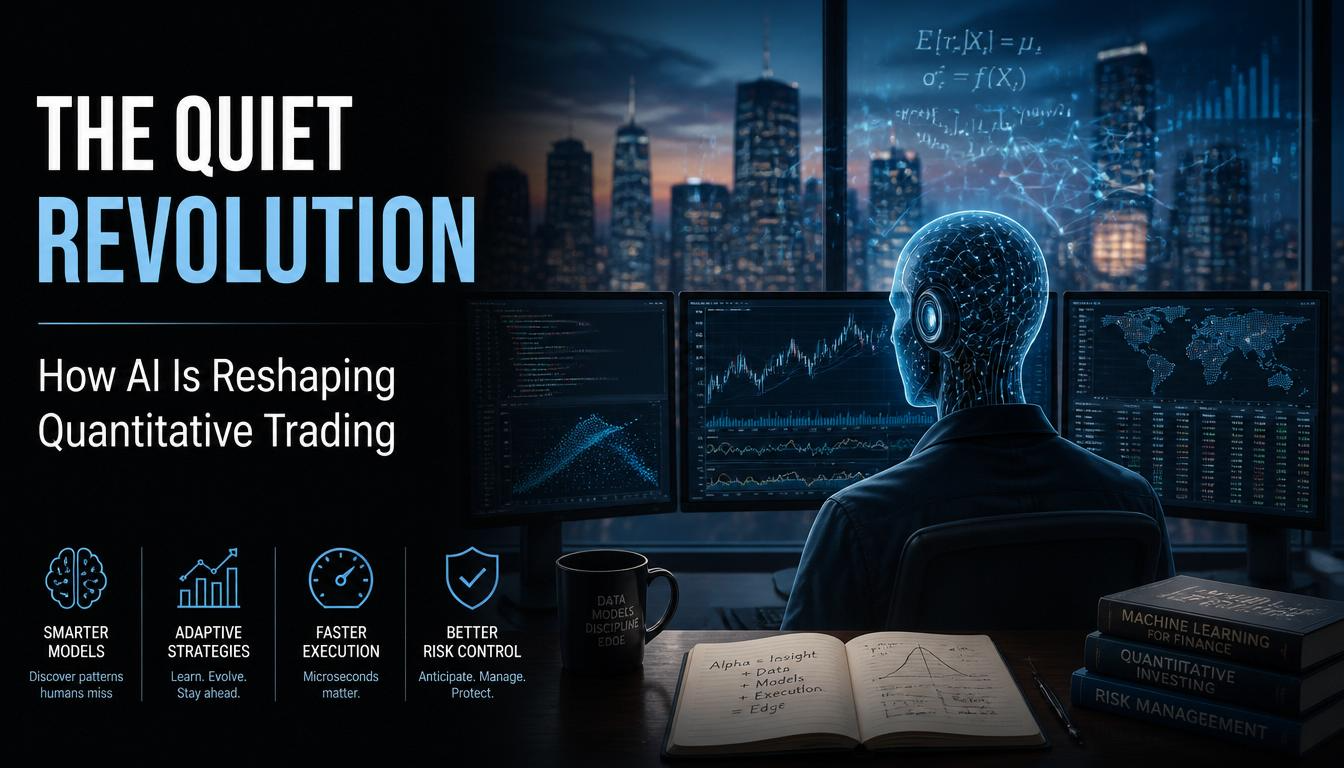
  • The Quiet Revolution: How AI Is Reshaping Quantitative Trading

    The Quiet Revolution: How AI Is Reshaping Quantitative Trading

    In the spring of 2024, a Bank of England survey returned a number that would have been unthinkable a decade earlier: 75% of financial firms now deploy some form of AI in their operations, and among large banks, insurers, and asset managers, the figure hits 100%. The quantitative trading world, long defined by mathematicians in quiet rooms building factor models and running regressions, has crossed a threshold. What began as rule-based automation — if the 50-day moving average crosses the 200-day, buy — has become something far more fluid: systems that learn, adapt, and form convictions from data no human analyst could ever process.

    This is not a story about machines replacing human traders. It is a story about what happens when the tools of modern artificial intelligence — deep neural networks, reinforcement learning, large language models — meet a domain that has always been, at its core, a signal extraction problem. Financial markets generate an ocean of data every second. Prices, volumes, order-book microstructure, news headlines, earnings call transcripts, satellite images of parking lots, shipping-container counts at ports. The question has always been: what matters? AI is fundamentally changing which signals get found, how portfolios get built, and what it means to have an edge.

    From Linear Regression to Neural Architecture

    Classical quantitative finance was built on a foundation of linear models and econometric assumptions. Factor investing — the idea that stocks can be explained by exposure to a handful of systematic drivers like momentum, value, size, and quality — powered decades of hedge fund returns. The models were interpretable, their assumptions well-understood, and their limitations well-known: they could not capture nonlinear relationships, regime changes, or the kind of complex interaction effects that real markets exhibit.

    Machine learning changed the terms of engagement. Where a linear regression sees a straight line, a gradient-boosted tree sees branching decision boundaries. A neural network sees layered representations. The shift is not merely about accuracy — it is about modeling the world as it actually behaves: nonlinear, path-dependent, and governed by feedback loops that econometrics was never designed to handle.

    Consider the limit order book, the real-time record of every bid and ask sitting at every price level in an exchange. A single liquid stock might generate millions of order-book events in a day — cancellations, amendments, executions — each encoding micro-information about the intentions of market participants. A human trader cannot read this firehose. A deep learning model can. Recent research has applied transformer architectures and state-space models to order-book data, treating the stream of messages as a sequence-modeling problem not unlike natural language. The model learns the grammar of market microstructure: which patterns of order flow precede price moves, which configurations signal the presence of an informed trader, which cancellations are genuine and which are spoofing.

    The results are striking. Research published in 2025 demonstrated that LSTM-based neural networks applied to cryptocurrency portfolios achieved a Sharpe ratio of 2.975 with a profit percentage of 94.86% in backtesting — numbers that would make any portfolio manager sit up. A Sharpe ratio above 1.0 is generally considered good; above 2.0 is excellent; approaching 3.0 is the territory where systematic strategies begin to look almost too good to be true. Whether such performance survives the transition from backtest to live trading is an open question — and a deeply contested one — but the direction of travel is unmistakable.

    Reinforcement Learning and the Quest for Adaptive Strategy

    If supervised learning is about recognizing patterns in historical data, reinforcement learning is about learning to act in an environment where every action changes the state of the world. That makes it a natural fit for trading, where placing an order moves the market, taking profit alters the portfolio, and the optimal action at any moment depends on what you have already done and what the market has already absorbed.

    Reinforcement learning agents learn by trial and error in simulated environments, receiving rewards for profitable actions and penalties for losses. Over millions of simulated trading days, they develop policies — mappings from market states to actions — that no human designed and no static rule book could encode. The most advanced implementations use actor-critic architectures, where one network (the actor) proposes trades and another (the critic) evaluates them, both improving together through experience.

    The approach has found particularly fertile ground in derivatives hedging. The classic Black-Scholes framework gives a clean, closed-form answer for how to hedge an option: delta-hedge continuously, rebalancing as the underlying moves. But reality intrudes. Transaction costs eat into returns. Markets gap. Volatility is not constant. Deep distributional reinforcement learning models, such as D4PG with quantile regression, have been deployed by quantitative hedge funds to learn hedging policies that directly optimize risk-adjusted returns under real-world frictions, measuring Value-at-Risk and Conditional Value-at-Risk across different volatility regimes. These models do not merely approximate the theoretical hedge — they discover strategies that a human options trader might recognize as experience-hardened intuition, but backed by statistical rigor the trader could never articulate.

    Portfolio management, too, is being reimagined through reinforcement learning. Traditional mean-variance optimization asks: given expected returns and a covariance matrix, what is the optimal allocation? A reinforcement learning agent asks a more fundamental question: given a stream of market data and a goal, what sequence of trades maximizes terminal wealth while respecting risk constraints? Multi-agent frameworks take this further, assigning separate learning agents to different asset classes or sectors and letting them coordinate — or compete — toward a shared portfolio objective. The result is a system that can shift allocations not according to a fixed rebalancing schedule but in response to the texture of the market itself.

    The Language of Markets: LLMs and Sentiment at Scale

    For most of quantitative finance’s history, the information that moved markets was divided into two categories. Hard data — prices, volumes, economic statistics — could be modeled mathematically. Soft data — Fed chair speeches, earnings call nuance, geopolitical tension, the tone of a CEO’s shareholder letter — belonged to the domain of human judgment. Quantitative traders got prices and fundamentals; discretionary traders got narrative and sentiment. The wall between them was high.

    Large language models have started to dismantle it. The same architectures that power ChatGPT and Claude — transformer models trained on vast corpora of text — can be fine-tuned on financial language and deployed to read the textual universe that human analysts struggle to keep up with. Every earnings call transcript, every SEC filing, every Federal Reserve statement, every news article from every wire service, every post on financial social media — the volume is staggering, and it is all rich with signal for a model that can parse it.

    FinBERT, a BERT model fine-tuned specifically on financial text, was an early milestone. More recently, models like FinGPT have added dissemination-awareness and context-enrichment, understanding not just what a news item says but how it is spreading through information networks and what it means in the context of the company’s recent history. A 2025 benchmark study comparing LLMs against classical sentiment analysis approaches found that the large language models outperformed in the vast majority of cases — not marginally, but decisively.

    The frontier is moving beyond simple sentiment classification — positive, negative, neutral — toward something more subtle. Modern systems extract structured signals from unstructured text: the probability that a central bank will hike rates, inferred from the linguistic patterns in speeches; the degree of uncertainty in a management team’s forward guidance, measured by the ratio of hedging language to declarative statements; the implied correlation between two companies based on the co-occurrence patterns in analyst reports. These are signals that existed before but could not be systematically harvested. LLMs are turning soft data into hard data at industrial scale.

    The architecture for deploying these models is evolving rapidly. Quantized versions of large language models — QF-LLM and similar approaches — reduce the memory footprint and inference cost to the point where real-time sentiment monitoring becomes practical even for smaller funds. Retrieval-Augmented Generation, or RAG, lets systems ground their analysis in up-to-date financial databases rather than relying on training data that may be months old. Multi-LLM ensemble approaches, like FinSentLLM, combine the judgments of several models to produce sentiment forecasts more robust than any single model could deliver.

    The Alternative Data Revolution

    The public-market data that everyone can see — price, volume, fundamentals — has been arbitraged to near-death. The edges that remain lie in data that is public in principle but difficult to process at scale, or data that was never traditionally considered financial information at all.

    Satellite imagery of retail parking lots, analyzed by computer vision models, can estimate foot traffic at major chains before quarterly earnings are released. Natural language processing of shipping manifests and port congestion data can anticipate supply-chain disruptions that will show up in earnings three months later. Geolocation data from mobile phones can track consumer behavior patterns with a granularity that official statistics cannot match. Credit card transaction panels, web scraping of product prices, social media sentiment aggregated across millions of posts — each of these is a dataset that, properly cleaned and modeled, can generate alpha.

    The technical challenge is immense. Alternative datasets are messy, biased, irregularly sampled, and often enormous. A single satellite imagery provider might generate terabytes of new images daily. The skill is not in having the data — it is in engineering the pipeline that ingests it, cleans it, extracts features from it, and connects those features to financial outcomes without overfitting. This is where modern AI toolchains shine: convolutional neural networks for image data, transformer architectures for text, graph neural networks for supply-chain relationships, all orchestrated through cloud infrastructure that can scale to the data’s size.

    The modern quantitative trading system might incorporate over 200 factors spanning momentum, value, quality, market microstructure, sentiment, and alternative data — each one a hypothesis about what predicts returns, each one requiring rigorous statistical validation, and each one competing for a place in a portfolio that must balance signal decay against transaction costs. Feature engineering — the art and science of transforming raw data into predictive inputs — remains critical even in the age of deep learning. The best systems combine both: automatically learned representations from neural networks alongside hand-crafted features that encode domain knowledge about how markets work.

    High-Frequency Trading and the Speed Frontier

    No discussion of AI in quantitative trading is complete without confronting high-frequency trading, or HFT — the domain where speed itself is the strategy. As of 2026, HFT accounts for approximately 72% to 78% of all US equity trading volume. The trades are held for microseconds to milliseconds. The edge is not in predicting where a stock will be in a week; it is in being the first to react to an order-flow imbalance, an exchange-route latency differential, or a cross-asset correlation breakdown.

    AI’s role in HFT is constrained by a hard physical limit: inference time. A deep neural network that takes 10 milliseconds to produce a prediction is useless in a world where the competition is making decisions in 800 nanoseconds. The AI models used in HFT are necessarily small, specialized, and often implemented directly in hardware — FPGAs running lightweight gradient-boosted trees or compact fully-connected networks, optimized to the level of individual logic gates. The heavy lifting of model development happens offline, in simulation, where deep learning can explore the space of possible strategies; what gets deployed to the live trading path is a distilled, hardened version stripped of everything that costs a microsecond.

    This hardware-software co-design is one of the least visible but most expensive frontiers in quantitative finance. A top-tier HFT firm might spend tens of millions of dollars on microwave towers, custom FPGA boards, and the engineering talent to program them — all for an advantage measured in nanoseconds. AI is not separate from this arms race; it is the brains, and the hardware is the body.

    The Problem That Won’t Go Away: Overfitting and Decay

    Every quantitative researcher learns the same lesson eventually, usually the hard way: a backtest is a story you tell yourself about what might have happened, not a guarantee of what will happen. AI amplifies both the promise and the peril. A neural network with millions of parameters, trained on terabytes of data and optimized across thousands of hyperparameter combinations, can find patterns that are statistically significant in the training set and completely meaningless out of sample. The financial literature is littered with papers reporting spectacular Sharpe ratios that vanish the moment the strategy goes live.

    The problem is structural. Financial data is not like ImageNet. The data-generating process is non-stationary: the statistical properties of markets change over time as participants adapt, regulations shift, and macroeconomic regimes transition. A model trained on the low-volatility bull market of 2012–2019 may be catastrophically wrong in the volatile, rate-driven market of 2022–2023. The market is the ultimate adversarial environment, because every profitable strategy, once discovered and deployed, changes the very patterns it was designed to exploit. The strategy becomes part of the market, and the market adapts.

    The best quant funds treat model decay as a first-order concern, not an afterthought. They monitor performance degradation continuously, retrain on rolling windows, maintain ensembles of models trained on different regimes, and build kill-switches that deactivate strategies when their signal quality drops below a threshold. They treat models as perishable goods, not durable assets — a mindset fundamentally different from the “train once, deploy forever” approach that works in other AI domains.

    Regulation and the Black Box Problem

    When a linear regression says a stock should go up because it is cheap relative to its peers, a regulator can understand the reasoning. When a deep neural network with 50 million parameters produces the same conclusion, the reasoning is impenetrable — even to the people who built it. This is the black box problem, and it is attracting increasingly serious regulatory attention.

    The Bank for International Settlements highlighted AI’s dual nature in financial stability — “tremendous opportunity, serious risk” — in its June 2025 financial stability report. The concern is not merely about individual firms losing money on bad models. It is about systemic risk: the possibility that dozens of independently developed AI trading systems, trained on similar data and optimized for similar objectives, might all converge on the same behavior at the same moment — herding into the same positions, fleeing the same assets in a stress event, amplifying rather than dampening market dislocations.

    The regulatory response is still taking shape, but the direction is clear. Explainability requirements are likely to tighten. Model risk management frameworks, already standard at large banks, will need to evolve to accommodate non-linear, non-interpretable models. Stress testing may need to account for the possibility that AI agents, not human panic, could be the transmission mechanism for the next flash crash.

    This is not an argument against AI in trading. It is an argument that AI in trading is now systemically important, and systemically important things get regulated. The firms that thrive will be those that build not just the most accurate models, but the most robust ones — models that can explain themselves, models that degrade gracefully under stress, models embedded in governance structures that satisfy both regulators and internal risk committees.

    The Shifting Competitive Landscape

    One of the quieter transformations AI has brought to quantitative trading is who gets to play. A decade ago, building a systematic trading operation required hiring PhDs in physics and mathematics, leasing server rooms, and negotiating expensive data-feed contracts with exchanges. The barrier to entry was high enough that only well-capitalized hedge funds and bank desks could compete.

    That barrier is crumbling. Cloud computing puts institutional-grade infrastructure within reach of a small team. Open-source machine learning frameworks — PyTorch, TensorFlow, scikit-learn — are free and world-class. Alternative data vendors sell curated datasets to anyone with a subscription budget. Pre-trained language models can be fine-tuned on a single GPU. The result is a Cambrian explosion of small quantitative funds, many of them running AI-native strategies from the start rather than bolting machine learning onto a traditional factor-investing chassis.

    This democratization is not without tension. The largest firms still have advantages that are hard to replicate: proprietary datasets that no vendor sells, the ability to co-locate servers inside exchange data centers, teams of dozens of researchers attacking the same problem from different angles, and the capital to survive drawdowns that would wipe out a smaller competitor. But the gap is narrower than it has ever been, and it continues to narrow. The edge is shifting from who has the most data to who uses it most intelligently — and intelligence, in the age of open-source AI, is more evenly distributed than capital.

    What Comes Next

    The pace of change in AI makes prediction hazardous, but several trajectories are already visible.

    Multi-agent systems, where specialized AI agents handle different aspects of the trading problem — one for signal generation, another for execution, a third for risk management — and coordinate through structured communication, are moving from research papers to production. The vision is a trading desk where the strategist, the trader, and the risk manager are all AI agents, overseen by a human who intervenes only when the system flags an anomaly or a regime change.

    Generative AI is entering the quant workflow itself. Researchers are using large language models not just to analyze market sentiment but to generate hypotheses, write code for backtesting, and summarize research literature. A quant might describe a trading idea in natural language and have an LLM translate it into a Python backtesting script, run it against historical data, and produce a summary of the results — all in minutes rather than days. This collapses the cycle time from idea to test, which in quantitative finance is the fundamental unit of research productivity.

    Quantum computing for portfolio optimization remains experimental as of 2026, but the theoretical case is compelling. Constrained portfolio optimization — the problem of selecting the best combination of thousands of assets subject to risk, turnover, and exposure constraints — is computationally hard in ways that map naturally to quantum circuits. If and when practical quantum advantage arrives for this class of problem, the consequences for portfolio construction could be transformative. The prudent assumption, for now, is that quantum is a decade away but worth watching closely.

    The most important trend may be the one that gets the least attention: AI is making quantitative trading less purely quantitative. The old caricature of the quant as someone who believes only in numbers — who dismisses narrative, sentiment, and qualitative judgment as noise — is becoming obsolete. The new quant is someone who builds systems that integrate all available information, structured and unstructured, numerical and textual, historical and real-time, into a single coherent view of the market. AI is not replacing human judgment; it is expanding what judgment can be based on.

    The Edge That Endures

    Markets evolve. Models decay. Technology advances. The quantitative traders who thrive in 2026 will not be running the same strategies in 2027. The edge that endures is not any particular model or dataset — it is the capacity to keep learning, to adapt the research pipeline as the tools improve, to ask better questions as the answers to the old ones get priced in.

    What makes this moment different from previous waves of technological change in finance is the rate of improvement in the tools themselves. The AI models available to a quant today are qualitatively more capable than those available two years ago, and the models that will be available in two years will make today’s look primitive. A trading operation that treats AI as a static toolkit — something you install and use — will find itself behind within a quarter. An operation that treats AI as a moving frontier — something you continuously integrate, experiment with, and push against — has a chance.

    That is the quiet revolution. Not that AI can trade — that part is already settled. But that AI is changing what it means to be a quantitative trader, and the change is just getting started.

  • The AI Funding Machine: Why $255 Billion in a Quarter Should Make You Nervous, Not Excited

    Here’s a number that stopped me cold.

    In Q1 of 2026, AI startups raised $255.5 billion globally. That’s not a typo. A quarter trillion dollars. In three months. And here’s the thing — that single quarter blew past the entire 2025 full-year total for AI venture funding.

    I’ve been tracking startup funding for years and I’ve never seen anything like it. Not during the dot-com era. Not during the mobile app gold rush. Not during the crypto boom. The scale of capital moving into AI right now is genuinely unprecedented, and if you’re not paying close attention to where it’s going — and more importantly, where it isn’t — you’re missing the actual story.

    So let’s talk about it. Not the press release version. The uncomfortable one.

    Three Companies, Two-Thirds of Everything

    PitchBook dropped a report a few days ago that should honestly be required reading for anyone in this industry. Of that $255.5 billion in Q1, three companies — OpenAI, Anthropic, and xAI — accounted for $172 billion. That’s 67.3% of all AI venture capital.

    Let that sit for a second.

    The remaining $83.5 billion got split across 1,543 other companies. Quick math: that’s about $54 million per company on average. But averages lie, and they lie hard here. The median AI VC deal size in 2025 was $5 million. The mean was $35.8 million. The gap between those two numbers tells you everything about how concentrated this market has become. A tiny handful of deals at the top are yanking the averages up while most AI startups are raising perfectly normal, unremarkable rounds.

    And it’s getting worse, not better. Foundational AI companies — the ones building the actual models — raised $178 billion in Q1 2026 across just 24 deals. Twenty-four. In all of 2025, that category did $88.9 billion across 66 deals. The number of companies getting funded at this level is shrinking while the check sizes are exploding.

    There’s a word for this dynamic and it’s not “healthy ecosystem.”

    Here it is, in case you want to stare at the numbers directly:

    SegmentCompaniesFunding (Q1 2026)Share
    The Big Three — OpenAI, Anthropic, xAI3$172 billion67.3%
    Everyone else1,543$83.5 billion32.7%
    Total1,546$255.5 billion100%

    Three companies. Two-thirds of the money. The “everyone else” bucket works out to roughly $54 million per company on average — but remember, the median deal was $5 million. Most of those 1,543 companies raised far less than the average suggests.

    Follow the Money (It’s Not VC Anymore)

    One of the weirder subplots that doesn’t get enough attention: venture capital isn’t really driving this anymore.

    Corporate venture capital now represents 43% of AI startup funding. Sovereign wealth funds are piling in. Microsoft, Amazon, Google, NVIDIA — they’re not writing checks because they want 10x returns on a Series B. They’re writing checks because they need to lock down compute agreements, secure cloud revenue, and make sure they don’t get left behind in a platform shift that could eat their existing businesses.

    When Microsoft disclosed that 45% of its $625 billion cloud backlog was tied to OpenAI, the stock dropped 12% in a single day. That’s $440 billion in market cap. Evaporated. Because investors suddenly realized that a huge chunk of Microsoft’s future revenue depends on a company that burns $17 billion a year and doesn’t expect to turn a profit until 2030.

    That’s not a venture capital relationship. That’s a dependency. And it’s not limited to Microsoft.

    The “investment” flowing into these companies is increasingly circular. Microsoft invests in OpenAI, which spends the money on Azure compute, which shows up as Microsoft cloud revenue, which justifies the investment. Amazon invests in Anthropic, Anthropic buys AWS compute, Amazon reports cloud growth. Around and around it goes. Everyone’s revenue is someone else’s cost. It works brilliantly until someone decides the music stopped.

    The Unit Economics Are Brutal

    Let’s look at OpenAI, since they’re the biggest and most transparently messy.

    They’re targeting about $30 billion in revenue for 2026. That sounds impressive — and it is, in absolute terms. But they’re burning roughly $17 billion to get there. Their own internal projections show losses tripling to $14 billion this year against roughly $13 billion in sales, with total spending around $22 billion. They lost $13.5 billion in just the first half of 2025.

    Every dollar of revenue costs them more than a dollar to generate. The cumulative burn from 2025 through 2029? An estimated $115 billion.

    Let me put OpenAI’s numbers in one place, because seeing them side by side makes the absurdity harder to ignore:

    Metric20252026 (Projected)
    RevenueNot disclosed~$30B
    Net Loss$13.5B (H1 only)~$14B
    Cash Burn~$17B
    Total Spending~$22B
    Valuation$300B (Mar round)~$850B (Mar round)
    Forward Revenue Multiple~28x

    They’re valued at roughly $850 billion as of their March 2026 round. At $30 billion in projected revenue, that’s somewhere around 28x forward revenue. For a company with negative gross margins. In what universe is that sustainable?

    Anthropic is doing better on the surface — they surprised everyone by hitting a $30 billion annualized run-rate earlier this year. But they’re also burning cash at a pace that makes traditional SaaS investors queasy, and their valuation sits around $380 billion. The model providers are in an arms race where the cost of competing goes up faster than the revenue does. Every new model generation requires more compute, more data, more infrastructure, and the pricing pressure from open-source alternatives and Chinese competitors means you can’t just pass those costs to customers.

    A quick side-by-side puts the two Western leaders in perspective:

    MetricOpenAIAnthropic
    Valuation~$850B~$380B
    2026 Revenue (projected)~$30B$30B annualized run-rate
    2026 Cash Burn~$17BNot disclosed
    Path to Profitability2029 targetNot disclosed
    Key Strategic BackerMicrosoftAmazon
    Revenue Multiple~28x forward~12.7x (on run-rate)

    Anthropic’s multiple looks almost reasonable by comparison. Almost. Neither company has demonstrated that selling intelligence at scale produces software-like margins rather than infrastructure-like ones.

    And then there’s DeepSeek. In February 2026, they launched V4 — a trillion-parameter coding model with a million-token context window. Built at a fraction of the cost of Western frontier models. If Chinese labs can produce competitive AI without burning through $17 billion a year, the entire “scale is the moat” thesis falls apart. You don’t need a fancy financial model to see the problem there.

    What About Everyone Else?

    The non-foundational-model startups — the application layer, the vertical SaaS plays, the tooling companies — are living in a completely different reality from the handful of giants at the top.

    They’re raising at perfectly normal multiples. The AI startup valuation range in 2026 is wide — 10x to 50x revenue, with the median landing somewhere around 20x to 30x. But those multiples come with strings attached. Investors are asking harder questions than they were two years ago. What’s your moat, really? What happens when the model providers ship a feature that does 80% of what your product does? How defensible is your data advantage?

    The application-layer AI companies that are actually doing well tend to have one thing in common: they’re not just thin wrappers around someone else’s API. They own a workflow. They have proprietary data. They solve a problem that’s too specific, too regulated, or too operationally complex for a horizontal model provider to bother with. Everything else is walking dead — it just doesn’t know it yet.

    And early-stage funding? It’s getting squeezed. Only 14% of AI mega-deals in 2025 were early-stage. The money is flowing to the companies that already raised billions, not to the ones trying to raise their first million. That’s a problem for the ecosystem long-term, even if nobody wants to talk about it while the party’s still going.

    Is This a Bubble?

    I get asked this constantly. And the honest answer is: it depends on what you mean by “bubble.”

    If you mean “are AI company valuations completely unhinged from economic reality?” — yes, absolutely. The S&P 500 is trading at 23x forward earnings, the most stretched it’s been since the dot-com era. The Bank of England formally warned about overvaluation risks in the AI sector. A National Bureau of Economic Research study found that 90% of firms report no measurable productivity impact from AI yet — but executives project it will increase productivity by 1.4%. That gap between expectation and reality is exactly the kind of thing that precedes a correction.

    US mega-caps are expected to spend $1.1 trillion on AI between 2026 and 2029. Total AI spending is expected to surpass $1.6 trillion. Those are staggering numbers, and they assume a level of return that nobody has demonstrated yet.

    But here’s the counterargument, and it’s not nothing: the dot-com comparison misses something important. In 2000, most of the money went into companies with no revenue, no infrastructure, and no real technology moat. Pets.com sold dog food online. Today’s AI giants are building actual infrastructure — data centers, custom silicon, model architectures that take years to develop. You can correct the valuation of a software company overnight. You can’t wish a $15 billion data center out of existence. The physical assets create a floor that the dot-com era never had.

    What we’re probably heading for isn’t a pop. It’s a slow, grinding correction. The absurd valuations will come down. The “we put a chatbot on it” companies will disappear. The conversation will get more boring and more useful. That’s actually healthy.

    The risk isn’t that AI fails. The risk is that the returns don’t justify the $1.6 trillion price tag. And that’s a much more interesting problem to think about.

    What This Means If You’re Building

    I’ll keep this practical because that’s what actually matters.

    If you’re raising at the application layer, you need to be able to answer one question cold: what happens when OpenAI or Anthropic ships your feature? If your answer is “they won’t” or “our data moat is too deep,” you’d better have receipts. The model providers are not sitting still. They’re vacuuming up talent, acquiring companies, and expanding into enterprise workflows. Complacency is a death sentence.

    If you’re an early-stage founder, the funding environment is probably tighter than the headline numbers suggest. Yes, $255 billion moved in Q1. Almost none of it went to pre-seed or seed-stage AI companies. You’re competing for attention in a market where the mega-rounds suck up all the oxygen. That means you need to be capital-efficient by default, not by aspiration. The burn multiple — how much you spend for every dollar of new recurring revenue — has become the investor metric of choice in 2026. AI-native startups that use automation to keep burn multiples below 1.0x are getting funded. Everyone else is fighting uphill.

    And here’s something nobody in Silicon Valley wants to admit out loud: 29% of startups fail because they run out of money. Not because the product was bad. Not because the market wasn’t there. They just ran out of cash. In an environment where capital is concentrating at the top, that number goes up. If you’re building, know your runway down to the week. Twelve to eighteen months is comfortable. Anything under six is emergency mode.

    The brutal truth about AI funding in 2026: there’s more money in the system than ever before, and it’s never been harder to get your hands on it unless you’re already one of the chosen few. The concentration at the top masks how competitive things are for everyone else. And the unit economics at the top suggest that even the chosen few haven’t figured out how to make the math work.

    That’s not a reason to be bearish on AI. The technology is real, the adoption is real, and the long-term trajectory is up and to the right. But the funding environment has gotten weird in ways that reward skepticism. The people who win in markets like this are the ones who can tell the difference between a genuine growth story and a money-go-round — and who have the discipline to build something that works even when the easy money dries up.