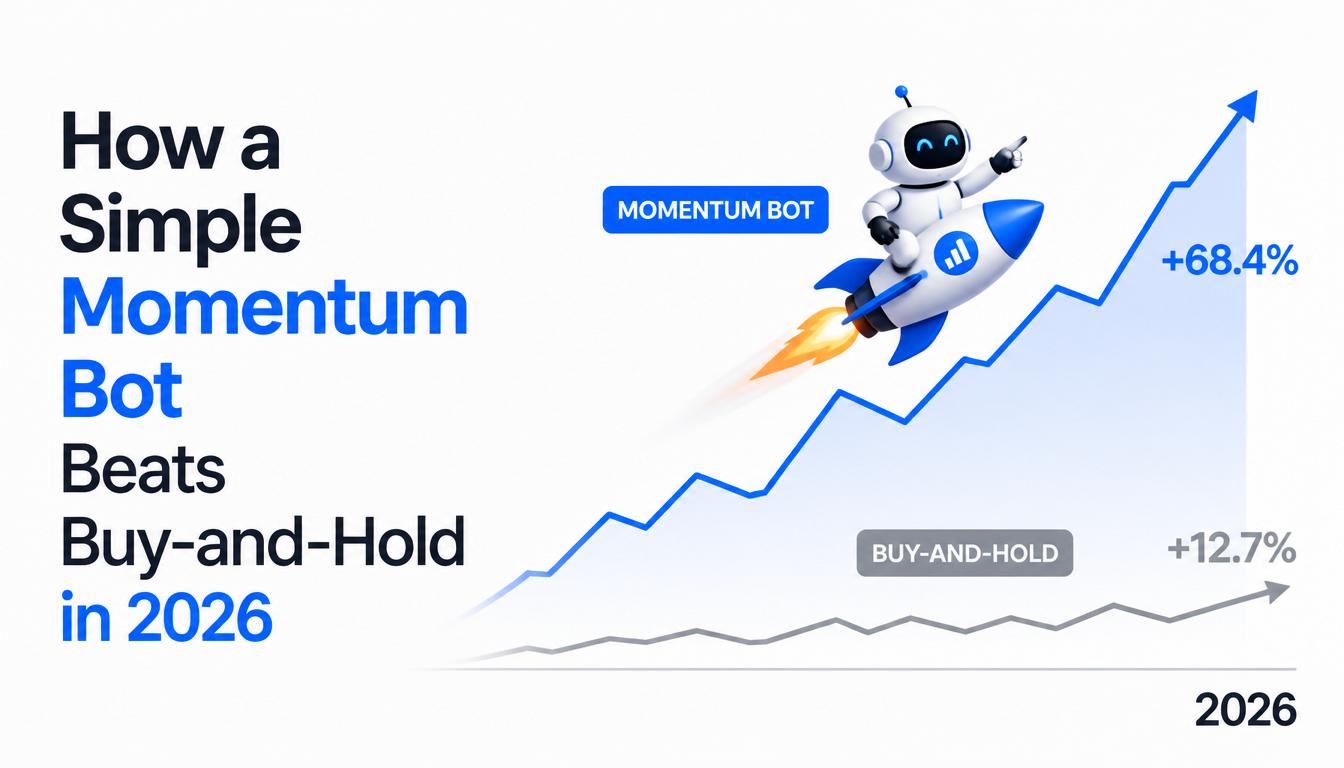
Buy-and-hold is the strategy everyone defends and few actually survive. It works beautifully on a chart — until a 40% drawdown arrives and you sell at the bottom like everyone else. A simple momentum bot offers a different deal: similar long-run returns, but with a fraction of the gut-wrenching pain. That trade is the real reason momentum has endured for decades, and it’s why a modest bot can quietly outperform the “just hold” crowd where it counts.
Notice the careful wording. A momentum bot doesn’t always print more raw profit than buy-and-hold. What it does is win on risk — and once you understand that distinction, the appeal becomes obvious.
What this guide covers
- The core idea: ride strength, cut weakness
- How a simple momentum bot works
- What the backtests actually show
- Why the real edge is risk, not return
- Where a momentum bot shines and stalls
- Tuning the lookback period
- Momentum bot vs mean reversion
- Momentum through a crash: a worked illustration
- Building your first momentum bot
- The honest caveats
- FAQ
- Key takeaways
The core idea: ride strength, cut weakness
Momentum trading rests on one stubborn market observation: things that have been going up tend to keep going up for a while, and things falling tend to keep falling. You buy strength and you sell weakness, riding a move until it fades.
Buy-and-hold ignores this entirely. It owns the asset through every storm, accepting the full drawdown in exchange for never missing the recovery. A momentum bot instead steps aside when the trend turns down, sitting in cash through the worst declines and stepping back in when strength returns. Same asset, very different ride.

How a simple momentum bot works
The beauty of a momentum bot is that the rules fit on an index card. A classic version uses a single moving average:
- Entry: when the price closes above its 200-day moving average, buy.
- Exit: when the price closes below the 200-day moving average, sell and hold cash.
- Repeat: let the rule decide, every day, with no opinions.
That’s it. When the asset is in an uptrend, the bot is invested. When it breaks down, the bot is out. There’s no forecasting, no news-reading, no emotion — exactly the qualities that make momentum a natural fit for automation. As QuantifiedStrategies documents, even these bare-bones rules produce a coherent, testable strategy.
What the backtests actually show
Here’s where honesty matters, because the marketing usually skips it.
In realistic backtests, a simple momentum strategy often keeps almost even with buy-and-hold on raw return. One representative test showed momentum producing a 7.2% CAGR versus buy-and-hold’s 7.9% — slightly behind on the headline number. If you only look at total return, buy-and-hold edges it out.
But that momentum strategy achieved its result while spending only about 65% of the time in the market. For a third of the period, it sat safely in cash, exposed to nothing. That single fact reframes the whole comparison — and it’s the key to why a momentum bot can still be the smarter choice.
Why the real edge is risk, not return
Returns tell you what you earned. Risk tells you whether you could stomach the journey to earn it. This is where momentum wins decisively.
Because the bot exits during downtrends, it sidesteps the deepest crashes. That produces lower maximum drawdowns and higher risk-adjusted returns than buy-and-hold, even when the raw CAGR is a touch lower. A strategy that returns slightly less but never puts you through a 50% loss is, for most real humans, the better strategy — because you’ll actually stick with it.
Buy-and-hold’s hidden failure isn’t its math. It’s that few investors hold through the pain. A momentum bot enforces the discipline that humans lack, capping the drawdown that makes people capitulate at the worst possible moment. That behavioral edge is worth more than a fraction of a percent in CAGR.
Where a momentum bot shines and stalls
Momentum is not magic, and matching it to the right conditions matters.
It shines when:
- Markets trend persistently, up or down, giving the bot clean signals to follow.
- You care about drawdown control as much as raw return.
- You want a hands-off, rules-based system you can actually trust through a crash.
It stalls when:
- Markets chop sideways, whipsawing the bot in and out for small losses (a “death by a thousand cuts” that a grid strategy would actually enjoy).
- Trends reverse sharply, since a lagging moving average always exits a step late.
No single strategy wins everywhere. Momentum trades a little choppy-market friction for major crash protection — usually a deal worth taking.
Tuning the lookback period
The single biggest dial on a momentum bot is the lookback period — how far back the moving average reaches. It quietly decides the bot’s entire personality.
A short lookback (say a 50-day average) reacts fast. The bot catches new trends early and exits declines quickly, but it pays for that speed with frequent whipsaws in choppy markets — lots of small in-and-out losses. A long lookback (200 days or more) reacts slowly. It ignores short-term noise and stays in major trends longer, but it gives back more profit at every turn because it always exits late.
There is no universally “correct” number. The 200-day average is popular precisely because it’s slow enough to filter noise while still dodging the worst crashes. The honest danger here is optimization: testing dozens of lookbacks and picking whichever scored best on past data. That’s curve-fitting, and it rarely survives live. Pick a sensible, round number for a defensible reason, and resist the urge to tune it to perfection.
Momentum bot vs mean reversion
It helps to understand momentum by its opposite. A momentum bot assumes a move will continue — it buys strength. A mean reversion strategy assumes an extreme move will reverse — it buys weakness. They are mirror images, and they win in opposite conditions.
Momentum thrives in trending markets and suffers in choppy ones. Mean reversion thrives in range-bound, choppy markets and gets destroyed by strong trends. Neither is “better.” They’re tools for different weather. This is exactly why the most robust setups, covered in our roundup of algo trading strategies that work, often combine a momentum core with regime awareness — running trend-following logic when the market trends and standing aside, or switching to reversion, when it doesn’t. A momentum bot is the natural first strategy to master, but knowing its mirror image makes you a far sharper builder.
Momentum through a crash: a worked illustration
Theory is easy to dismiss, so picture how the strategy behaves in a real downturn. Take a broad equity index entering a bear market that ultimately falls 35% from its peak.
A buy-and-hold investor rides the entire decline. On paper they simply hold. In practice, many capitulate near the bottom, locking in the loss and missing the recovery. Their drawdown is the full 35%, and the emotional toll is worse than the number suggests.
The trend-following bot behaves differently. As the index breaks below its 200-day moving average early in the decline, the bot sells and moves to cash. It then sits out the bulk of the crash, untouched. When the index eventually reclaims its moving average during the recovery, the bot buys back and rejoins the uptrend.
The result is telling. The bot’s worst drawdown might be 12–15% instead of 35%, because it exited before the deepest part of the fall. It gives up some of the sharp initial rebound, since moving averages always re-enter late. So over the full cycle, its total return may land close to buy-and-hold’s. But the path is far smoother.
That smoother path is the entire point. A trader who never sees their account cut by a third is far more likely to stay invested and follow the system. The strategy’s value shows up precisely in the years buy-and-hold investors would rather forget. In a relentless bull market with no real correction, the same bot will lag — there’s no crash to dodge, and its time in cash only costs it upside. Judge it across a full cycle, crashes included, not in a single calm stretch.
Building your first momentum bot
You can build a basic momentum bot in an afternoon with Python and a free data source:
- Pull historical prices for one liquid asset — an index ETF is ideal.
- Compute the 200-day moving average with a library like pandas.
- Generate signals: invested when price is above the average, cash when below.
- Backtest honestly, including fees and slippage, and compare both the CAGR and the maximum drawdown against buy-and-hold.
- Paper trade before risking real money.
Keep it simple at first. The temptation to add filters and indicators is exactly how beginners overfit a clean idea into a fragile one.
The honest caveats
A momentum bot is a tool, not a money machine, and the same traps apply.
Over-optimization is the big one. Academic research shows that strategies with backtest Sharpe ratios above 3.0 almost always underperform in live trading — a sky-high backtest is a warning, not a trophy. Live execution adds its own friction: slippage, fees, and the occasional need to monitor and adjust. And in a long, uninterrupted bull market, plain buy-and-hold will simply beat a momentum bot that keeps stepping out. The bot earns its keep across full cycles, including the bad years, not in any single green stretch.
FAQ
Does a momentum bot really beat buy-and-hold? On raw return, often only narrowly — sometimes buy-and-hold wins. On risk-adjusted return and drawdown, a momentum bot frequently wins clearly, because it sidesteps the worst declines.
What’s the simplest momentum bot rule? Buy when price closes above its 200-day moving average; sell to cash when it closes below. One rule, fully automatable.
Why does momentum spend time in cash? It exits during downtrends to avoid losses. That’s the source of its lower drawdown — and why it sometimes trails buy-and-hold’s total return in roaring bull markets.
Does a momentum bot work on crypto? Yes, and crypto’s strong trends can suit it well, but higher volatility means more whipsaws in choppy phases. Test before trusting it.
Is momentum trading hard to automate? No. Its rules-based, unemotional nature makes momentum one of the most beginner-friendly strategies to code.
Momentum bot vs buy-and-hold — which should a beginner use? If you’d panic-sell in a crash, a momentum bot’s drawdown protection makes it the safer choice, even when raw returns are similar. If you can genuinely hold through a 35% decline without flinching, low-cost buy-and-hold is simpler. Be honest about your temperament — most people overestimate their tolerance for pain.
Key takeaways
- A momentum bot rides strength and exits weakness using a simple rule like a 200-day moving average.
- On raw return it roughly matches buy-and-hold — sometimes a touch lower (7.2% vs 7.9% CAGR in one test).
- Its real edge is risk: lower drawdowns and higher risk-adjusted returns, while spending less time exposed.
- The biggest practical win is behavioral — the bot holds the discipline humans lose in a crash.
- It struggles in choppy markets and long bull runs; test across full cycles, not one good year.
Want to build this bot yourself? Our free Algo Trading Starter Kit includes a ready-to-run Python momentum-bot template, a backtest worksheet that compares drawdowns, and our broker comparison. Download it free → and trade the trend with discipline instead of hope.